Secret Found...
Color Mason The Moose!

CLOSE
CLOSE

GAME SETTINGS game settings icon

Find It! New Hampshire and the American Revolution

All the resources that appear in this unit are gathered here for you—the photographs, maps, objects, audiovisuals, documents, videos, biographies, and vocabulary words. Click on the image below to see a larger view of each resource with more information about each one. On some of the resources you can even zoom in and get a closer look. So go ahead, dive in, and explore. Before you know it, you’ll be thinking like a historian.

Mason looking though binoculars

Find It! Scavenger Hunt

Can you help Mason find these items on the page and answer the questions?

Biographies in this Unit:

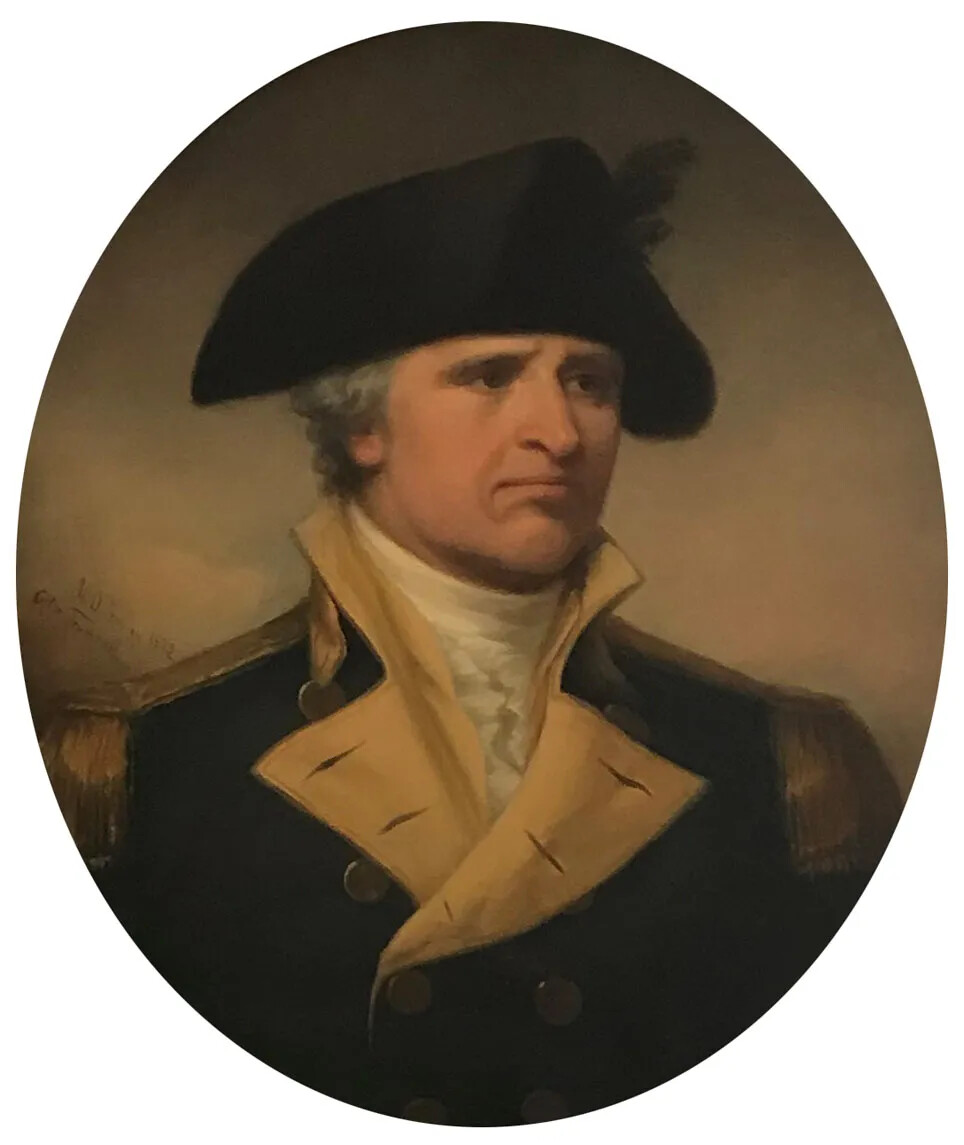
A circular, colored portrait of a white man looking off to the right. He wears a blue coat with a yellow collar and a black tri-cornered hat.
John Stark
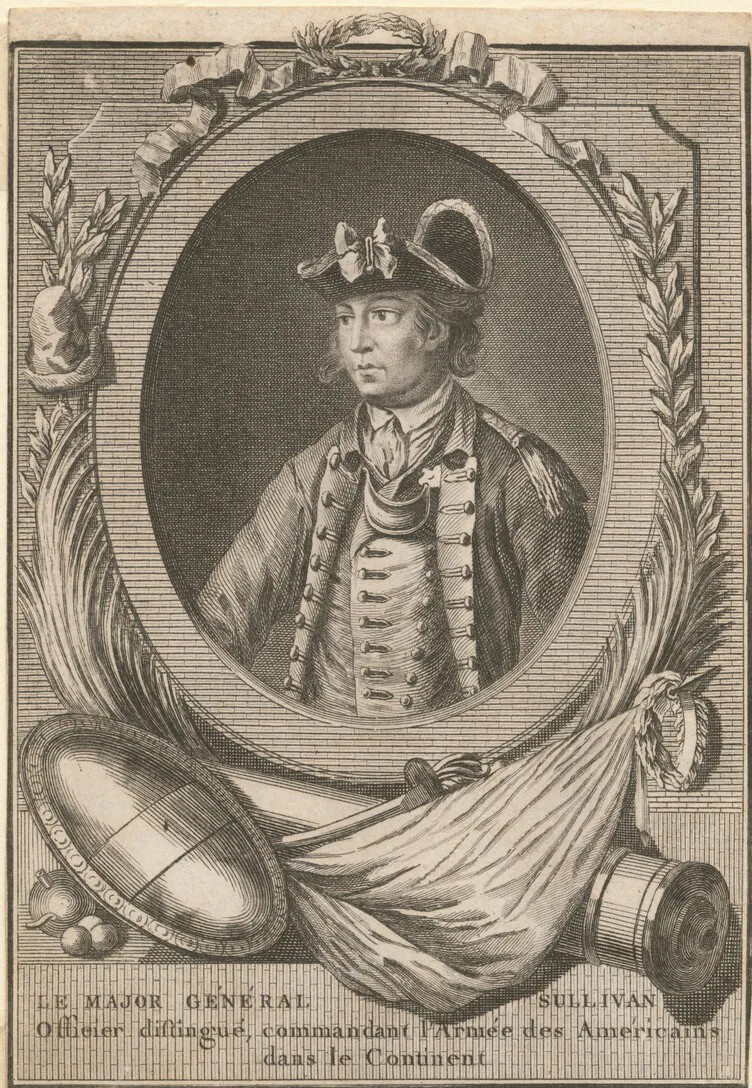
A black and white drawing of a white man looking off to the left. He wears a coat and vest that have many buttons on them, and a tri-cornered hat wth a large bow placed at its front corner. The title of the drawing, located along its bottom border, reads: "LE MAJOR GENERAL SULLIVAN." Beneath the title are several words in French.
John Sullivan
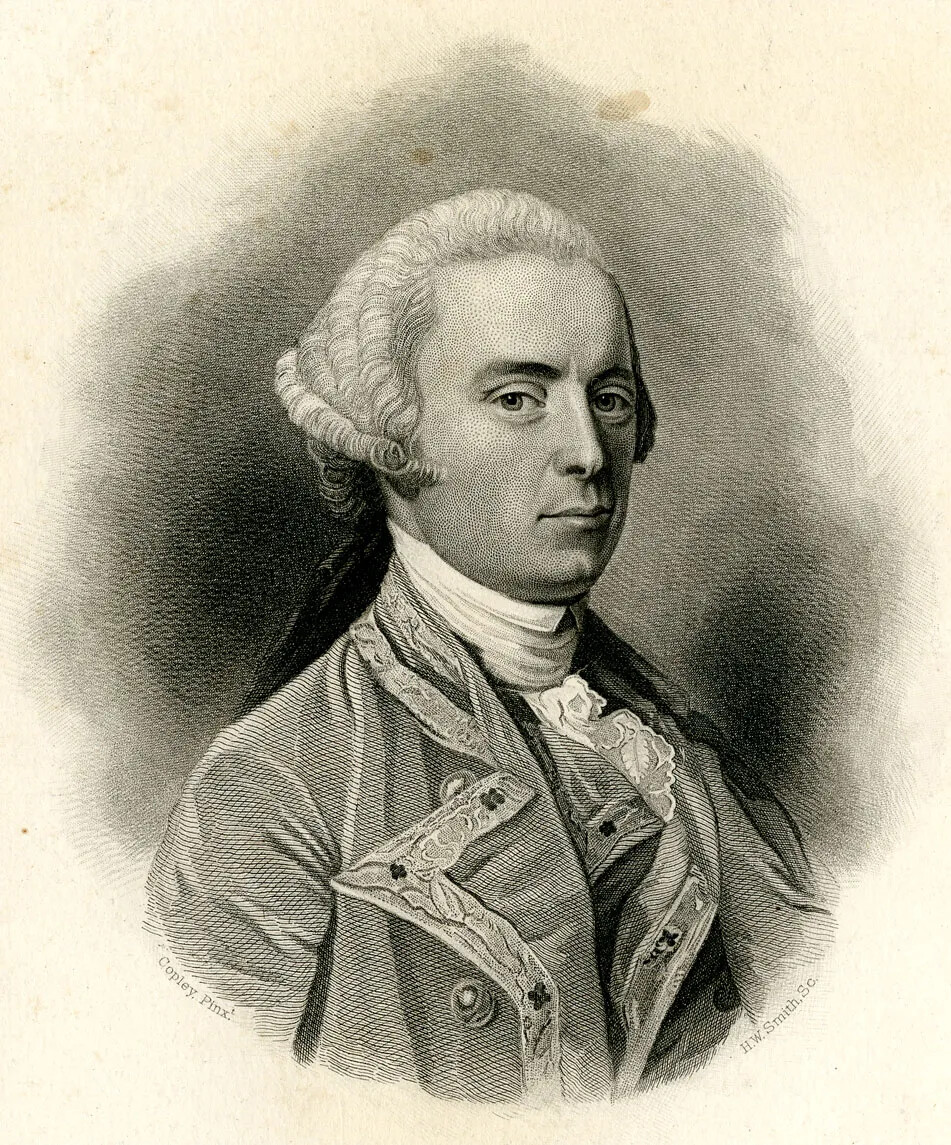
A pencil drawing of a man with a wig, facing the right and looking at the audience. He wears a high-necked white shirt and a fancy vest and coat. Underneath the drawing is the word "Wentworth," written in cursive handwriting, in black ink.
John Wentworth
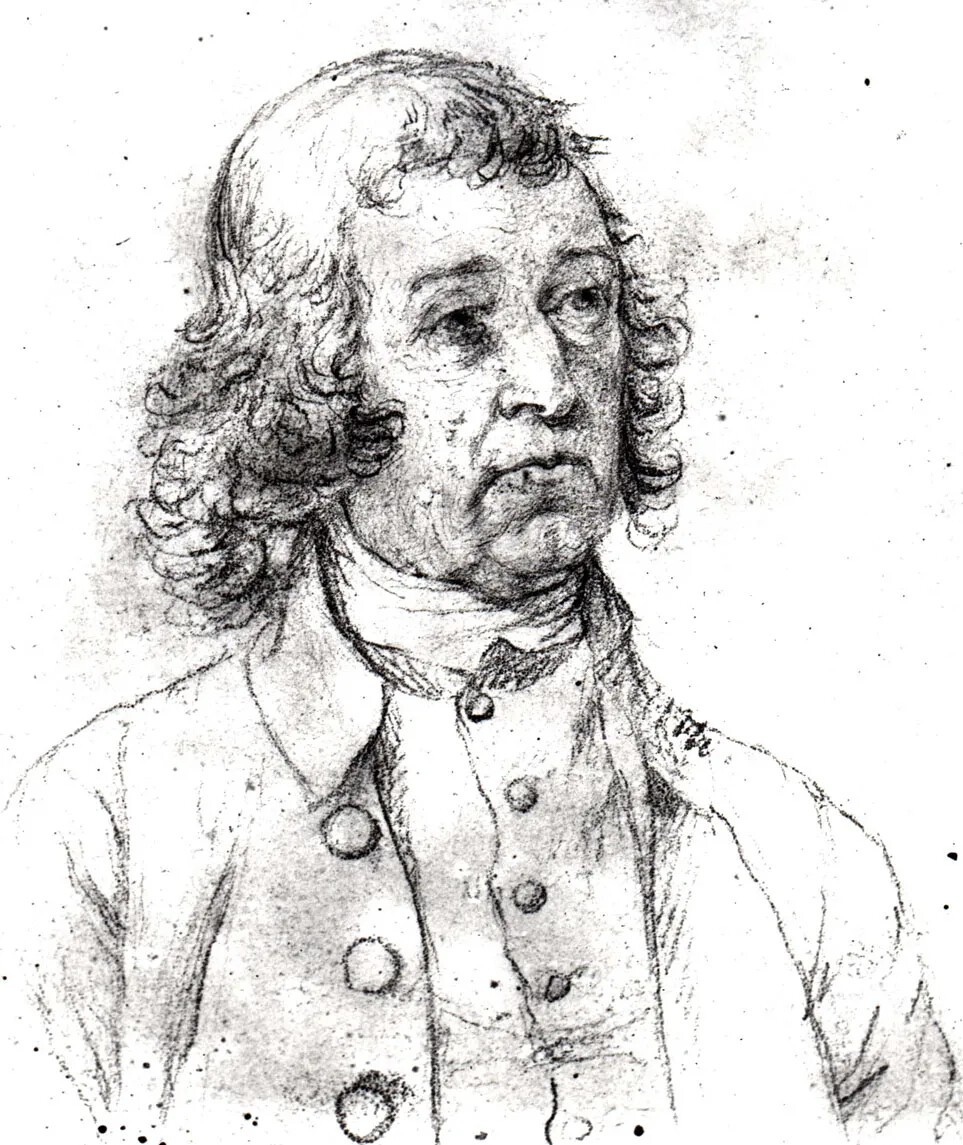
A pencil drawing of a man with long curly hair, looking to the right. He wears a shirt with a high neck, a vest with small buttons, and a collared coat with large buttons.
Josiah Bartlett
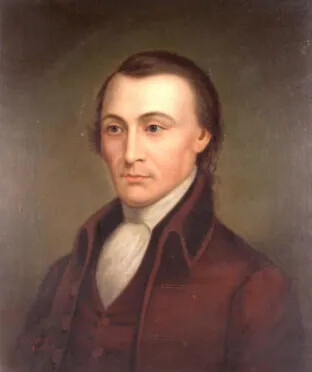
A colored painting of a man with brown hair, looking to the left. He wears a high-necked white shirt and a reddish-brown vest and coat.
Matthew Thornton
A solid black image of a moose, with white capital letters inside reading "SORRY, NO PICTURE AVAILABLE."
Nero Brewster
A solid black image of a moose, with white capital letters inside reading "SORRY, NO PICTURE AVAILABLE."
Prince Whipple
A solid black image of a moose, with white capital letters inside reading "SORRY, NO PICTURE AVAILABLE."
Wentworth Cheswill
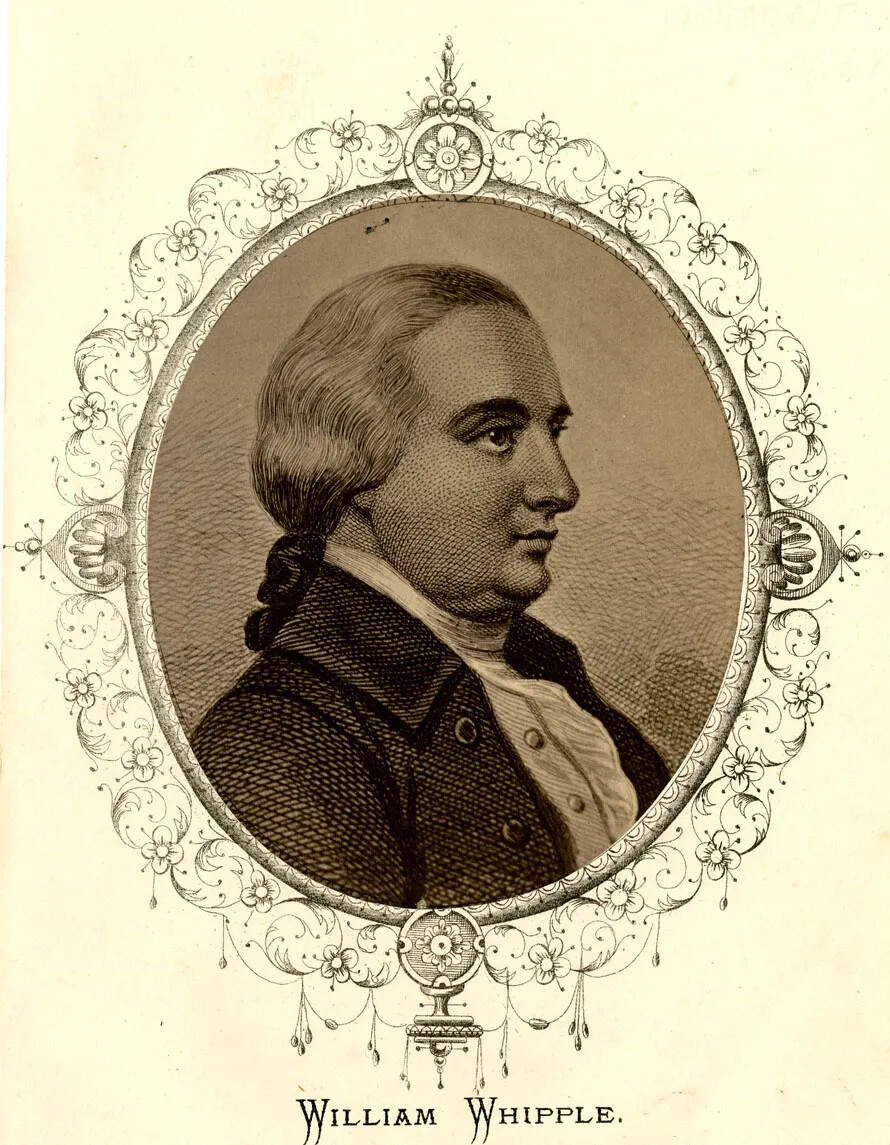
Head and shoulders portrait of a man with long light hair tied at the neck with a black ribbon, wearing a white collar, light vest with two buttons, and dark jacket. He faces right with a sepia colored background, in an oval frame decorated with scollops and tassels. The frame is surrounded by sprays of flowers and branches with leaves with four decorative objects, one at each quarter. "WILLIAM WHIPPLE." is printed beneath the portrait. Beneath this is a paper adhered to the print, "Wm. Whipple" in script in brown ink. 
William Whipple

Documents in this Unit:

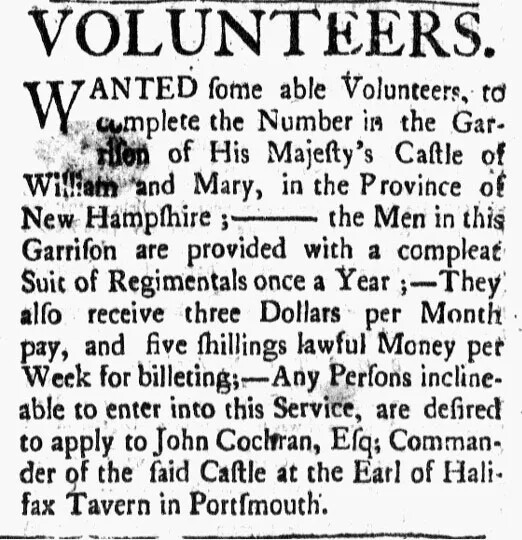
A paragraph of typed text in black ink on faded white paper. The title of the document reads: "VOLUNTEERS."
Advertisement for Soldiers to Join Fort William and Mary
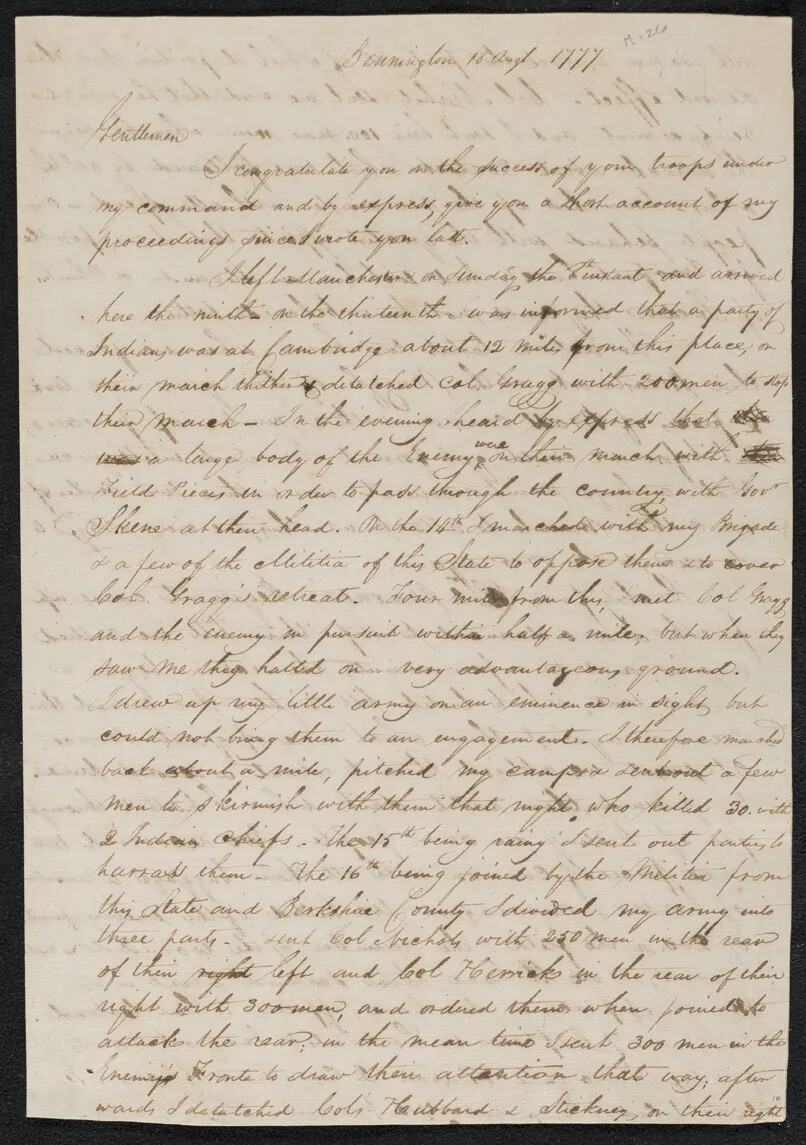
A page of handwritten script is shown. The script is elaborate and precise, and there are about 30 lines. The line at the top reads "Bennington 18 Aug 1777."
Battle of Bennington Report
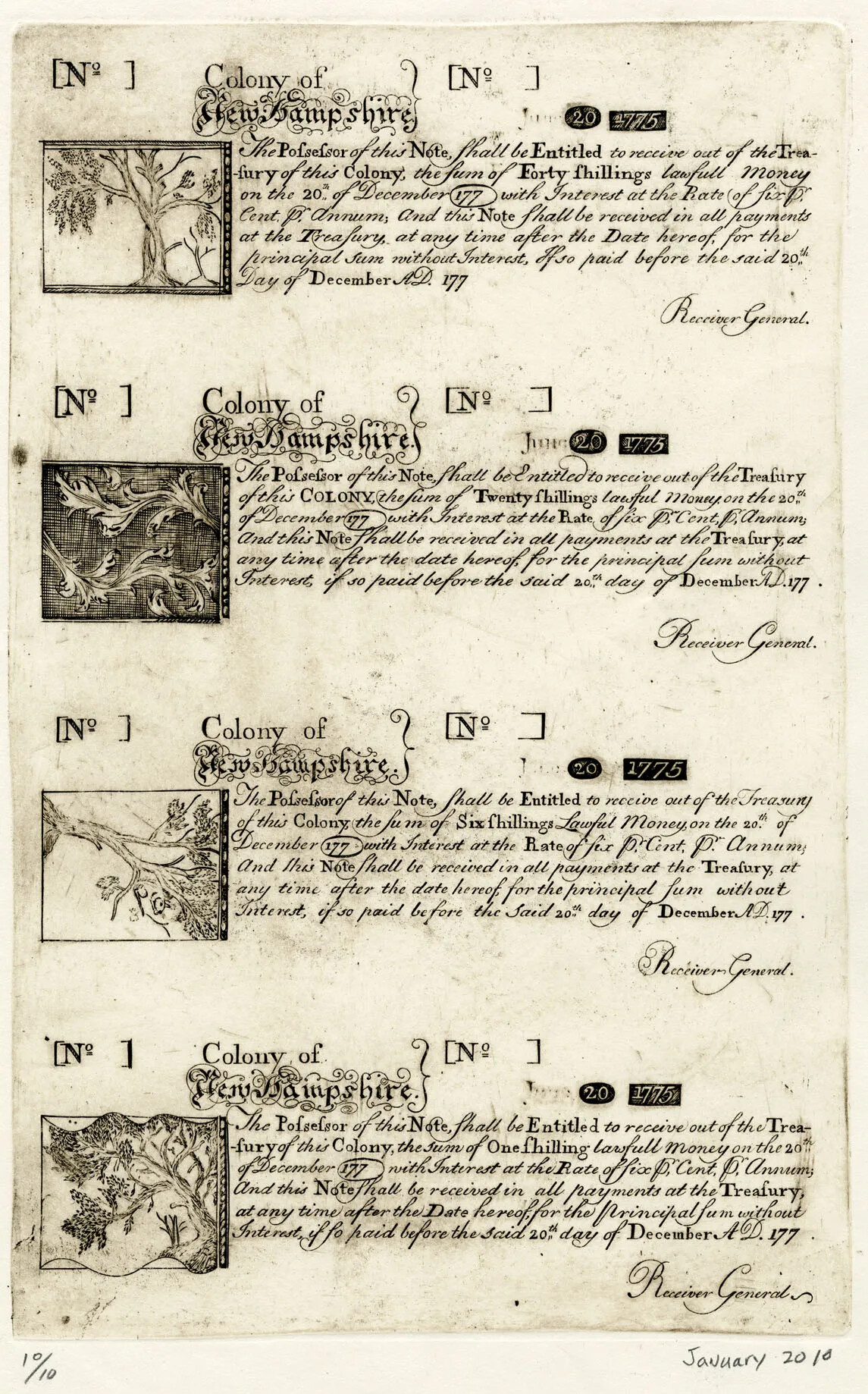
Sheet of four denominations of New Hampshire colonial currency, printed from copper printing plate in 2010. The four denominations are 40 shillings, 20 shillings, 6 shillings, and 1 shilling. The notes are horizontal rectangles. Each one has ten lines of text entitling the possessor to receive out of the treasury the various sums of money. There is space for serial numbers and for official signatures. Along the left side when printed, are illustrations, each one different. The 40 shilling note has a large spreading tree with crossed trunks; the 20 shilling note has a two-leaf design; the 6 shilling note has a squirrel upon a large tree branch, and the 1 shilling note has a large leaning tree.
Currency Plate Printing
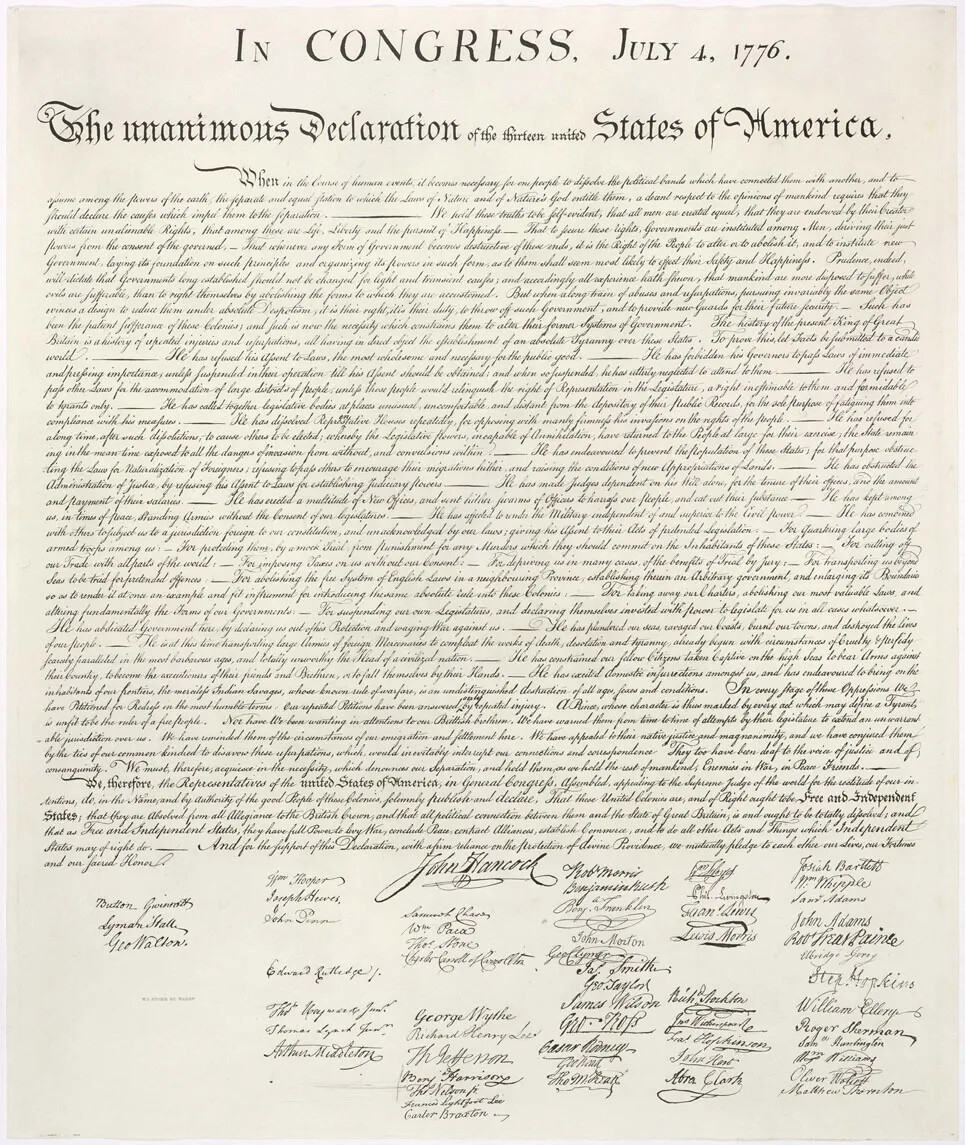
A large handwritten document on white paper with black text. The text at the top of the document, written in larger handwriting, reads “In CONGRESS, July 4, 1776./The unanimous Declaration of the thirteen united States of America,”. The middle of the document is a large block of text, written smaller in cursive. The lower part of the document contains many signatures, written in elaborate cursive, in various columns of different sizes.
Declaration of Independence
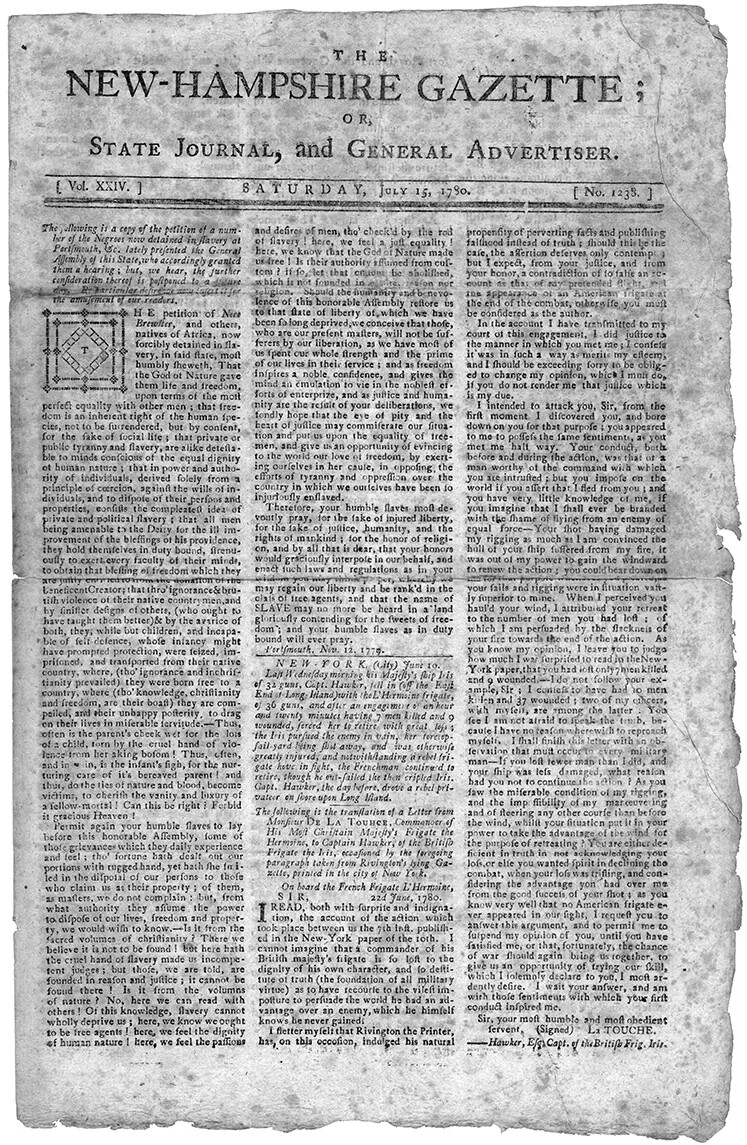
Freedom Petition in the New Hampshire Gazette
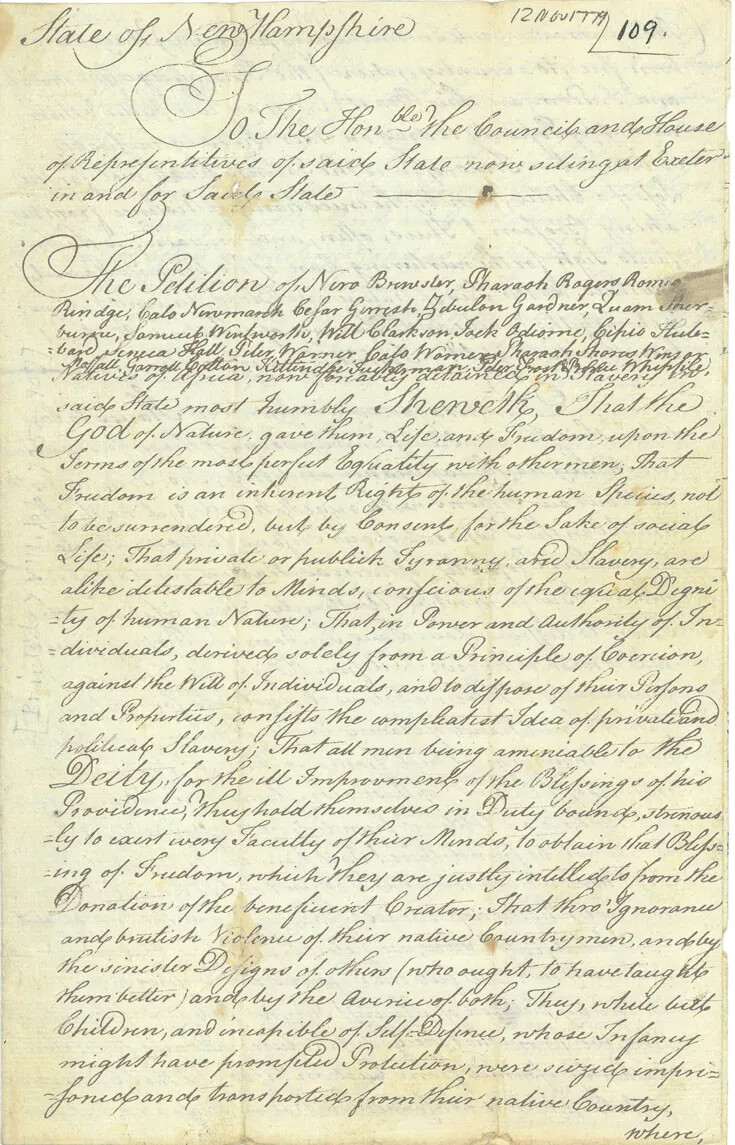
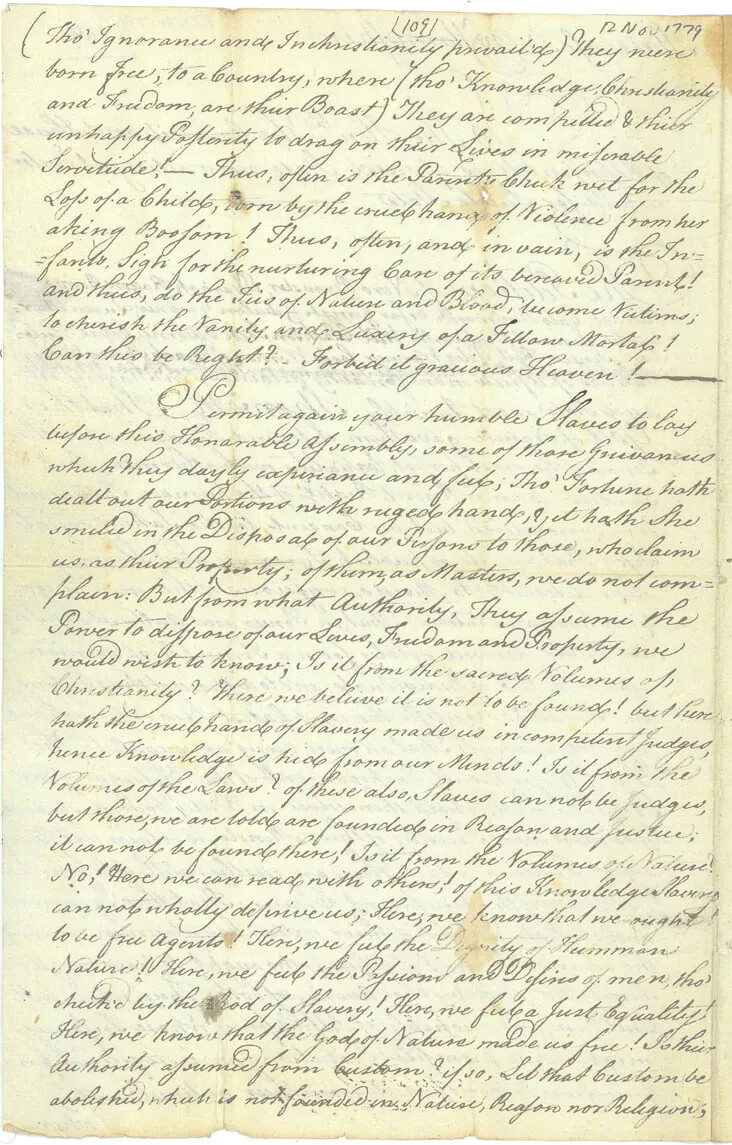
A large handwritten document on white paper. The text of the document is written in small and large cursive handwriting, in black ink.
Freedom Petition Submitted by Enslaved People to the New Hampshire State Legislature page 1 of 4
A large handwritten document on white paper. The text of the document is written in small and large cursive handwriting, in black ink.
Freedom Petition Submitted by Enslaved People to the New Hampshire State Legislature page 2 of 4
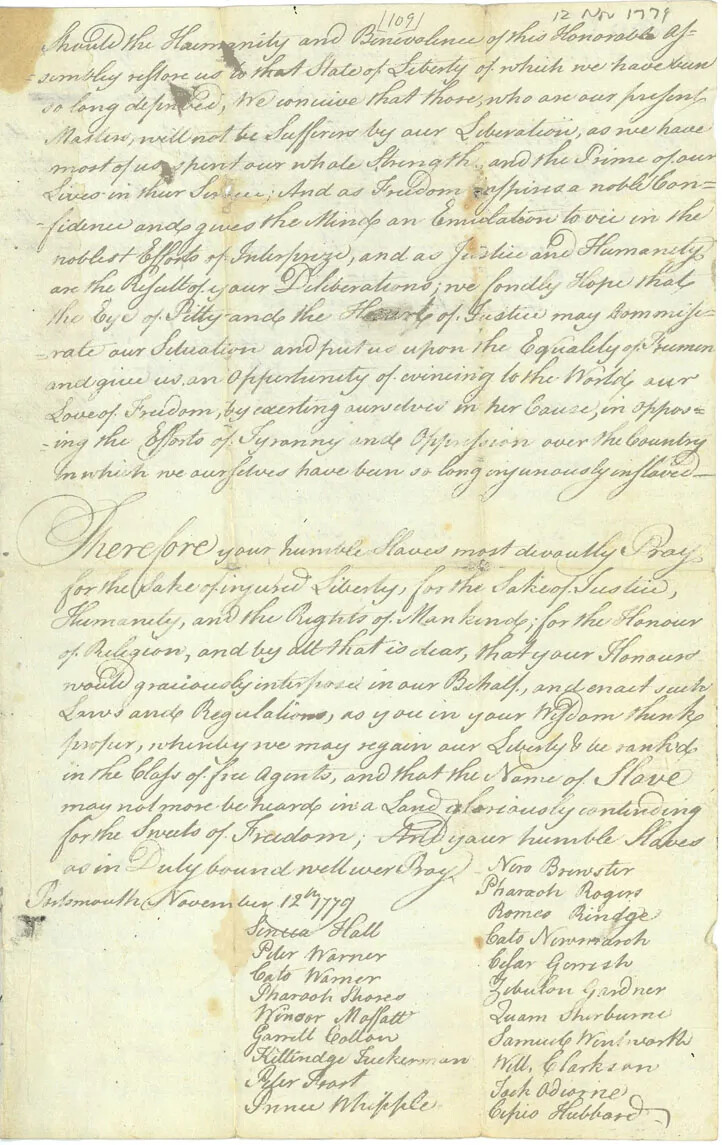
A large handwritten document on white paper. The text of the document is written in small and large cursive handwriting, in black ink. At the end of the document are several signatures.
Freedom Petition Submitted by Enslaved People to the New Hampshire State Legislature page 3 of 4
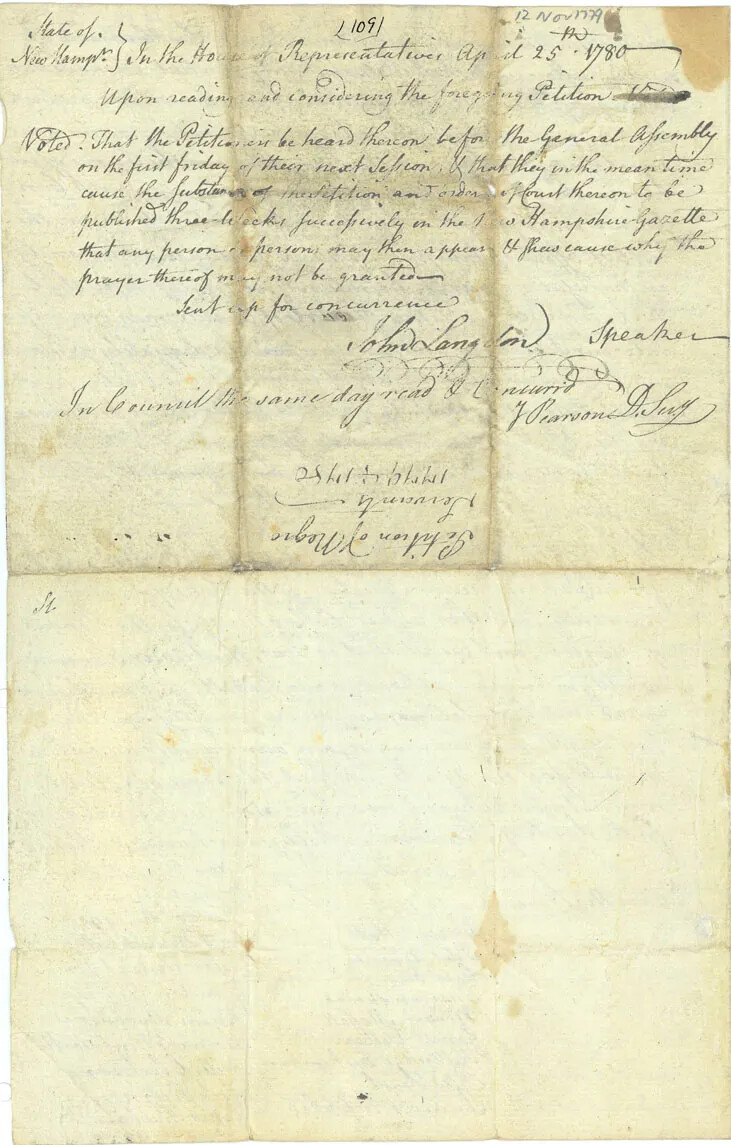
A large handwritten document on half a piece of white paper. The text of the document is written in small and large cursive handwriting, in black ink.
Freedom Petition Submitted by Enslaved People to the New Hampshire State Legislature page 4 of 4
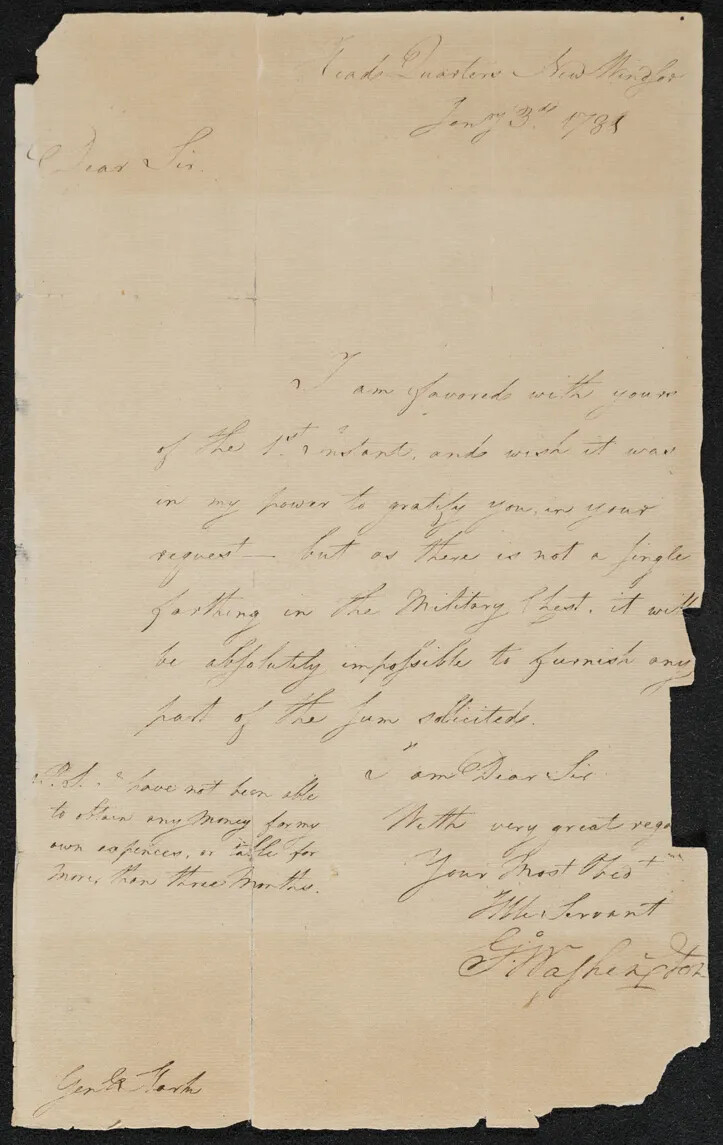
A piece of yellowed paper is torn at some edges, and shows handwritten script. The date and place are at the top, then after "Dear Sir," there are seven lines of communication before a signature with a smaller note next to it.
George Washington's Letter to John Stark
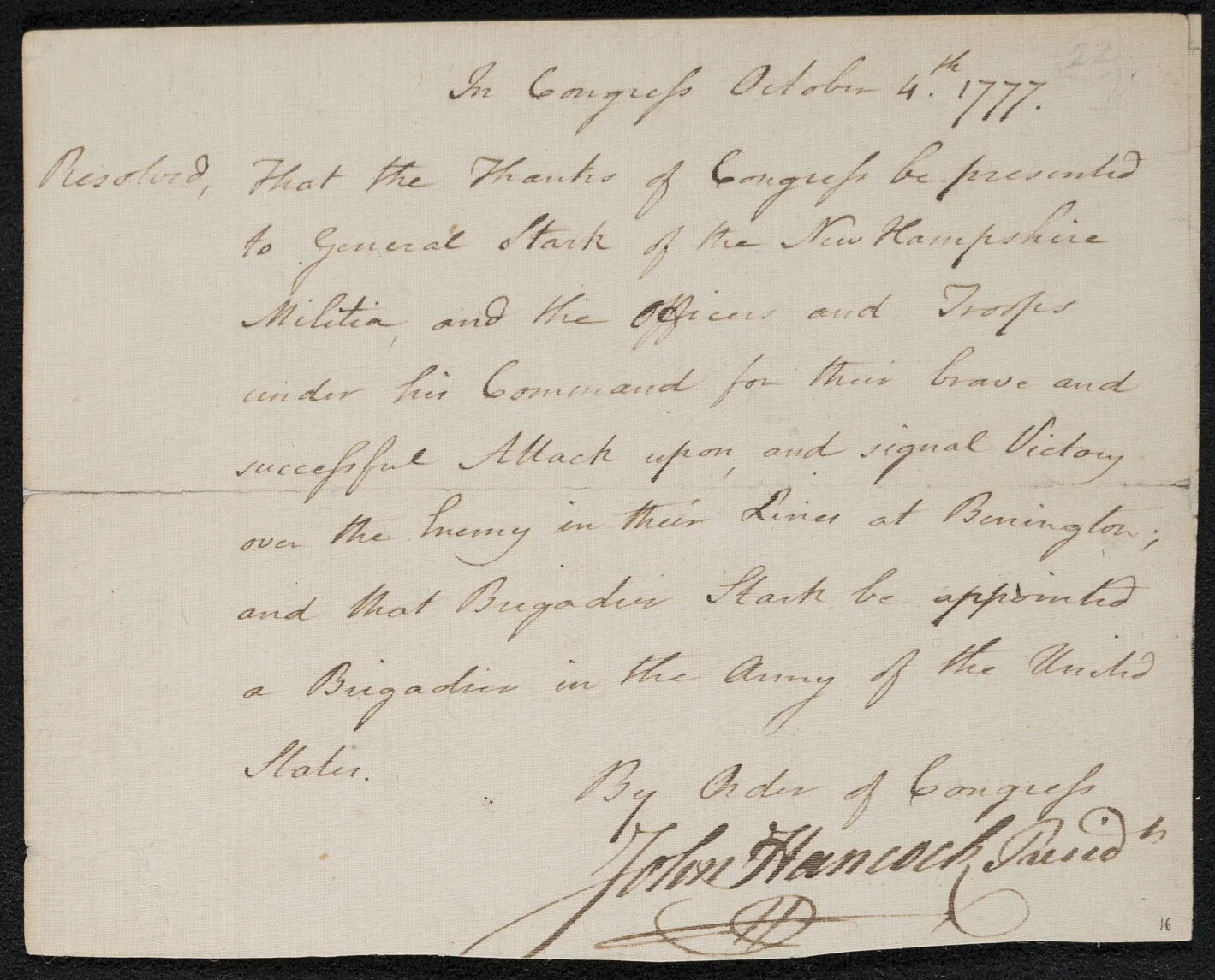
A handwritten note has nine lines of text written in a precise script. At the top it is dated 1777, and at the bottom signed "John Hancock" with a flourish below.
John Hancock's Letter to John Stark
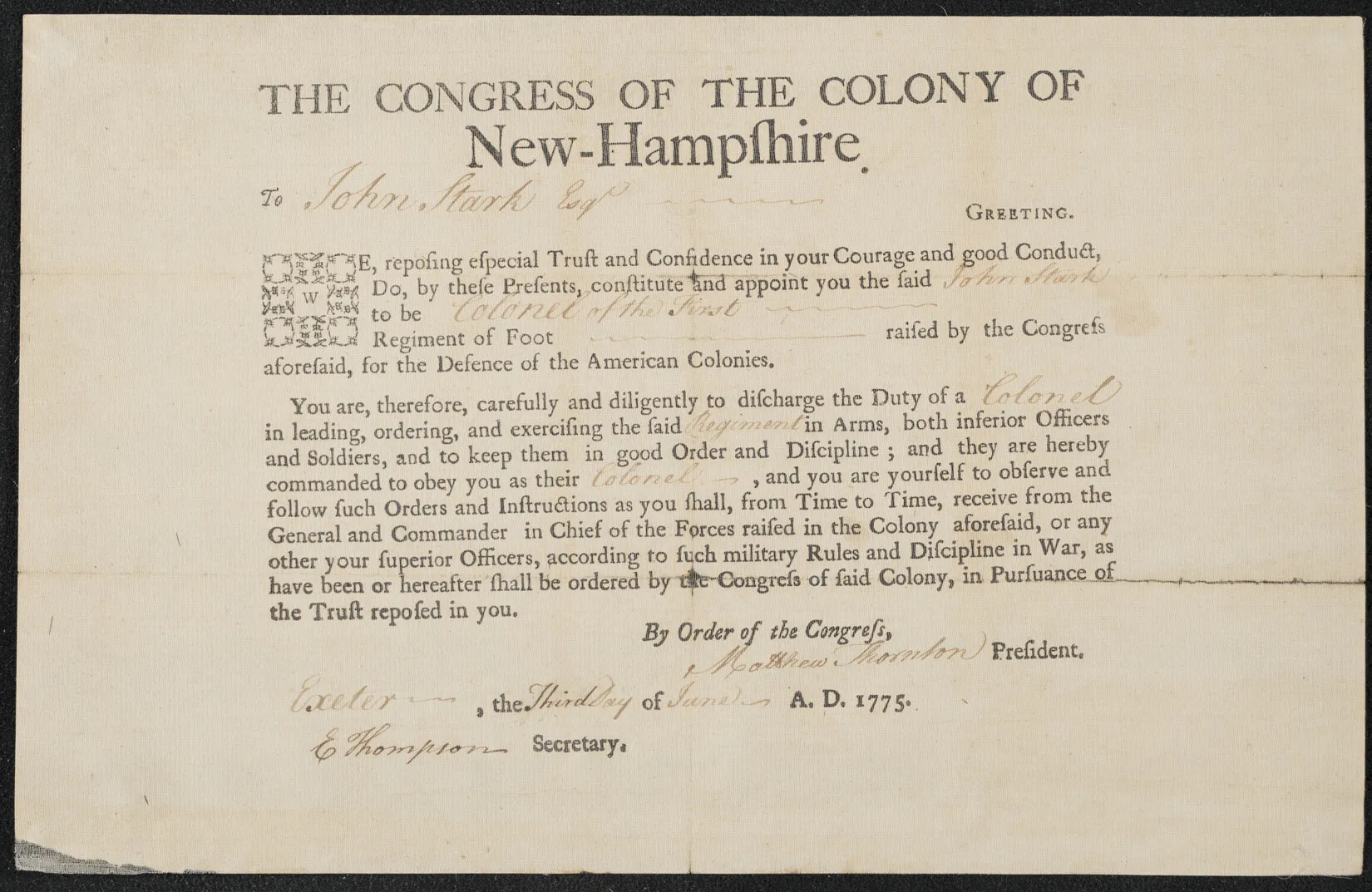
A printed piece of paper is shown with several words written in by hand. It is titled "THE CONGRESS OF THE COLONY OF NEW-HAMPSHIRE." It is two paragraphs long and gives "John Stark the Colonel of the First Regiment of Foot" appointment, dated June 3, 1775.
John Stark's Military Commission
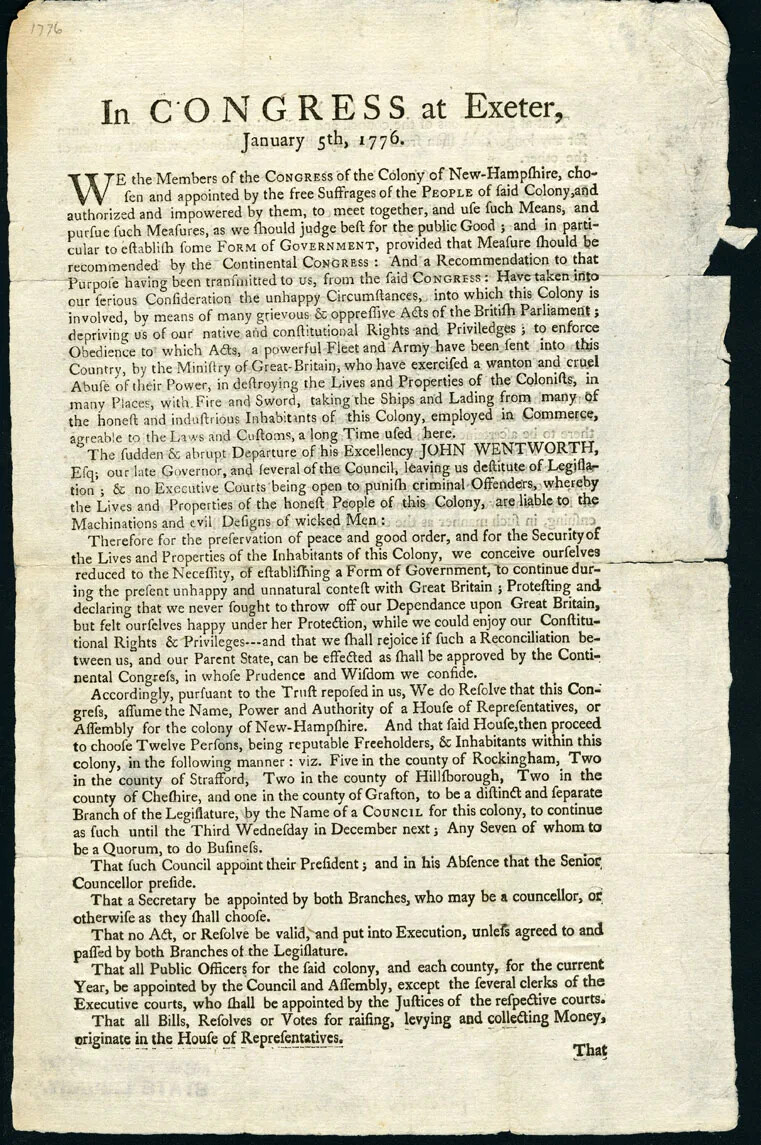
An old document with large paragraphs of black typed text. The title of the document reads: "In CONGRESS at EXETER,/January 5th, 1776."
New Hampshire Constitution of 1776
A document on browning paper typed in black text. The title of the document reads "THE/New-Hampshire [STATE] Gazette,/ OR,/EXETER Circulating Morning Chronicle./[Vol. 1.] TUESDAY, November 26, 1776. [No. 28]" Beneath the title is large and small typed text.
New Hampshire Gazette
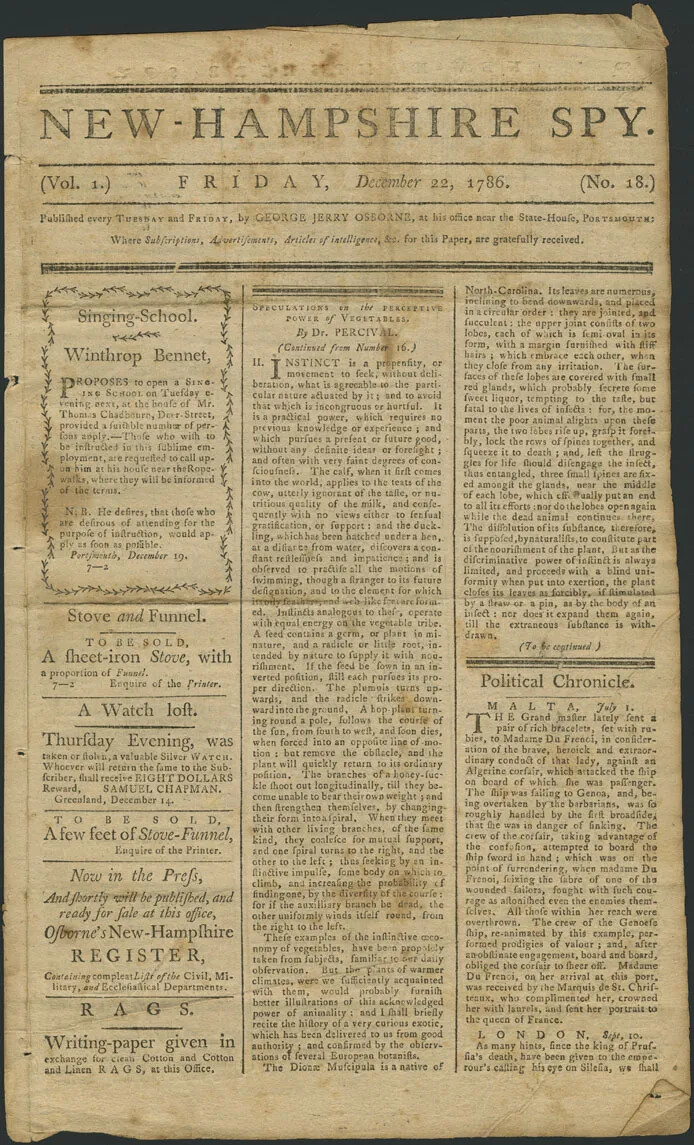
A document on browning paper typed in black text. The title of the document reads "NEW-HAMPSHIRE SPY./(Vol. 1.) FRIDAY, December 22, 1786. (No. 18)/Published every TUESDAY and FRIDAY by GEORGE JERRY OSBORNE, at his office near the State-House, Portsmouth;/Where Subscriptions, Advertisements, Articles of intelligence, &c. for this Paper, are gratefully received." Beneath the title is large and small typed text. Each article is separated by bolded horizontal lines.
New Hampshire Spy
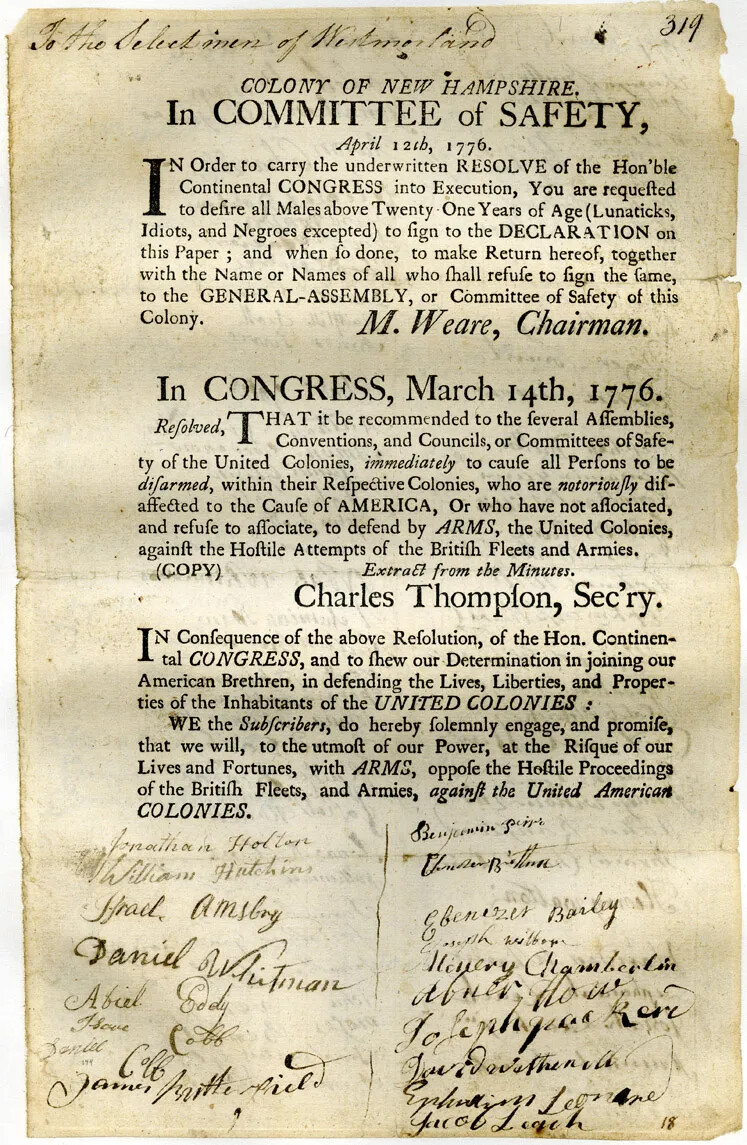
An old document on faded white paper with both handwritten and typed text in black ink. There are three paragraphs of typed text and several signatures beneath the third paragraph. The title of the document reads "COLONY OF NEW HAMPSHIRE."
Oath of Loyalty to the Patriots
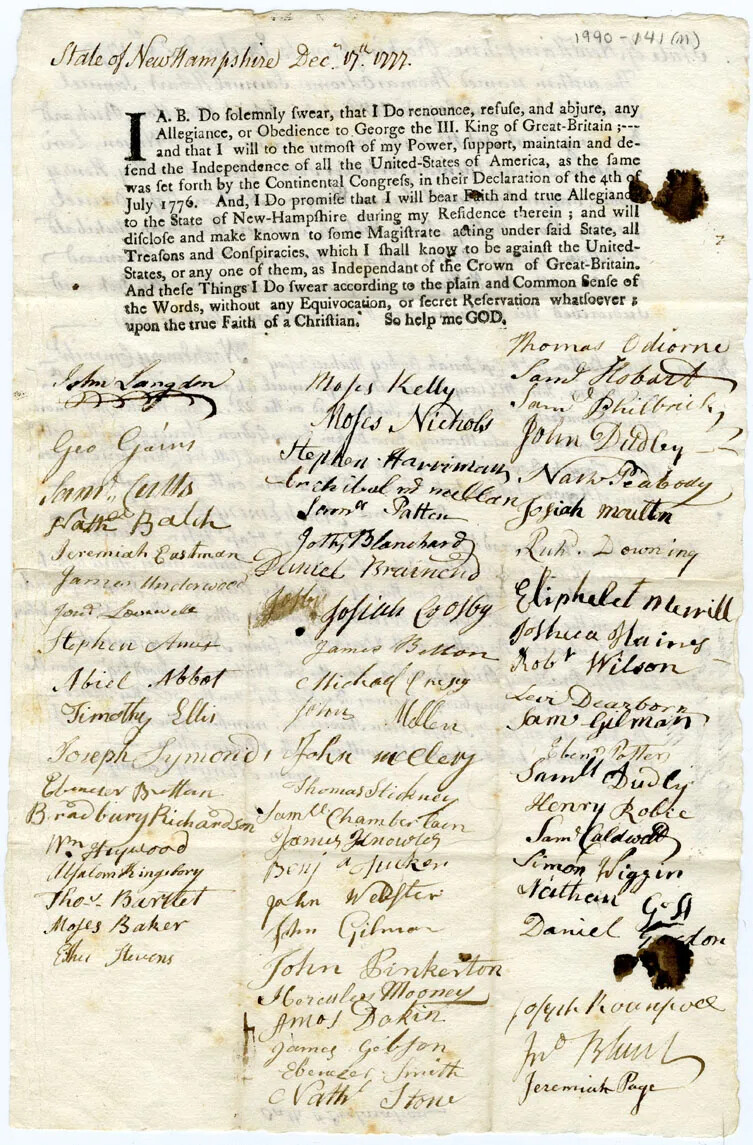
An old document on faded white paper with both handwritten and typed text. Both the typed and handwritten text is in black ink. The typed text is placed along the top border, while the handwritten text is placed both below and above the typed text.
Oath Renouncing Loyalty to King George III
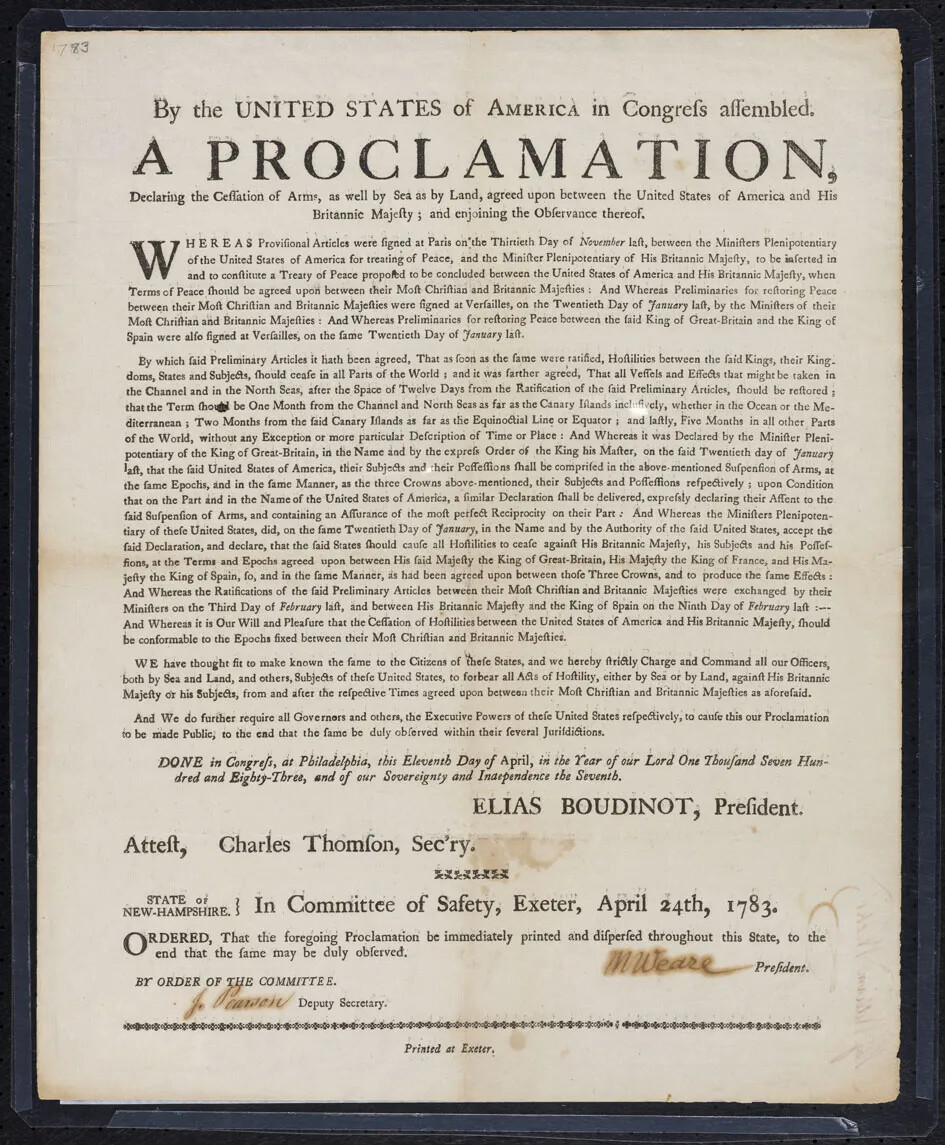
A vertical document, with black text printed onto white paper. The title of the document, located along the upper border of the page, reads: By the UNITED STATES of AMERICA in Congress assembled./A PROCLAMATION/Declaring the Cessation of Arms, as well by Sea as by Land, agreed upon between the United States of American and His/Britannie Majesty ;  and enjoining the Observance thereof." Beneath the title are two large paragraphs of typed text in a smaller font, and then several names in large font at the end of the document.
Proclamation Announcing the Peace Treaty with Great Britain
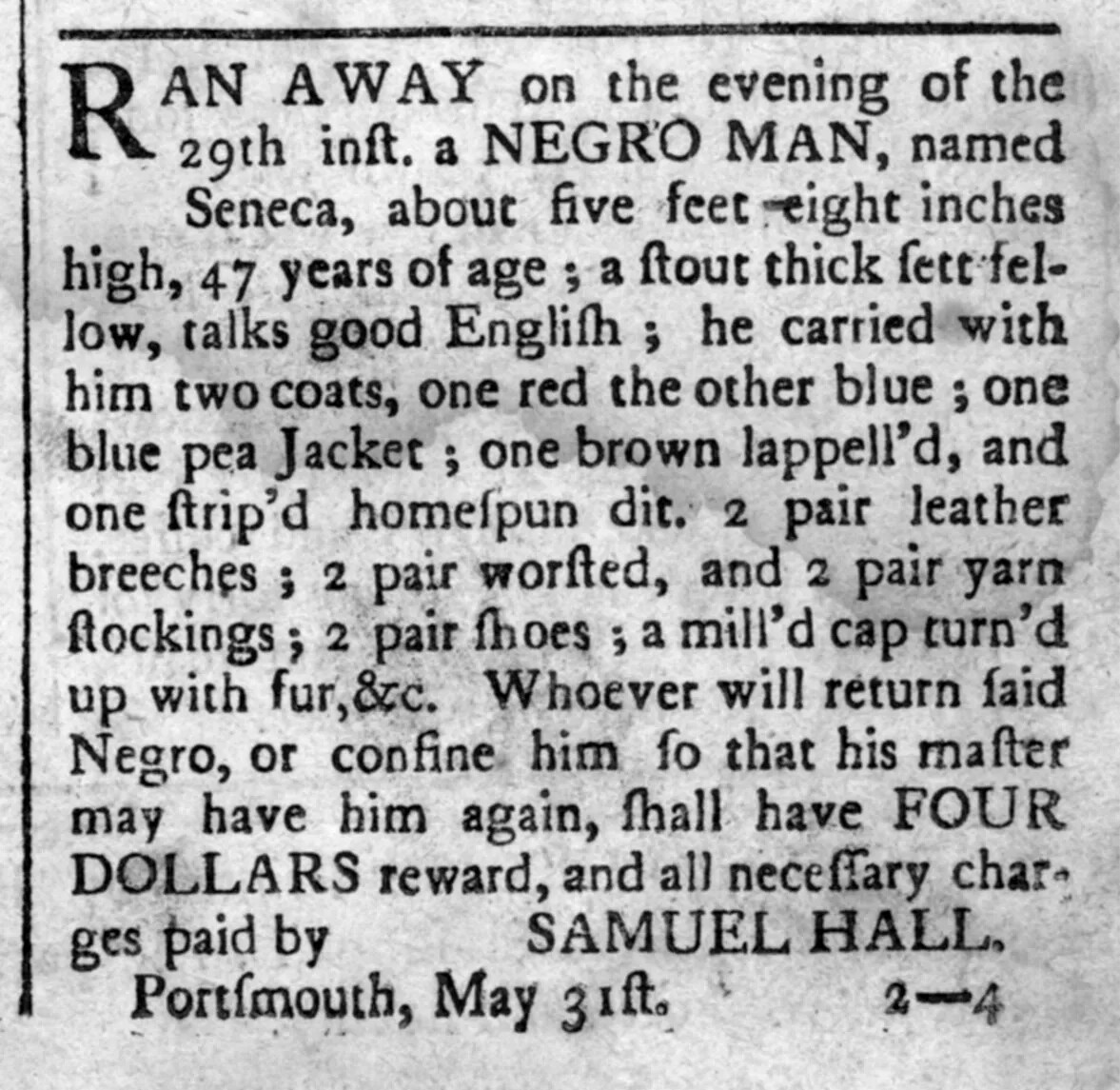
A newspaper clipping of a short article written in black text. The article reads "RAN AWAY on the evening of the/29th inst. A NEGRO MAN, named/Seneca, about five feet eight inches/high, 47 years of age; a stout thick fett fel-/low, talks good English; he carried with/him two coats, one red the other blue; one/blue pea Jacket; one brown lappell'd, and/one strip'd homspun dit. 2 pair leather/breeches; 2 pair worsted, and 2 pair yarn/stockings; 2 pair shoes; a mill'd cap turn'd/up with fur, &c. Whoever will return said/ Negro, or confine him so that his master/may have him again, shall have FOUR/DOLLARS reward, and all necessary char-/ges paid by SAMUEL HALL./Portsmouth, May 31st. 2-4."
Runaway Notice for Seneca Hall
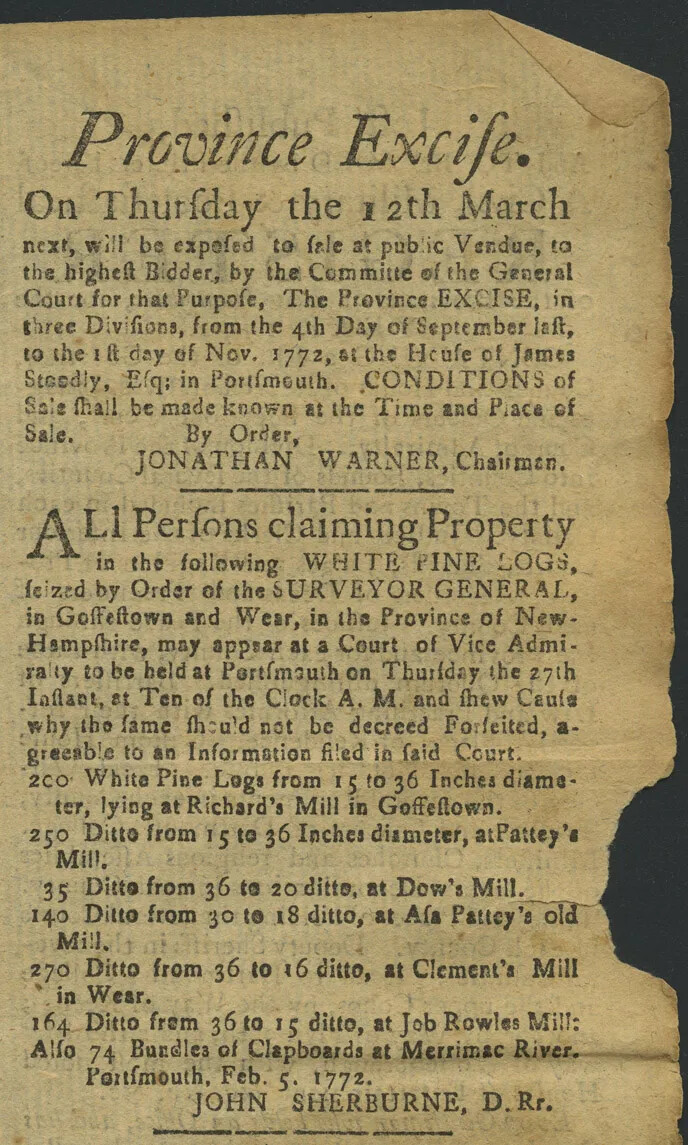
A torn newspaper clipping of two short articles written in black text. The title of the document reads "Province Excise." The two articles are separated by a thin black line. Both articles begin in a large font on the first line and then change to a smaller font on the second line.
Sale of White Pine
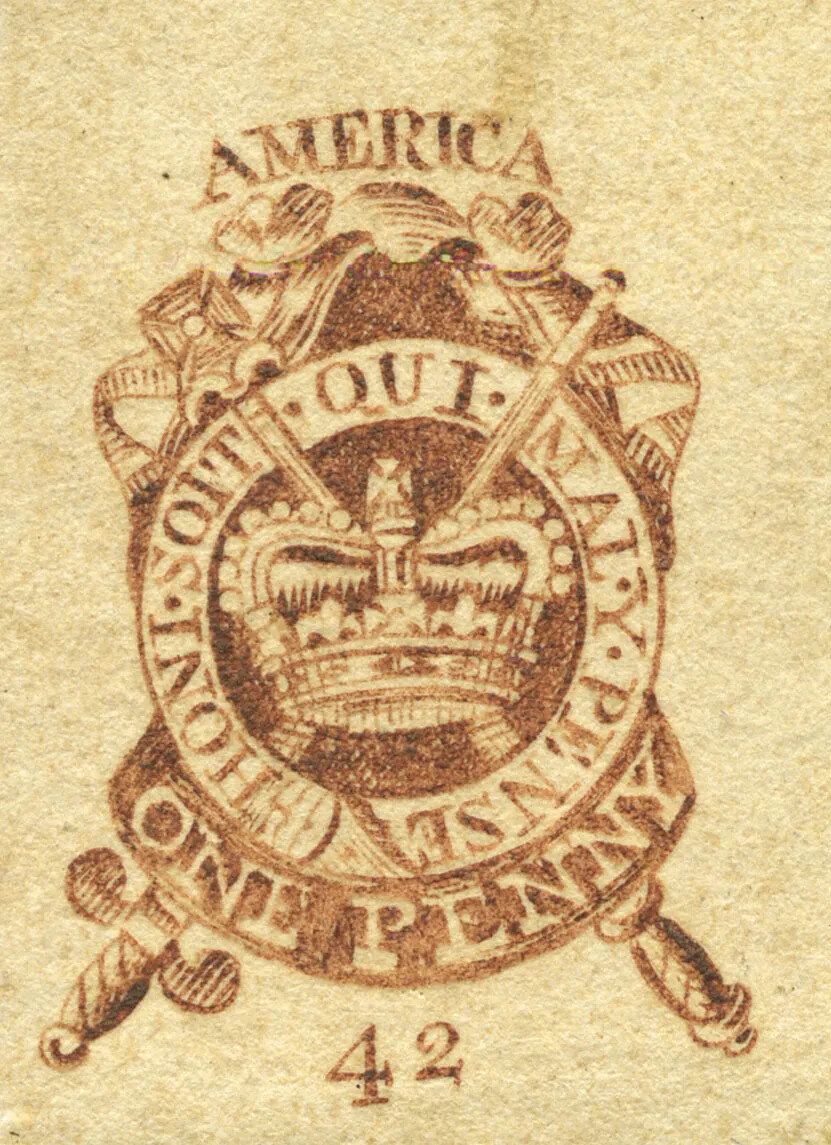
A brown stamp of a shield. A sword and a staff cross each other through the center of the shield. In the center of the stamp, there is a circle with a crown in the middle. The crown is surrounded by a ring of brown words along a white background. The words are in a different language. Above the shield is the word "AMERICA" and below the shield are the words "ONE PENNY/42."
Stamp Act Mark

Explainer Videos and Virtual Field Trips in this Unit:

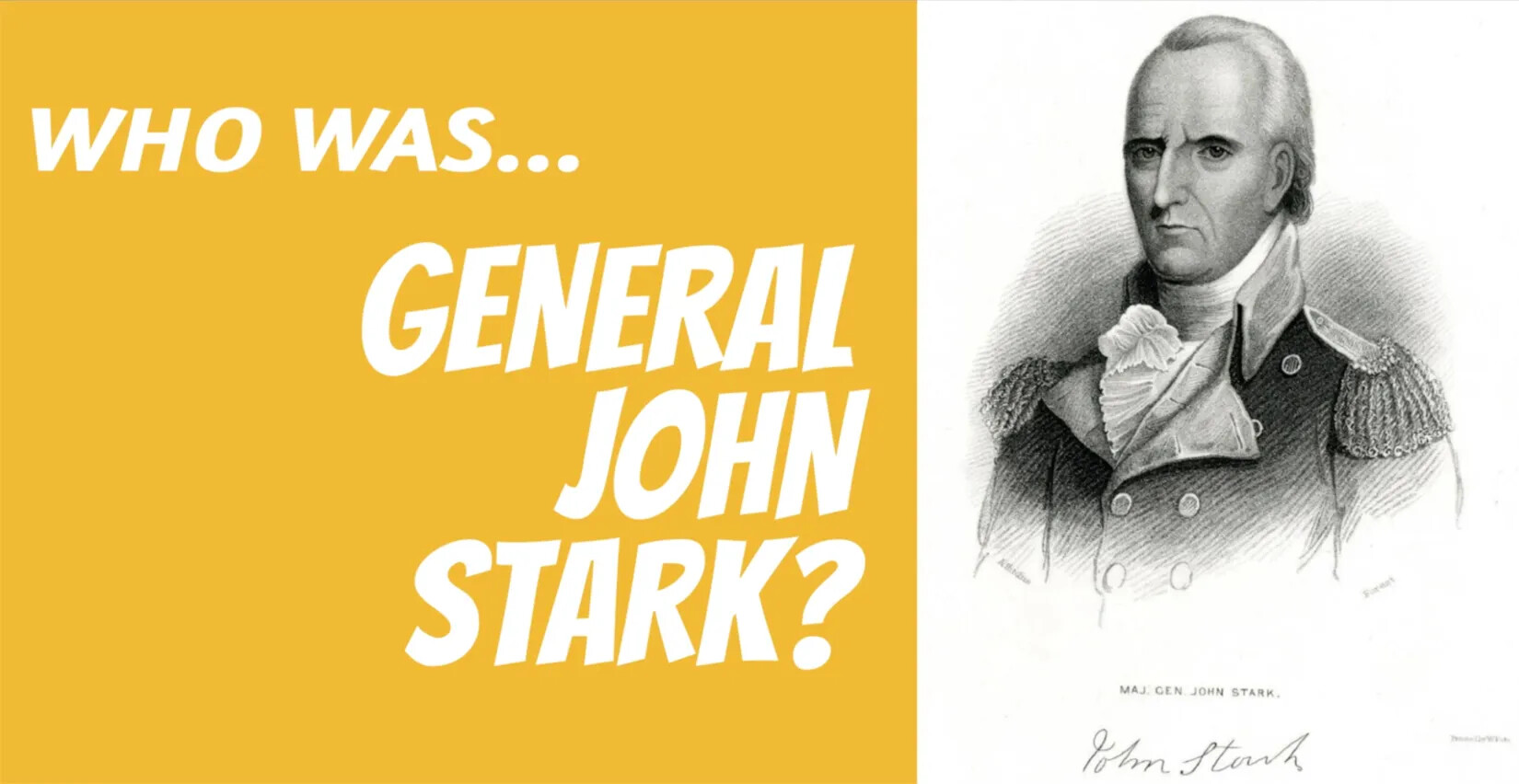
Mason Asks: Who Was John Stark?
Mason Explains: Causes of the American Revolution
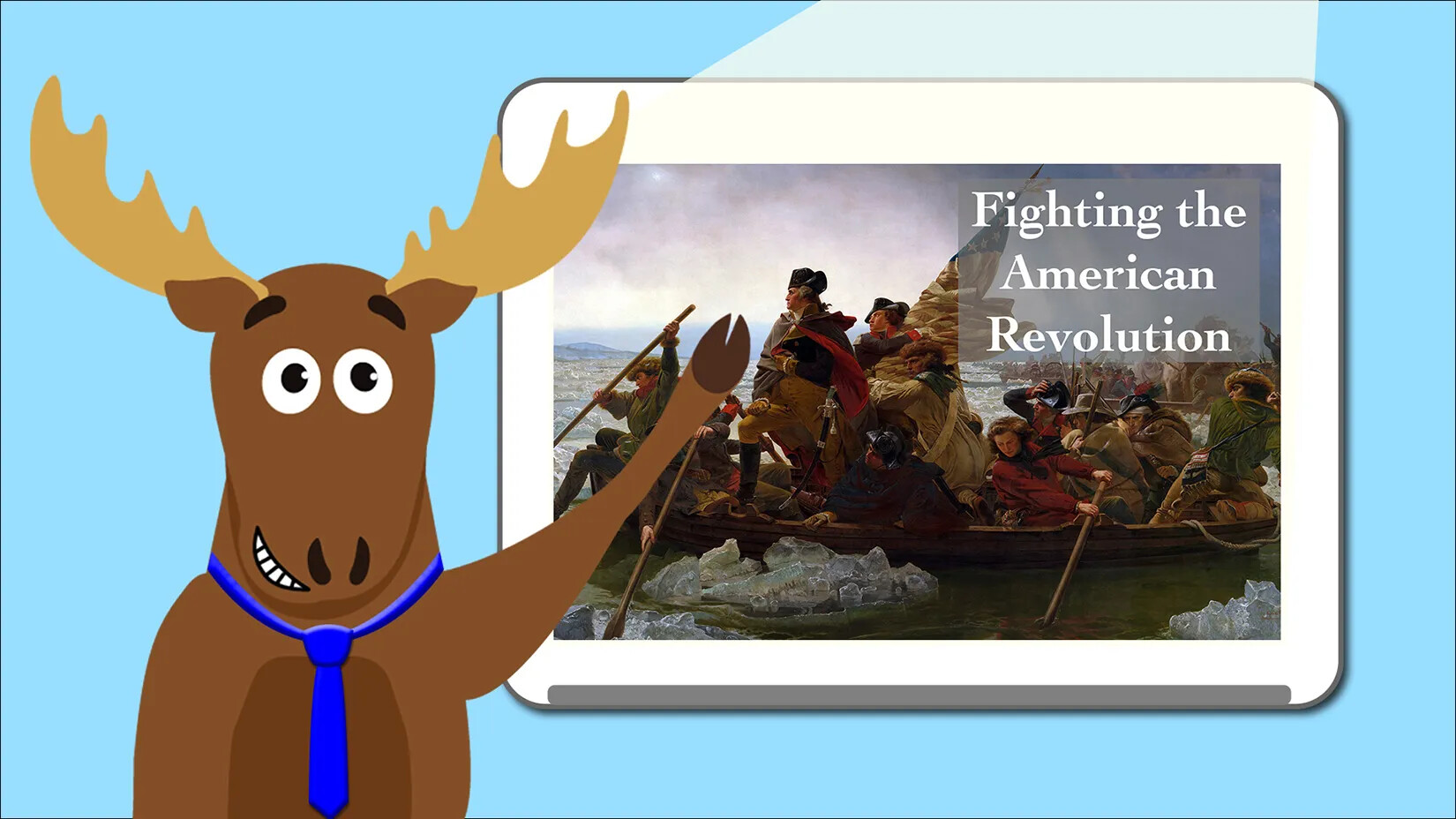
Mason Explains: Fighting the American Revolution
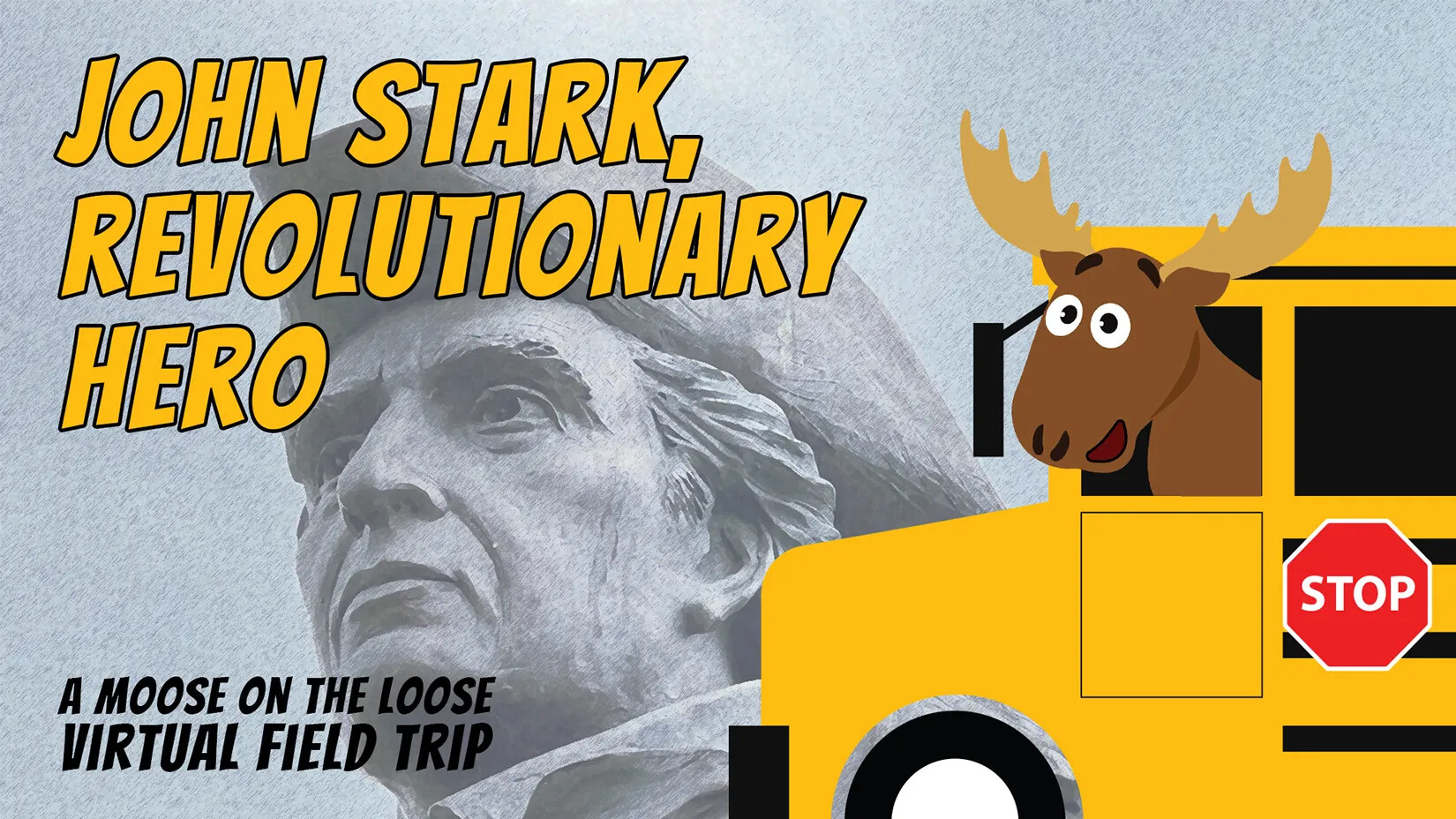
Virtual Field Trip: John Stark, Revolutionary Hero

Maps & Charts in this Unit:

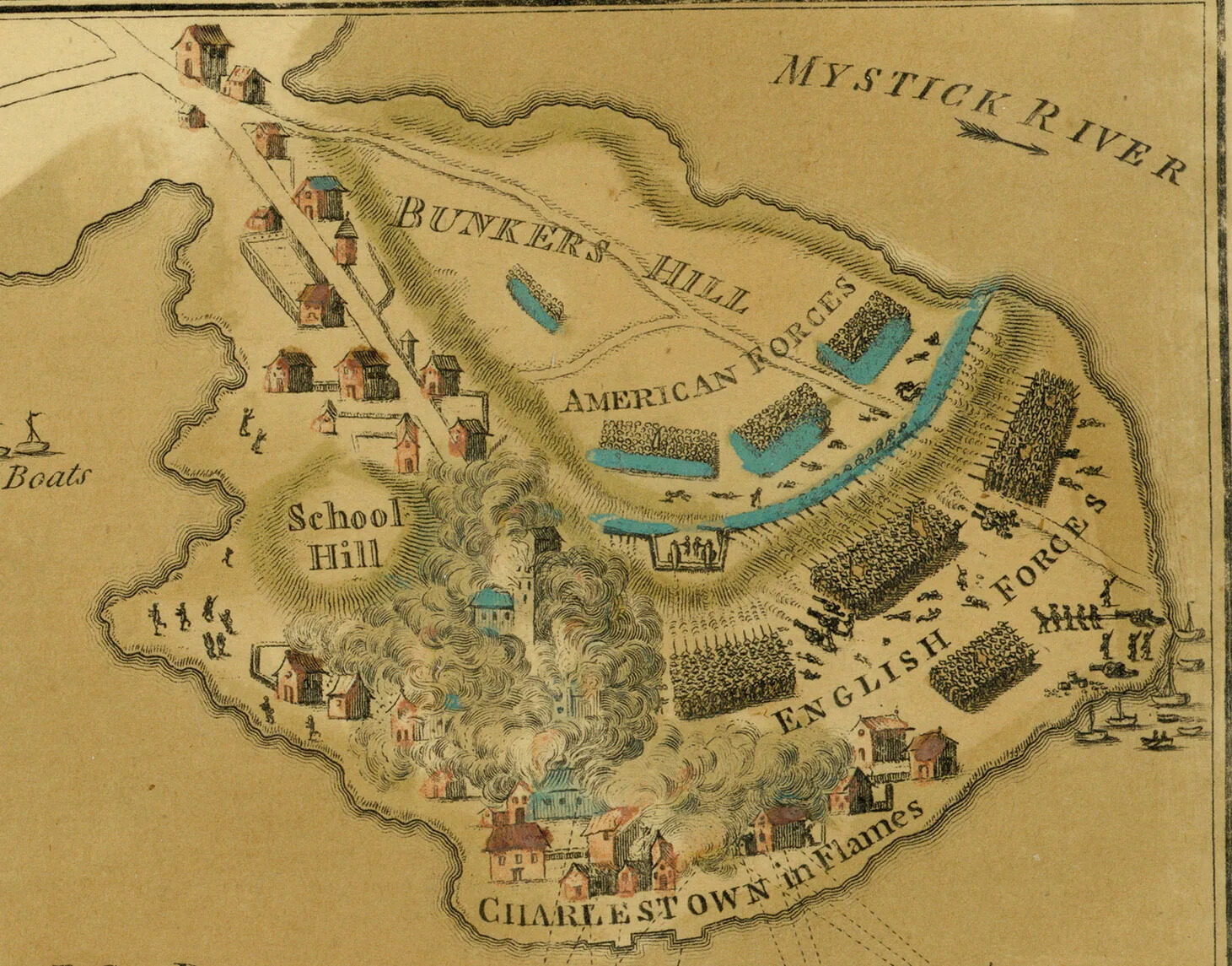
A color drawing is shown of a penninsula titled "Bunker's Hill." On the map, "Mystick River," "School Hill," and "Charlestown in flames" are also marked. The bottom right of the penninsula shows four bodies of English forces attacking three bodies of American forces, who are in the upper right of the penninsula behind a barricade. Charlestown, drawn with houses covered by smoke and fire, is in the bottom left, and an ordered street with a few houses on it is in the upper left. The street leads off the penninsula.
Battle of Bunker Hill Map

Objects in this Unit:

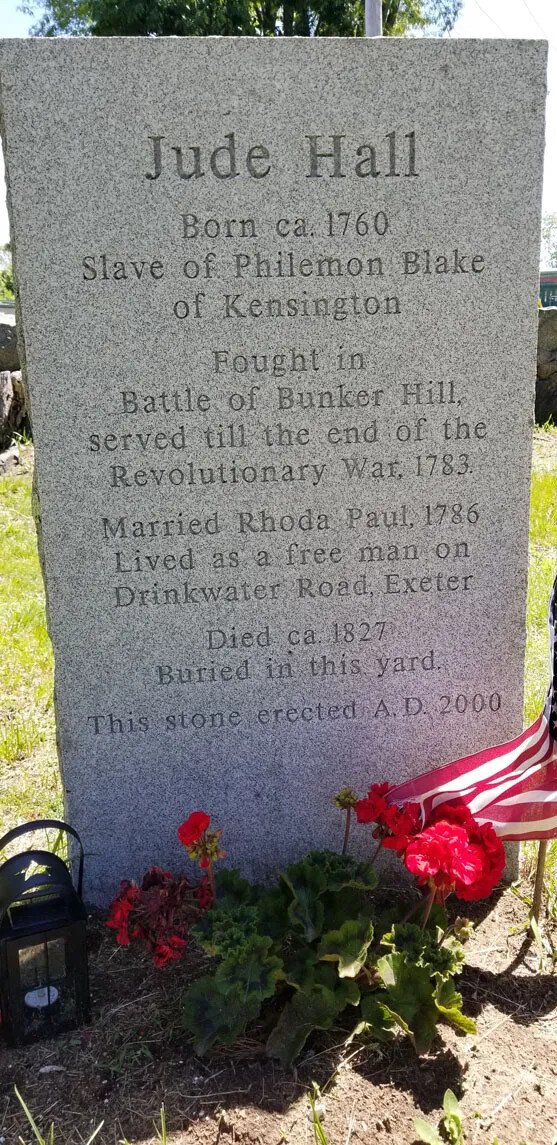
A colored photograph of a gravestone. In front of the gravestone are flowers, a lantern, and an American flag. The words "Jude Hall/Born ca. 1760/Slave of Philemon Blake/of Kensington/Fought in/Battle of Bunker Hill,/served till the end of the/Revolutionary War, 1783/Married Rhoda Paul, 1786/Lived as a free man on/Drinkwater Road, Exeter/Died ca. 1827/Buried in this yard./This stone erected A.D. 2000" are carved into the tombstone.
Grave of Jude Hall
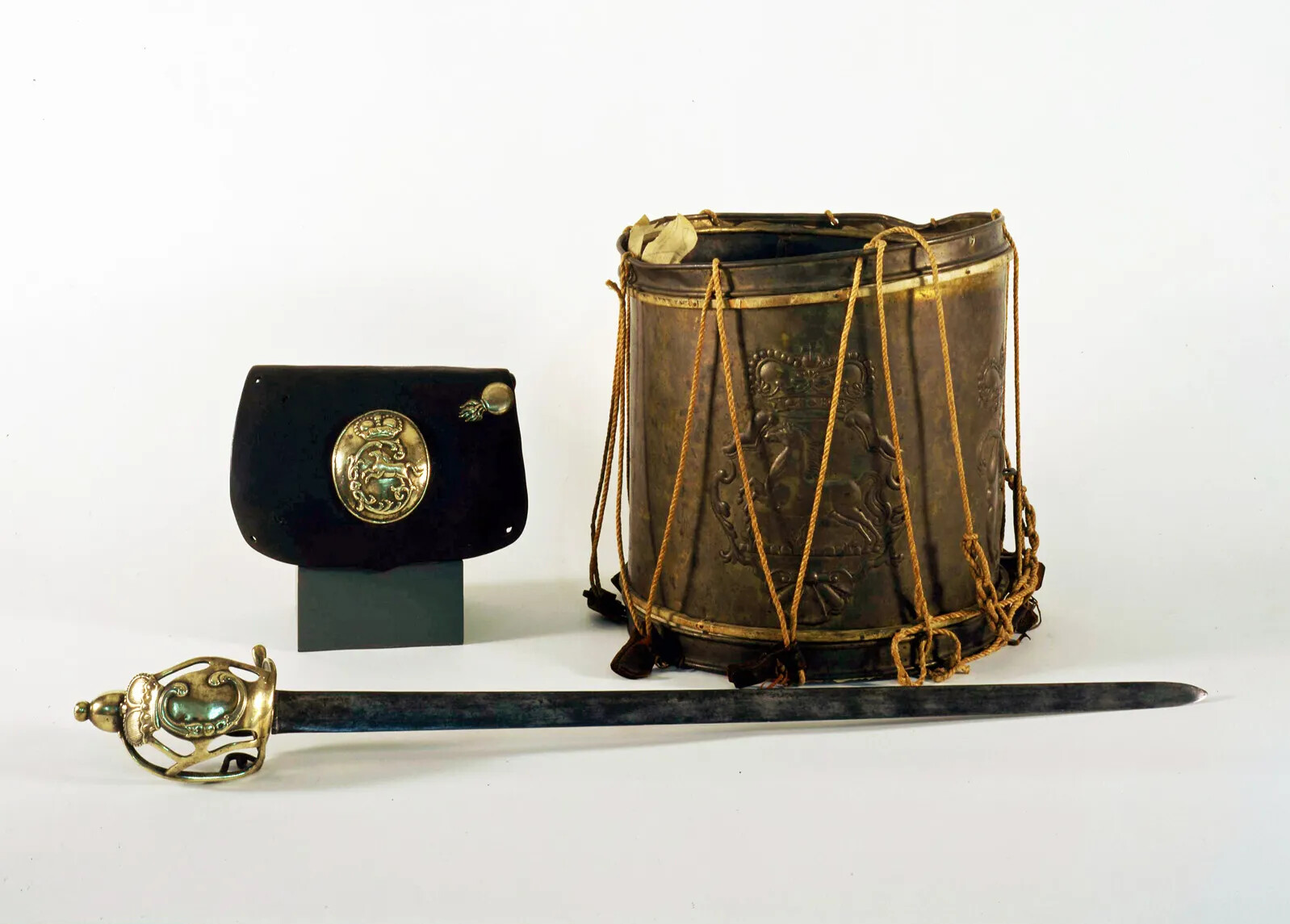
Three items are shown. A sword with decorative golden handle lies horizontally. A black square pouch with golden seal in the middle and a round circle in the upper left hand corner stands next to it. The last item is a drum, showing signs of age. It is made of metal with a seal embossed on it, and the top drum head is torn off. There is twine woven through the top and bottom hoops to keep the drum together.
Hessian Drum, Sword, and Cartridge Box
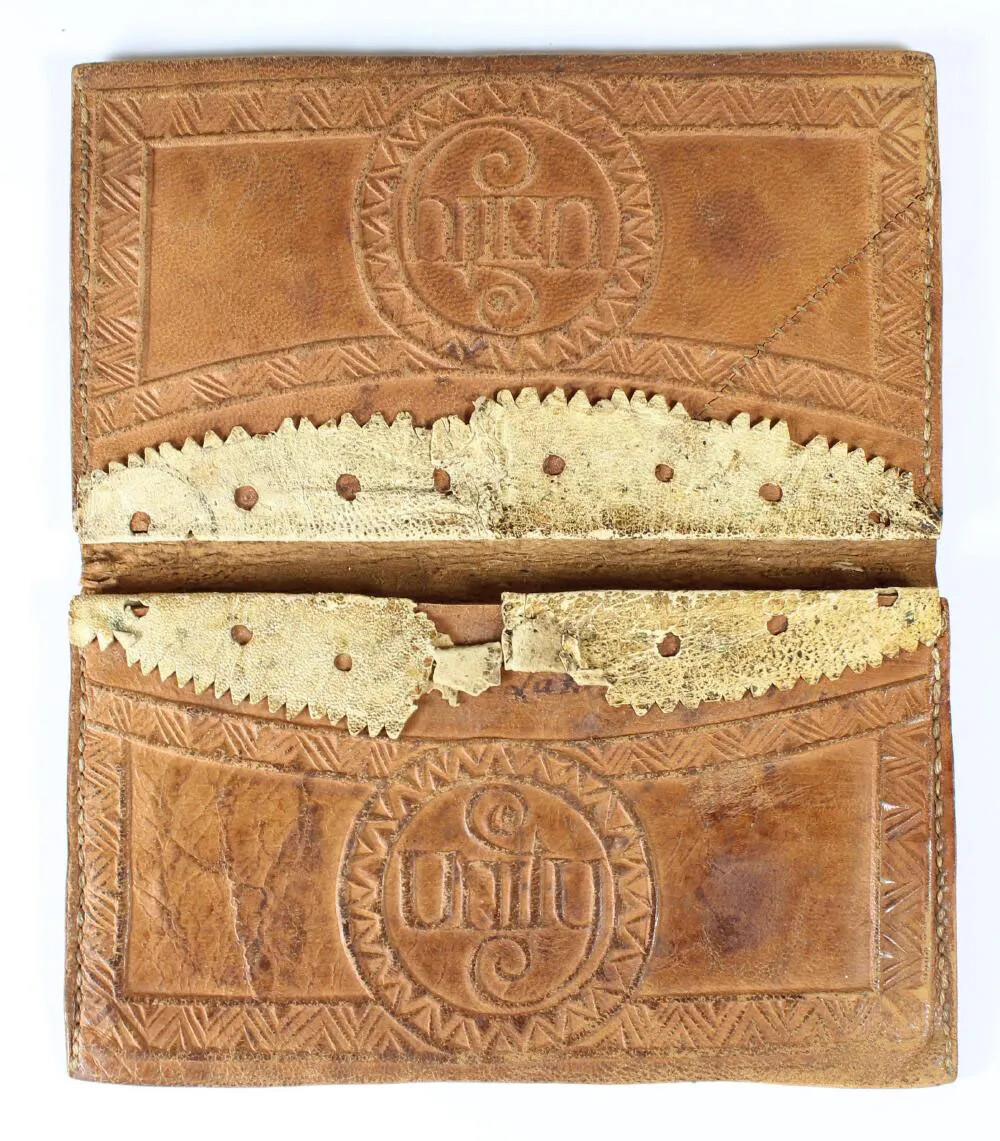
Rectangular, two panels, folding leather wallet, appearing worn. "Unity" embossed in circle on both interior panels with geometric designs around border. Serrated flap on each compartment. "Jabez Lane of Stratham / his pocketbook" written in ink on interior panel.
Jabez Lane's Wallet (inside)
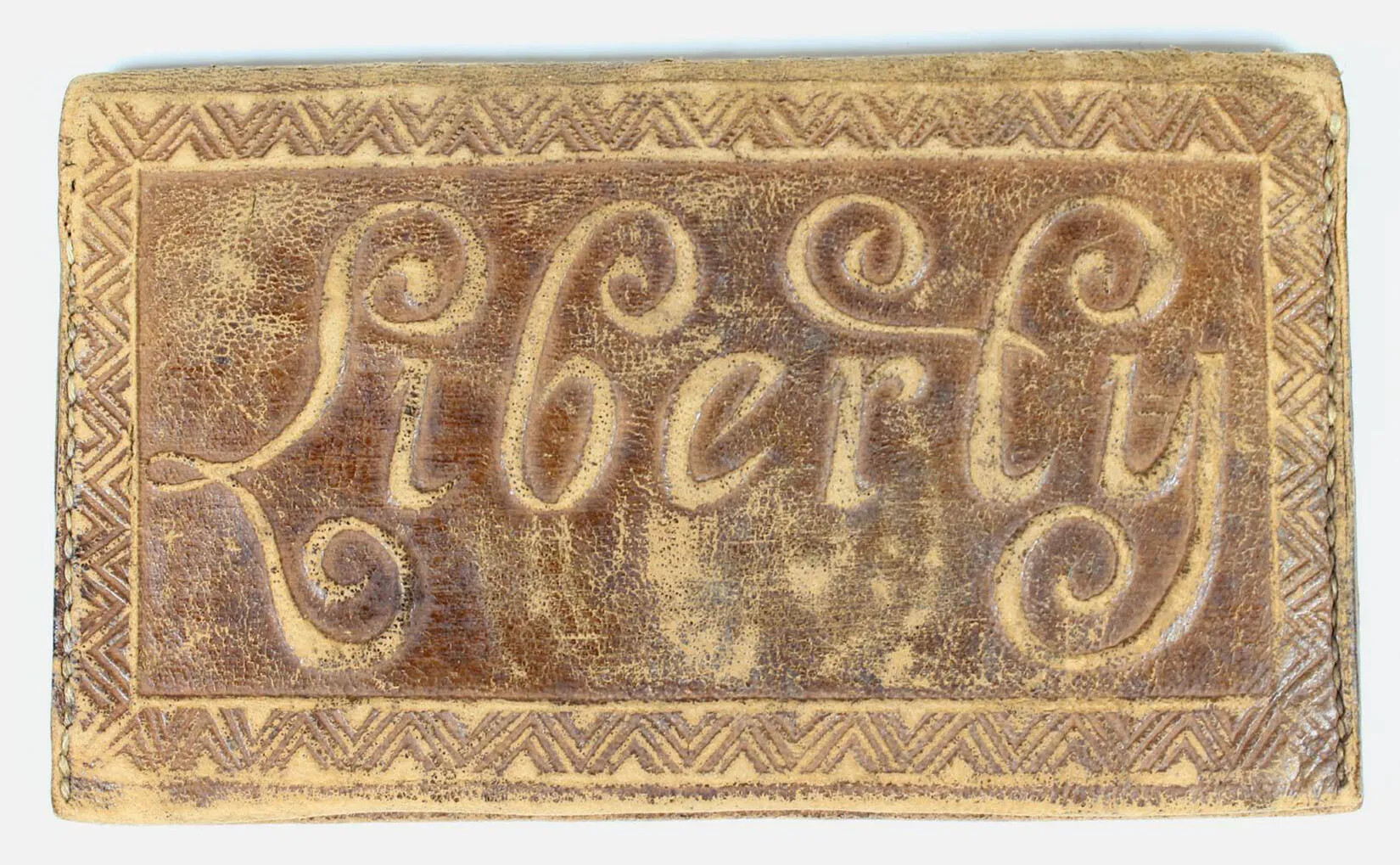
Rectanglar brown leather wallet. Embossed with geometric borders. "Liberty" engraved in script on cover.
Jabez Lane's Wallet (outside)
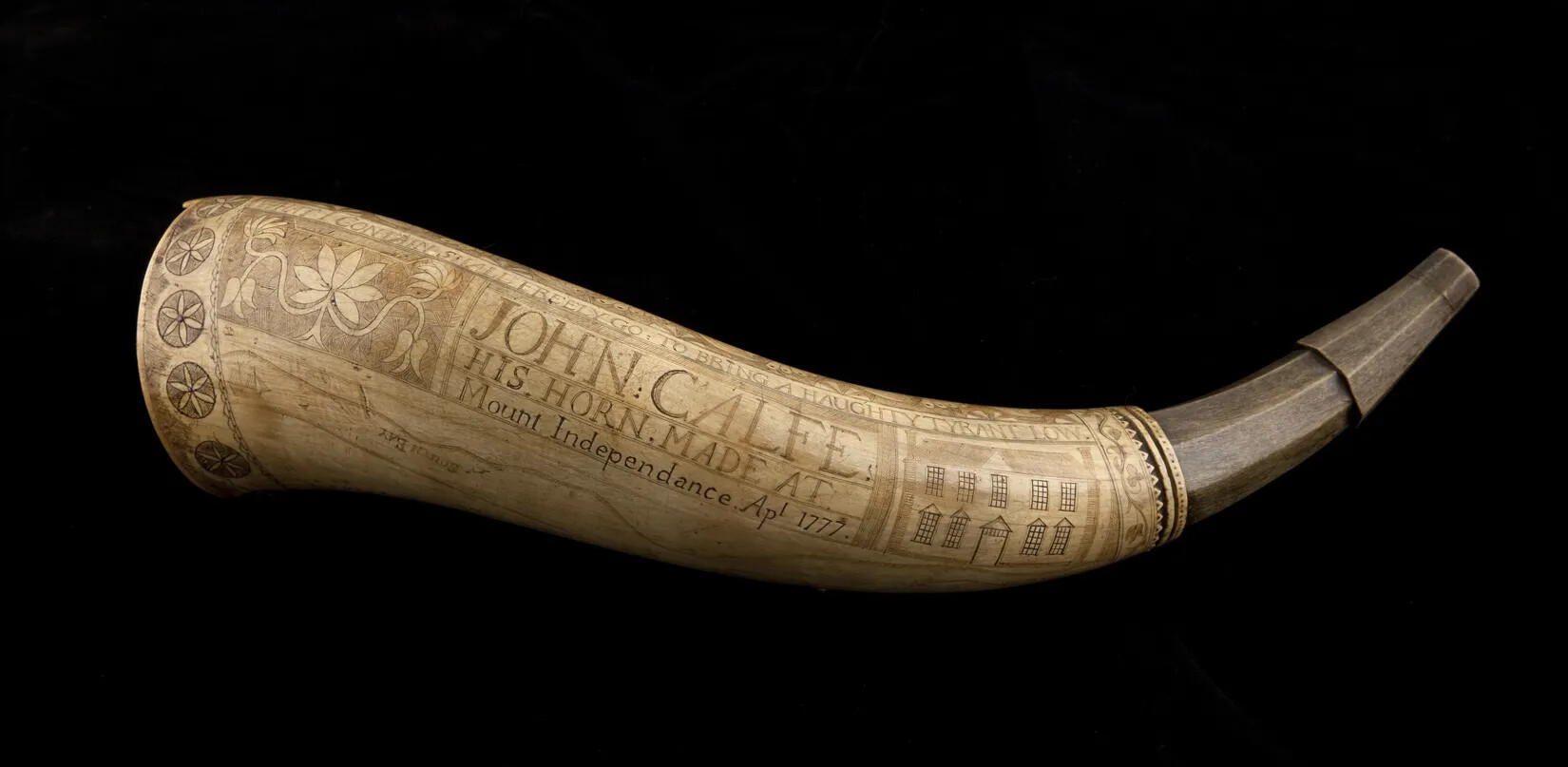
A large horn from an animal that has many words and drawings carved onto it. The words "JOHN CALFE/HIS HORN, MADE AT/Mount Independance Apl 1777" can be seen in the center of the horn. To the right of this text is a two storied house. To the left of the text is a floral design.
John Calfe's Powder Horn
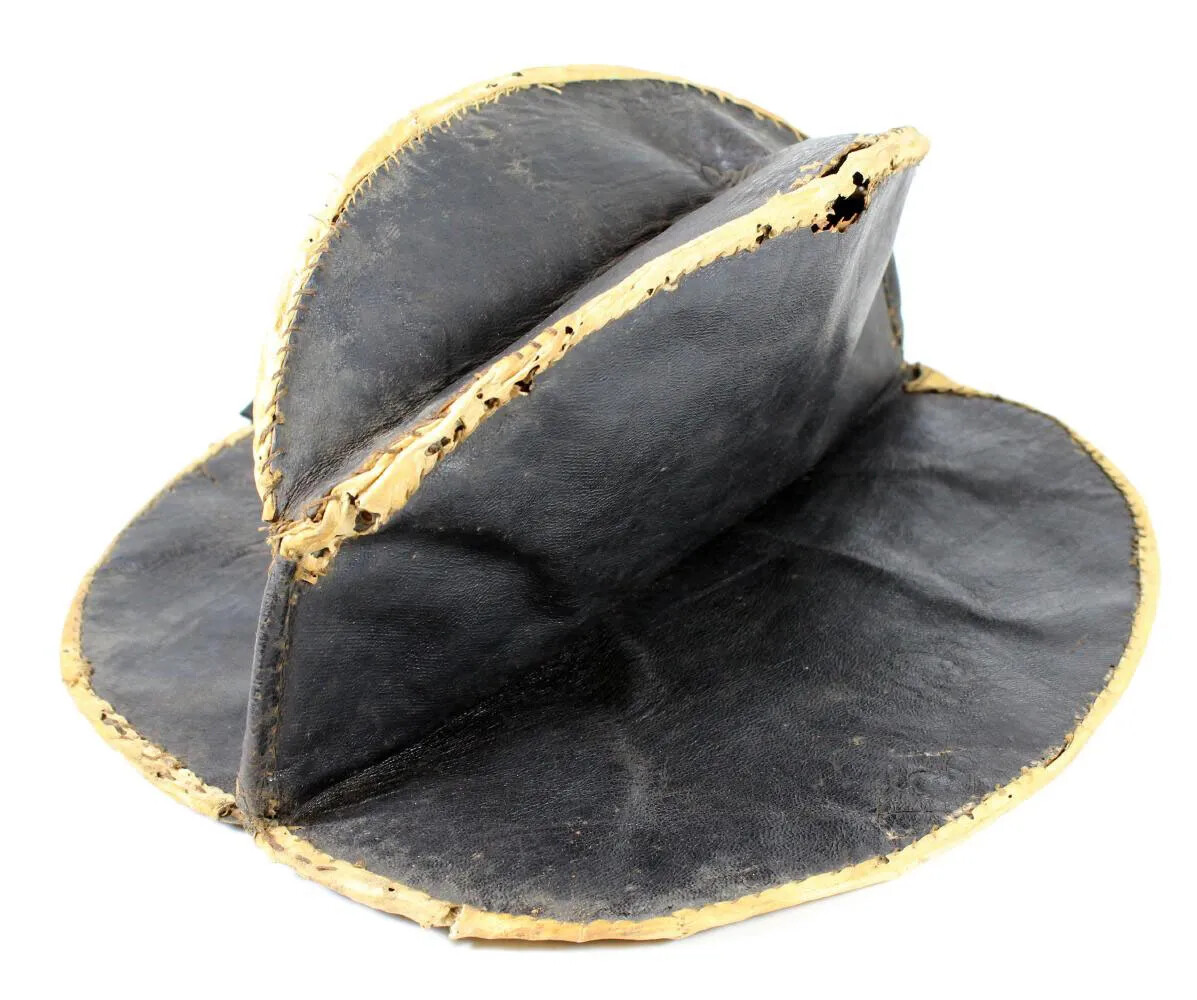
A folded black hat with a faded yellow rim. On the hat rests a piece of white paper with cursive handwritting in black ink. The note reads ""Corporal Josiah Moody / Volunteer in Col. John Stark's / Regiment - 1775 / 5th Regiment New Hampshire / Continental Infantry 1776. / Loaned by his Grandson / W.S. Moody Norwalk Ct."
Josiah Moody's Hat
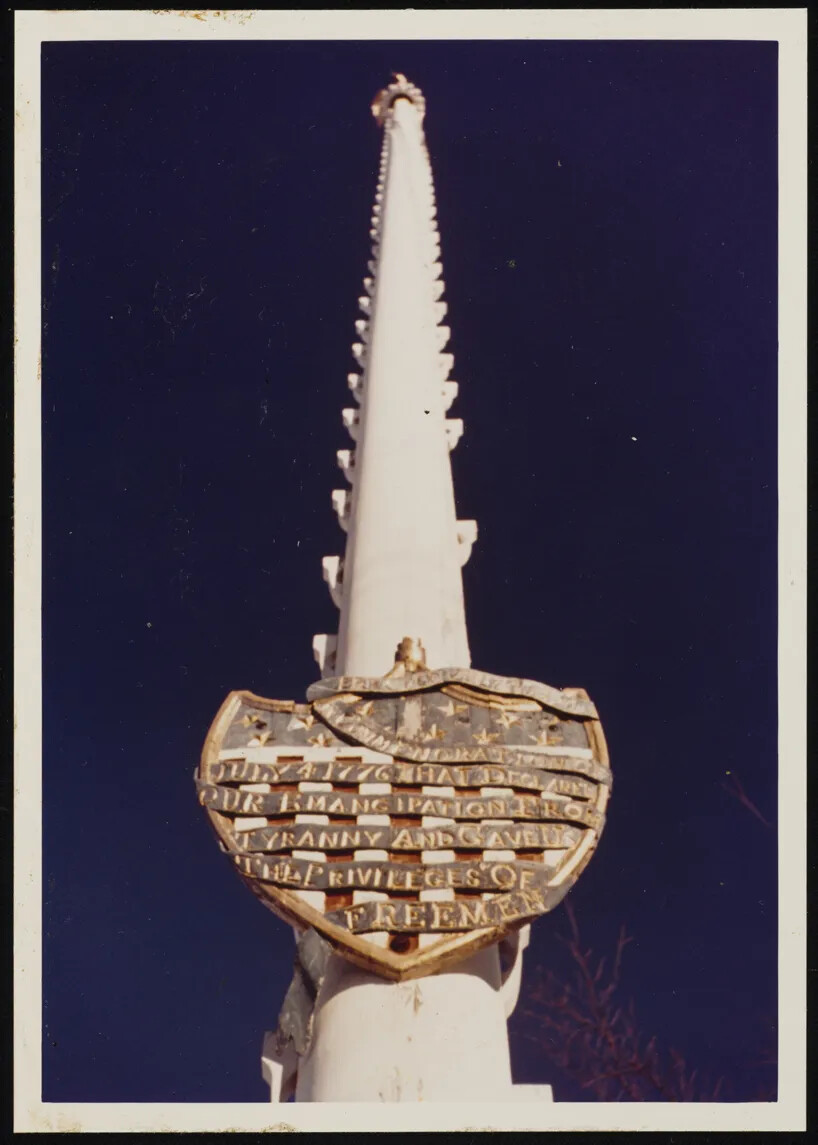
A tall white flag pole. Placed onto the flag pole is a plaque in the shape of a shield. The shield is framed in gold paint, with blue and gold stars painted on the upper half and red and white vertical stripes painted on the lower half. Words written in gold paint are draped on a blue ribbon on top of the shield.
Liberty Pole in Portsmouth
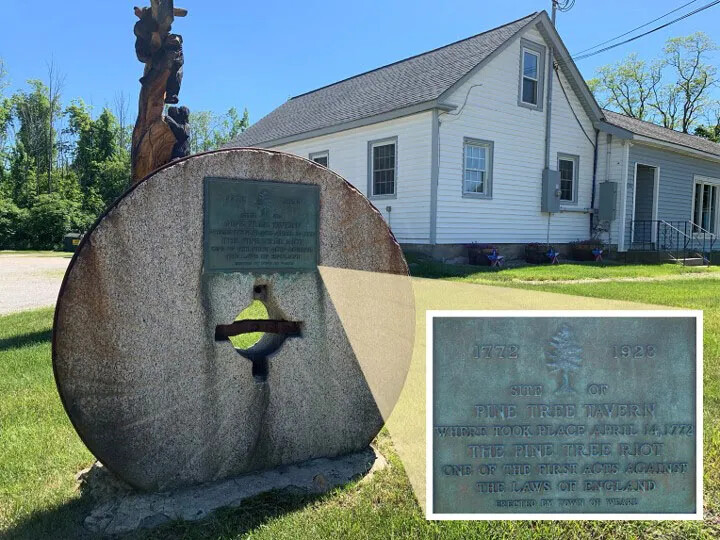
A large stone wheel stands upright and has a hole in the middle. On the upper rim of the wheel, a large plaque is placed above the hole. The words on the plaque are raised engravings. The words read: "1772 1928/SITE OF/PINE TREE TAVERN/WHERE TOOK PLACE APRIL 14, 1772/THE PINE TREE RIOT/ONE OF THE FIRST ACTS AGAINST/THE LAWS OF ENGLAND/ERECTED BY THE TOWN OF WEARE."
Pine Tree Riot Monument
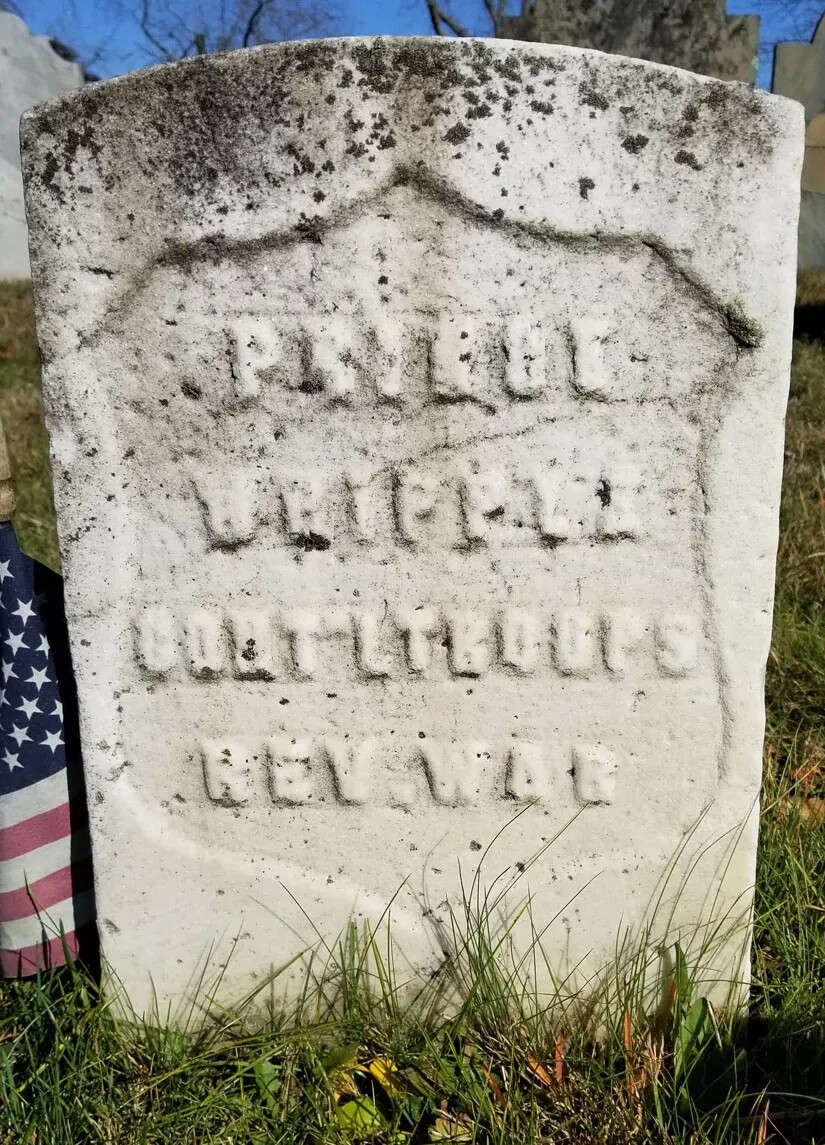
A colored photograph of a white gravestone surrounded by green grass. To the left of the gravestone is an American flag. Carved into the gravestone are the words "PRINCE/WHIPPLE/(illegible)/REV. WAR"
Prince Whipple's Gravesite
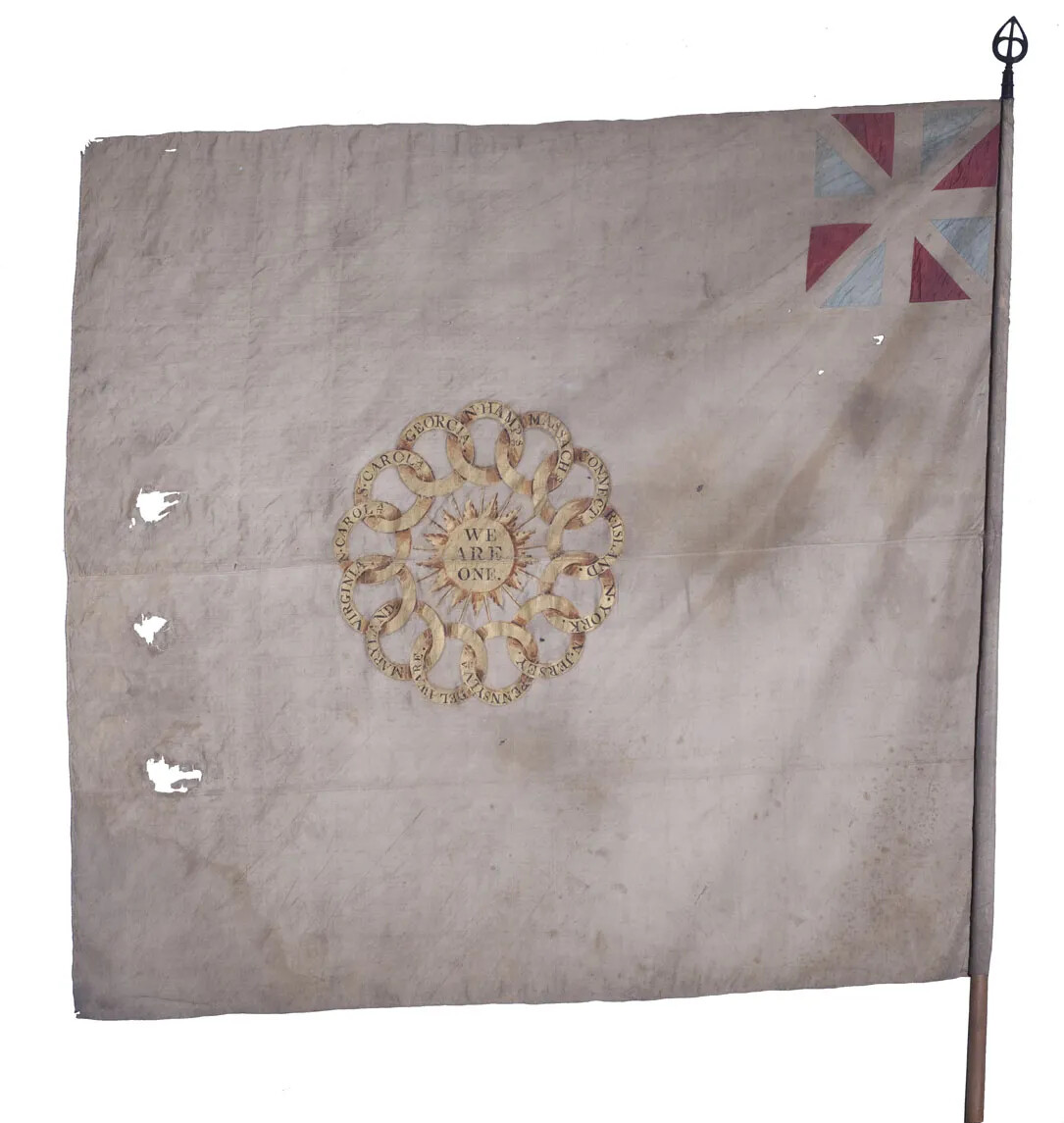
A large white flag, with the flag pole to the right, and the flag’s fabric to the left. In the top right corner, three red and three light blue triangles form the shape of the British flag. At the flag’s center, a set of thirteen rings with the names of the original thirteen colonies interlace. From clockwise top, they read “N.HAMPS/MASSACHS/CONNECT/R.ISLAND/N.YORK./N.JERSEY/PENNSYLVA/DELAWARE./MARYLAND./N.CAROLA/S.CAROLA/GEORGIA.” In the center of the rings is a sun with the words “WE/ARE/ONE.” To the left of the rings are three misshaped holes in a vertical line.
Revolutionary War National Flag
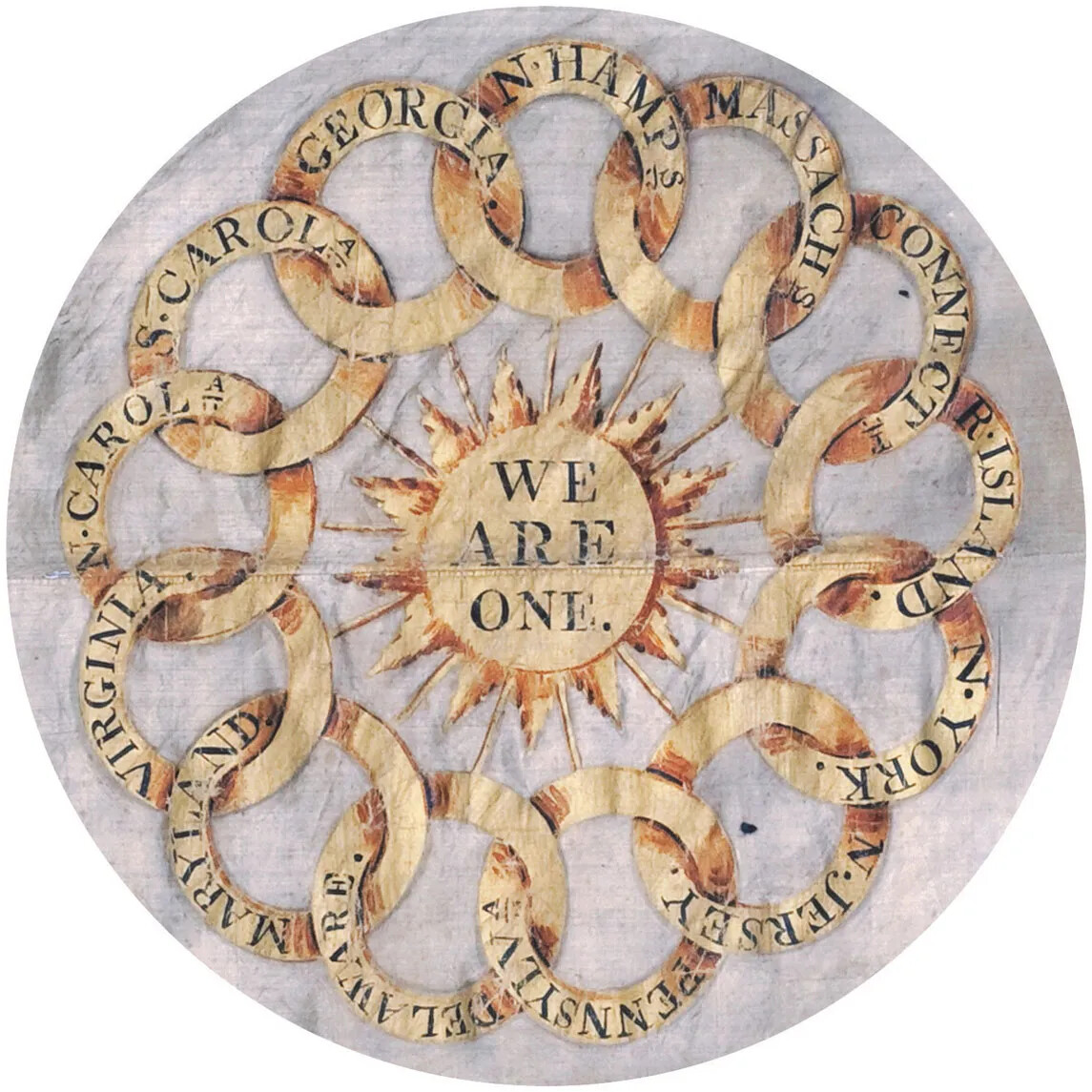
Close up of center image in a flag. A set of thirteen rings with the names of the original thirteen colonies interlace. From clockwise top, they read “N.HAMPS/MASSACHS/CONNECT/R.ISLAND/N.YORK./N.JERSEY/PENNSYLVA/DELAWARE./MARYLAND./N.CAROLA/S.CAROLA/GEORGIA.” In the center of the rings is a sun with the words “WE/ARE/ONE.” To the left of the rings are three misshaped holes in a vertical line.
Revolutionary War National Flag (Detail)
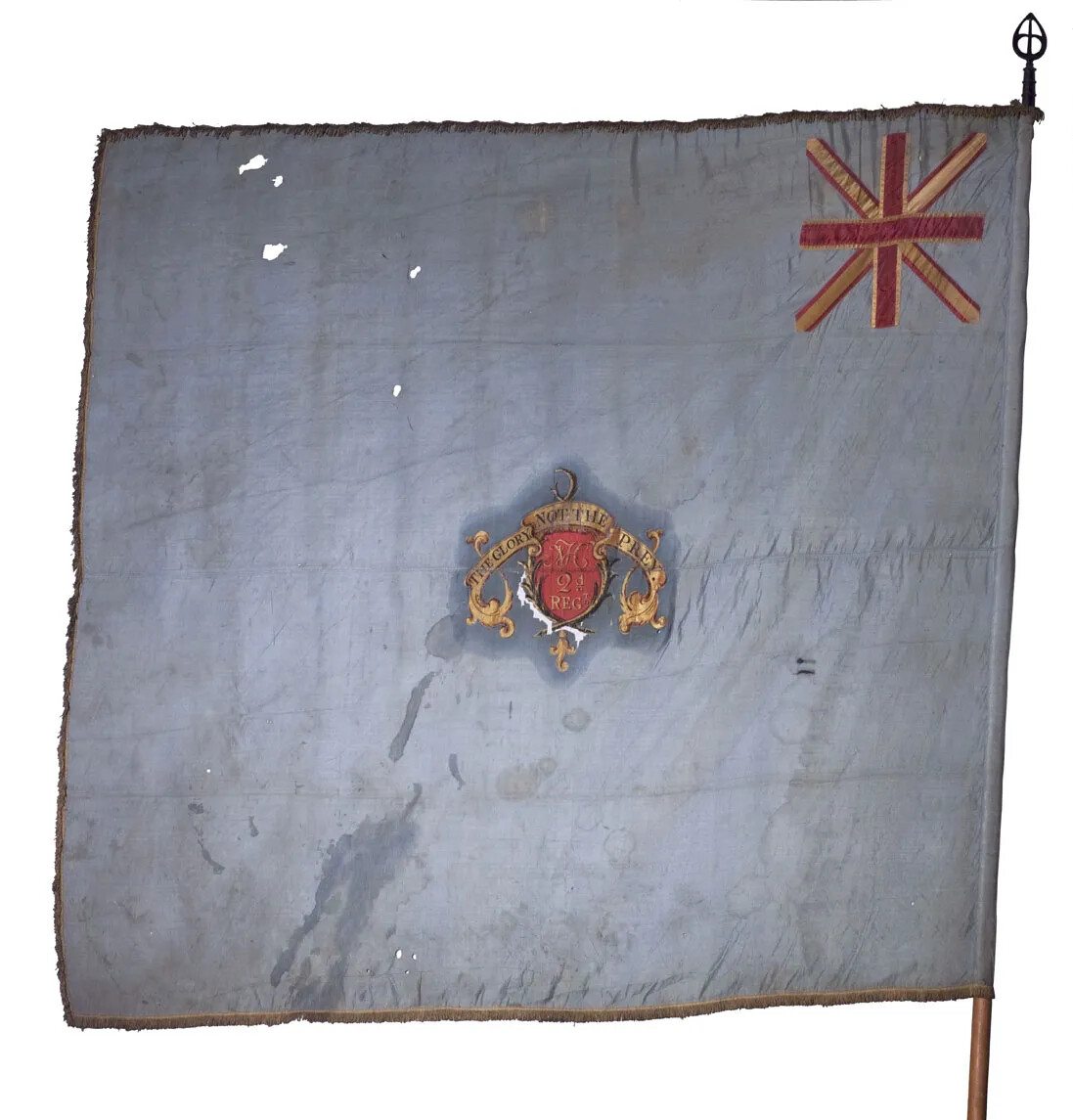
A large, faded blue flag with the flag pole to the right, and the flag’s fabric to the left. In the top right corner, diagonal stripes of red and white fabric form the shape of the British flag. At the flag's center is a red crest with gold words placed in its center. The words read "N. H. / 2D / REG." Draped above the crest is a gold ribbon with black words which read "THE GLORY NOT THE PREY."
Revolutionary War Regimental Flag

Photographs & Prints in this Unit:

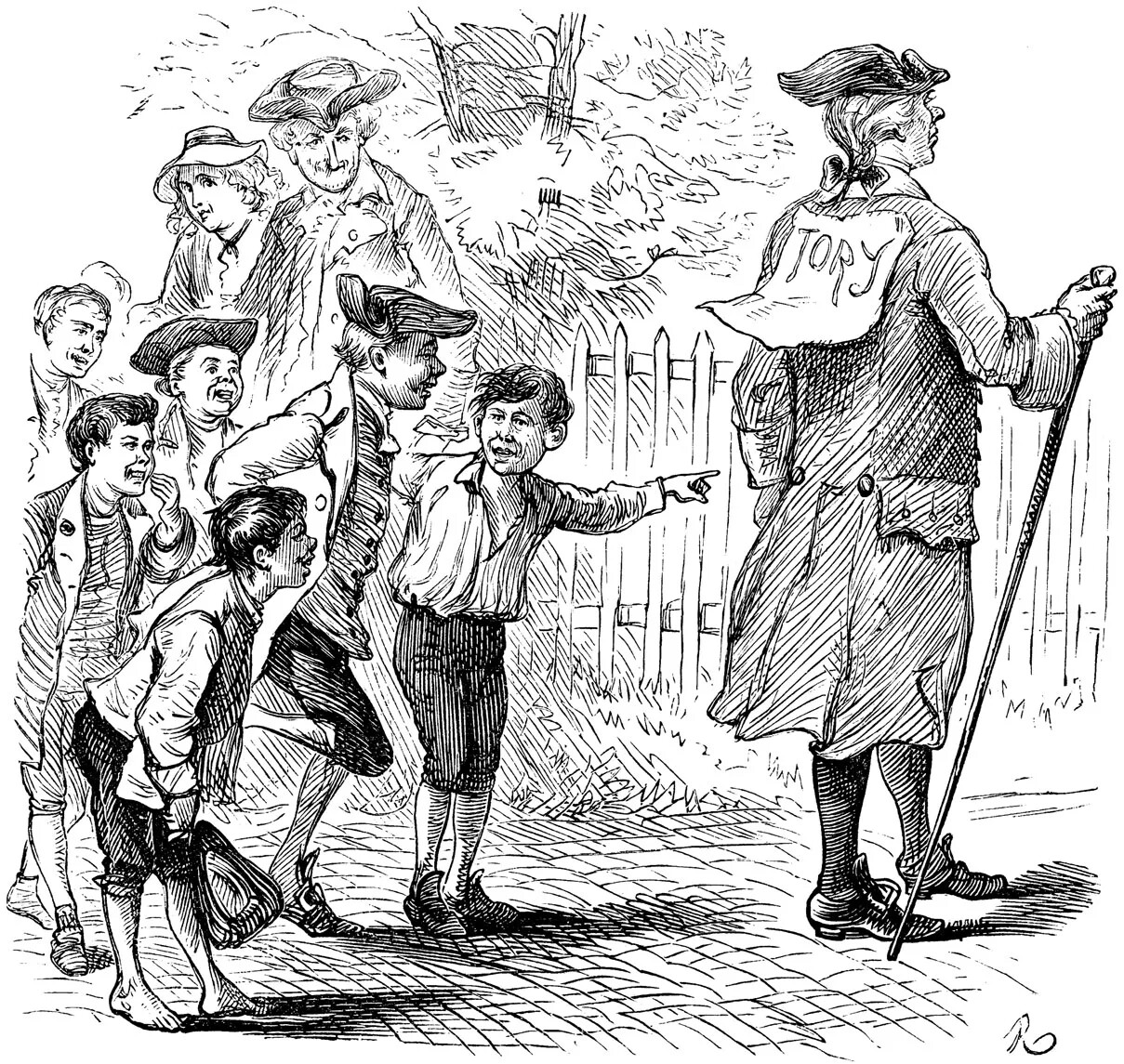
A black and white drawing of a group of young boys laughing and looking at a man who stands with his back to the group. On the man's back is a piece of paper with the word "TORY" written on it.
A Tory
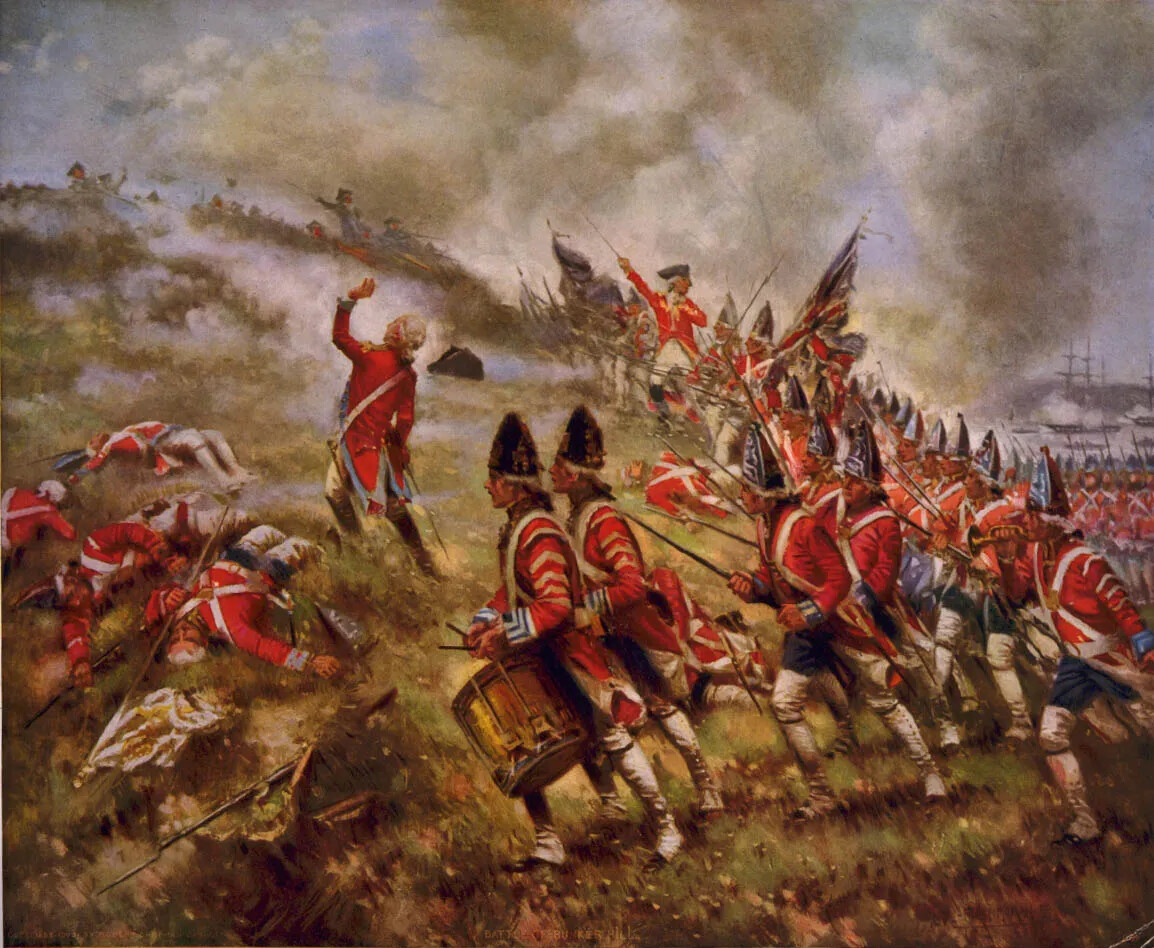
A colored painting of a large group of soldiers in red and white uniforms advancing up a steep hill. Two soldiers are carrying drums, while the rest carry muskets. One solider on the right-side of the painting carries the British flag. Ships firing their cannon are seen in the distance on the right-hand side of the painting. The sky is filled with smoke and mist. On the left side of the painting, several soldiers lie on the ground.
Battle of Bunker Hill
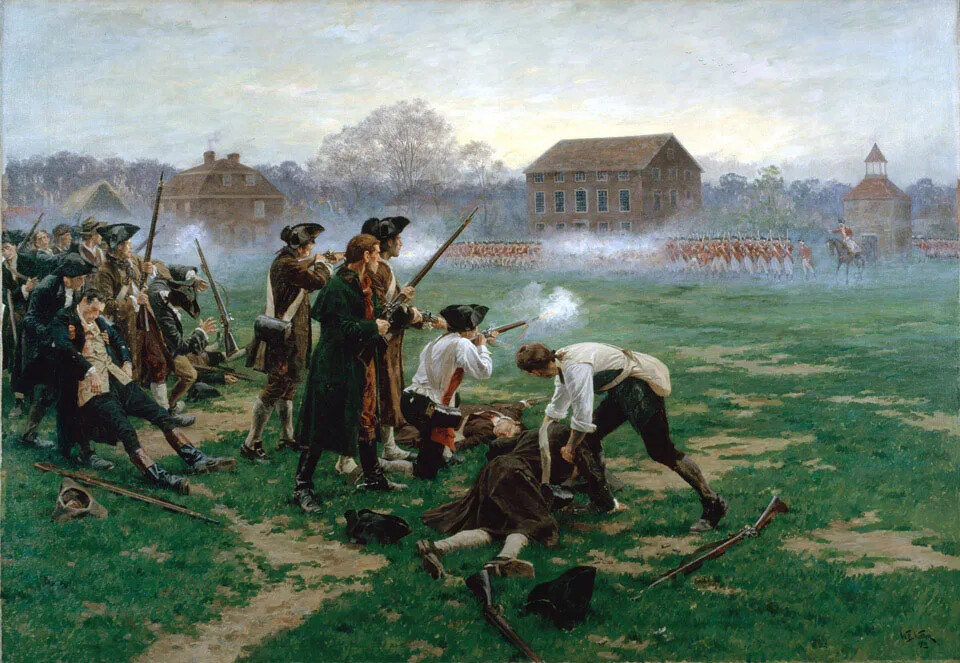
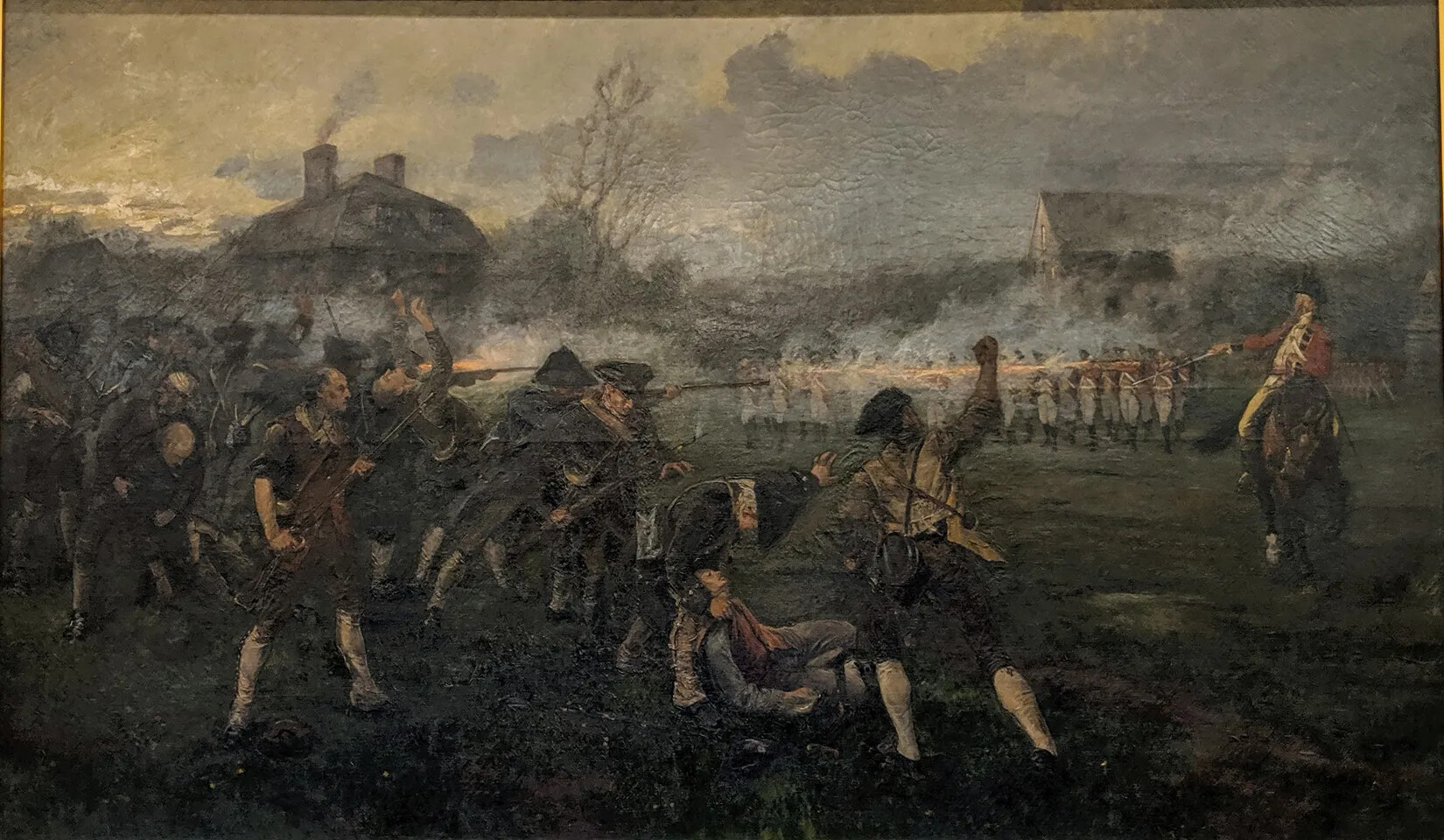
A colored painting of two groups of men firing muskets at each other on a grassy field. The first group stands in a cluster near the left side of the painting, with their backs to the viewer. They all wear different colored pants, shirts, and coats. In the distance, organized lines of soldiers in red jackets and white pants stand in front of several two-and three-storied buildings.
Battle of Lexington
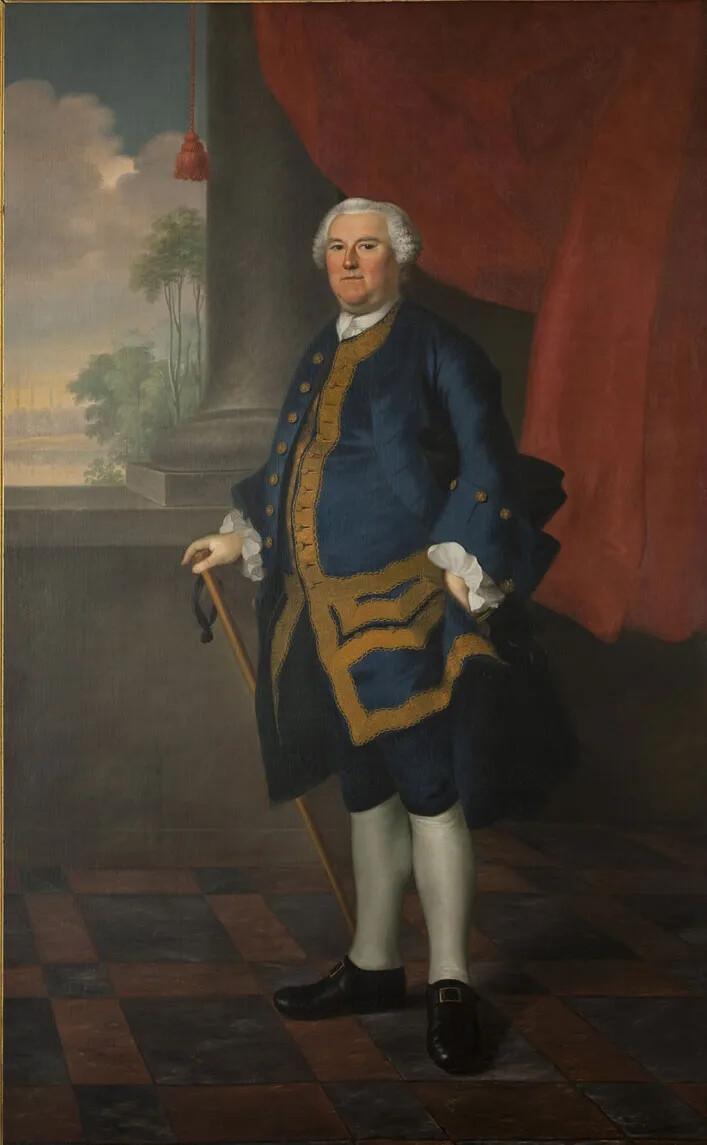
A colored painting of a man standing in a blue coat with gold edges and buttons, blue breeches, knee-high white stockings, and black shoes with large buckles. His left hand rests on a long wooden cane and his right hand rests in his right pocket. Behind the man is an exterior landscape of tall trees to his left and a large red curtain to his right.
Benning Wentworth
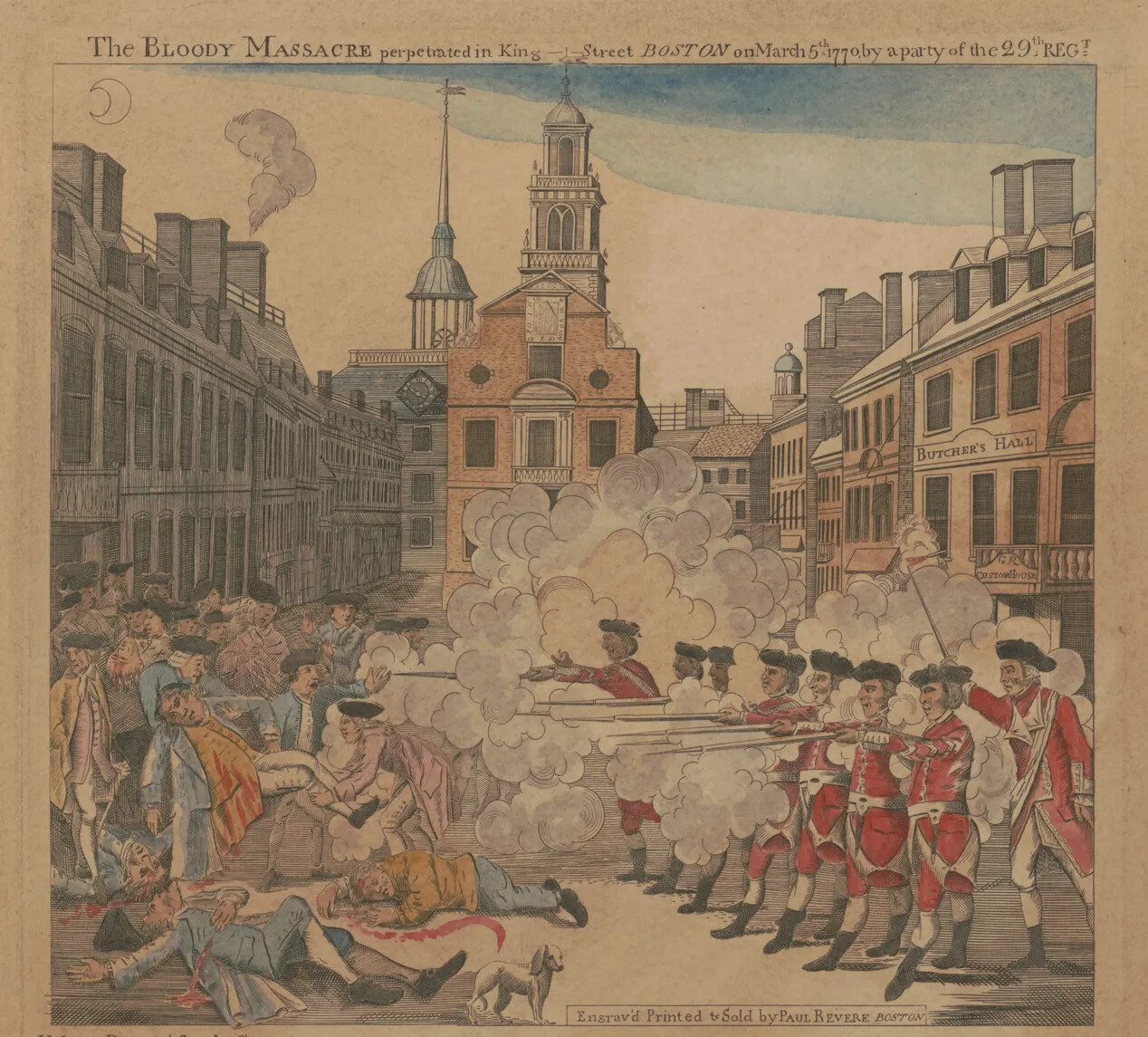
A colored drawing of a group of soldiers dressed in red coats and white pants firing muskets up close on a group of people dressed in different colored coats and pants. Several people lay on the ground, wounded. The two groups of people stand on a street lined with several three-and four-storied buildings. The drawing's title, located along the upper border of the drawing, reads: "THE BLOODY MASSACRE perpetrated in King--Street BOSTON on March  5th 1770, by a party of the 29th REGt."
Boston Massacre
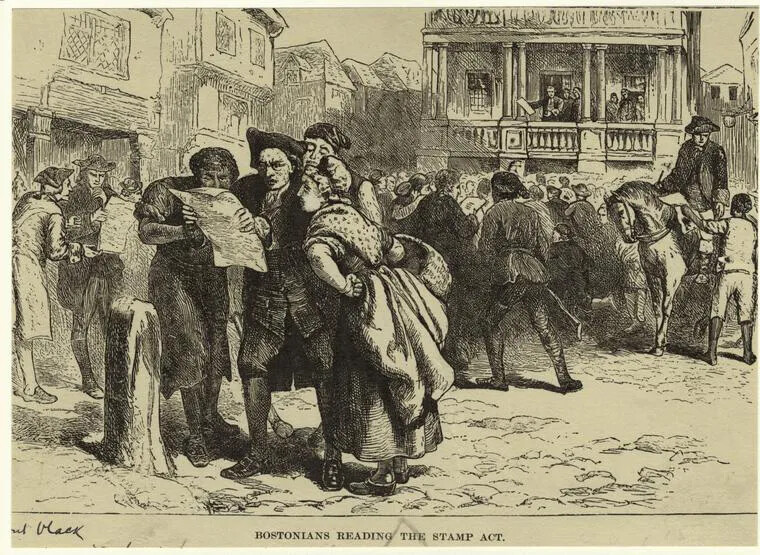
A black and white drawing of a group of people standing in a clearing between several buildings. Several people stand with their backs of the viewer, looking up at a man holding a document on a building's balcony. Two smaller groups of people, one with two men and one with three men and one woman, face the viewer, looking  at a document. The title of the drawing, located along the bottom border of the drawing, reads: "BOSTONIANS READING THE STAMP ACT."
Bostonians Reading the Stamp Act
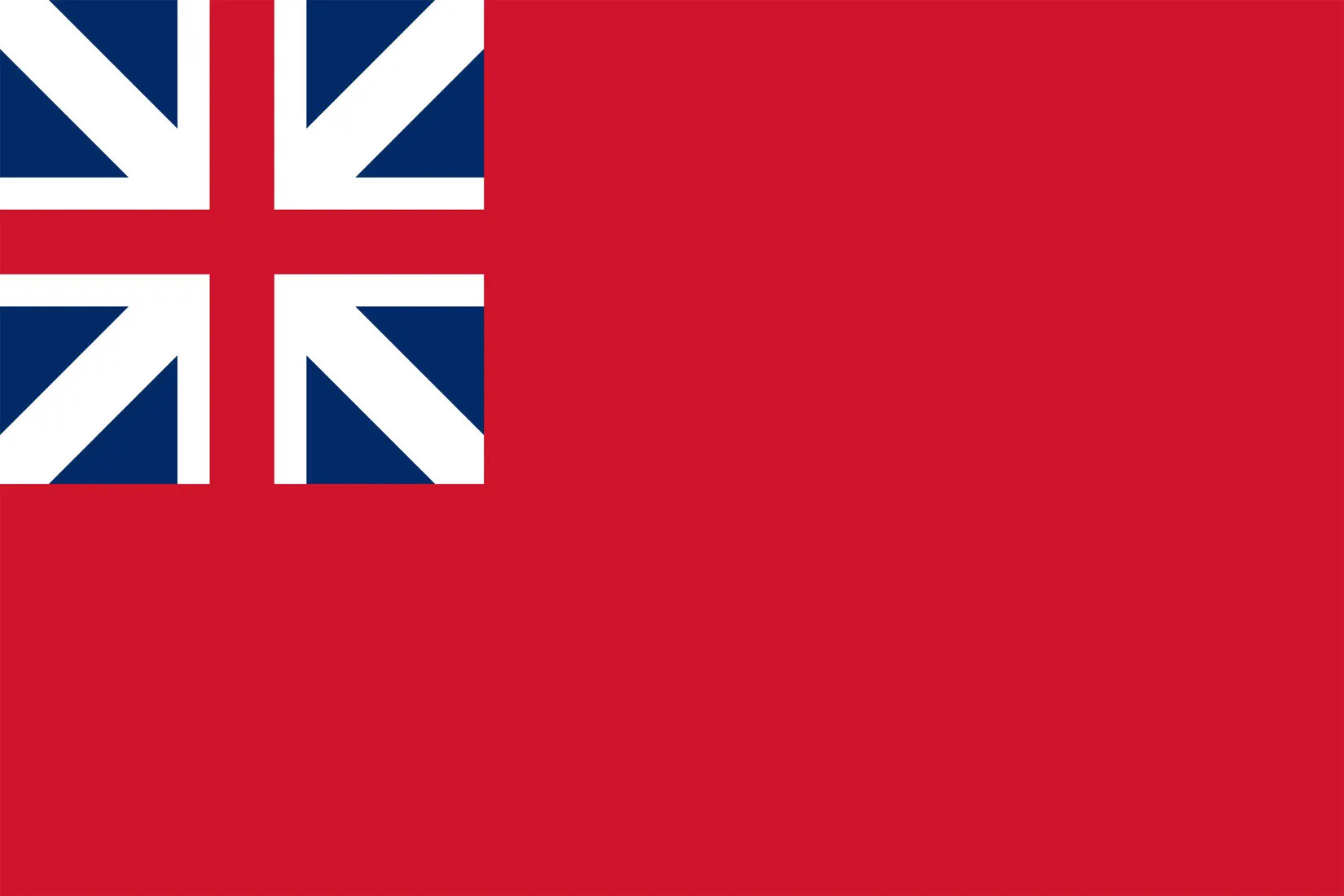
A colored print of a flag. The majority of the flag is red, and in the top left-hand corner, there is a square of blue with white and red diagonal lines drawn through it.
British Red Ensign Flag
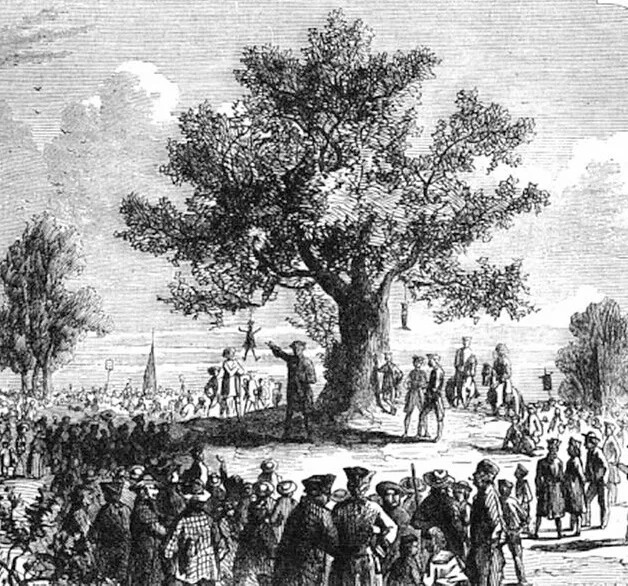
A black and white drawing of a group of people standing in a circle, surrounding a large tree. Several men stand directly beneath the tree, and look out over the people. One man stands to the left of the tree, and gestures out to the people with his right arm.
Colonists Under the Liberty Tree
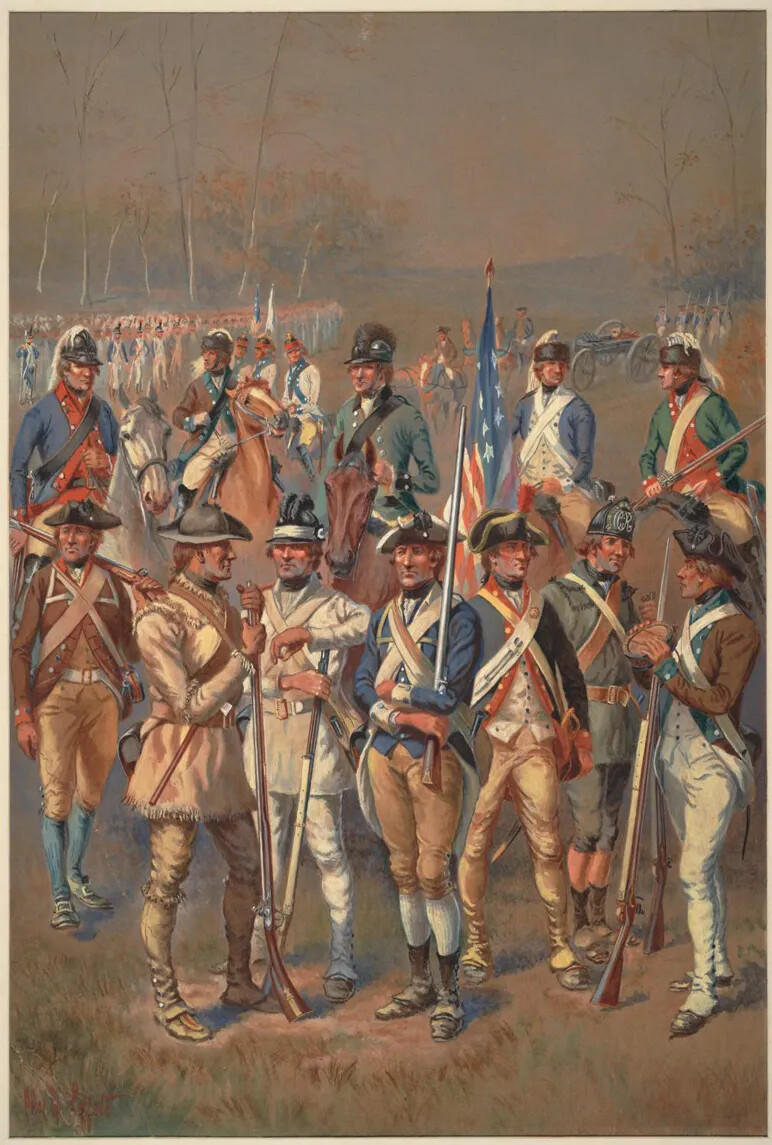
A colored painting of a group of man standing in two rows. The men in the first row stand, while the men in the second row ride horses. All of the men wear different colored hats, coats, and pants. An American flag is held upright by one of the men at the center of the painting. Behind this group is a larger group of men standing in organized diagonal lines.
Continental Army Soldiers
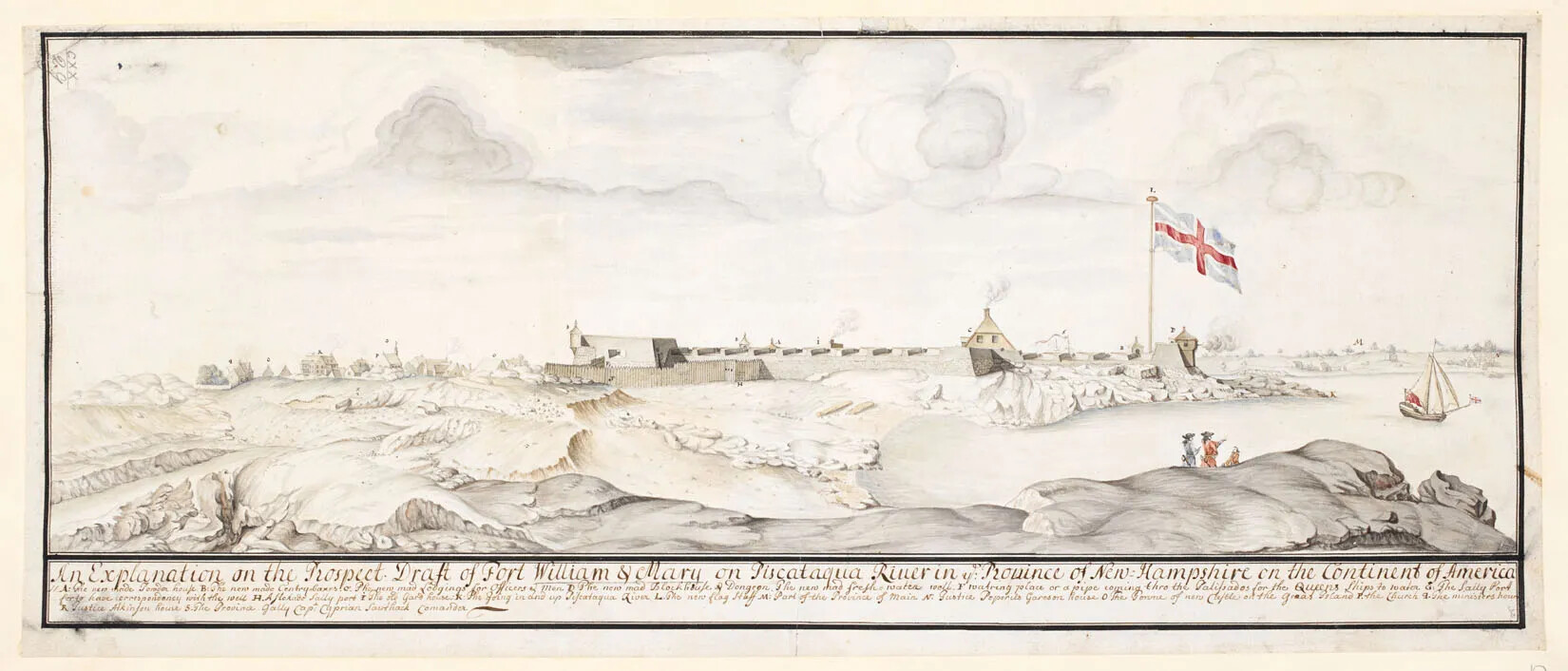
A watercolor painting of a large fort and several houses on a rocky landscape. In the right-hand side of the painting, a large blue flag with a red cross and white diagonal lines flies above the fort. To the right of the fort is a body of water with a sailboat in the right-most corner. To the left of the sailboat are three men, two in red uniforms and one in a blue uniform, walk along the rocky cliffs by the water. The words "An Explanation on the Prospect Draft of Fort William & Mary on Piscataqua River in (illegible) Province of New Hampshire on the Continent of America" are written along the bottom border of the painting in cursive handwriting in black ink. Beneath these words is more cursive handwriting in much smaller text.
Fort William and Mary
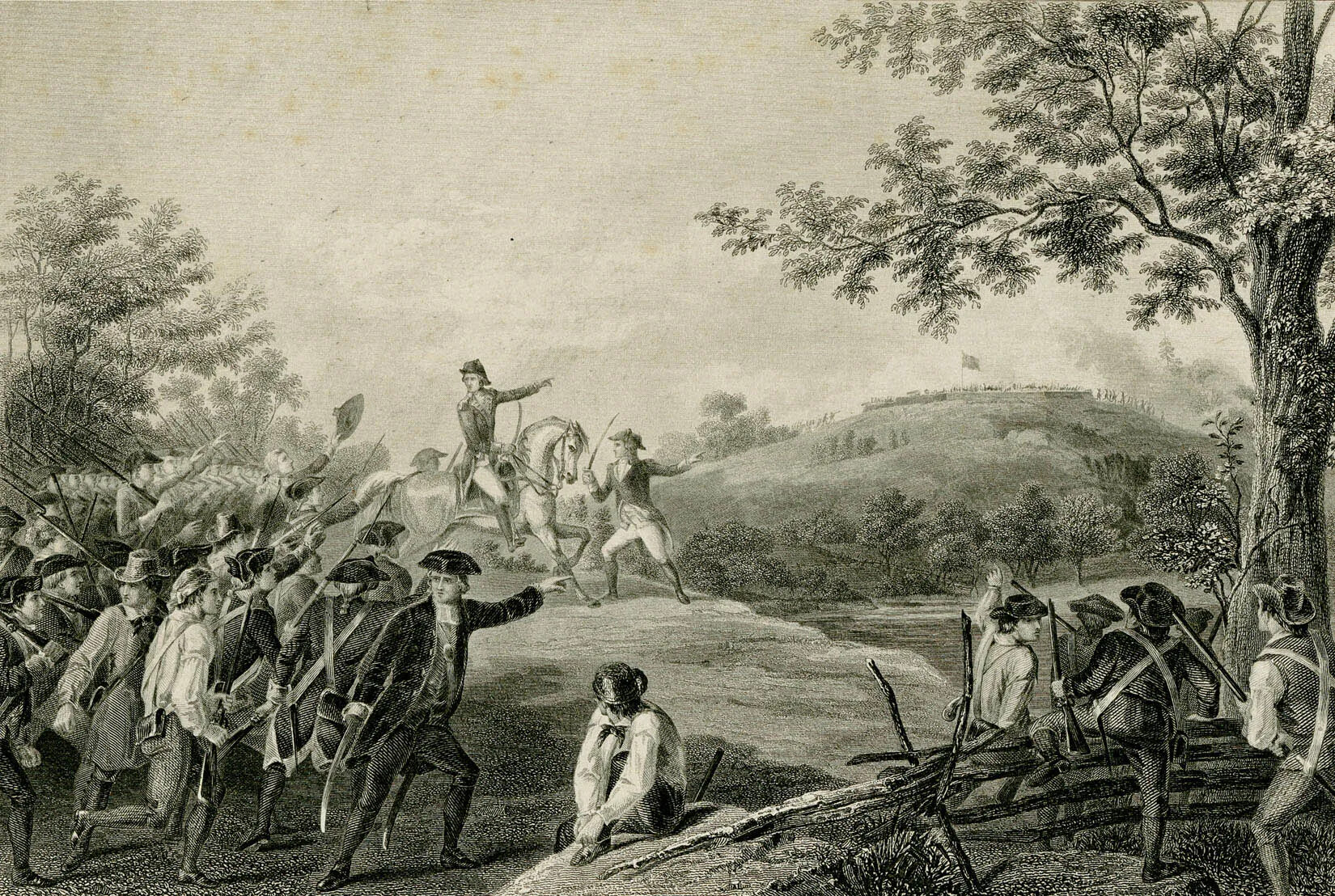
A black and white drawing of a group of men standing on the left side of the drawing, looking and pointing at a hill positioned on the right side of the drawing. On the hill is a fort-like building, with a large flag raised over it. At the center of the drawing, looking at the group of men behind him, with his right arm raised towards the hill, is a man riding a horse.
General Stark at Bennington
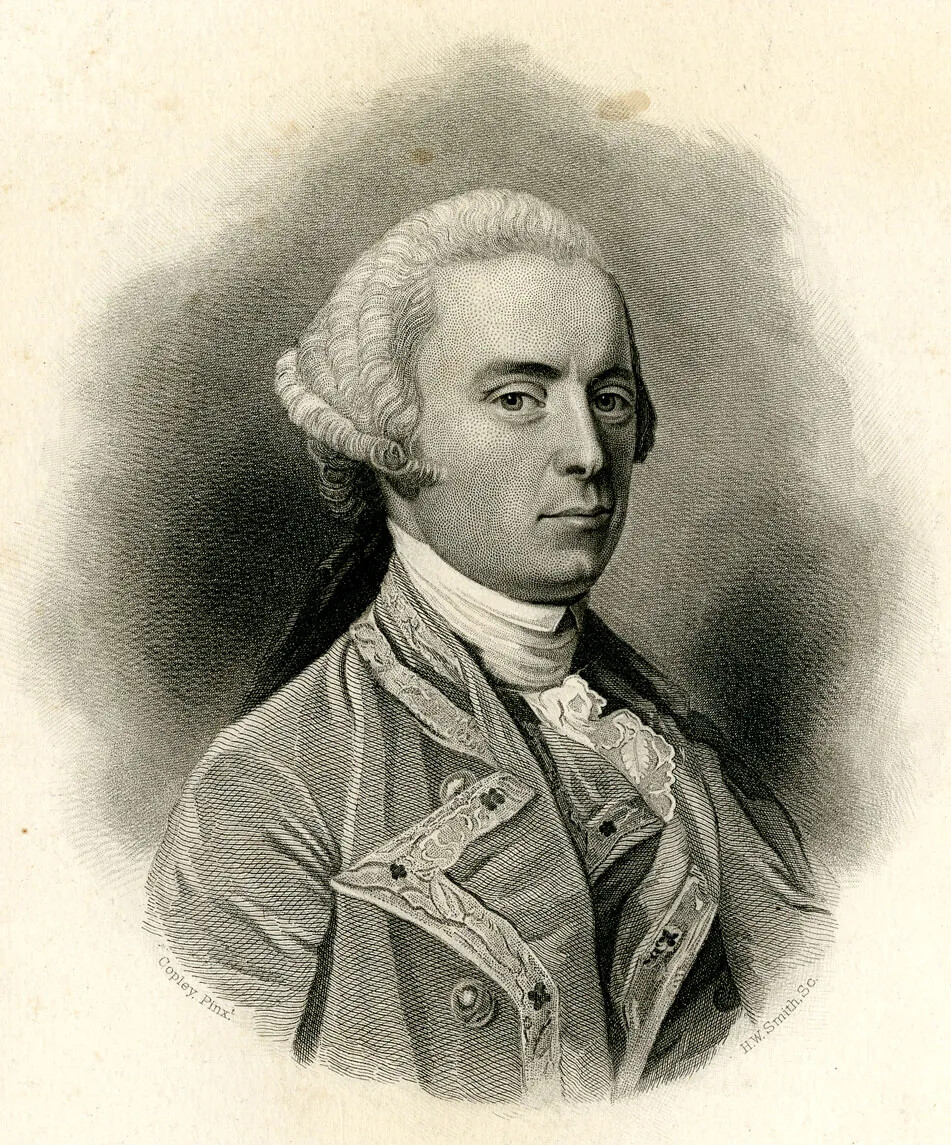
A pencil drawing of a man with a wig, facing the right and looking at the audience. He wears a high-necked white shirt and a fancy vest and coat.
Governor John Wentworth
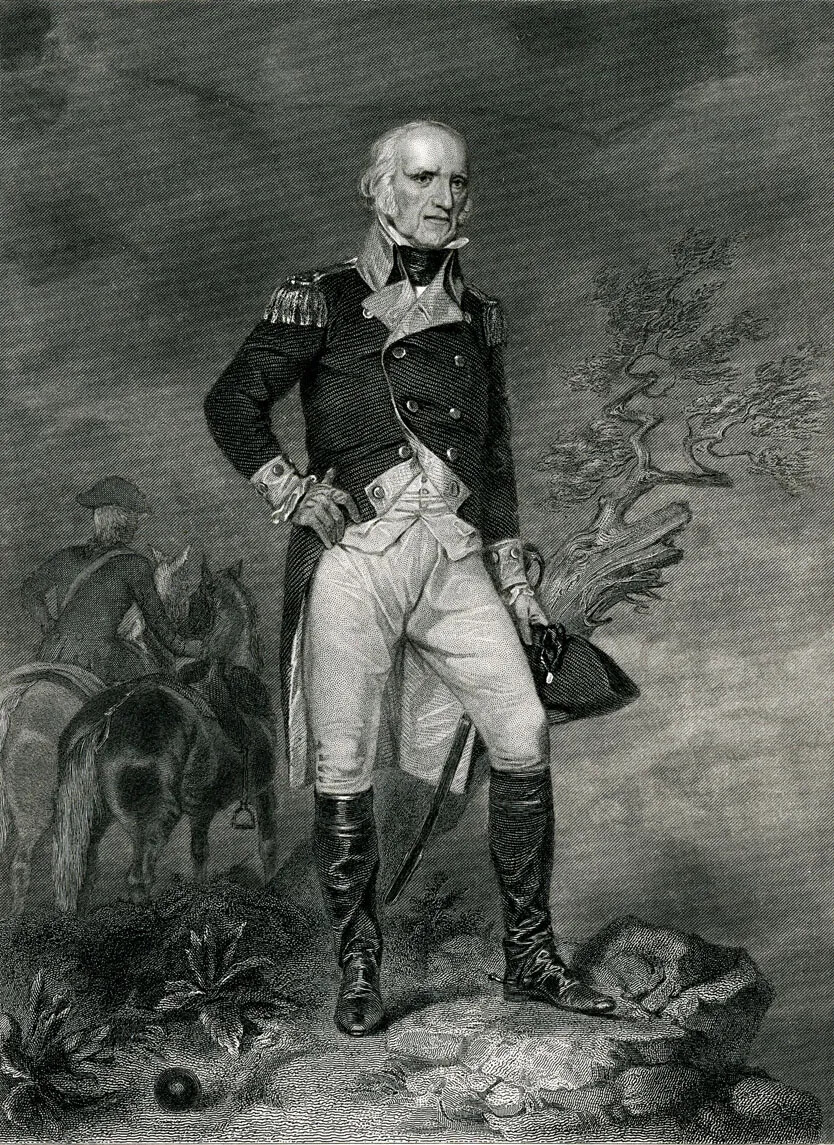
A black and white painting shows a man in military dress standing on a blurred landscape, which has a man and a horse walking away and a tree. The man who is the subject of the painting has one hand on his hip and one foot forward. He has grey hair which is short on the sides, and he is bald on top. He has a sword hanging from his hip, and holds his hat in his hand. His uniform is decorative with tassles at the shoulders, white pants, and high black boots.
John Stark
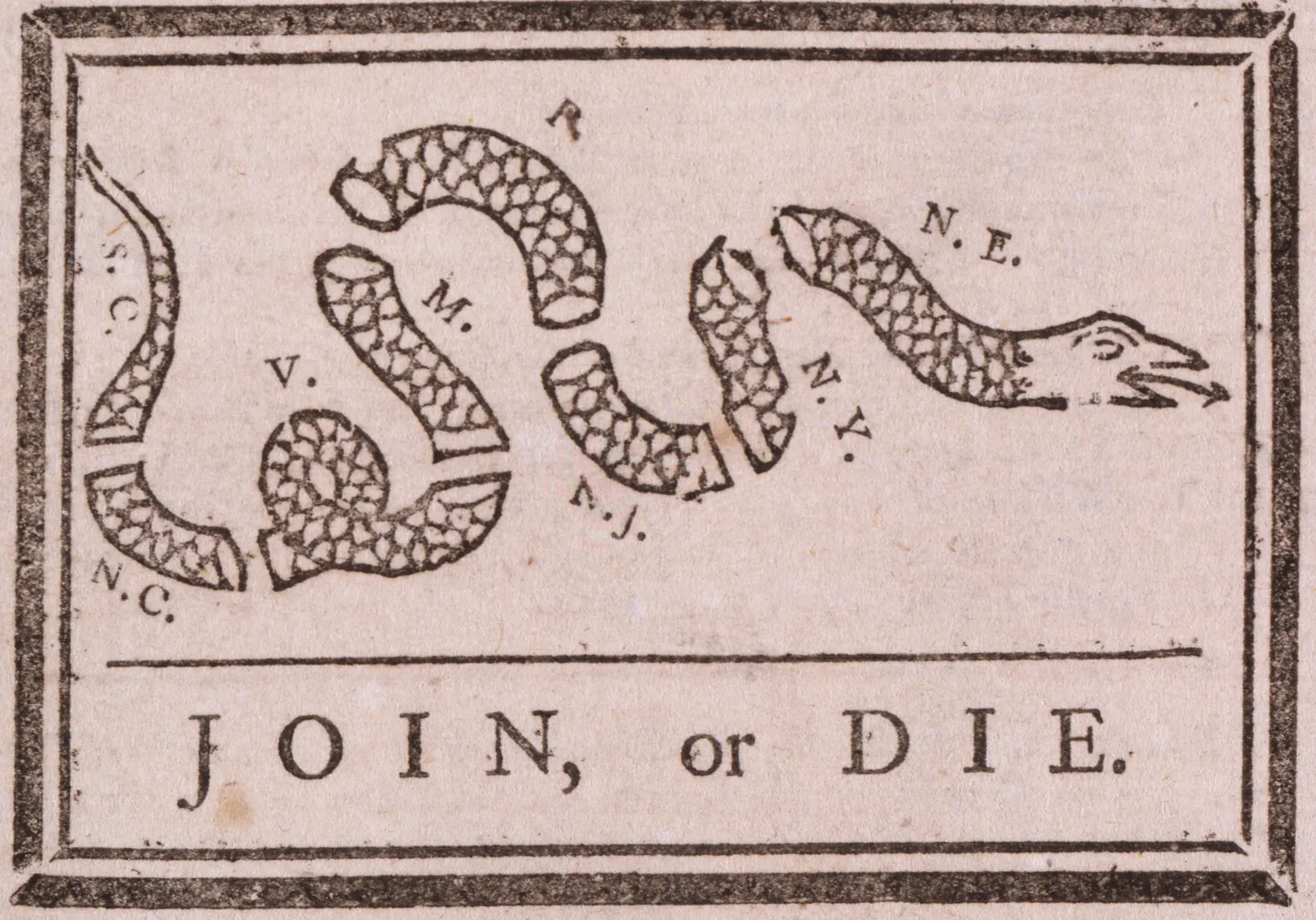
A black and white drawing of a snake that has been cut up into several pieces. The cut parts of the snake are labeled with capitalized letters, which read, from left to right: "S.C./N.C./V./M./R./N.J./N.Y./N.E." The title of the drawing, located along the bottom border of the drawing, reads: "JOIN, or, DIE."
Join or Die
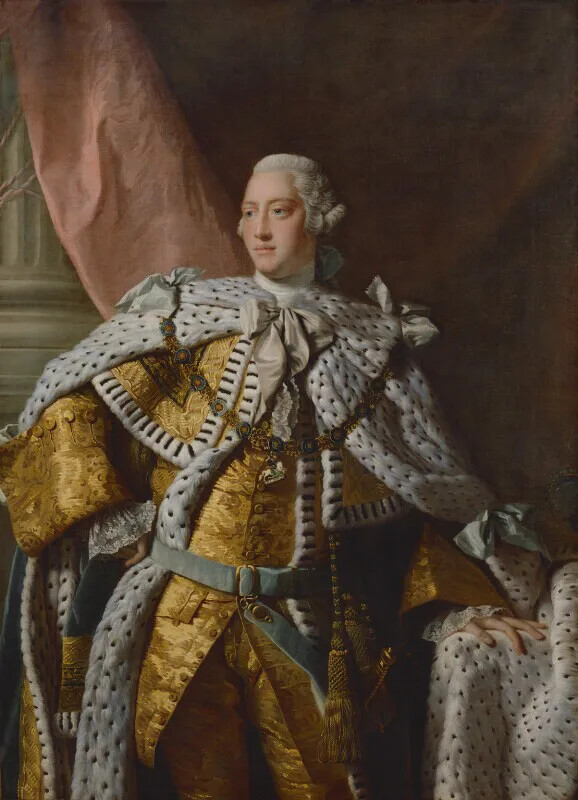
A colored painting of a man in a black and white-spotted fur cape, with a gold-colored coat and pair of pants. His left hand rests on his hip and his right hand rests on his cape, which drapes over a raised platform. He wears a white wig on his head, and looks of to the left.
King George III
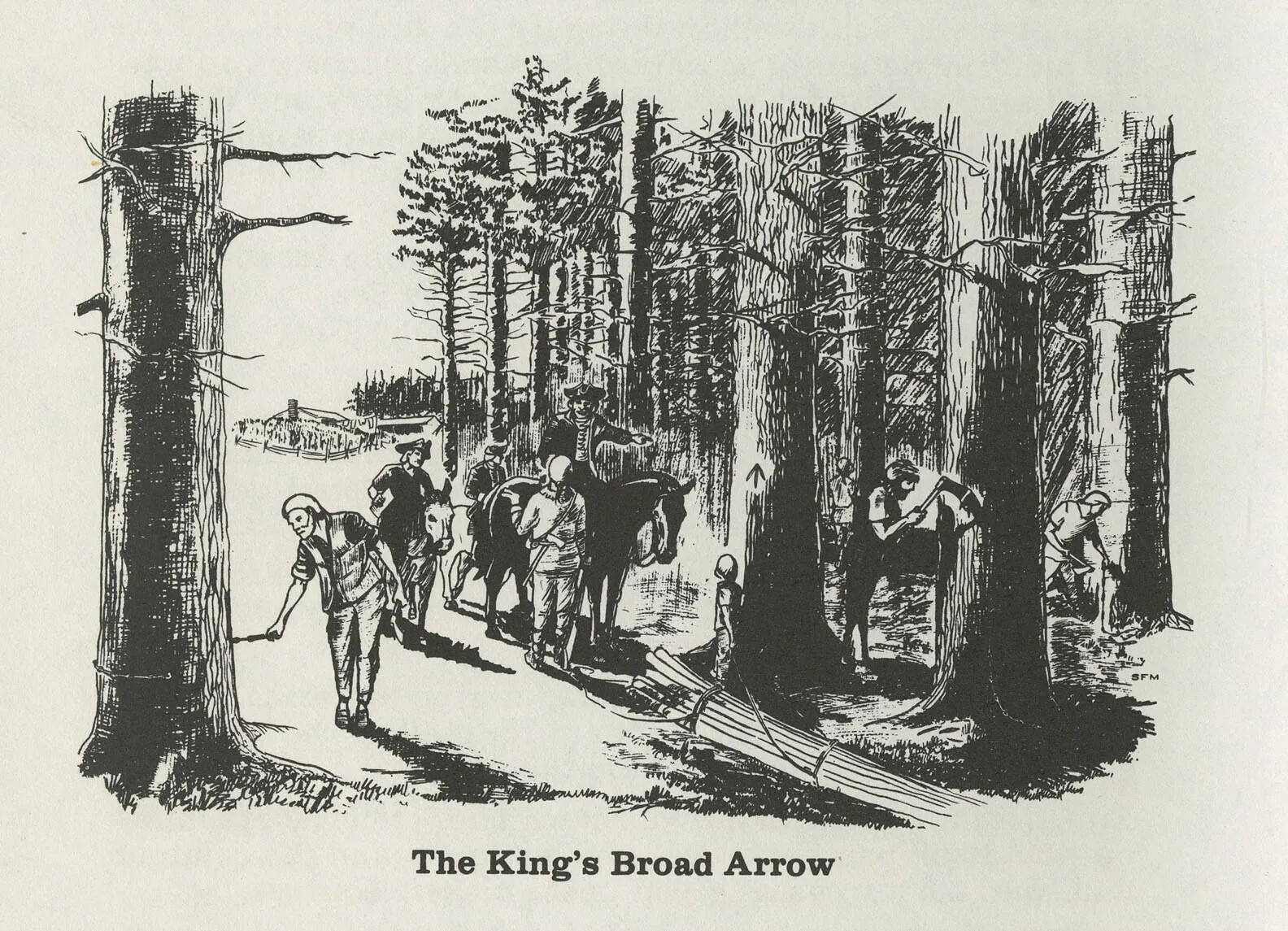
A black and white drawing of several men, five standing and three on horseback, in a forested area. Three of the standing men are in front of trees with axes. On the center most tree is a carving of an arrow, with two diagonal lines met by a center, vertical line.
King's Broad Arrow
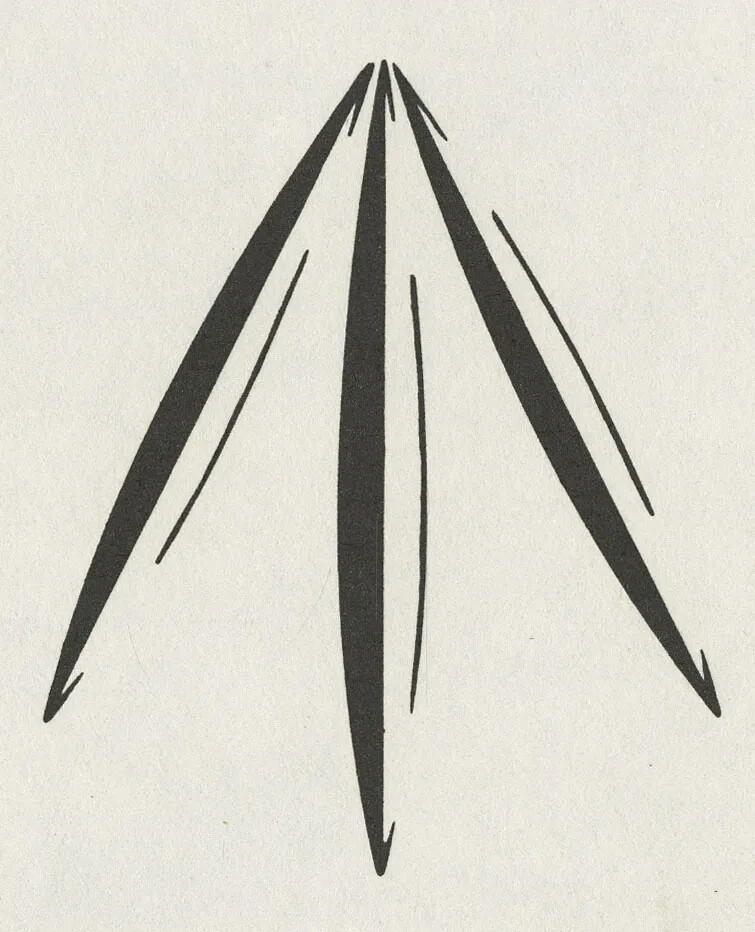
A black and white drawing of an arrow, with two diagonal lines met by a center, vertical line.
King's Broad Arrow Mark
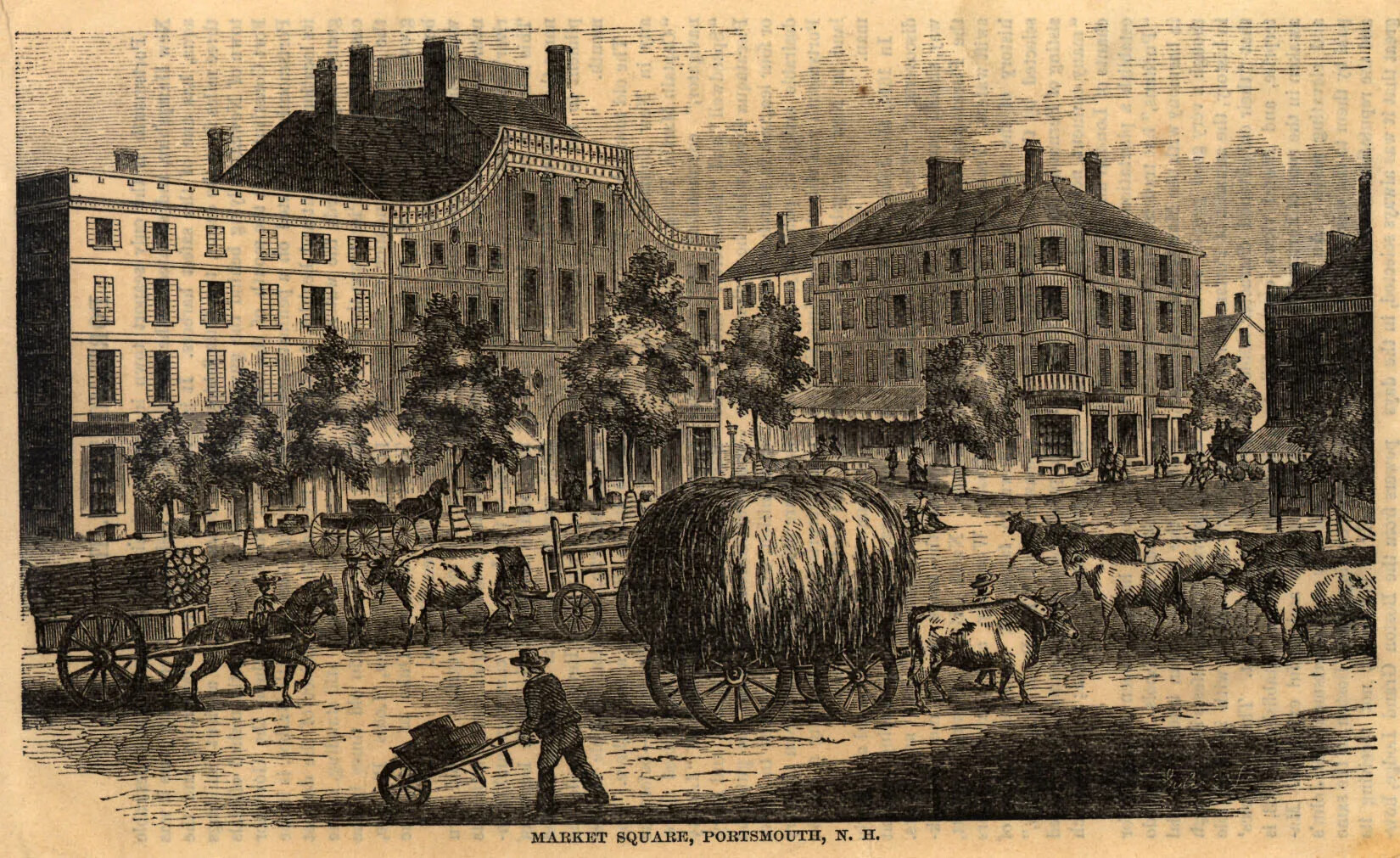
A yellowed piece of paper with a black and white sketch. The sketch shows two buildings, each four-stories tall, with one building facing the street in the foreground, and one positioned along the side street to the right. The streets and sidewalks in front of the buildings are lined with trees, and a few people are walking along them. The street in the foreground, from left to right, contains a horse-drawn carriage pulling logs, a man pushing a wheelbarrow, two sets of cattle pulling carts of hay, and various cattle roaming free. Typed text to the left of the sketch, along the border, reads “Portsmouth, N. H./415”.
Market Square, Portsmouth
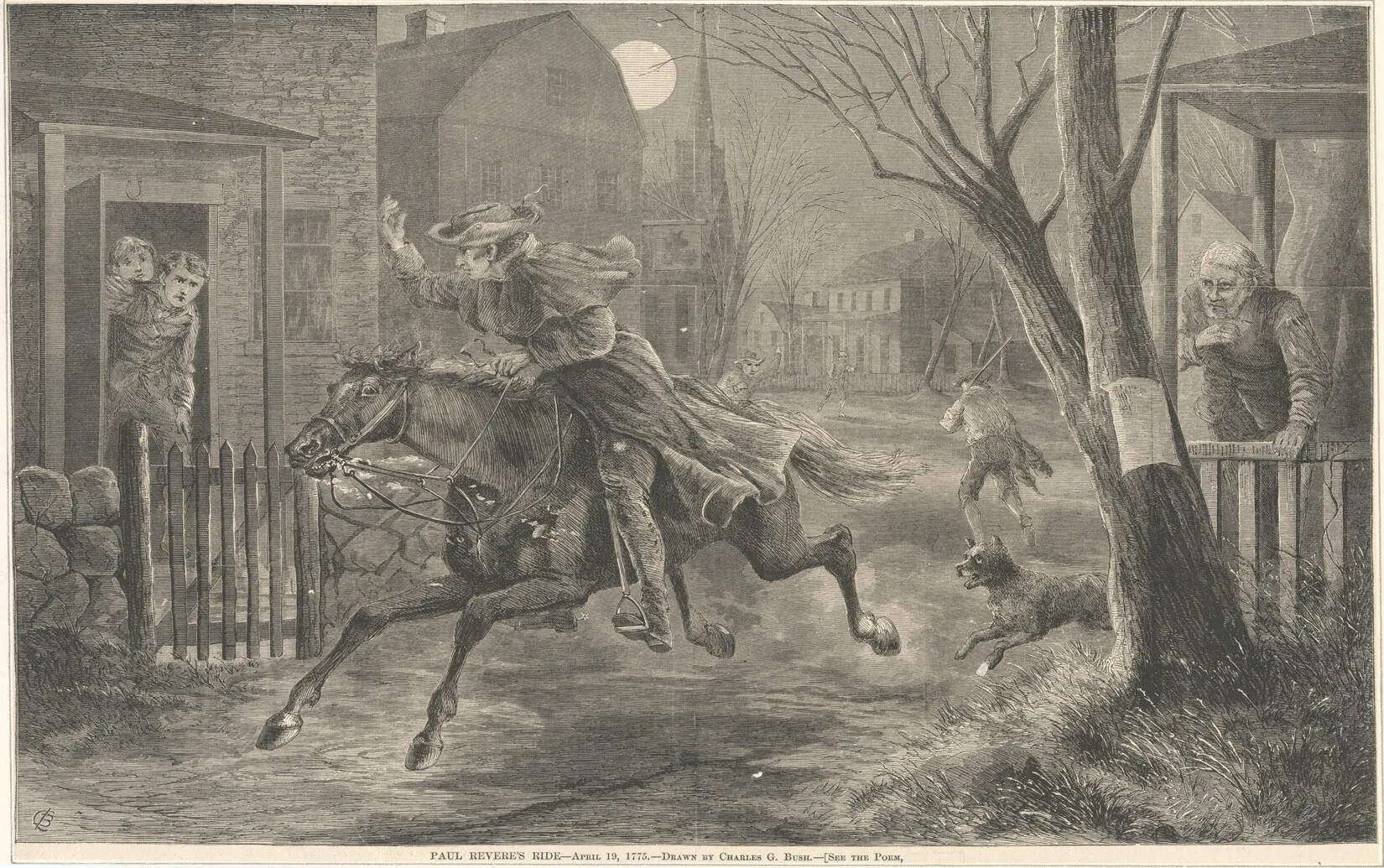
A black and white drawing of a man on a running horse, traveling through a lane lined with two-and three-storied houses. He has his left arm raised, and looks at two people who peer out at him from their home on the left side of the drawing. A man on the right side of the drawing looks at the rider as well. In the background, a dog chases the horse, and two man stand in the street, one with his back to the viewer, while the other looks over his right shoulder to look at the rider. The drawing's title, located along the bottom border of the drawing, reads: "PAUL REVERE'S RIDE-April 19, 1775-DRAWN BY CHARLES G. BUSH-{SEE THE POEM,".
Paul Revere's Ride
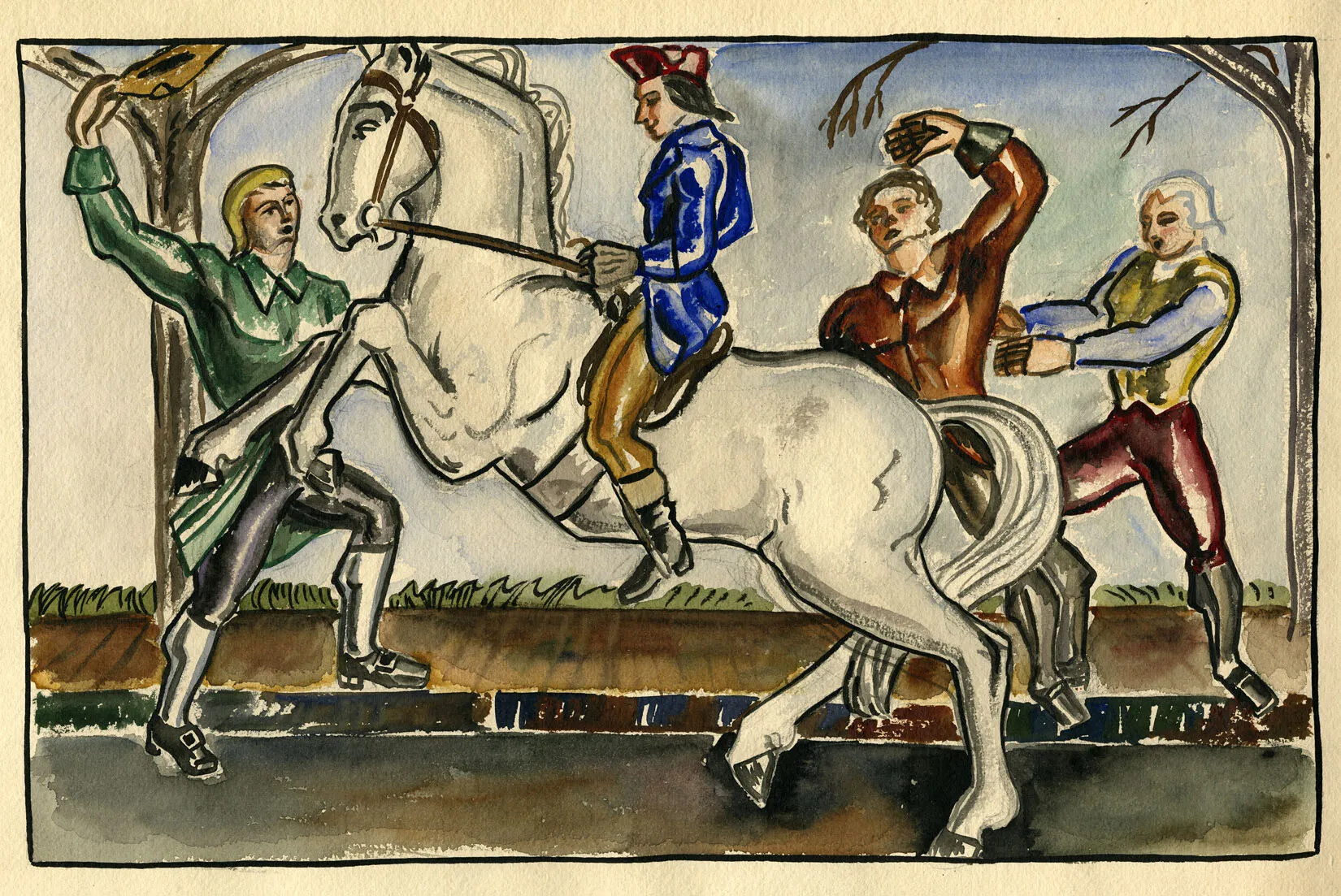
A colored drawing of four men on a road. Moving from left to right is a man in a green coat, waving his brown hat in the air with his left arm, a man in a blue coat riding a white horse, a man in a brown coat with his right arm raised, and a man in a blue shirt and yellow vest reaching towards the man in brown. The horse is balancing on its two back feet, and has its two front feet raised in the air.
Paul Revere's Ride to Portsmouth
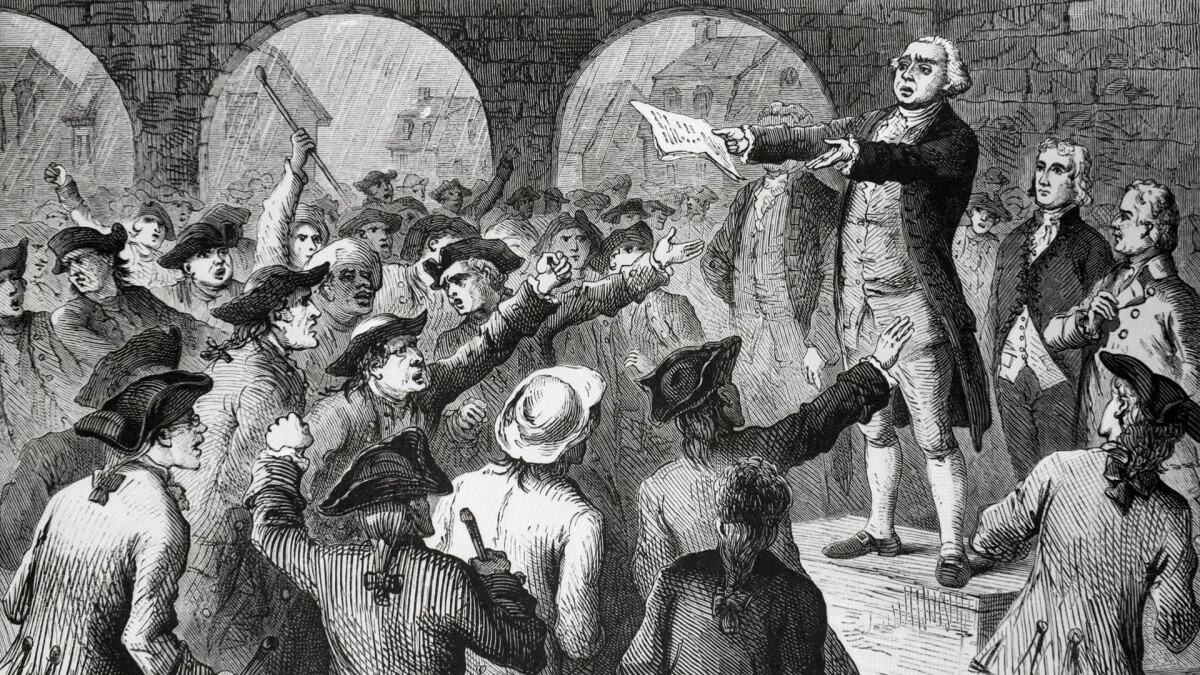
A black and white drawing of a group of men in long coats and tri-corner hats looking at a man standing on a raised platform. The man on the platform has his arms raised out towards the group of men and a document in his left hand. He wears a long coat, a vest, knee-length pants, and shoes with large buckles. The group of men below him gesture angerly towards him.
Sons of Liberty Meeting
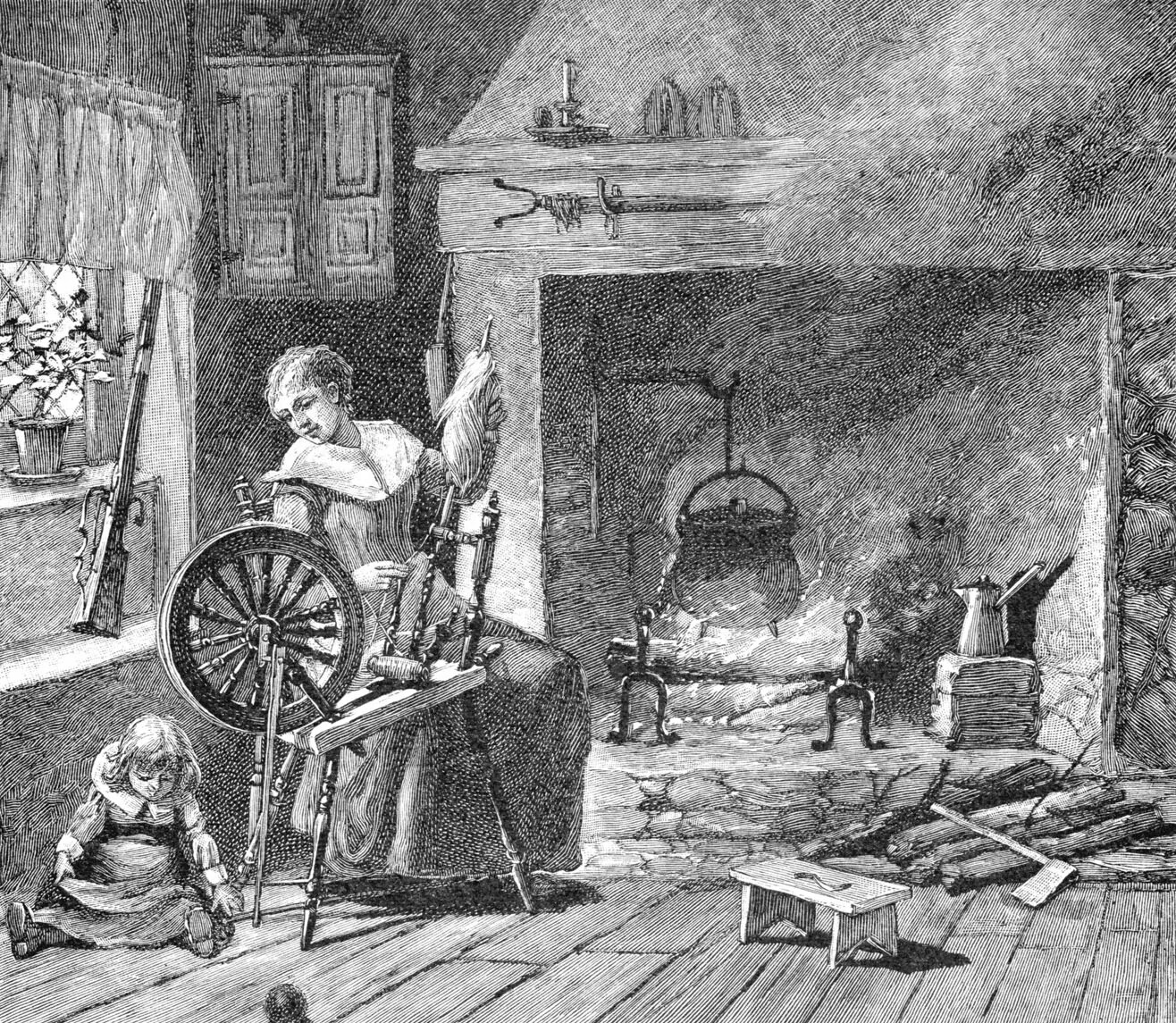
A black and white drawing of the interior of a house. On the left side of the drawing, a woman sits behind a tall table with a large wheel attached to it, looking at a small child playing on the floor. To the right of the woman is a large fireplace, with a large pot hung over a fire. On the ground in front of the fireplace is a pile of small pieces of wood and a small stool.
Spinning in the Colonial Kitchen
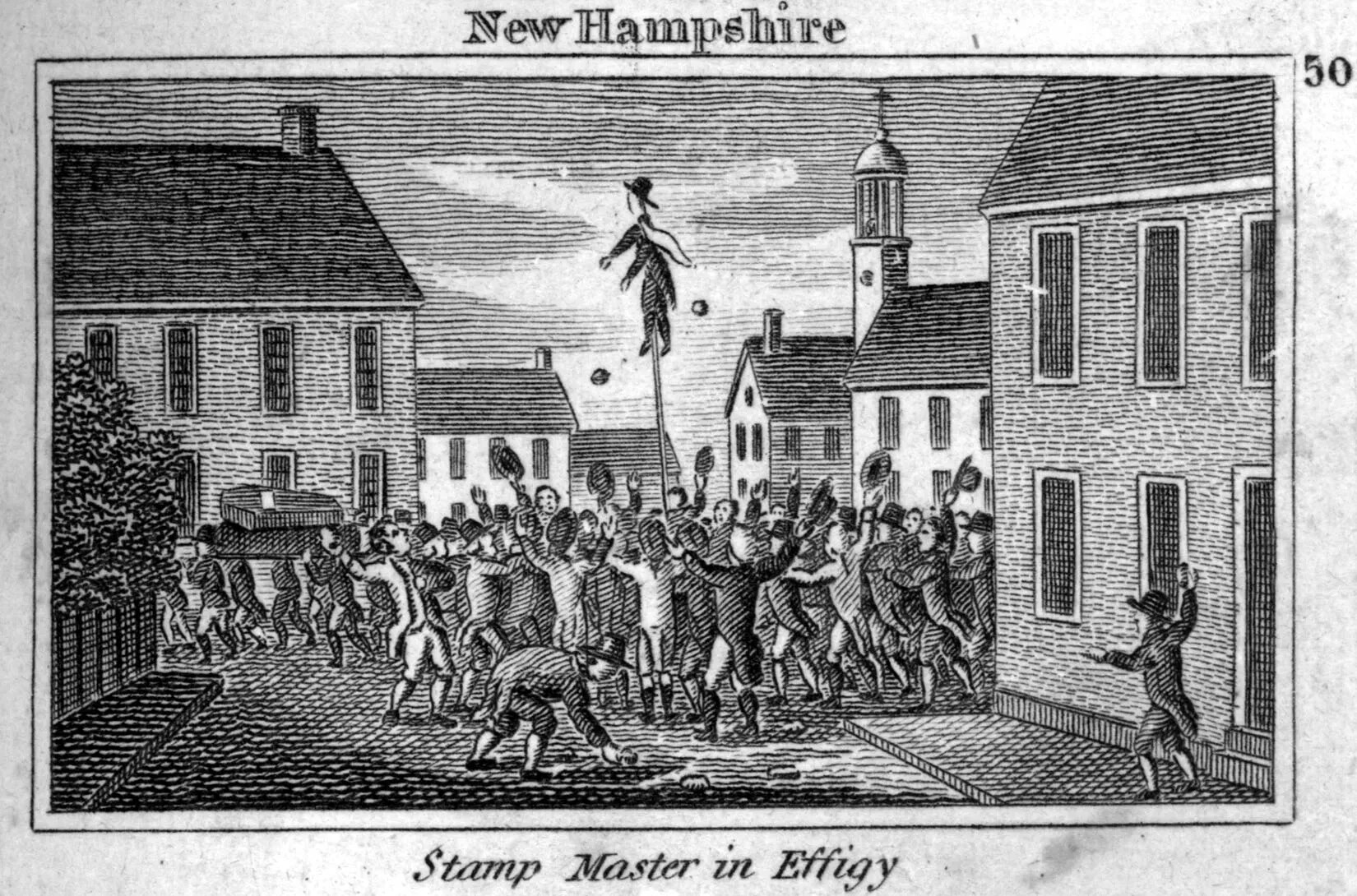
An engraving shows a town square bordered with two story colonial houses. In the center of the square is a crowd of people gathered, facing inwards, most with their arms up. Some hold hats in their upstretched hands. In the center of the crowd is a likeness of a person up on a stick above people's heads. There are two circular items up in the air near the figure. One person in front is bending down, perhaps to pick something up. About five figures to the left and in the background are carrying a large box on their shoulders. Above the engraving are the words "New Hampshire," and below it says "Stamp Master in Effigy."
Stamp Act Protest
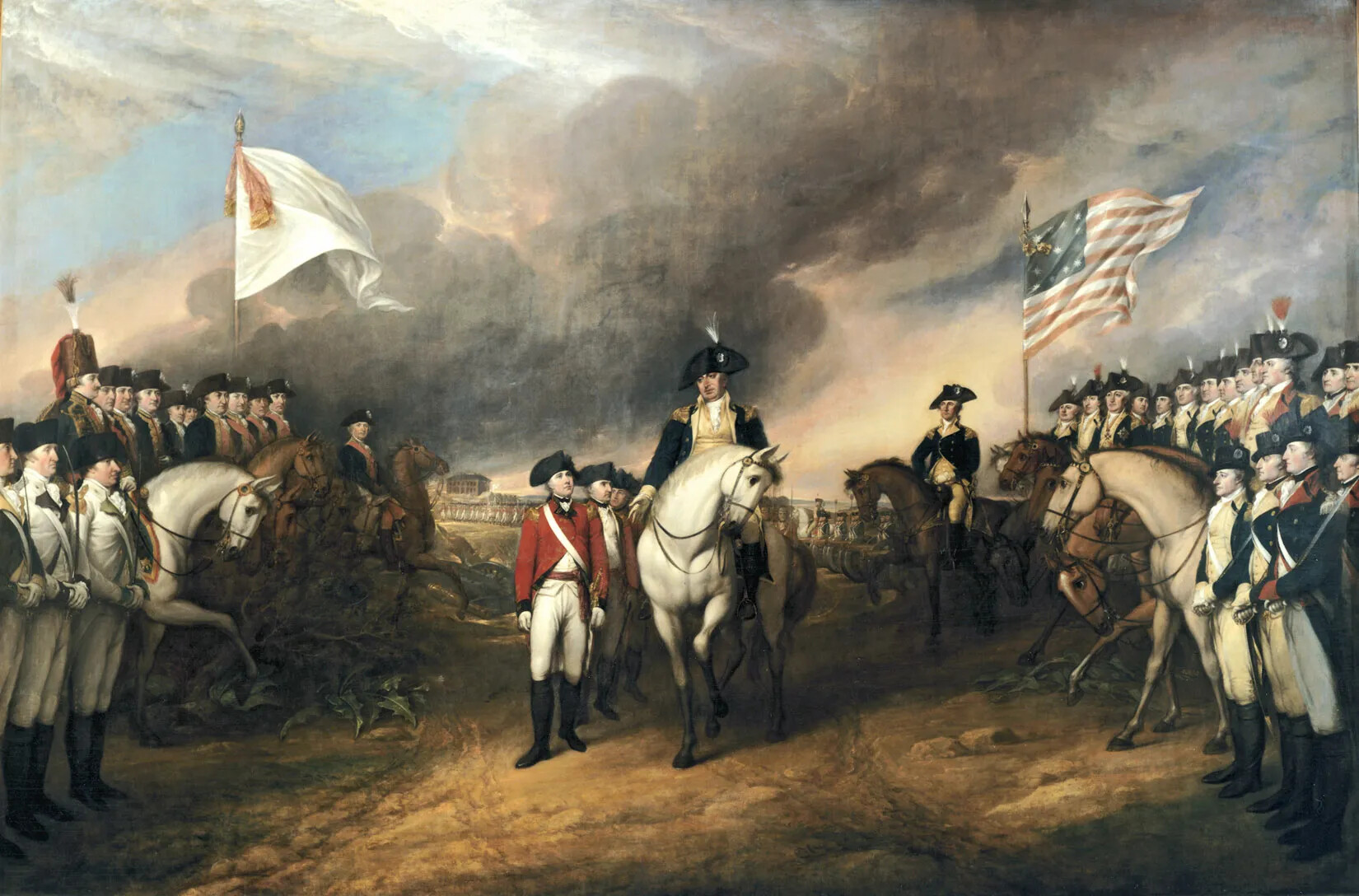
A colored painting of a man riding a white horse, as he rides through a path lined with men, either standing and on horse-back, who are all dressed in tri-corner hats, long blue coats, white pants, and tall black boots. The man on the horse also wears this outfit. Three men wearing red coats and white pants walk in a line next to the man on the white horse at the center of the painting. A flag with white and red stripes and a blue square in its upper left-hand corner flies above the men standing on the right side of the painting and a white flag with a red sash flies above the men standing on the left side of the painting.
Surrender of Lord Cornwallis
The Dawn of Liberty
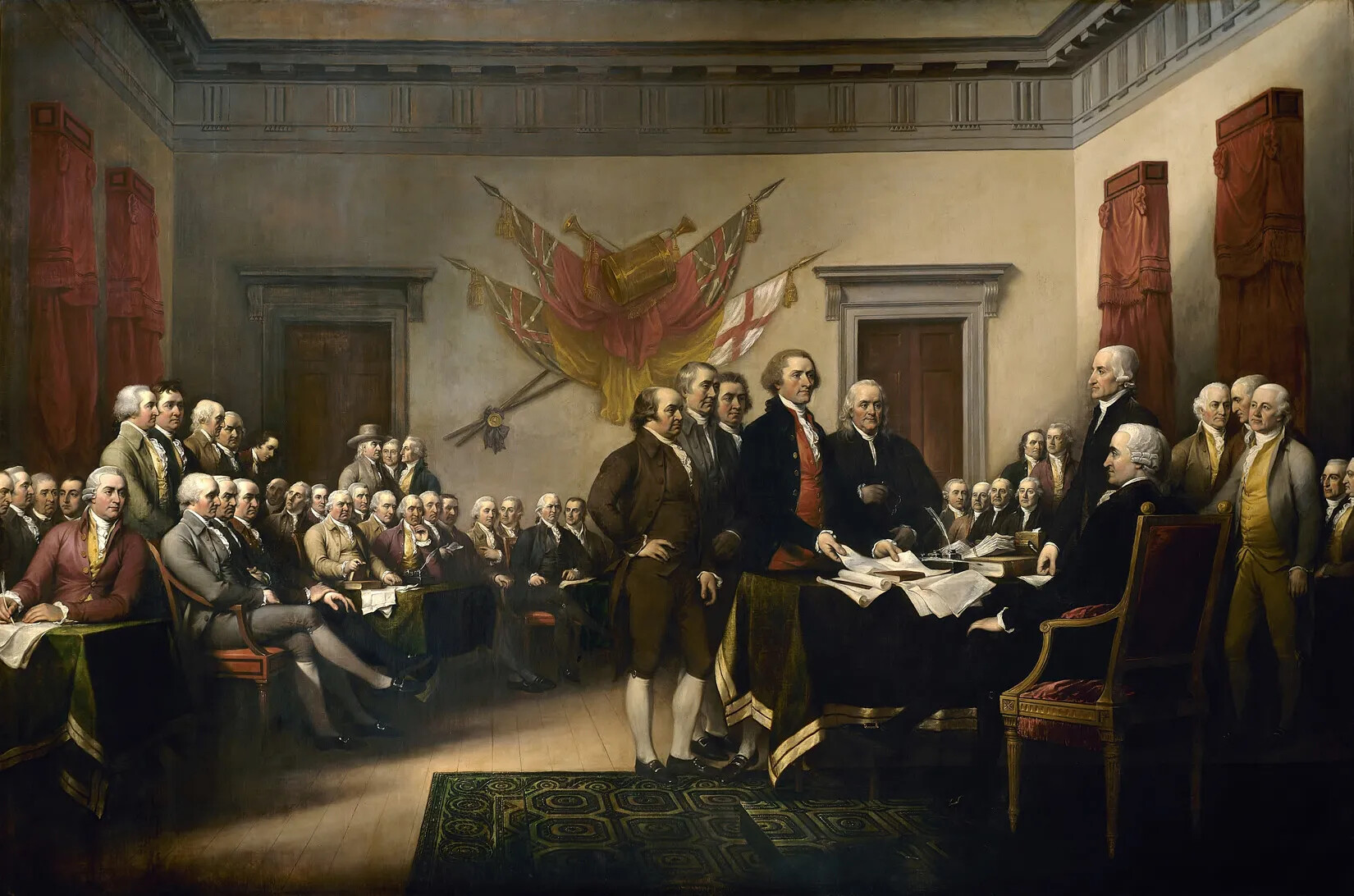
A colored painting of a group of men standing on a set of stairs, looking at a man with red hair, a yellow coat and knee-length pants, and a light-orange vest. He stands on the right side of the painting, and holds a document in his hands. The other men in the painting all wear different colored coats or capes, vests, knee-length pants, and black shoes.
The Declaration of Independence
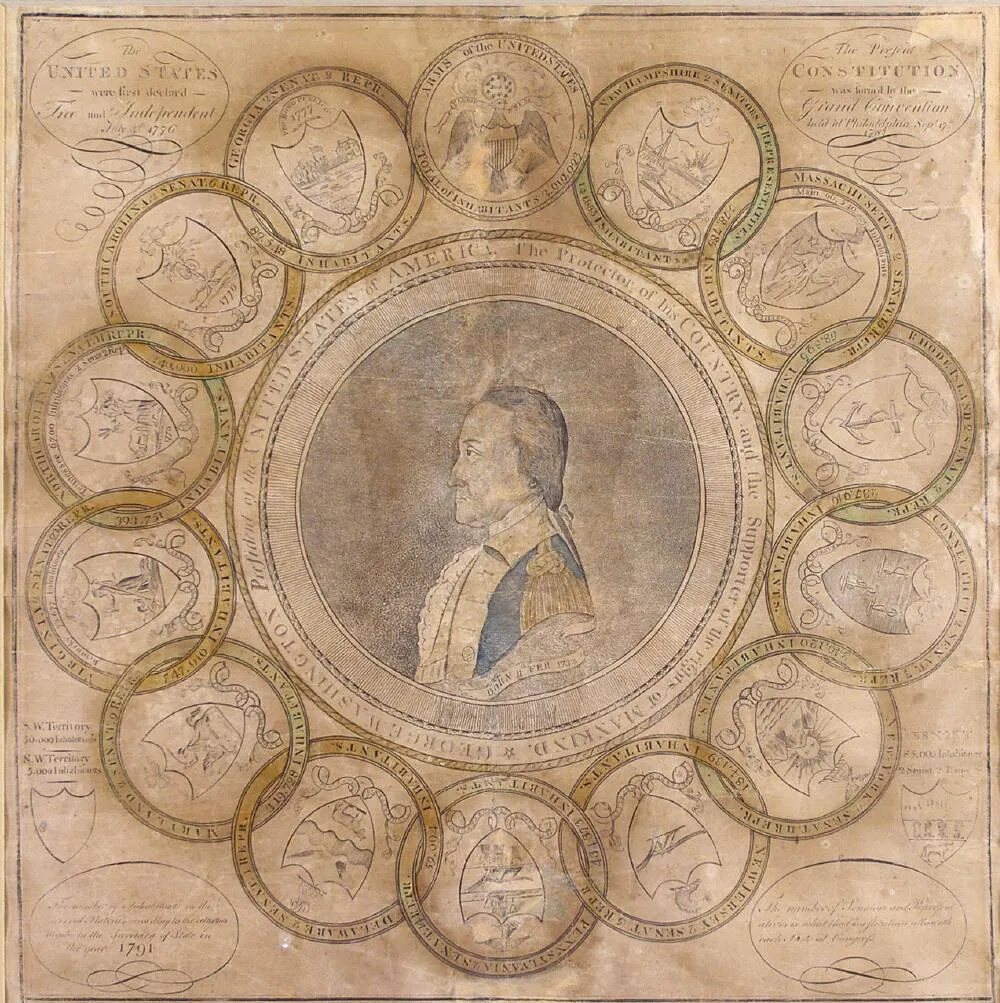
A colored drawing of a man facing to the left in the center of a large circle. Surrounding this circle are 14 smaller circles intertwined with one another. Inside the smaller circle at the top of the page is a bird with its wings held out on either side. The other 13 circles contain crests with different symbols on them.
United States of America
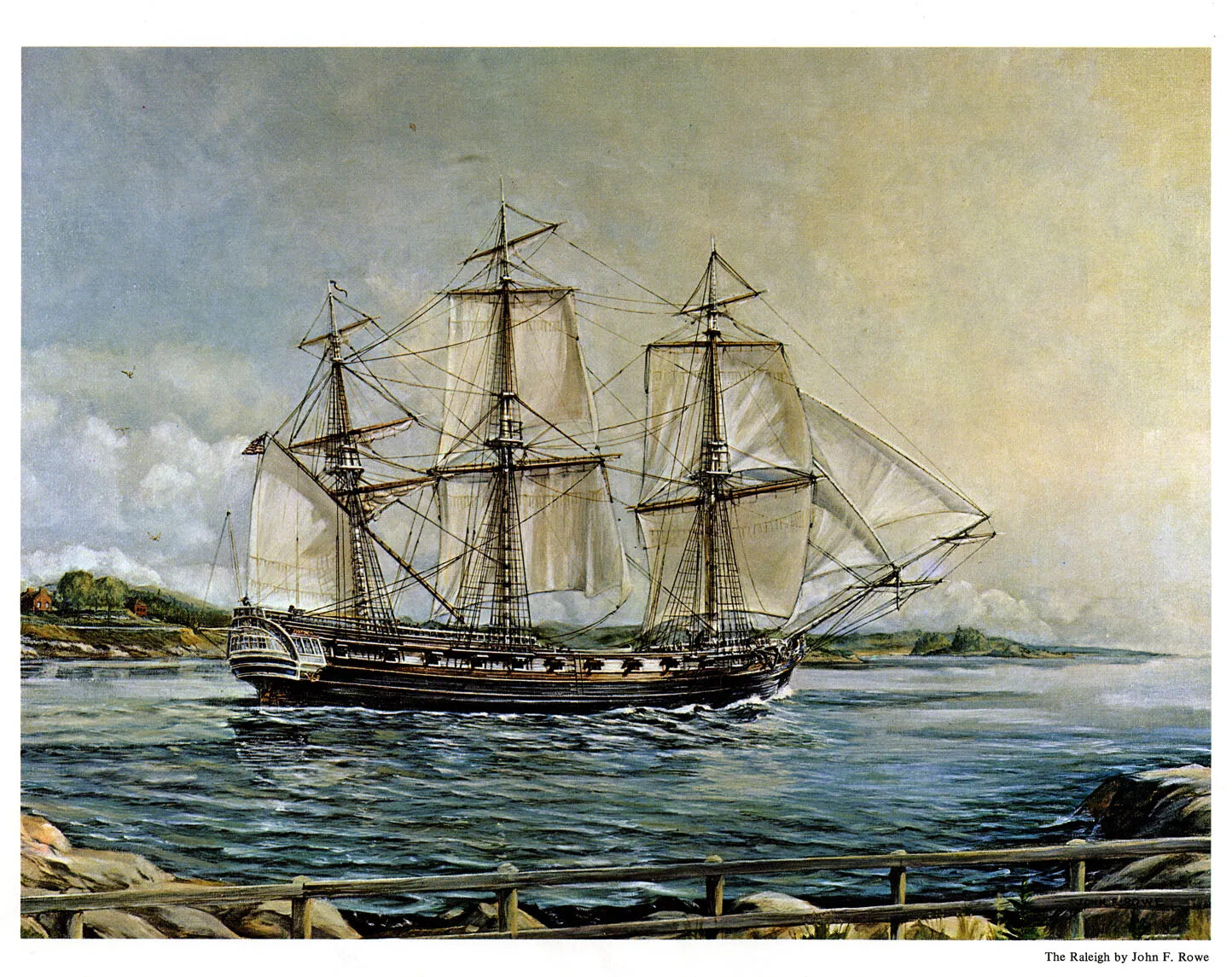
A colored painting of a large ship with three masts and seven open sails sailing on a body of water.
USS Raleigh
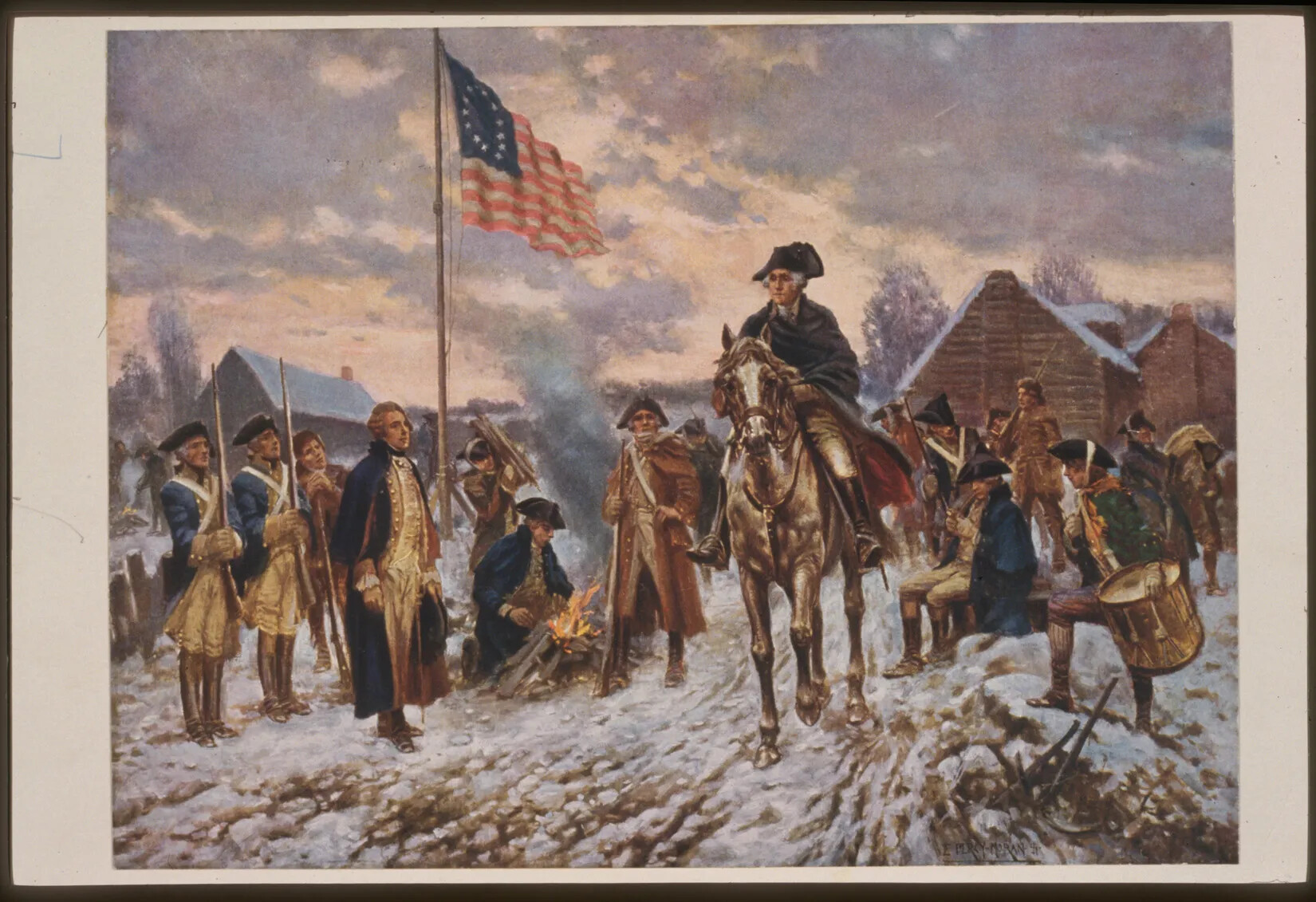
A colored painting of a man riding a brown horse, as he rides through a path lined with men dressed in tri-corner hats, long blue coats, white pants, and tall black boots. The man on the horse also wears this outfit. To the left of the man on the horse is a raised flag on a pole, with red and white stripes and a square of blue in the top right-hand corner. The blue square has a circle of white stars on it. Behind the group are several one-storied buildings.
Washington at Valley Forge