





Secret Found...
Color Mason The Moose!

CLOSE
CLOSE

GAME SETTINGS game settings icon

Mason with a top hat.

Timeline of Events

Mason’s Fun Fact! Did you know that Londonderry, New Hampshire, claims to be home to the first potato planted in North America? See if you can find it on the Timeline!

Timelines help you organize historical events so you can see how they relate to one another. They are usually organized chronologically, which means in date order. The timeline below is separated into two parts: New Hampshire events and events happening elsewhere in America and sometimes the world. An event on one side of the timeline might influence an event on the other side in the same way that New Hampshire is influenced by events in America and the world. You can also see how the Granite State has made a big impact on America.

NEW HAMPSHIRE EVENTS

U.S. & WORLD EVENTS

Click the Green Button to expand every event on the timeline.

Click the Purple Buttons on the timeline to see all event details in that date range.

Circa 2.6 million years BCE
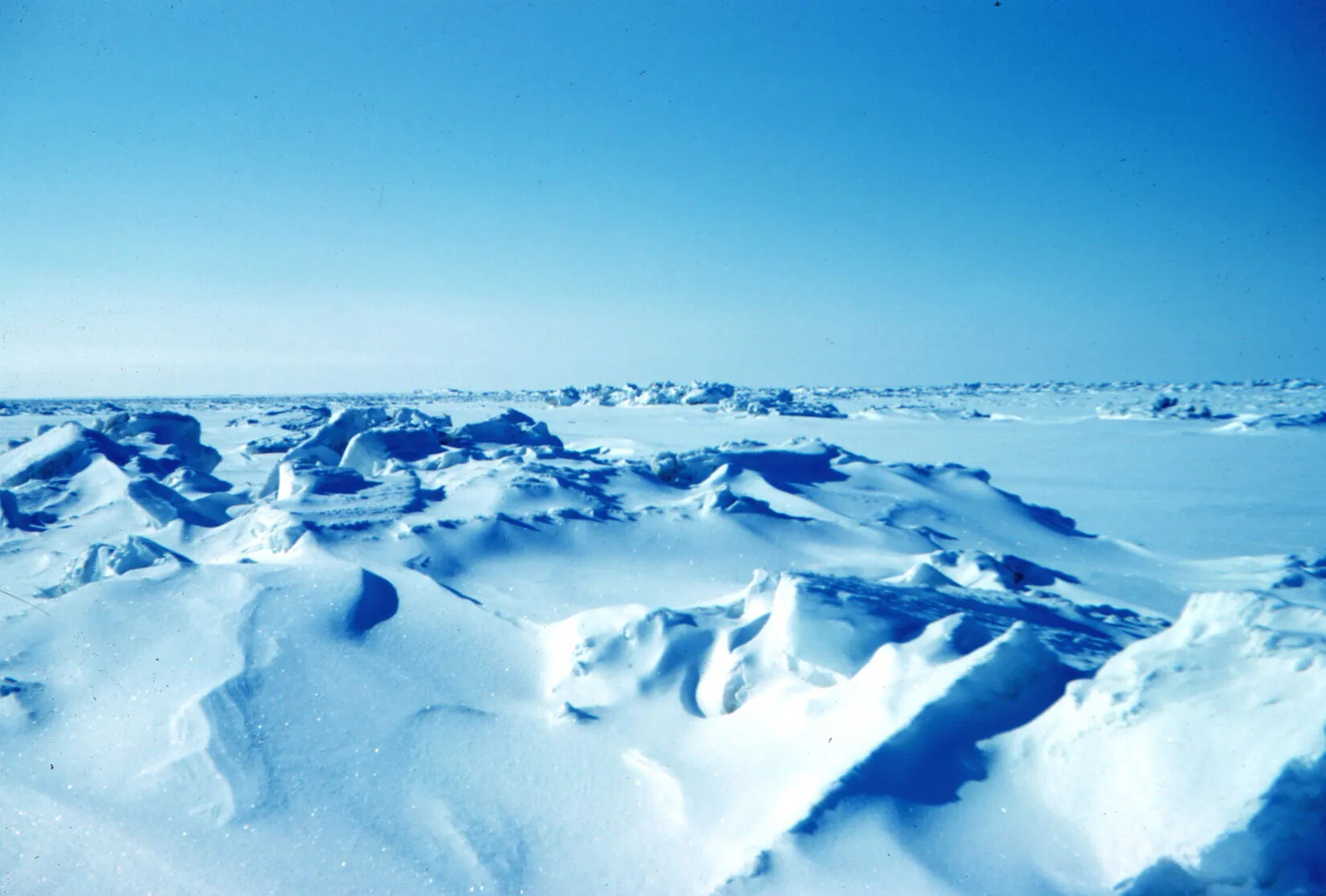
Ice Age in New Hampshire
A color photograph shows a wide open blue sky and ice and snow far into the distance. Some areas of snow and ice are flat and some have ice jutting up and making small hills.
Circa 14,000–1,000 BCE
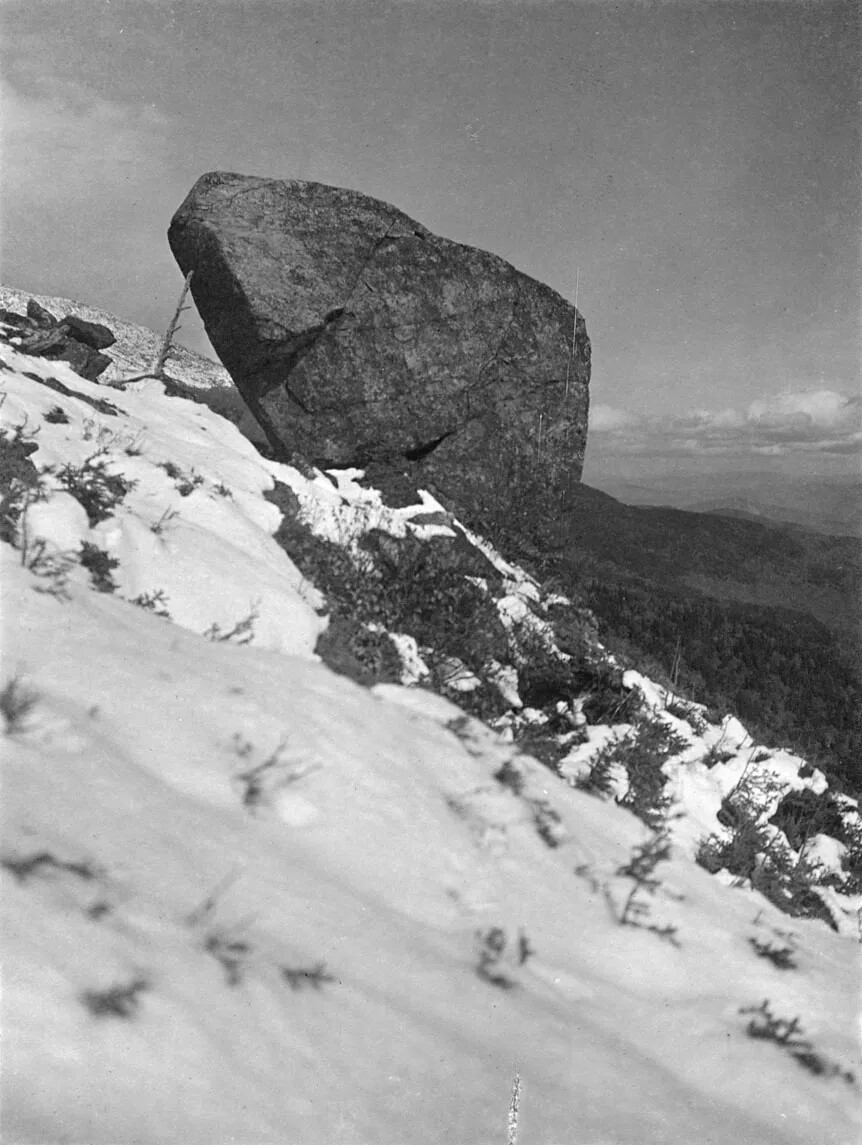
Glaciers melt in New Hampshire
On a snow-covered steep hill a large, irregularly-shaped boulder sits perched in this photograph.
Circa 10,000-8,000 BCE
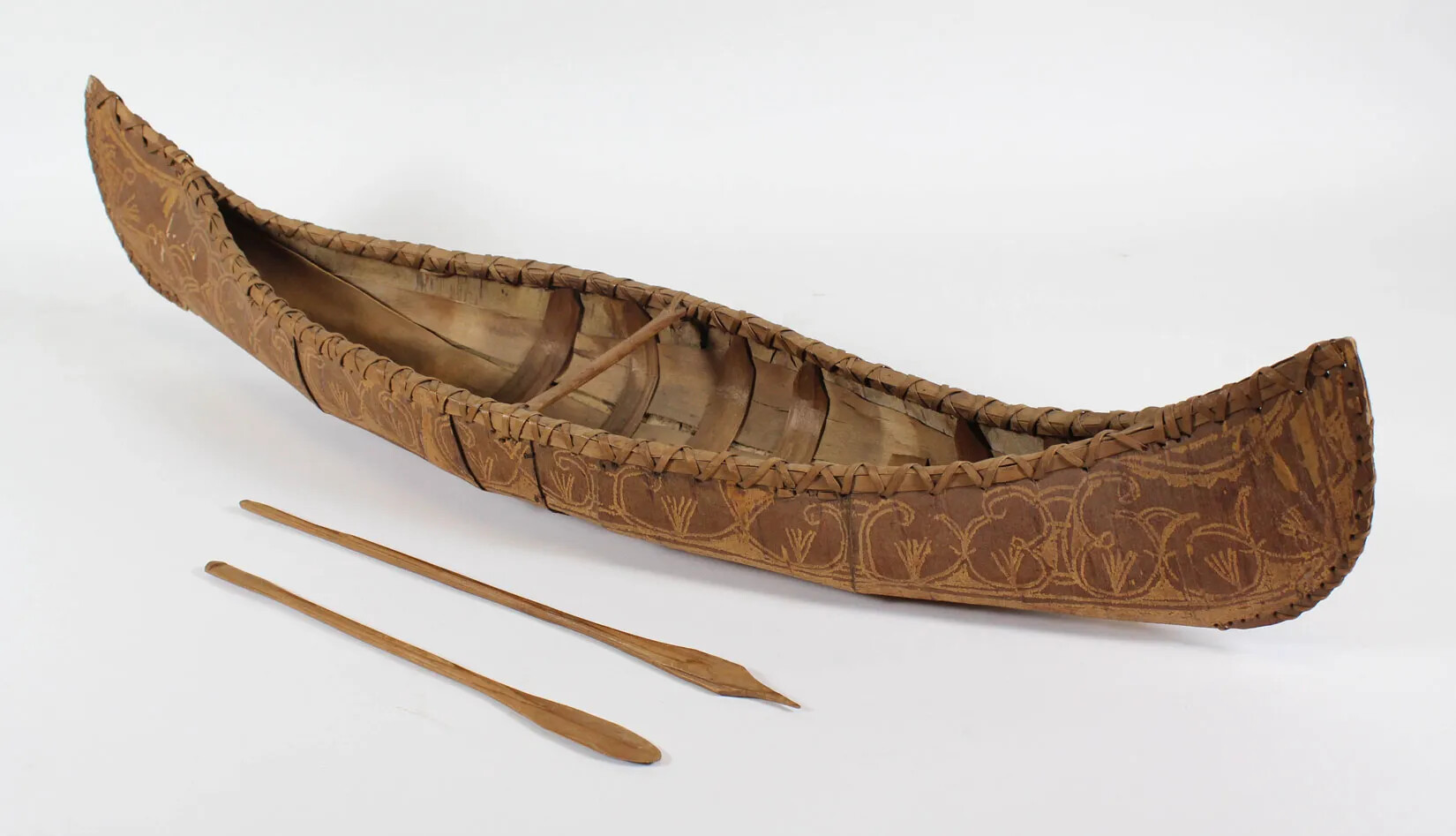
Abenaki settle in New Hampshire
A model of a birchbark canoe has brown birchbark on a wooden frame. There is one thwart in the center. Intricate double-curve designs are on the outside of the canoe. Two wooden paddles lie beside the canoe, one with a rounded blade and one with a pointed blade.
Circa 1,000 BCE
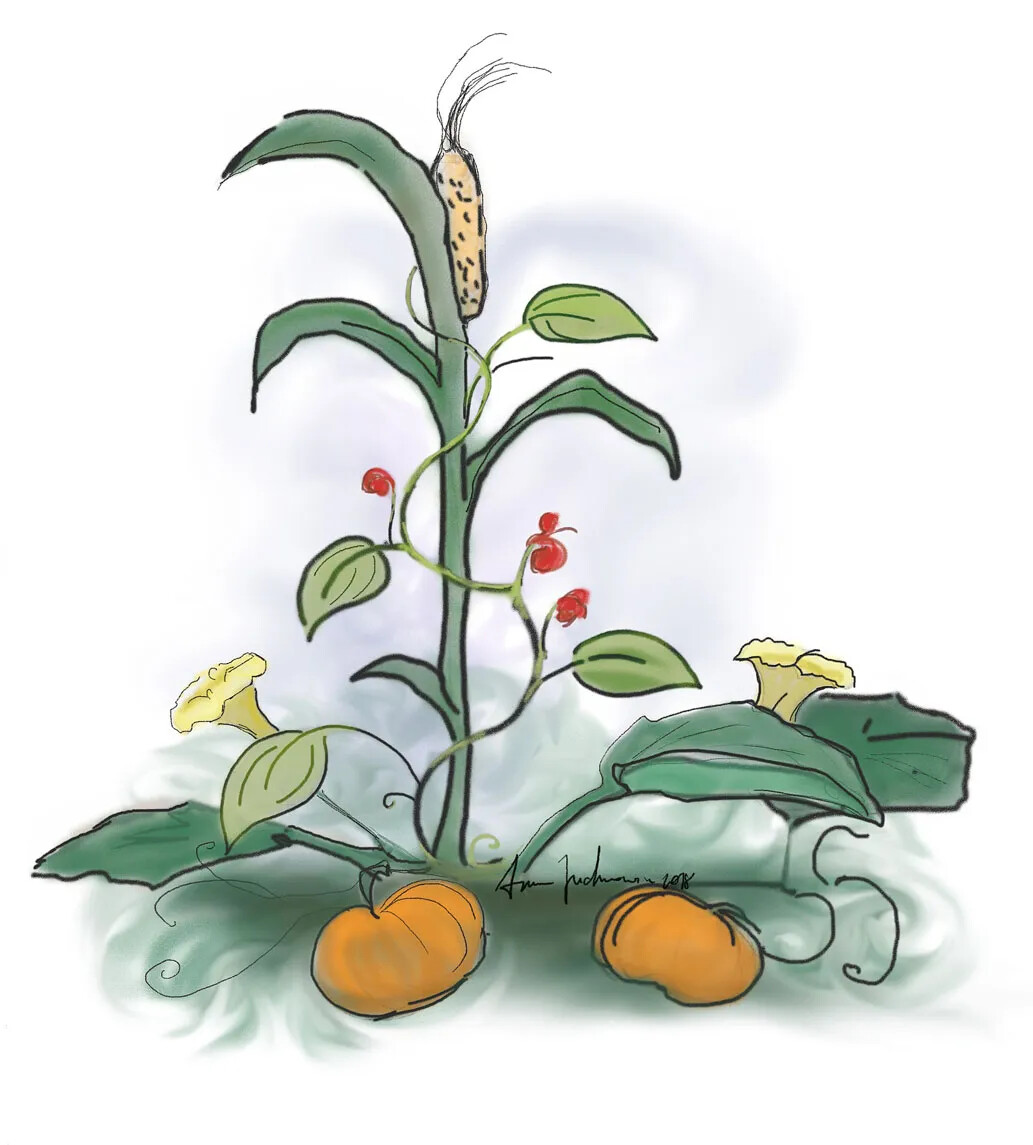
Abenaki develop agriculture
A colorful cartoon shows squash, corn, and beans planted together. The corn grows the tallest, and the bean plant climbs up, circling the corn stalk. The squash plant, with big leaves and flowers, grows along the ground under the two other plants.
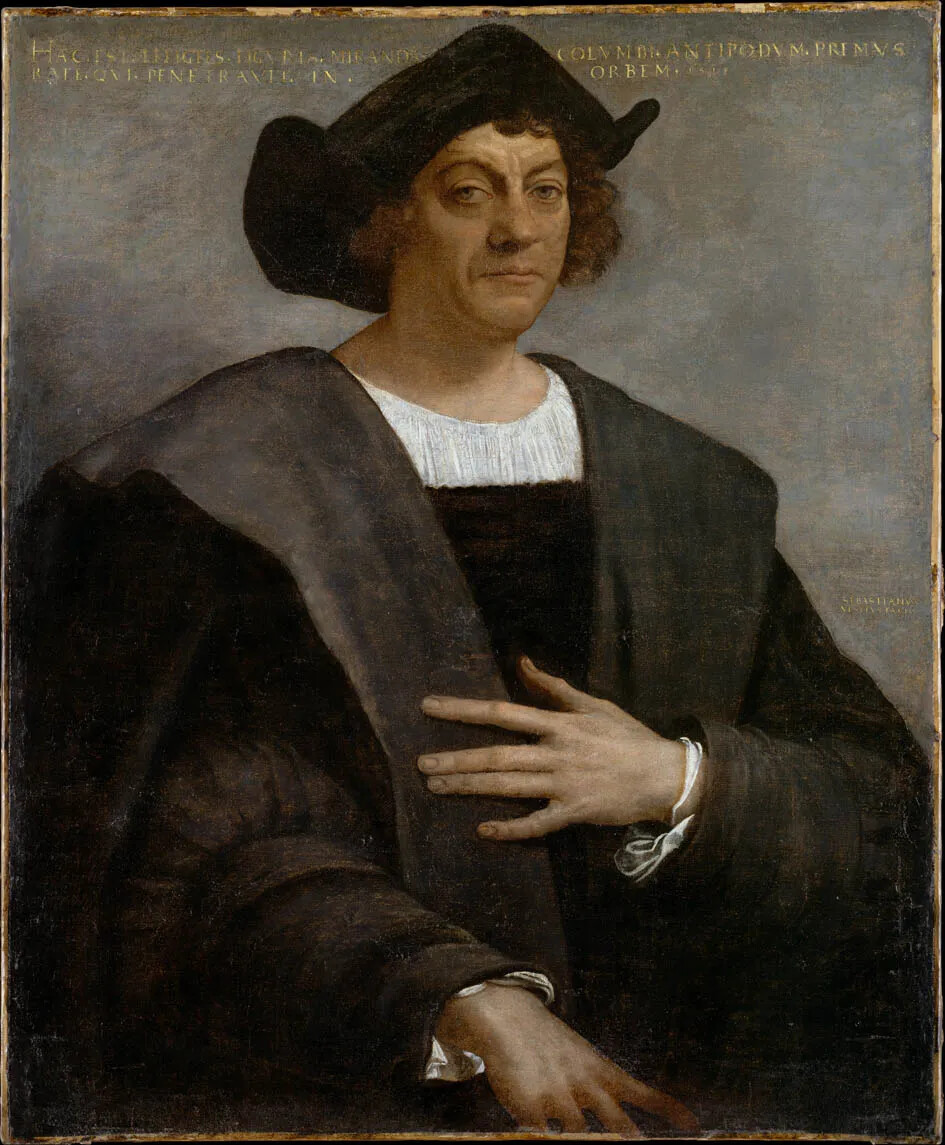
1492
Christopher Columbus reaches North America
Formal painting shows the torso and head of a man with a Middle Ages-style dark clothing and a formal hat. He has chin-length curly brown hair, is slightly frowning, and has one hand on his chest.
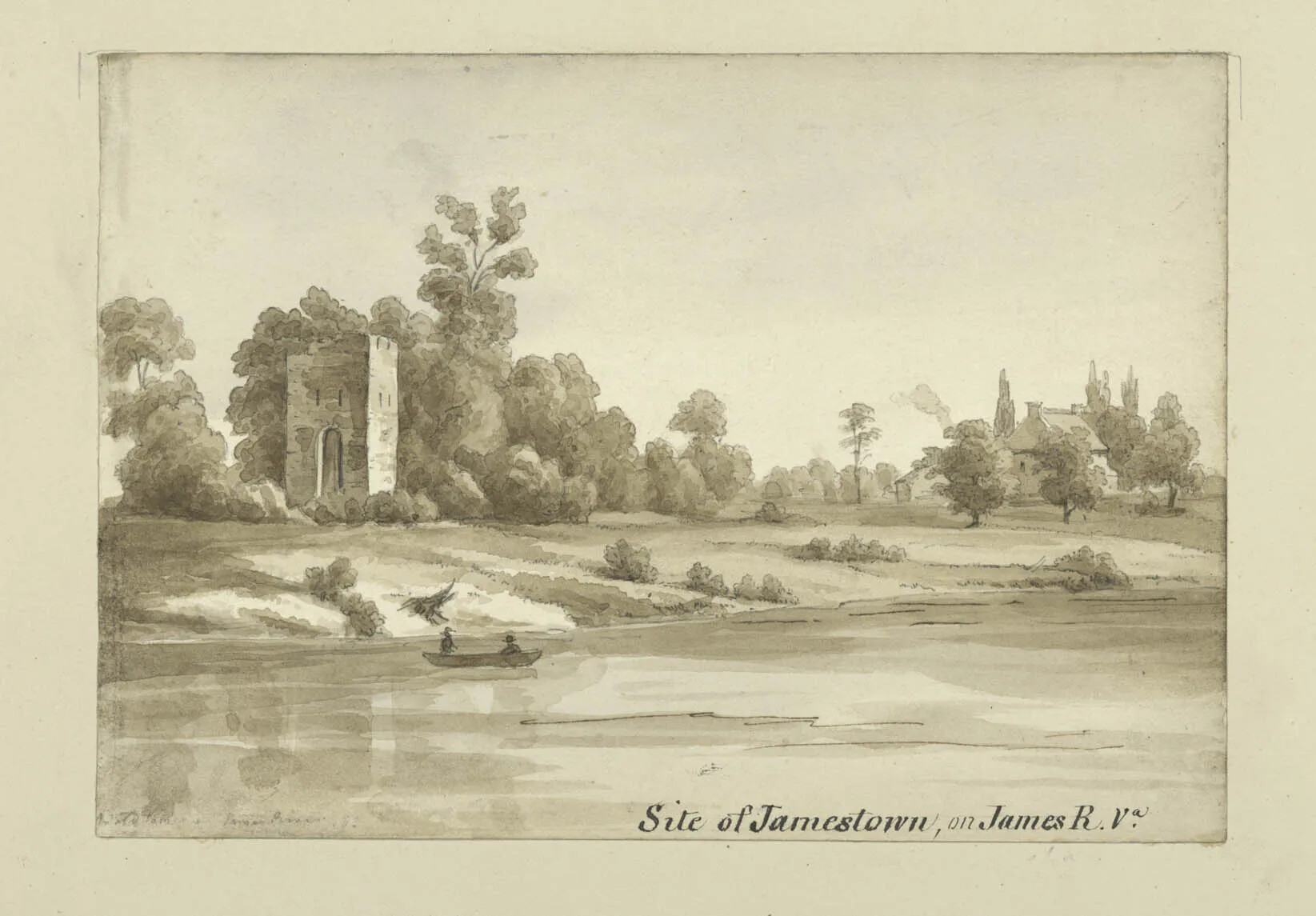
1607
Jamestown established
A black and white drawing of a river scene shows a canoe with two people on the river, and trees and grass lining the bank. There is a house in the distance hidden by trees, and a small stone tower closer. Text reads "Site of Jamestown, on James R.Va."
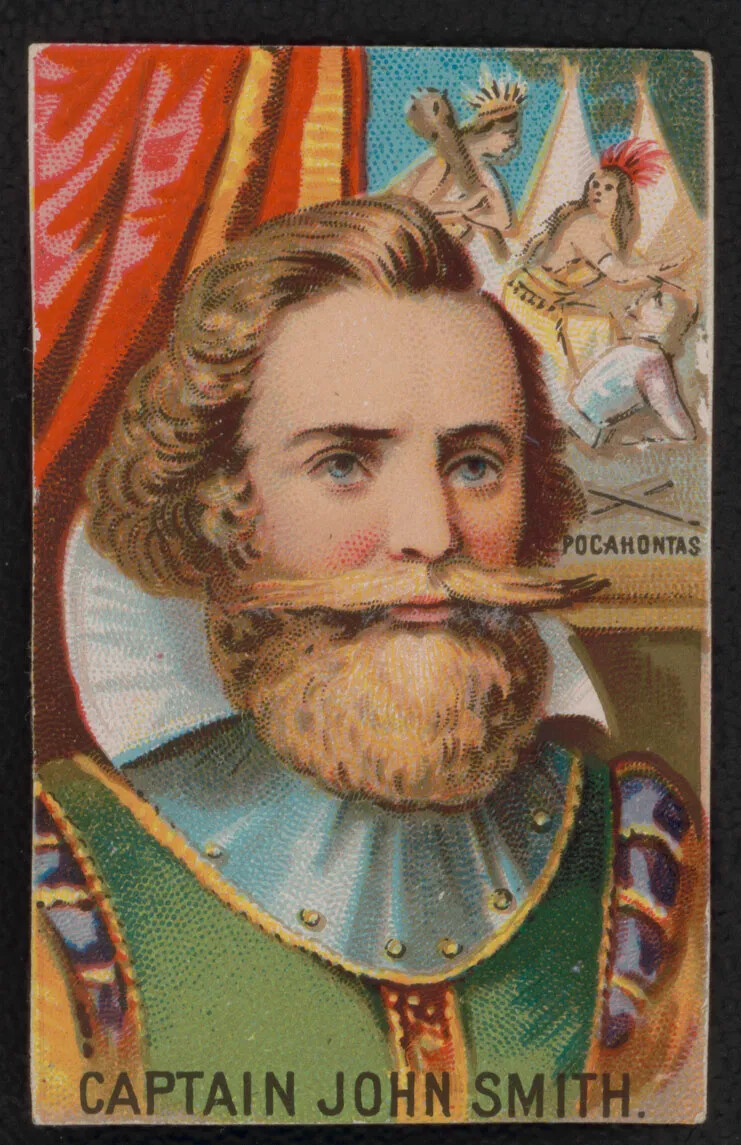
1614
John Smith lands at Isles of Shoals
A color drawing of a man shows his head and shoulders. He wears a decorative shirt with gold-threaded sleeves. He has a collar of armor, bordered with gold. His hair is brown and curly, as are his large beard and large, pointed mustache. Behind him on the left is a red curtain. On the right behind him, two figures with feather headdresses and leather-looking clothes are holding a person on her knees and threatening her. Under the person, who wears white, is the word "POCAHONTAS." At the bottom of the painting, it reads "CAPTAIN JOHN SMITH."
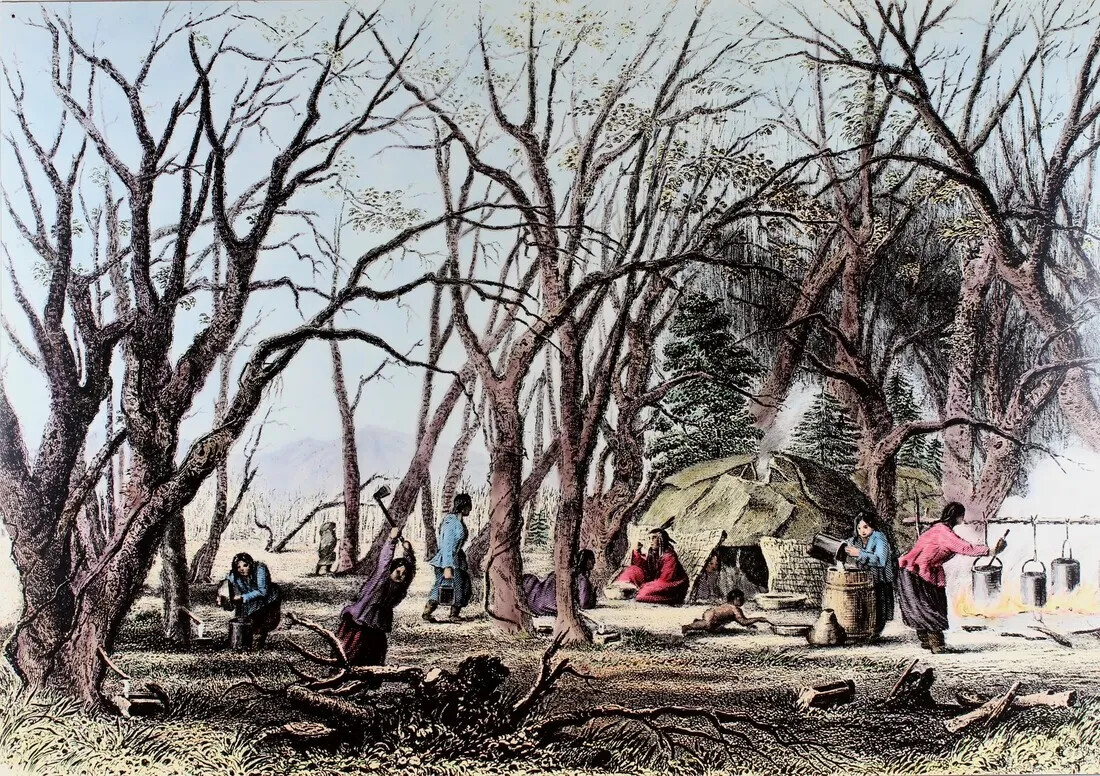
1616–1619
Disease strikes the Abenaki
An illustration shows a Native American camp under some trees. On the right, there is a fire with three large pots suspended over the flames. A person is tending it while another person pours something into a large barrel. A few people sit and stand in and outside of a wigwam next to the fire. The left side of the painting shows tress with few leaves and people working with them. The people are chopping, gathering, and kneeling near the trees.
1620
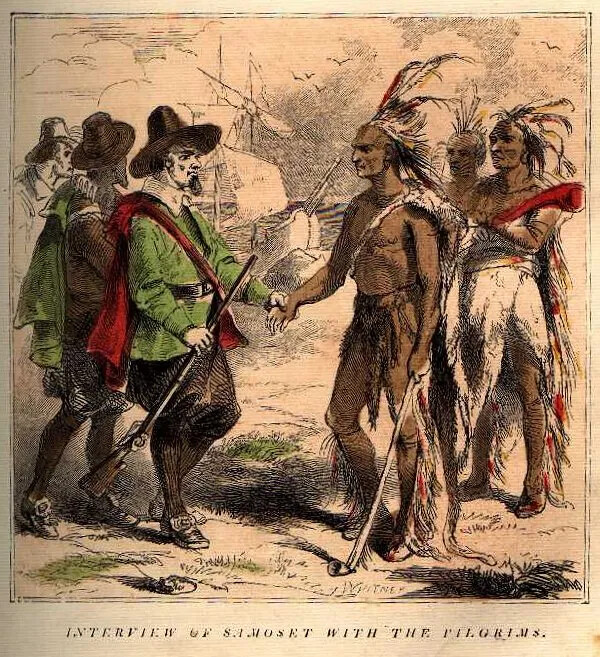
Pilgrims land at Plymouth
A drawing shows two groups of men in color, and, in the background, a two-masted ship in the water outlined in black and white. There are three men in the righthand ground, and they are dressed as traditional Native Americans. They have feather headdresses, clothing of animal skins covering parts of their bodies, and long horns. The three men on the left are dressed as traditional pilgrims. They have short, blousy pants, coats and cloaks, and black hats with wide brims all around. The man in front carries a rifle. The two men in front of each group are shaking hands. Under the picture, the words "Interview of Samoset with the pilgrims" appears.
1623
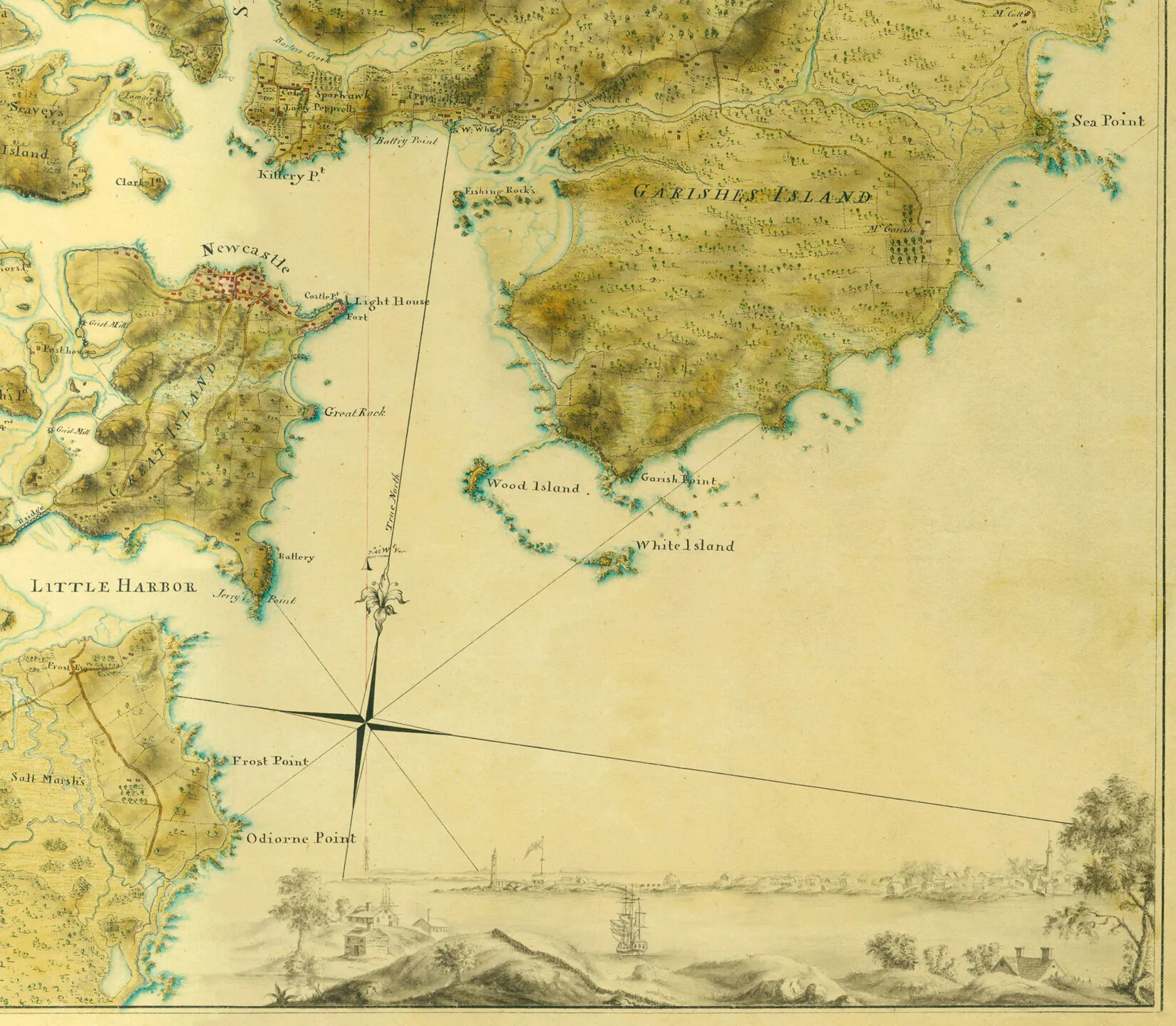
First English settlement in New Hampshire
A historic map is shown of islands, shoreline, and bays. The water is light yellow and the land is darker with grass and rivers indicated. A compass is in the middle of the map in the water. A few islands, bays, and settlements are marked on the map. On the bottom fifth of the map is a drawing of a settlement. It is on the coast and has houses, trees, and ships.
1629
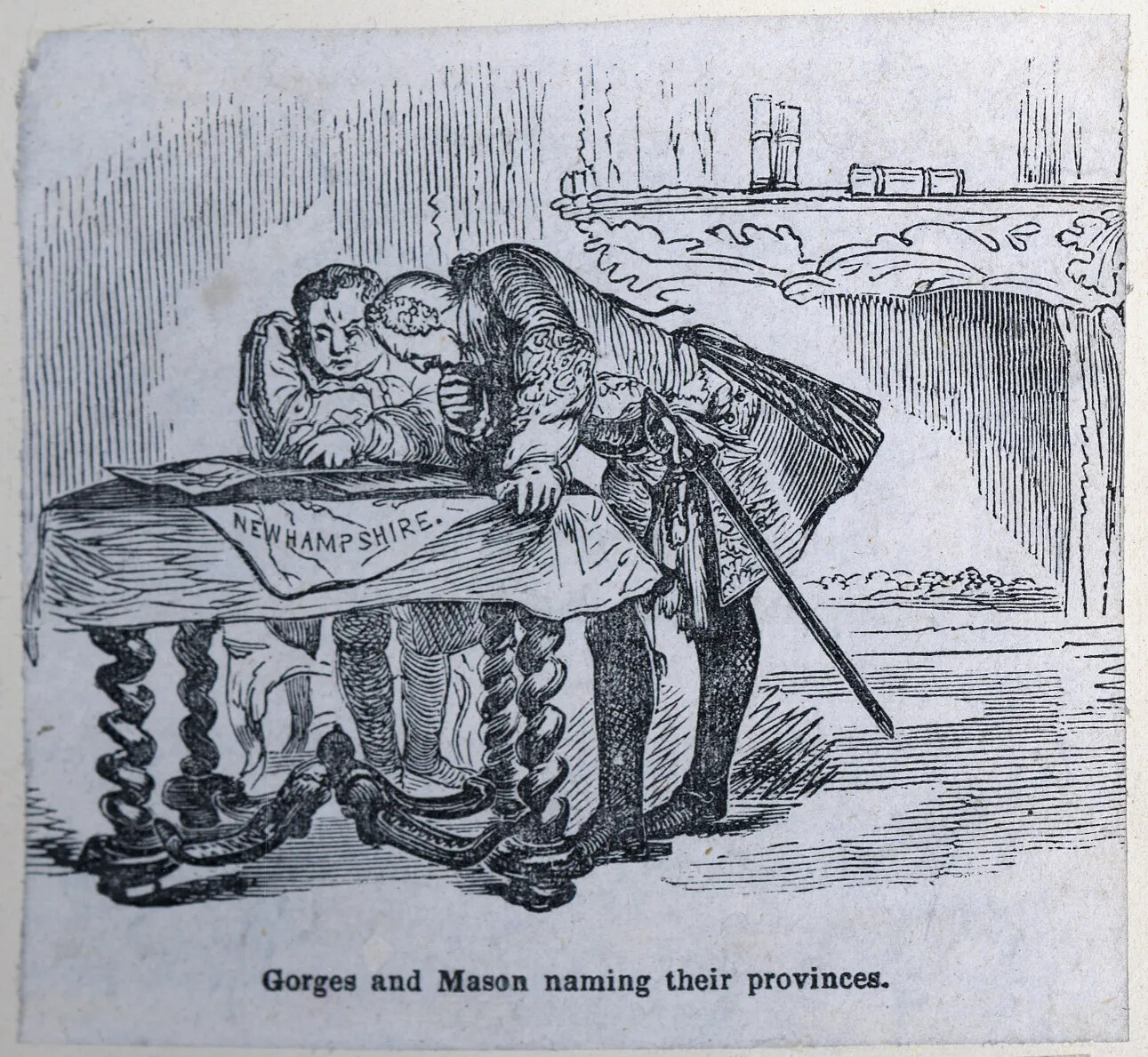
John Mason founds New Hampshire
In a black and white cartoon, two figures are seen bending over a desk, looking at a piece of paper. They are dressed in formal clothing from the 1600s, and one of them wears a sword. The table and mantle behind them are ornate. Over the tablecloth, a corner of the paper hangs and the viewer can see it says "NEW HAMPSHIRE." The caption reads "Gorges and Mason naming their provinces." 
1642
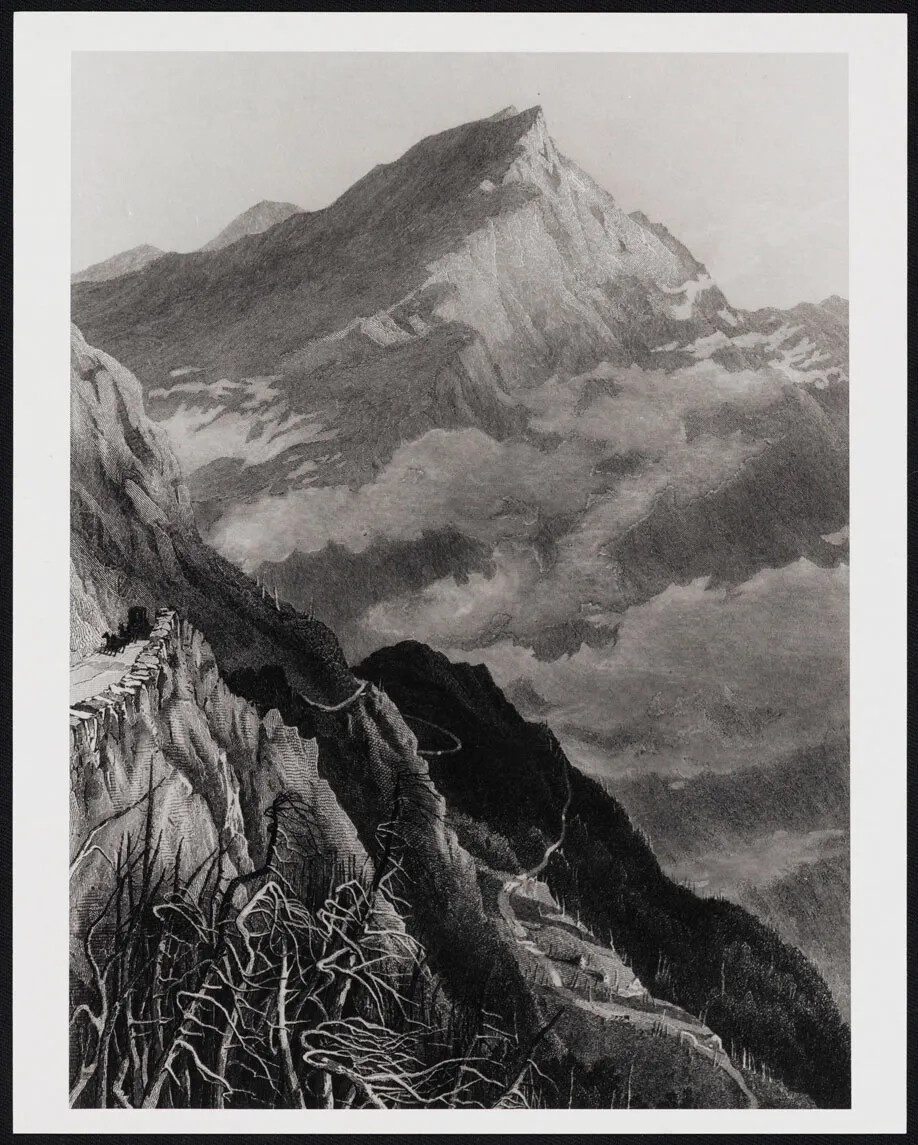
Darby Field ascends Mount Washington
A black and white photograph shows steep rocks rising to the left in the foreground. In the distance, a large mountain is seen, rising through clouds. The peak is rocky and bare.
1660
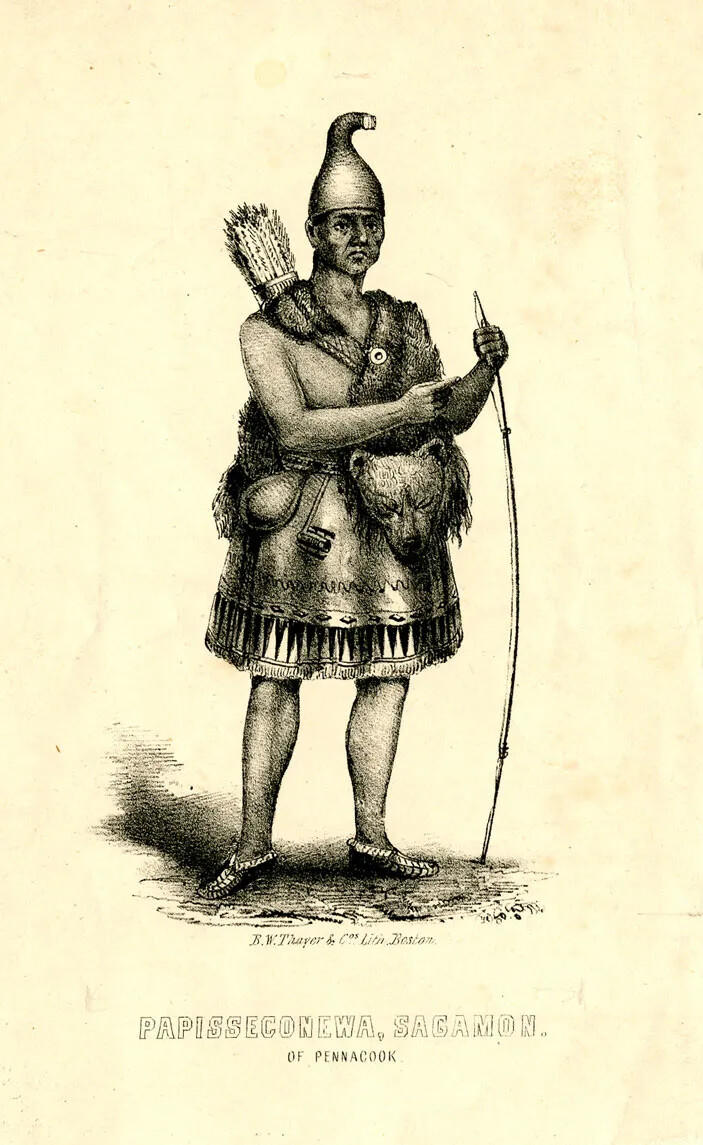
Passaconaway’s farewell
A drawing of a man in Native American dress is shown. He holds a bow and has arrows in a quiver on his back. He wears animal skins and a woven skirt, and has a curved smooth head covering. His sandals are hand made and his lower legs are bare. The caption reads "Papisseconewa, Sagamon, of Pennacook."
1719
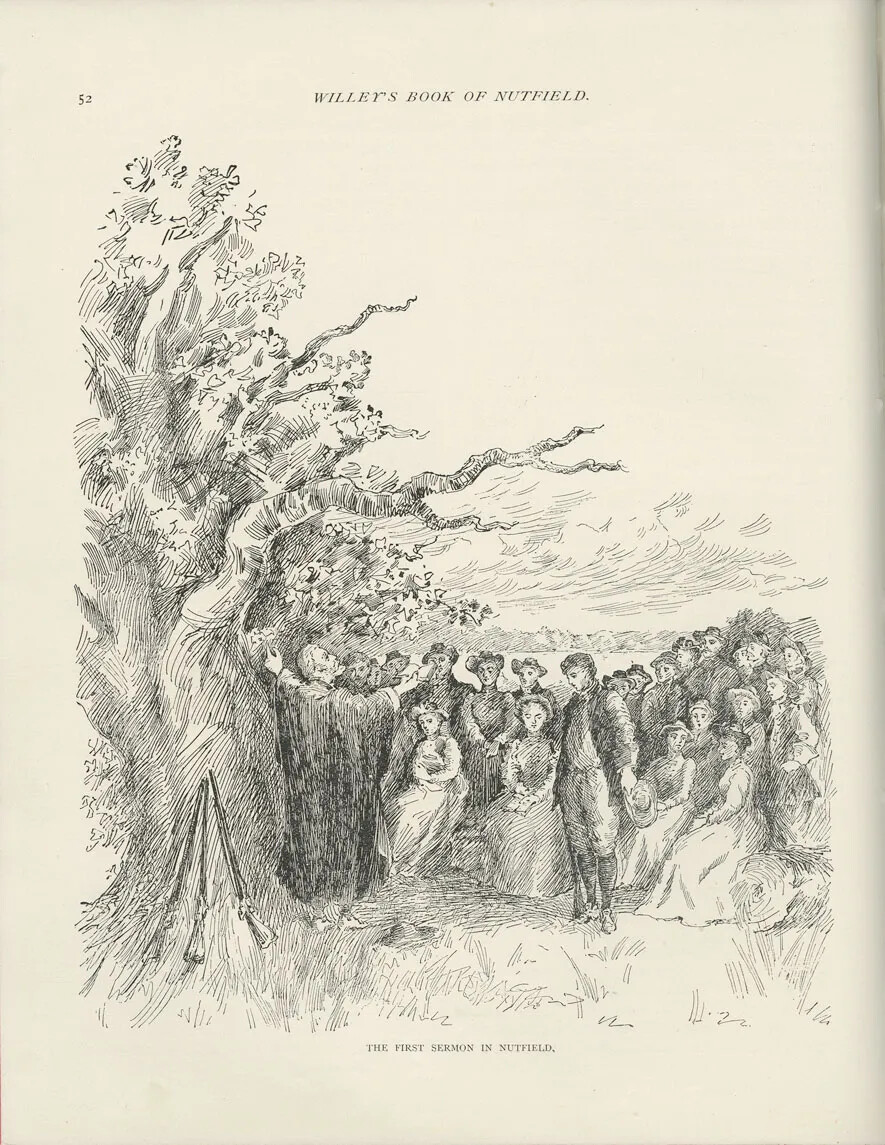
Scots-Irish come to New Hampshire
A black and white sketch shows an outdoor scene with a large tree with a thick trunk on the left. Under it a man stands with his arms outstretched to the sky. Facing him are a crowd of people, some sitting in front and some standing. The women wear long dresses and the men suits; most people wear hats. In the distance, there are clouds and many trees.
1741
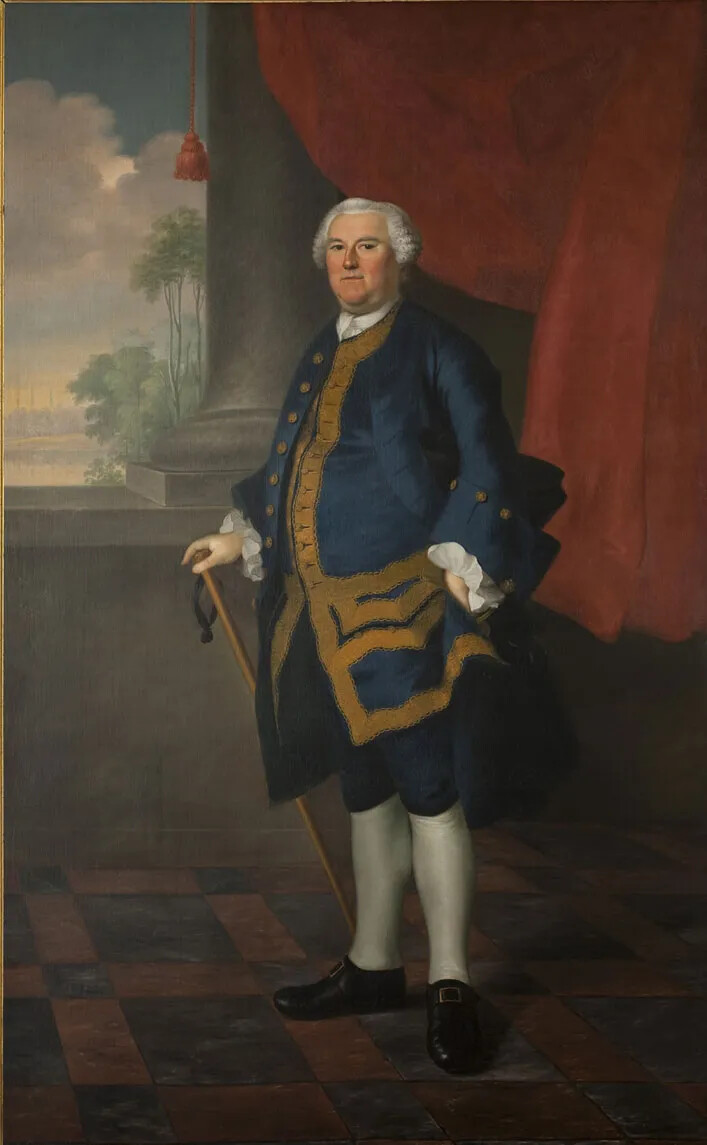
Benning Wentworth appointed first colonial governor
A colorful painting shows a white-haired man in formal dress posed standing with a cane. He is not smiling and looks directly at the viewer. He is wearing a long blue coat bordered with gold, a white shirt with ruffled cuffs, and knee-length blue pants. He has white stockings and black shoes with brass buckles. He stands on a black and tan checked floor in front of a column and red curtain. In the background are tall trees, clouds, and a village far away.
1765
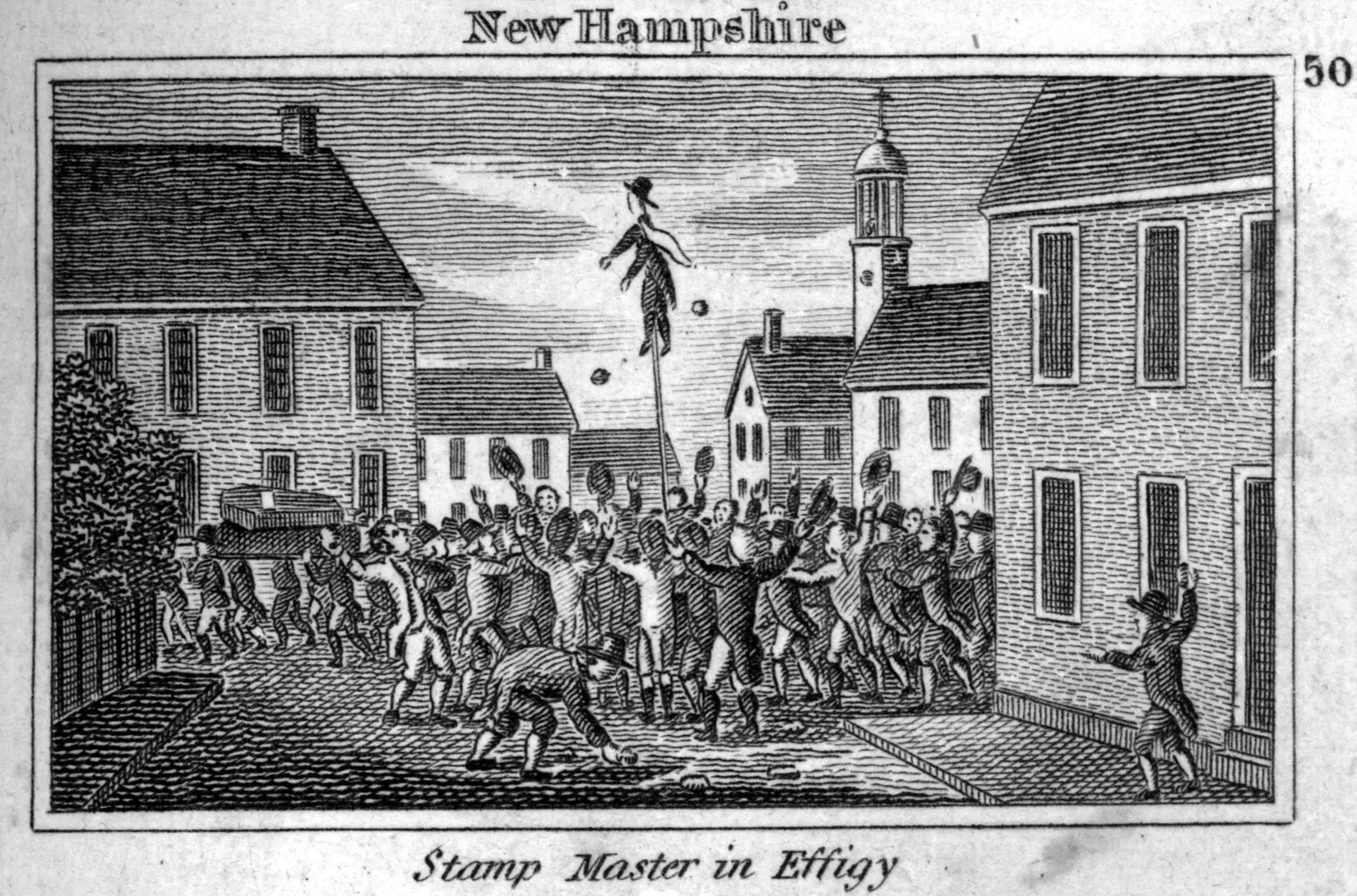
Stamp Act protests
An engraving shows a town square bordered with two story colonial houses. In the center of the square is a crowd of people gathered, facing inwards, most with their arms up. Some hold hats in their upstretched hands. In the center of the crowd is a likeness of a person up on a stick above people's heads. There are two circular items up in the air near the figure. One person in front is bending down, perhaps to pick something up. About five figures to the left and in the background are carrying a large box on their shoulders. Above the engraving are the words "New Hampshire," and below it says "Stamp Master in Effigy."
1772
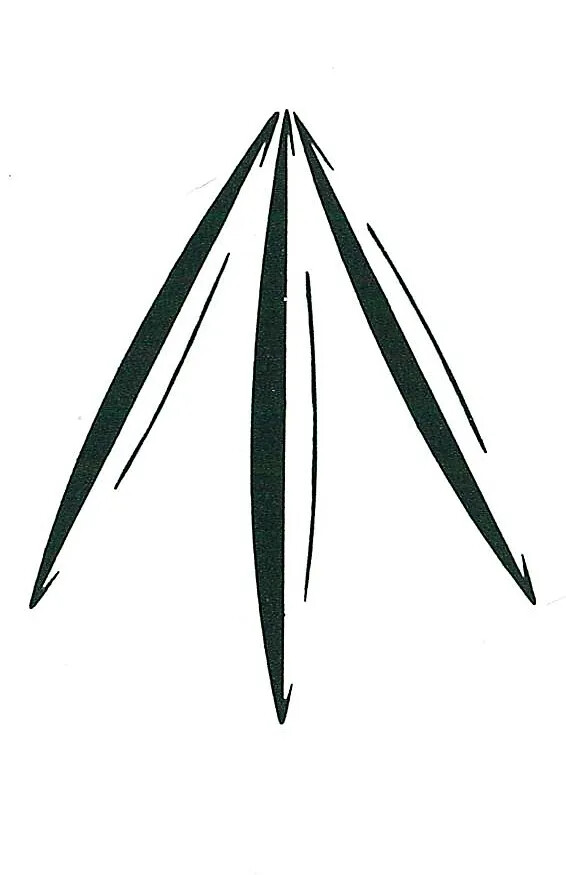
Pine Tree Riot
Three broad black lines come together at a point as if to form a tee-pee. There are smaller, black lines half the length of the first lines to the direct right of each line, parallel to each one.
1774
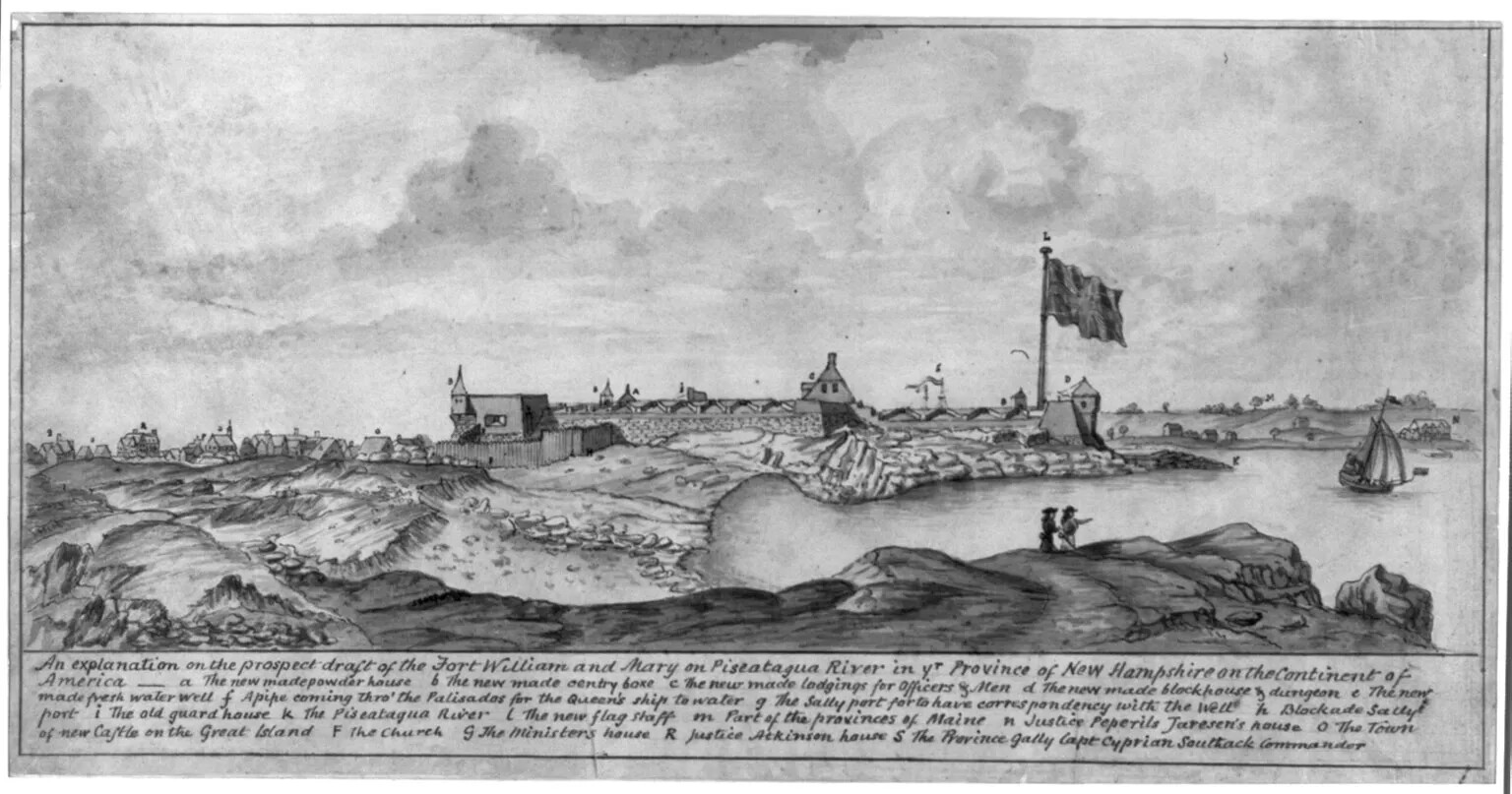
Attack on Fort William and Mary
A black and white drawing shows a view of a landscape. A river enters from the right side, and land surrounds it in a bay. There is a large sailboat on the river. In the center is a series of buildings with some towers connected by walls. There is a large flag hanging over the right side of the walls. A village is further away on the left side. Two figures stand on rocks in the foreground. At the bottom is script writing  identifying various features in the drawing.
1775–1783
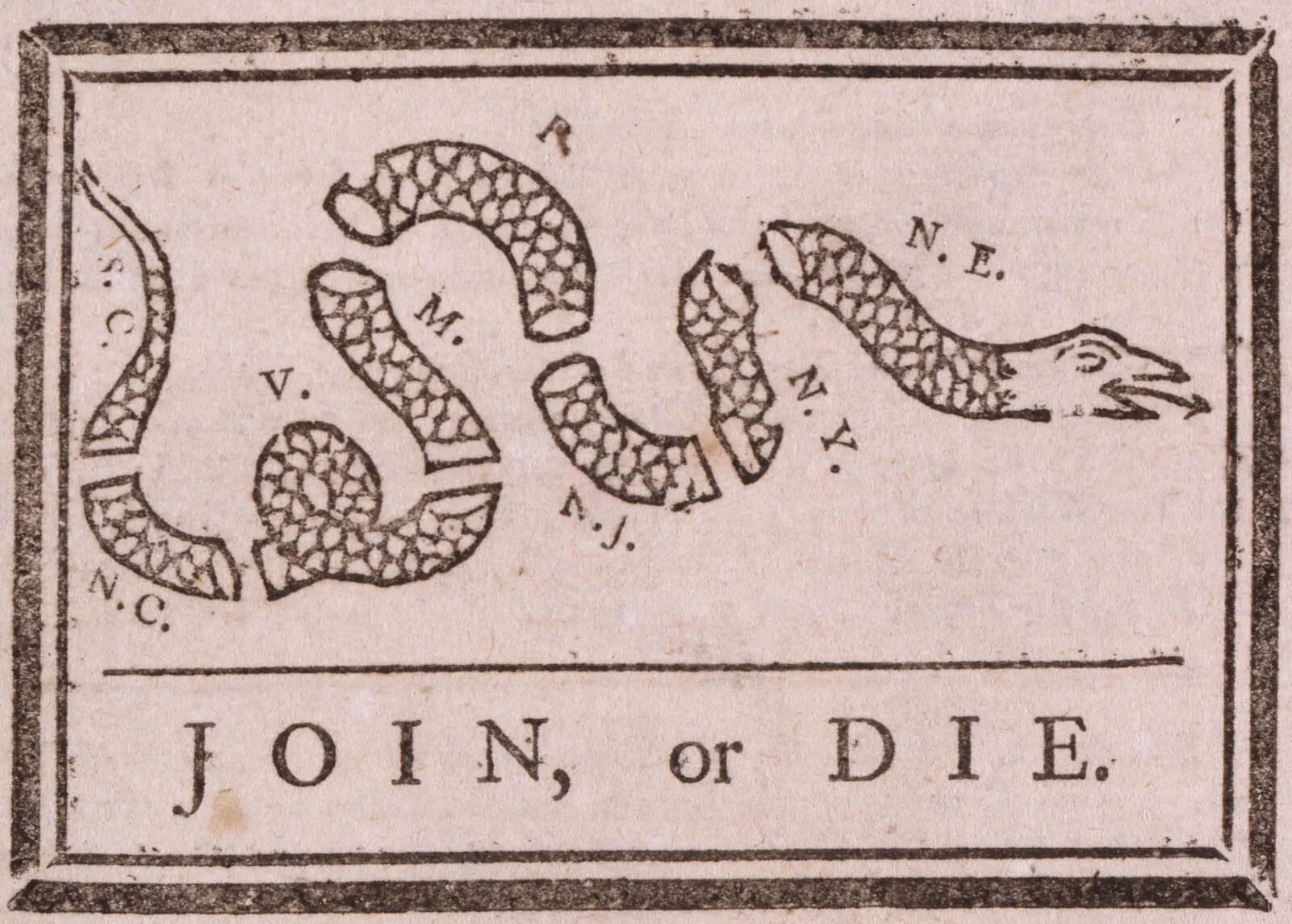
American Revolution
A drawing shows a snake cut into eight parts. Each part is labeled, left to right, as "S.C." "N.C." "V." "M." "R" "N.J." "N.Y." and "N.E." Under the snake, block printing says "JOIN, or DIE."
1775
Bunker Hill
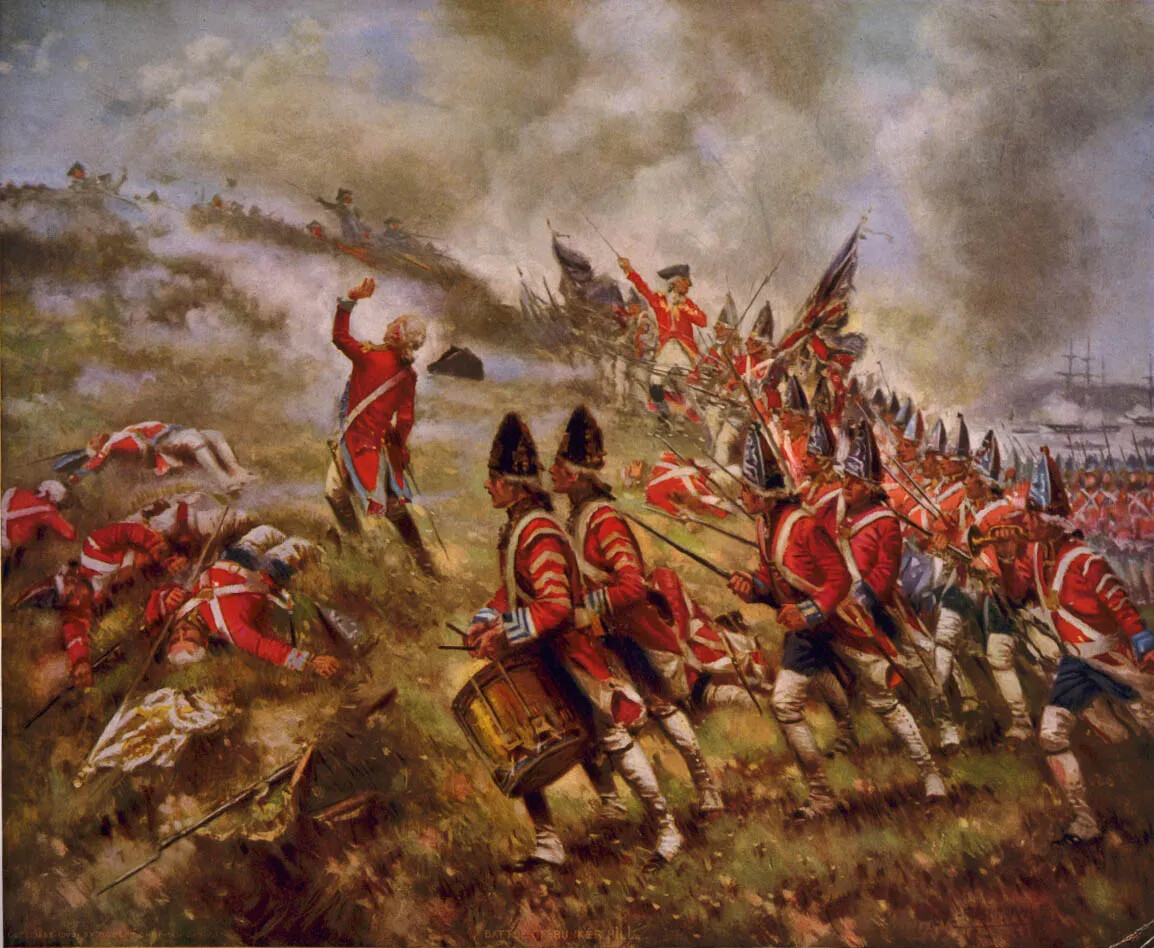
 Soldiers wearing late-1700s uniforms with red coats and blue pants run up a hill in a painting. They hold muskets with bayonets. Some are leading the charge, some are drumming, and some hold British flags. On the left side, there are soldiers struck down. One soldier appears to be falling. In the distance, smoke from a battle rises and large ships are visible.
1776
New Hampshire declares independence
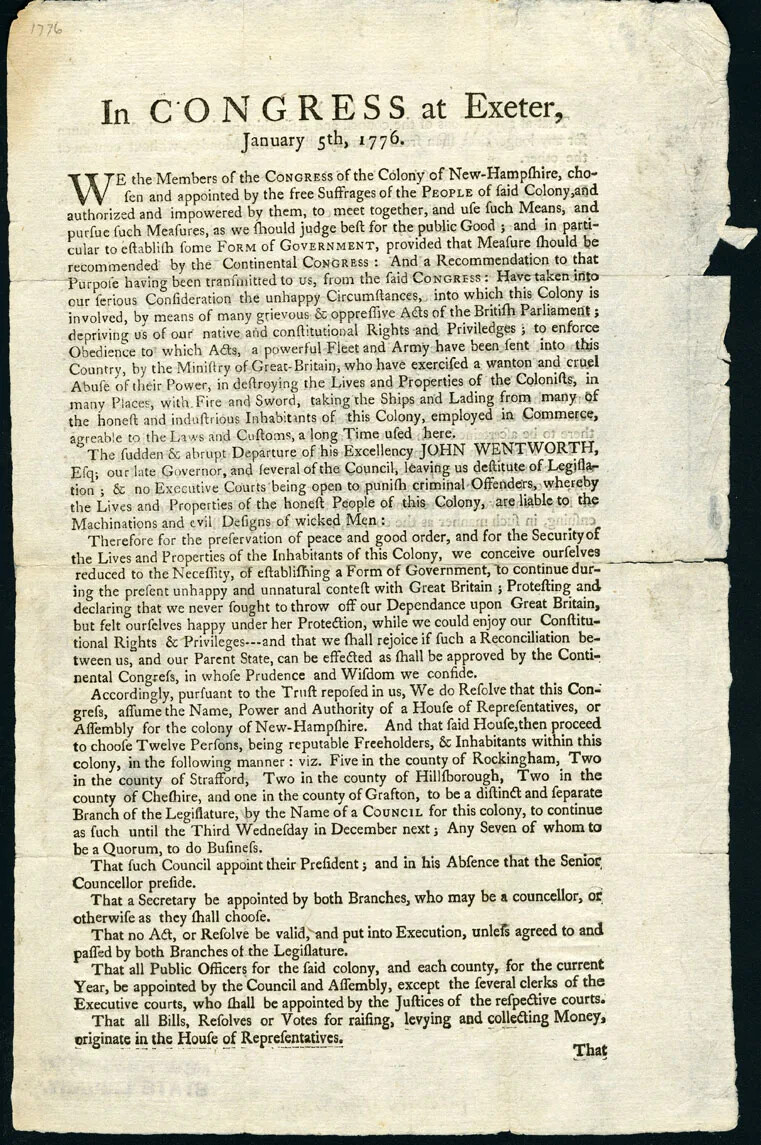
A document is seen with many lines of printed text. There are no pictures, and the document is slightly torn on some edges. In larger print at the top, the title reads "In CONGRESS at Exeter, January 5th, 1776."
1776
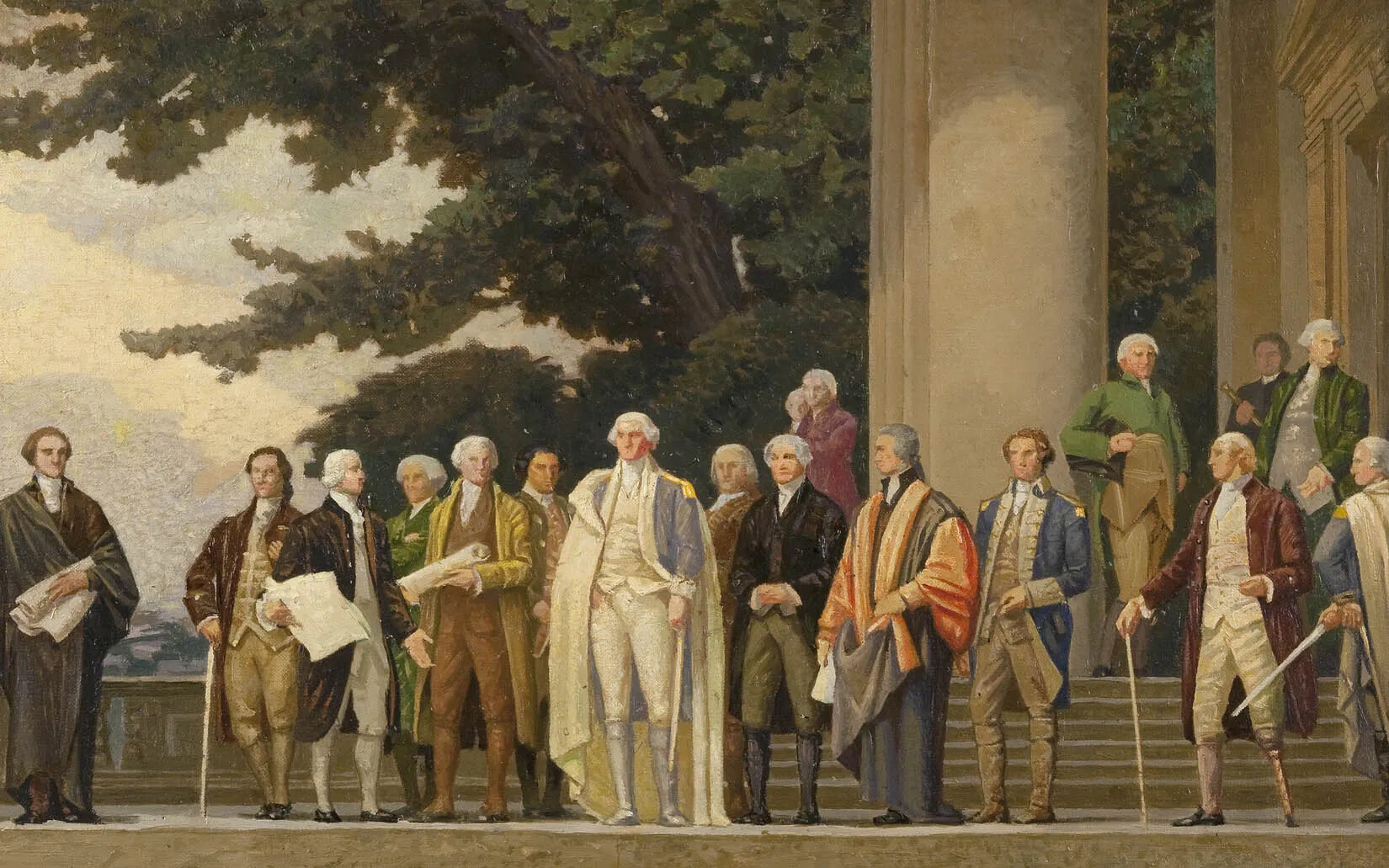
Declaration of Independence
A long rectangle painting shows many figures of men dressed in formal suits from the 1700s. They are standing on some steps in groups, talking together and looking at one man. That man has a long white object in his hand. The background is a building with large columns on the left, trees, and a sky filled in with clouds. Flags are massed on the extreme right.
1777
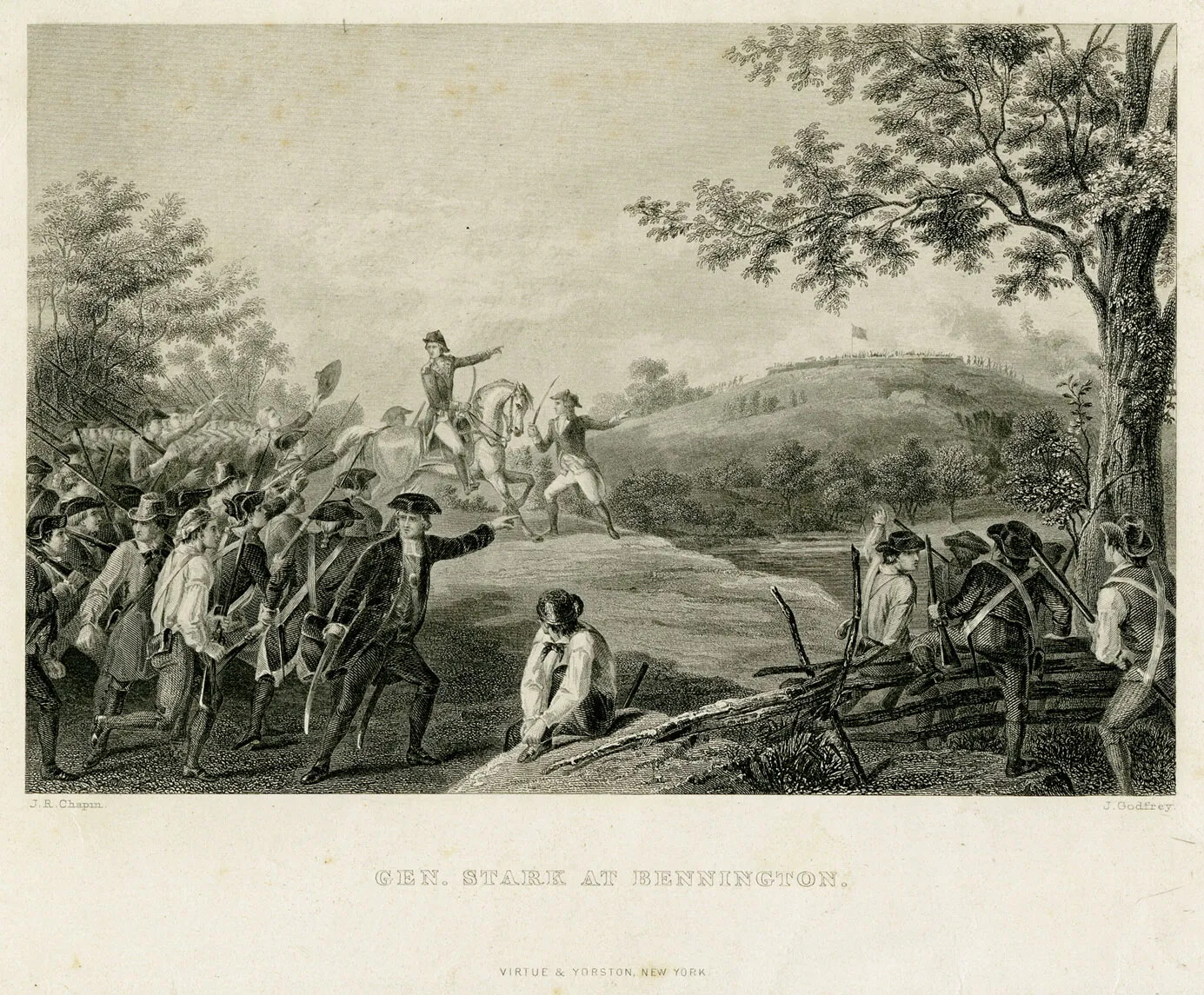
Battle of Bennington
A detailed engraving shows a scene in rural country. In the center are two men with swords, one riding a horse and one holding it. Both are pointing to the right and looking to the left. To their left are a crowd of men, some in uniforms and some in farmer-like clothing, but all with weapons. They look towards the men in the middle and raise their swords. On the right of the men in the middle are trees and a hill far away. On top of the hill is a flat building with a flag on it and some small figures. In the foreground are several men climbing over a fence pointing to the hill. They are also armed, and seem to be joining the crowd of men on the left.
1779
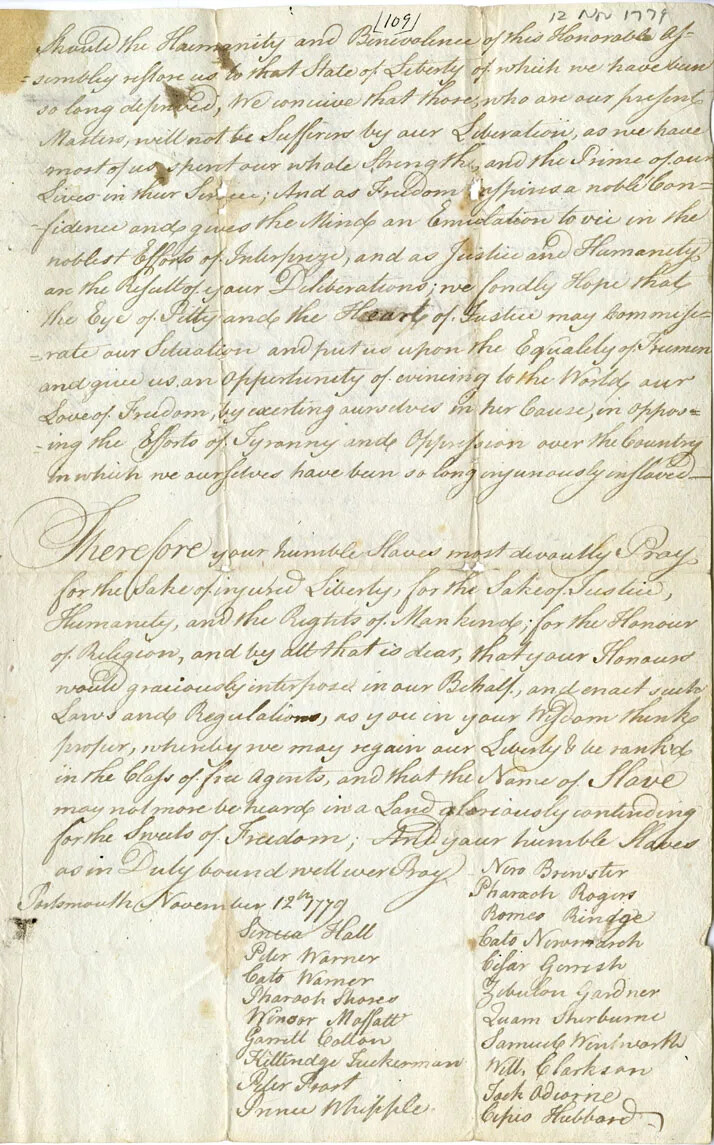
Freedom Petition
A document is seen with 12 lines of elaborate script. After the lines, starting about two-thirds of the way down the document, are two lists of names, numbering 20 names total.
1788
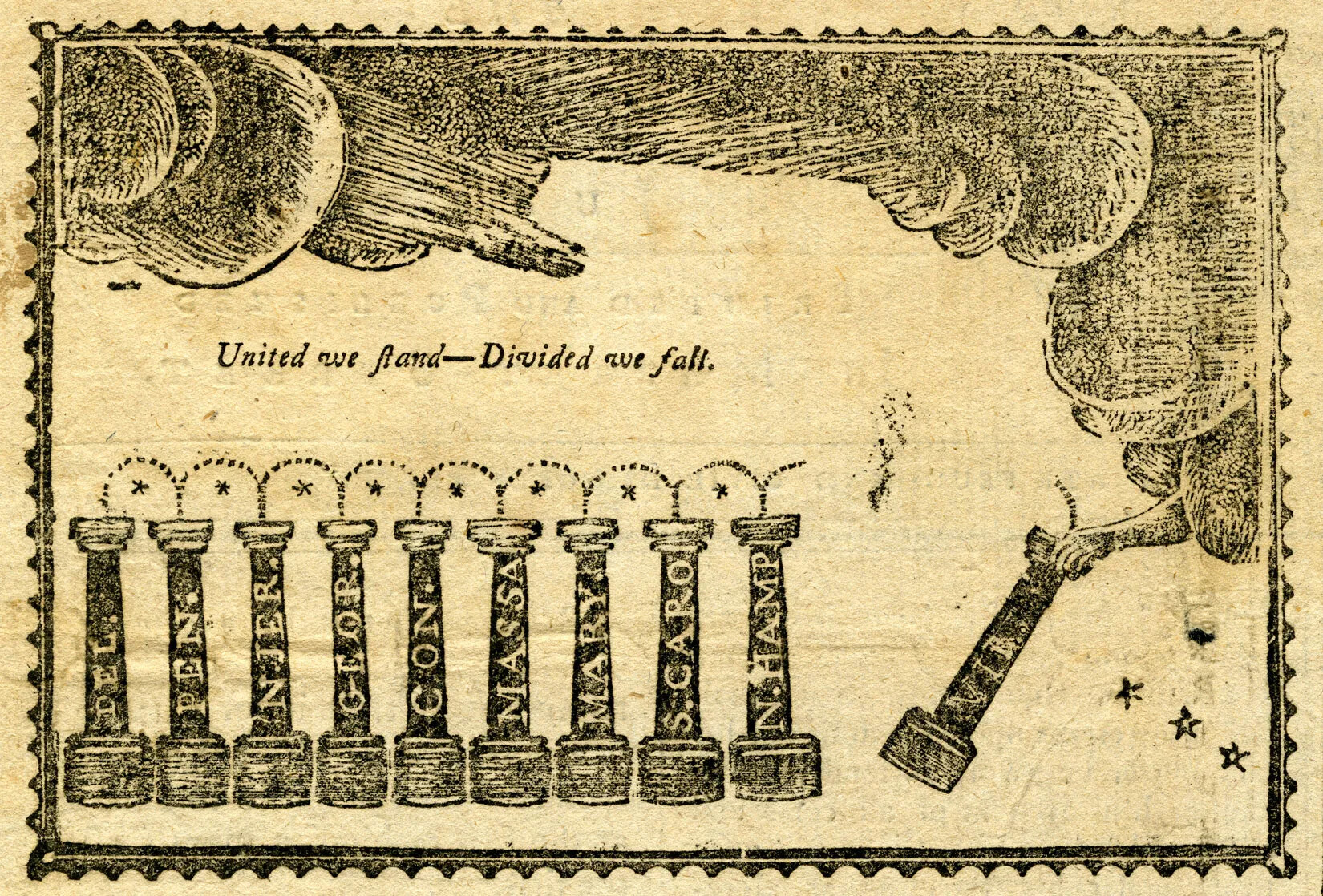
New Hampshire ratifies the U.S. Constitution
An engraving shows a symbolic drawing. There are nine pillars, each about a third of the height of the drawing, lined up next to each other. They each have letters on them. From left to right, they read "DEL." "PEN." "N.JER." "GEOR." "CON." "MASSA" "MARY." "S.CARO" and "N.HAMP." The tops of the pillars are connected by dotted arched lined, and under each arch is a star. Stormy clouds line the top of the drawing, and a hand from a cloud reaches down to place a tenth pillar in line. It reads "VIR." There are three stars to the right of the pillar being placed. Words above the pillars and below the clouds read "United we stand--Divided we fall."
1789
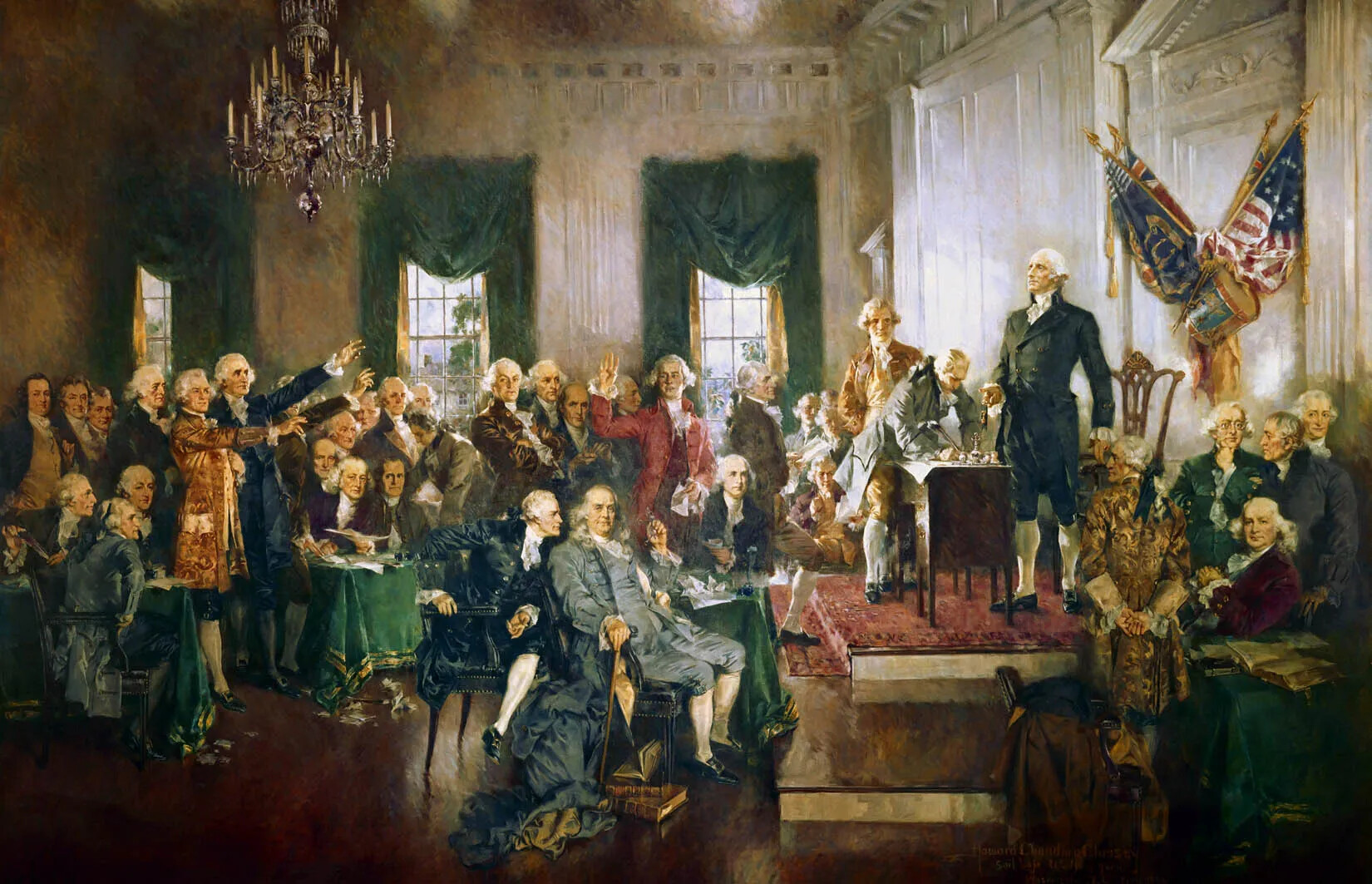
U.S. Constitution
A crowd of men sit and stand in a formal room with a chandelier and fancy window treatments. They are dressed in formal suits from the 1700s. They face a dais with a desk, where one man stands in front of a chair. Another man appears to be writing on something on the desk. Flags decorate the wall behind the standing man.
1796
Ona Judge flees slavery
A close up rectangle of an old newspaper is shown. The title is "Advertisement" and it reads "ABSCONDED from the houshold [sic] of the President of the United States, ONEY JUDGE, a light mulatto girl, much freckled, with very black eyes and bushy black hair. She is of middle stature, slender, and delicately formed, about 20 years of age. She has many changes of good clothes of all sorts, but they are not sufficiently recollected to be described—As there was no suspicion of her going off, nor no provocation to do so, it is not easy to conjecture whither she has gone, or fully, what her design is;—but as she may attempt to escape by water, all matters of vessels are cautioned against admitting her into them, although it is probable she will attempt to pass as a free woman, and has, it is said, wherewithal to pay her passage. Ten dollars will be paid to any person who will bring her home, if taken in the city, or on board any vessel in the harbour;—and a reasonable additional sum if apprehended at, and brought from a greater distance, and in proportion to the distance.   FREDERICK KITT, Steward. May 23"
1796
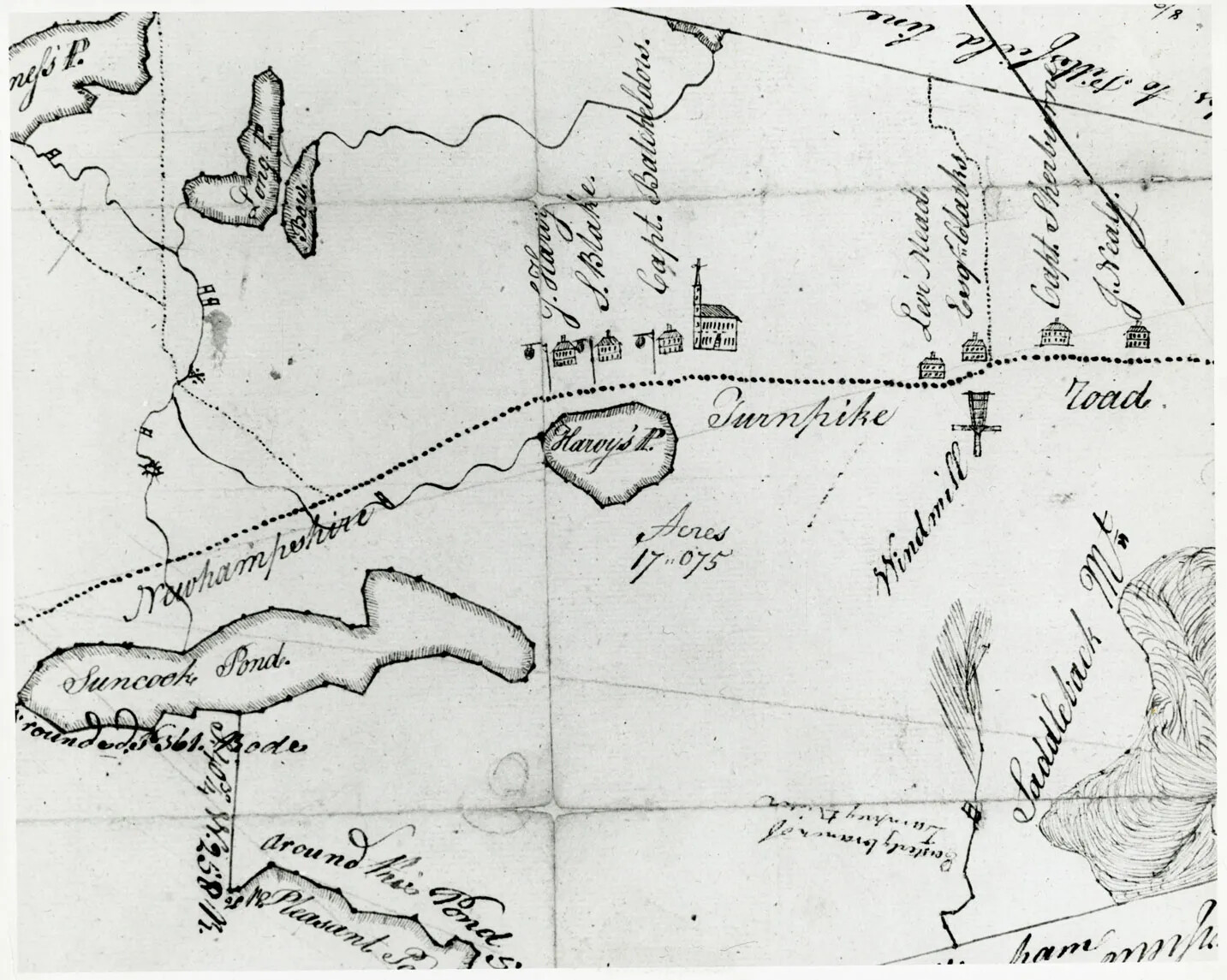
Roads across the state
A close up of a black and white hand-drawn map shows a dotted line running horizontally through the page. Below the line are a few ponds as well as acres marked and other items of interest. Directly above the line sit seven small houses and a church. There are other rivers and ponds marked above the line. All items are labeled in cursive script. The line is labeled "Newhampshire Turnpike Road." Items are cut off on the edges of the map, indicating that the map is larger than the sample shown.
1803
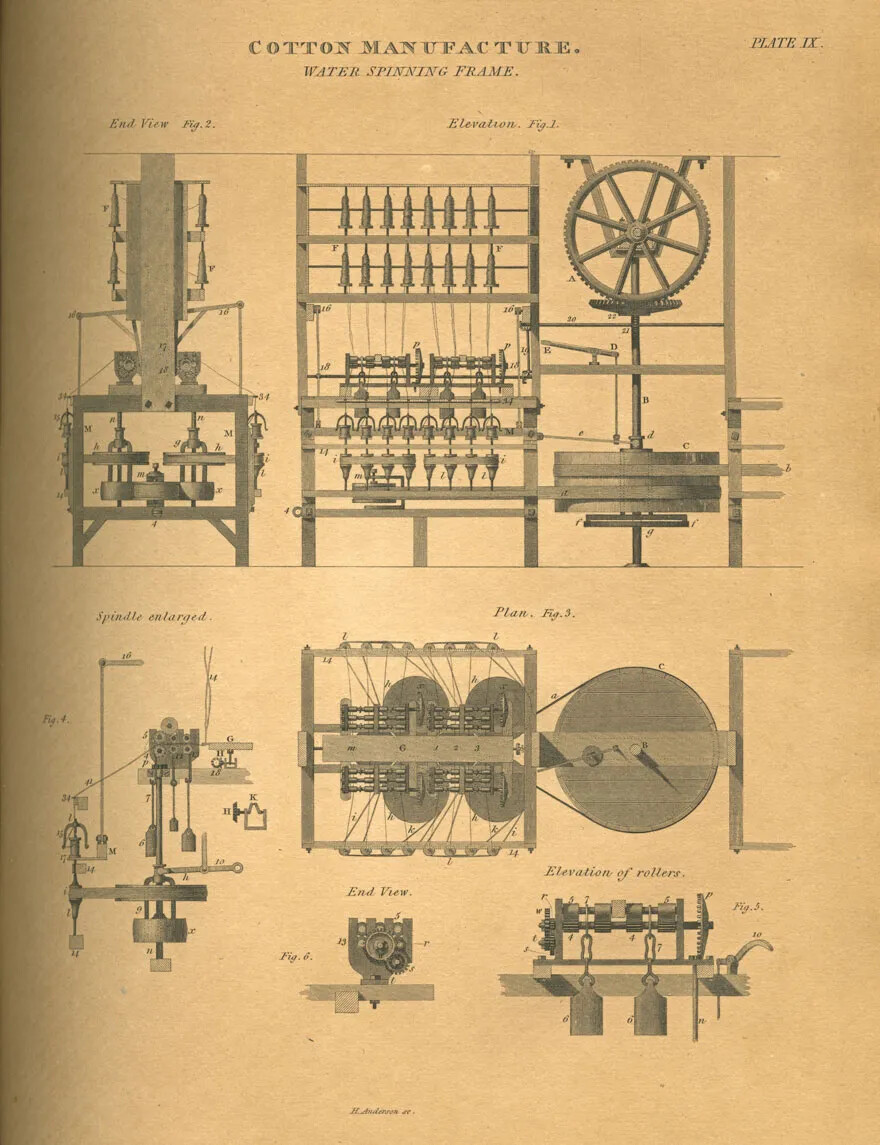
First textile mill in New Hampshire
A diagram of a spinning machine is seen in six parts. It is titled "Cotton Manufacture. Water Spinning Frame." The diagrams show intricate machinery connecting spinning wheels, spindles, and bobbins.
1803
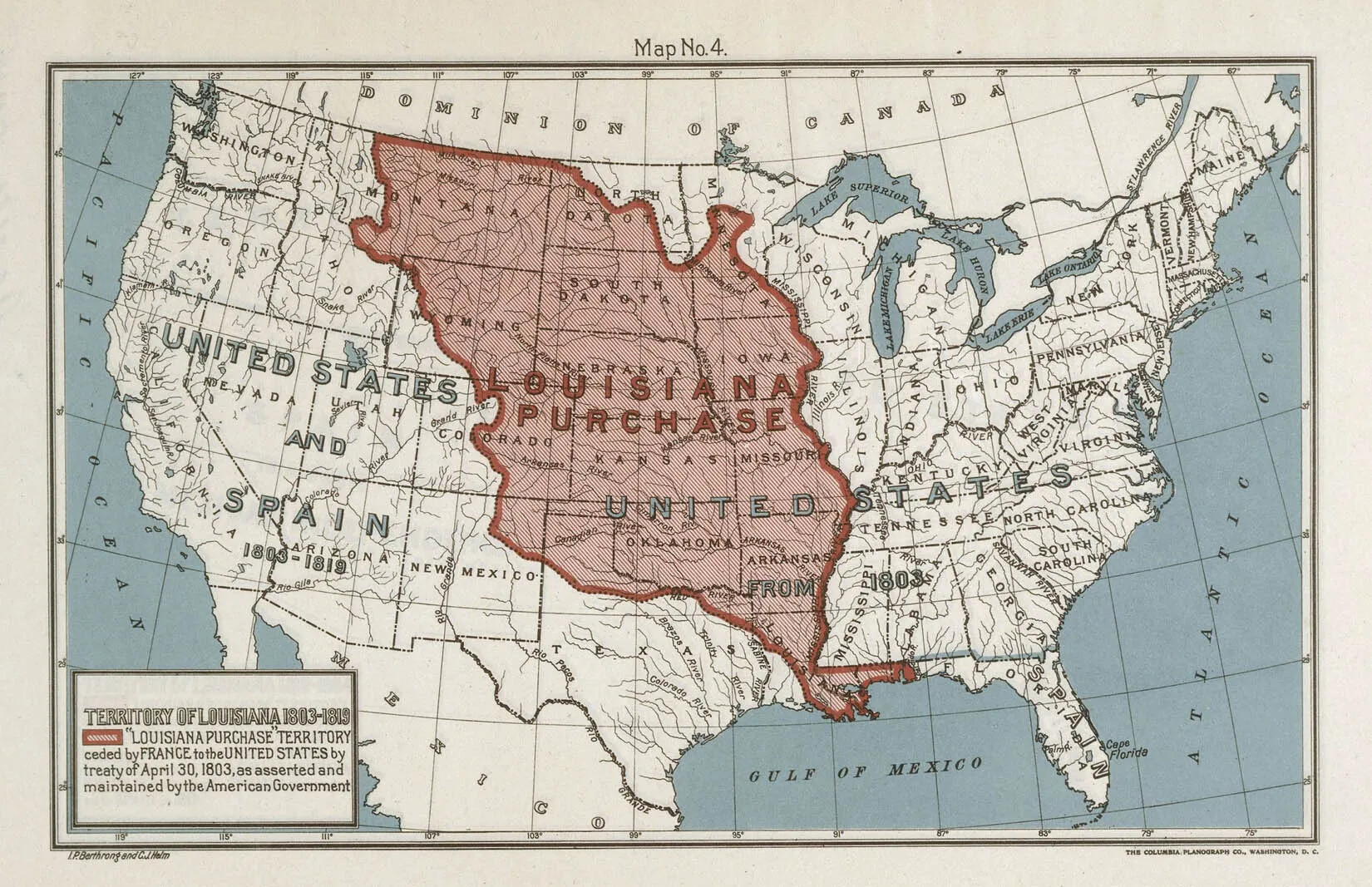
Louisiana Purchase
A historic map is shown of the United States and parts of Mexico and Canada. Bodies of water are blue and labeled, and rivers are shown as black lines. Major rivers are labeled. There are two layers of data. First, modern-day U.S. states are outlined in dotted black lines. Second, the  center third of the United States is colored red and labeled "Louisiana Purchase." The red area covers part or all of modern-day Montana, North Dakota, South Dakota, Wyoming, Minnesota, Nebraska, Iowa, Colorado, Kansas, Missouri, New Mexico, Oklahoma, Arkansas, Texas, and Louisiana. The Louisiana Purchase and U.S. to the east are together labeled "United States from 1803." West of the Louisiana Purchase is labeled "United States and Spain 1803 - 1819."
1805
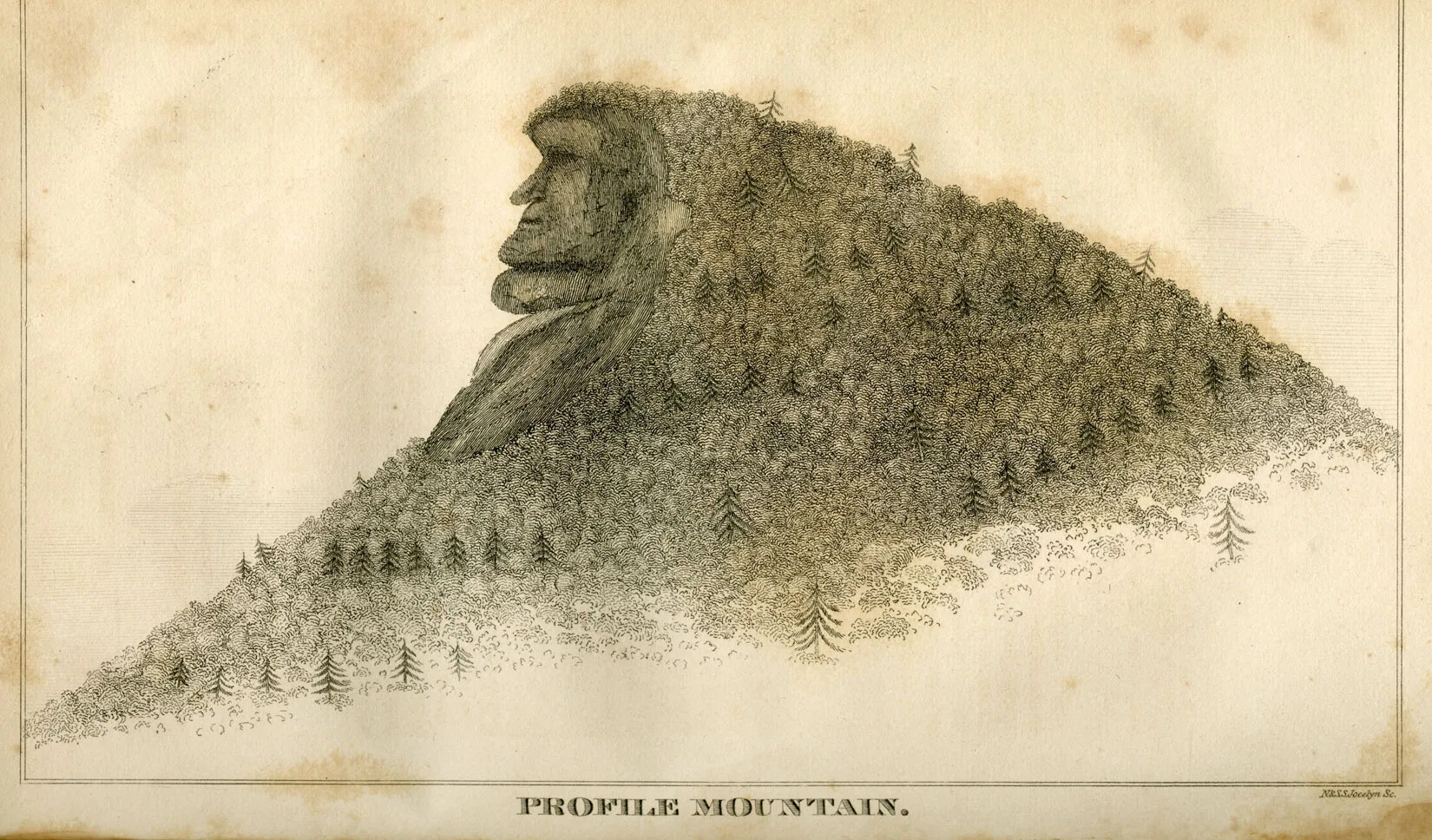
Old Man of the Mountain “discovered”
A black and white drawing of a mountain is seen. On the mountain are many trees, notably large pine trees. On the top of the mountain a face in profile, formed from rock, looks to the left. It is about a third the height of the mountain.
1809
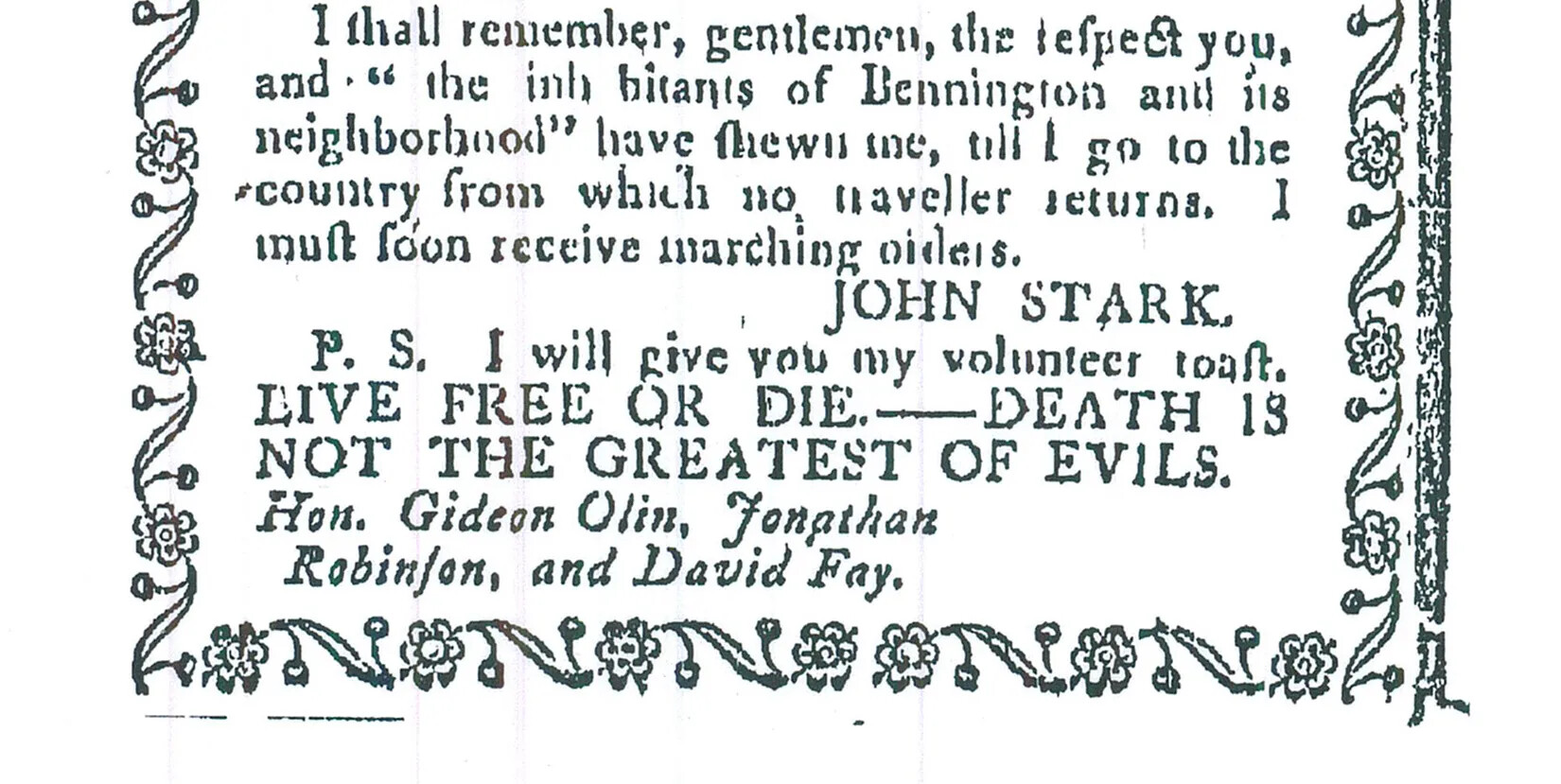
Live free or die
A black and white printing of a piece of writing is bordered by small swirling decorations. The title reads "Letter from Gen. Stark." There are seven paragraphs, and the under the signature is a P.S. It reads "I will give you my volunteer toast. LIVE FREE OR DIE. --DEATH IS NOT THE GREATEST OF EVILS."
1815
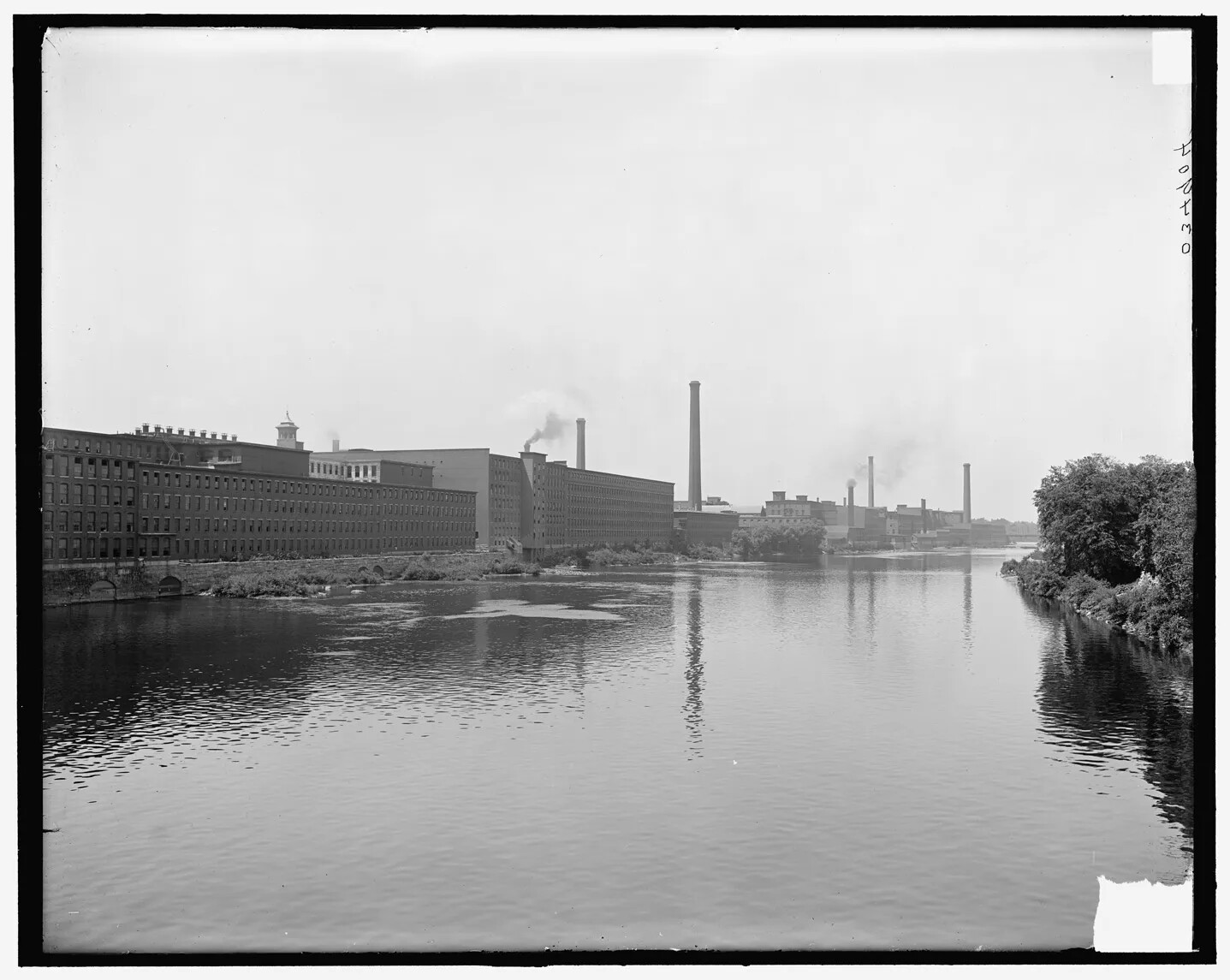
Textile mills in Lowell
A black and white photograph shows a wide, calm river in its center. On the right, the riverbank is lined with trees. On the left, long industrial buildings about five stories tall run the length of the river. There are many big windows on the buildings and they are flat on top. Smoke stacks are seen in the distance.
1815
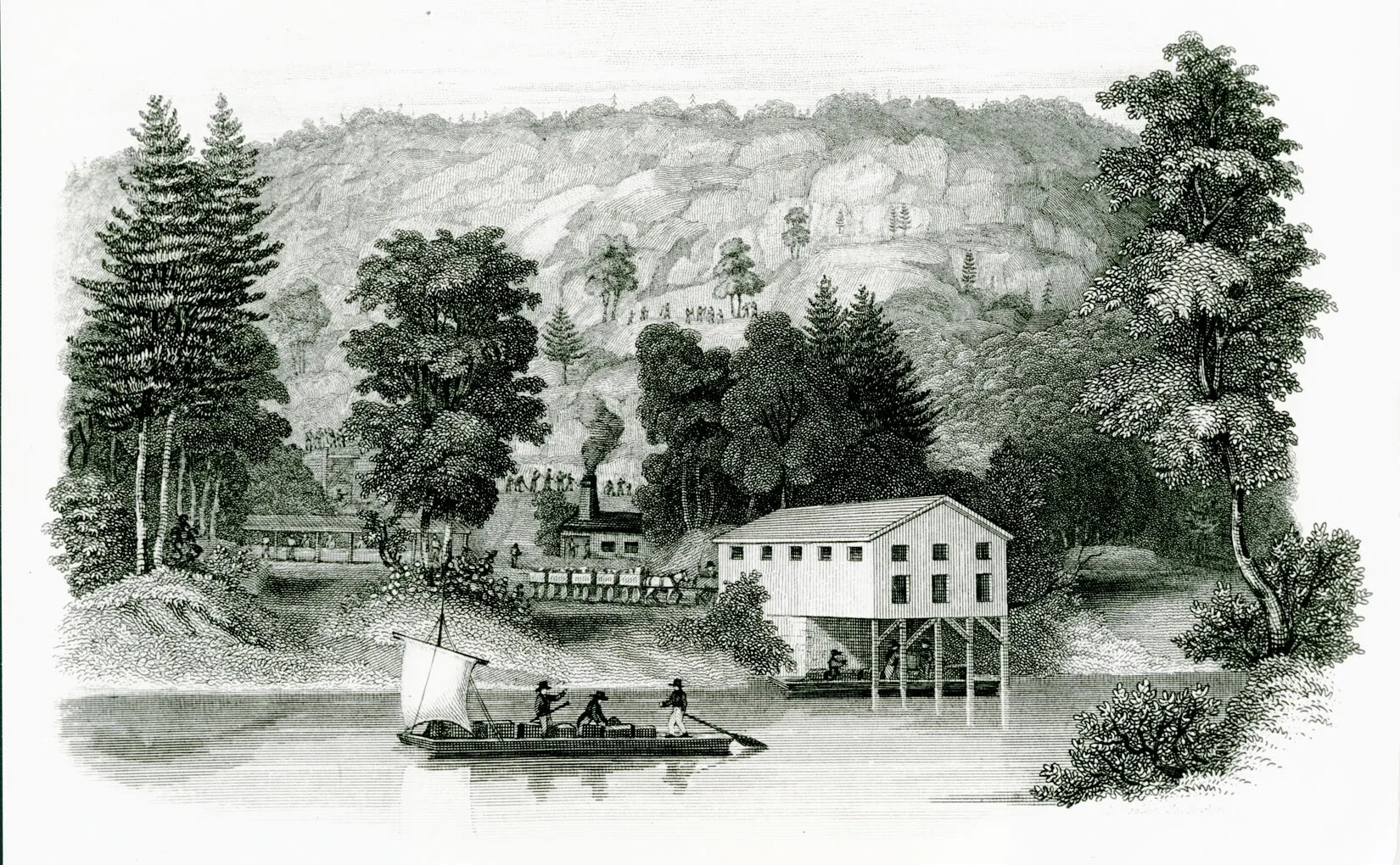
Merrimack River made navigable
In a drawing of rural woodlands on a river, a boat propelled with setting poles and sail approaches a building. The building is set above the river so that there is a landing dock on the river under it. There are three figures on the boat and several others throughout the scene, some on a small road and some in a field. The scene shows large trees and bushes next to the river, and smaller ones throughout the landscape up a hill. There is also a small road with a few buildings on it leading to the landing building.
1816
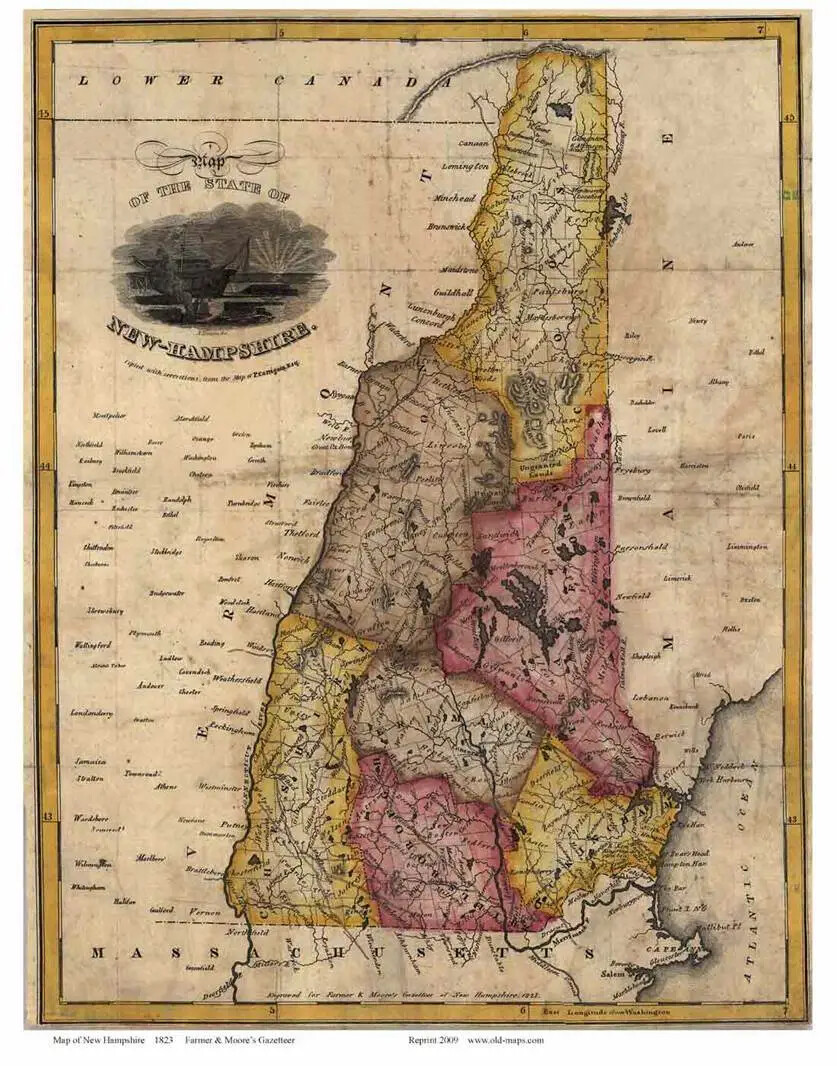
Carrigain Map completed
In this historic map of New Hampshire, the seven counties of New Hampshire are different colors and labeled. On the state's borders, "Lower Canada," Massachusetts, Maine and Vermont are labeled. All towns are outlined, and some are labeled. Rivers and bodies of water are noted. The title "Map of the State of New-Hampshire" is in the upper left corner; the words circle a drawing of the sun rising over a water scene.
1816–1819
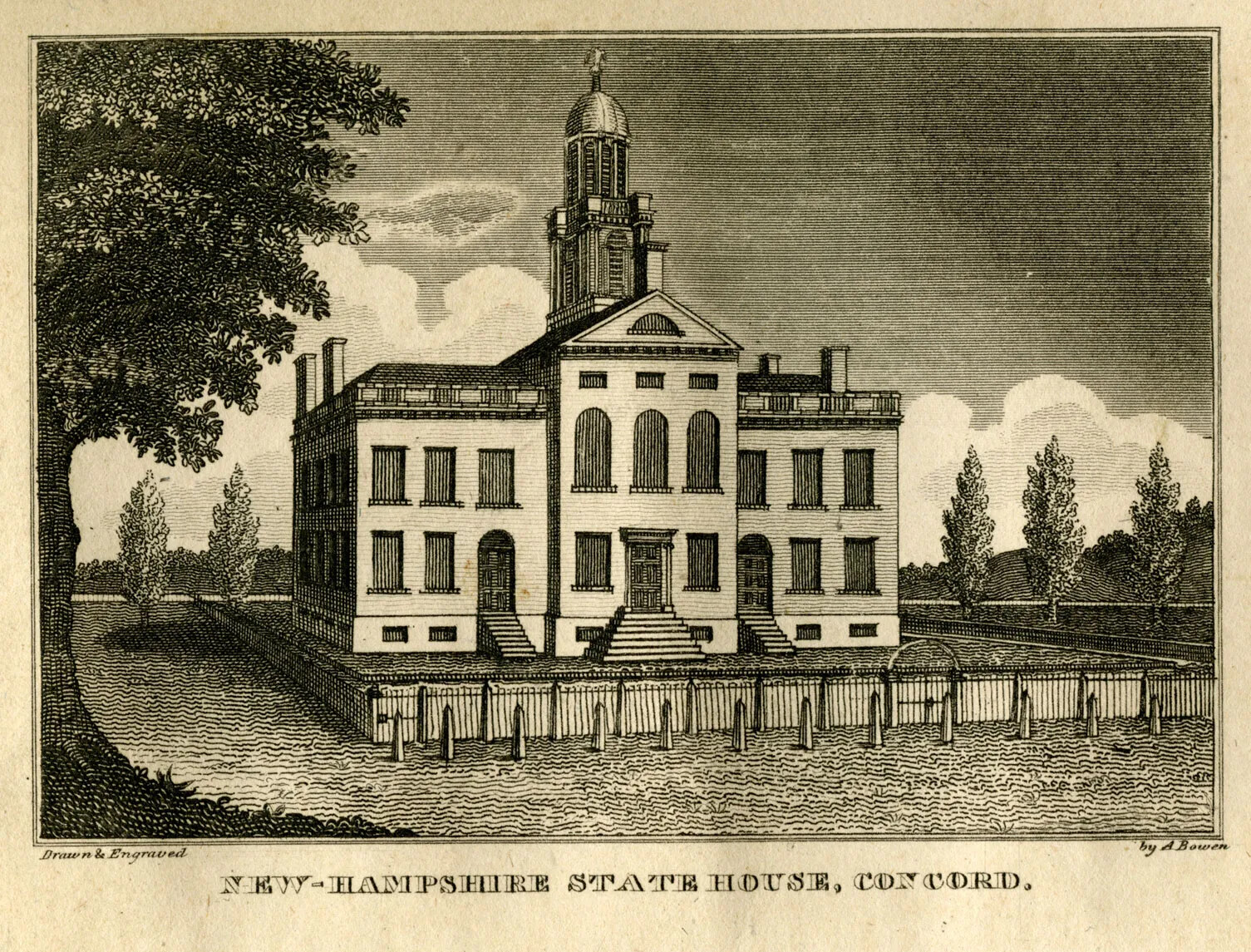
State House built
An engraving shows a large, stately building with rows of windows, four chimneys rising from the corners, and a tower with cupola. It sits on a flat landscape, bordered with a fence and trees. A large deciduous tree borders the left side of the engraving. The title reads "New-Hampshire State House, Concord."
1825
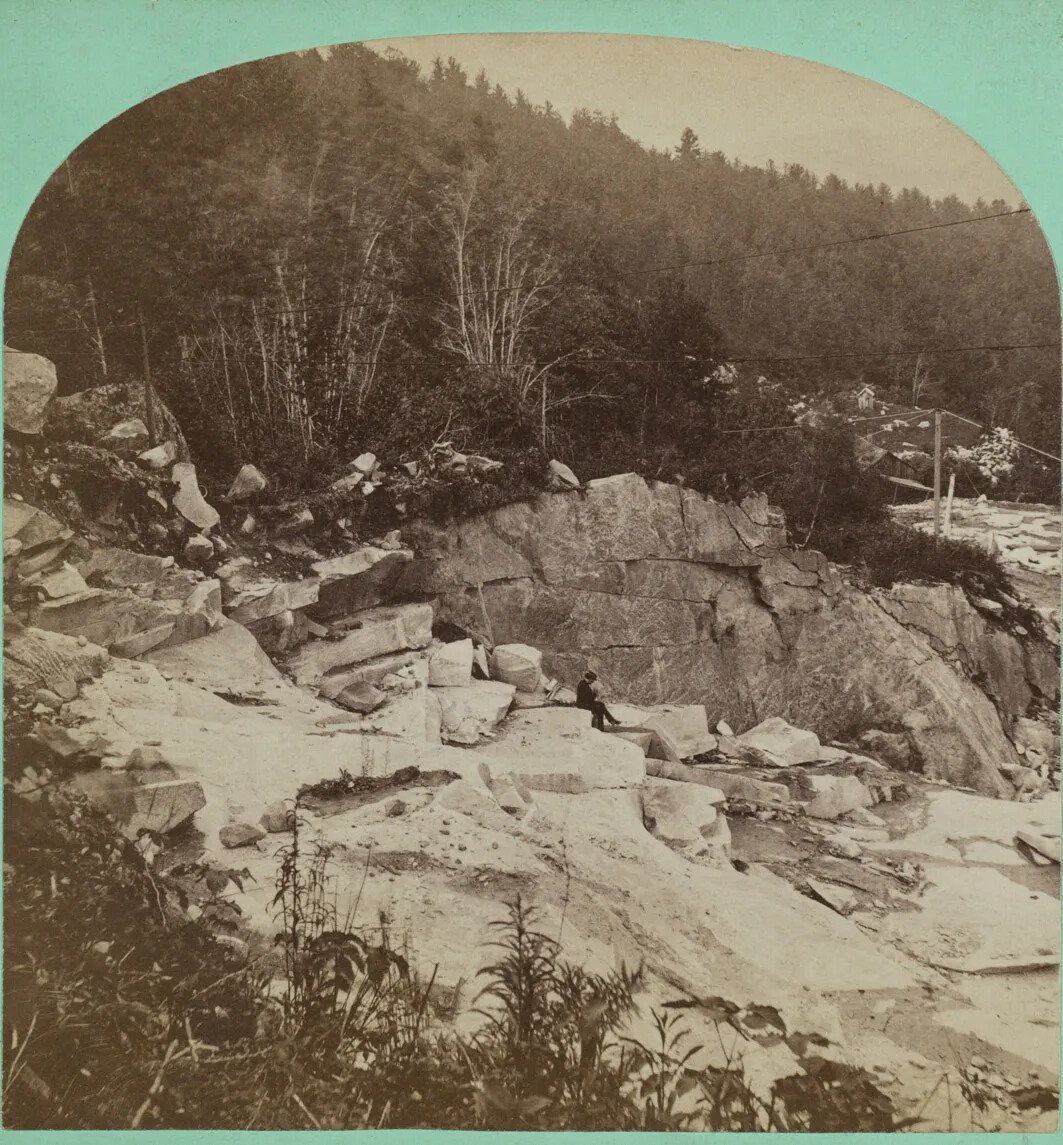
The Granite State
A square black and white image that is arched on top and bordered in teal on the top and bottom. The image shows the side of a hill, and the top and bottom of the image are wooded. In the middle is a wide swath of light colored rock. There are some large boulders, some slabs, and some cliff-like drops.
1825
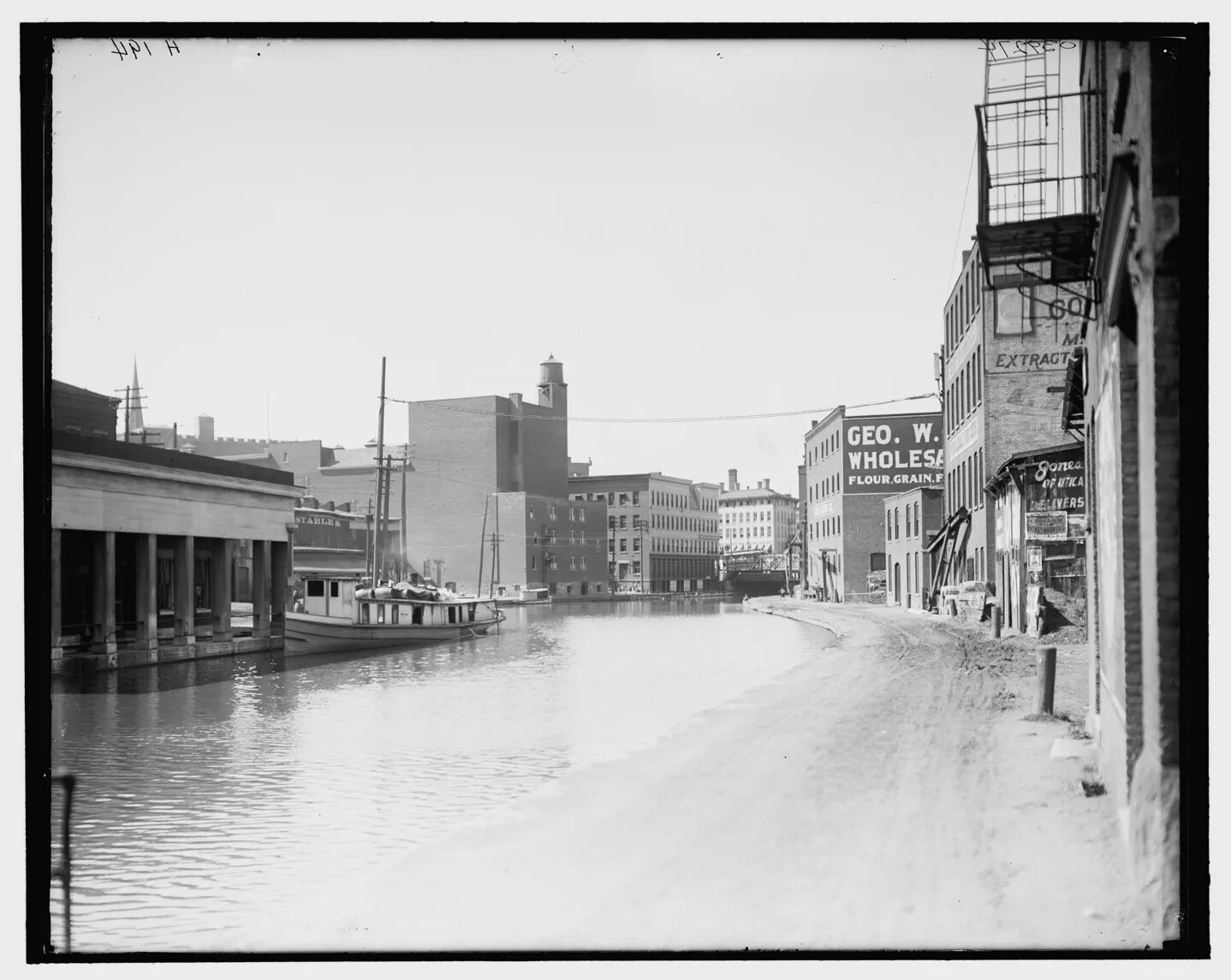
Erie Canal opens
A black and white photograph shows a wide, calm water canal curving through a developed town. On the right side, the water is bordered by sand and then buildings. On the left side, the water rises directly up to buildings. There is a boat tied up to one building.
1826
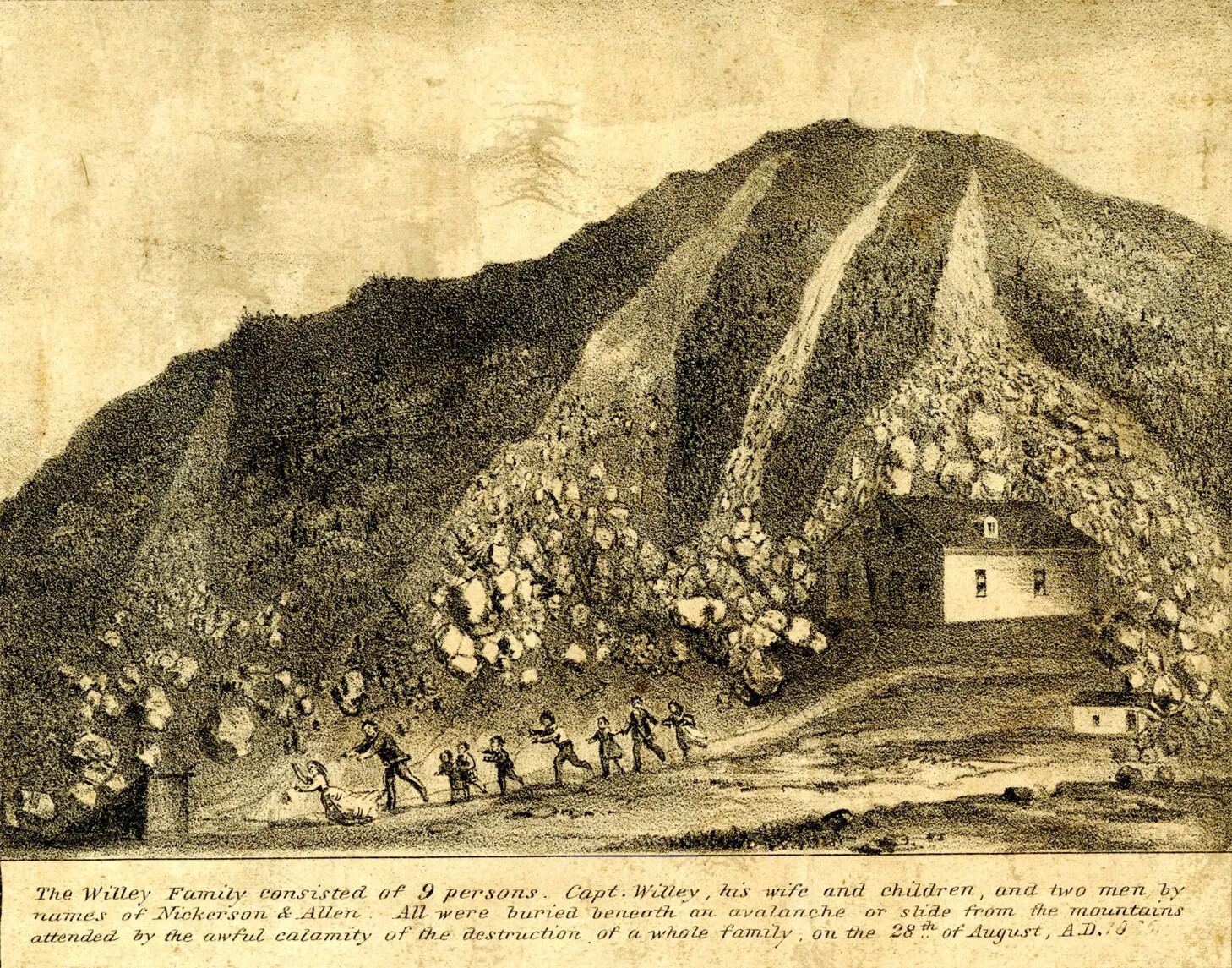
Willey slide tragedy
A drawing of a hillside shows a dark hill with four rock slides. Each rockslide looks like a river at the top of the hill, but resolves into individual rocks as it descends. The rightmost rockslide encircles a small house at the bottom of the hill. Along the bottom of the drawing, nine people are seen running in a line away from the house. Although they are small figures, based on their sizes and dress, they are a mix of men, women, and children. The four rockslides end all along their path. There are three lines of small writing below the drawing which describe the drawing.
1827
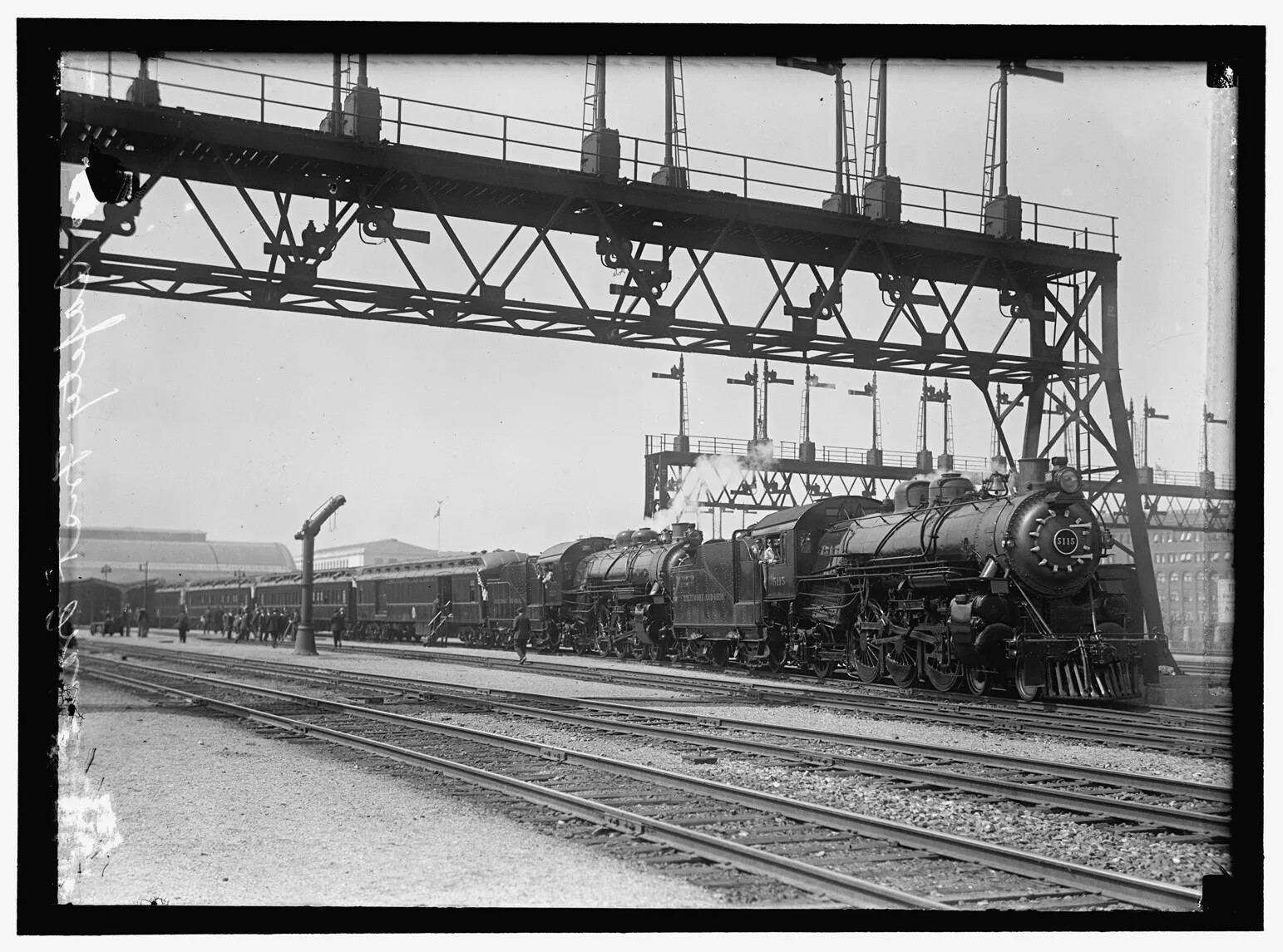
First railroad in America
A black and white photograph shows a steam locomotive running on a track. There are several more tracks next to it as well as steel beams overhead. Buildings are in the background. People can be seen getting into and out of the passenger cars attached to the steam locomotive.
1827
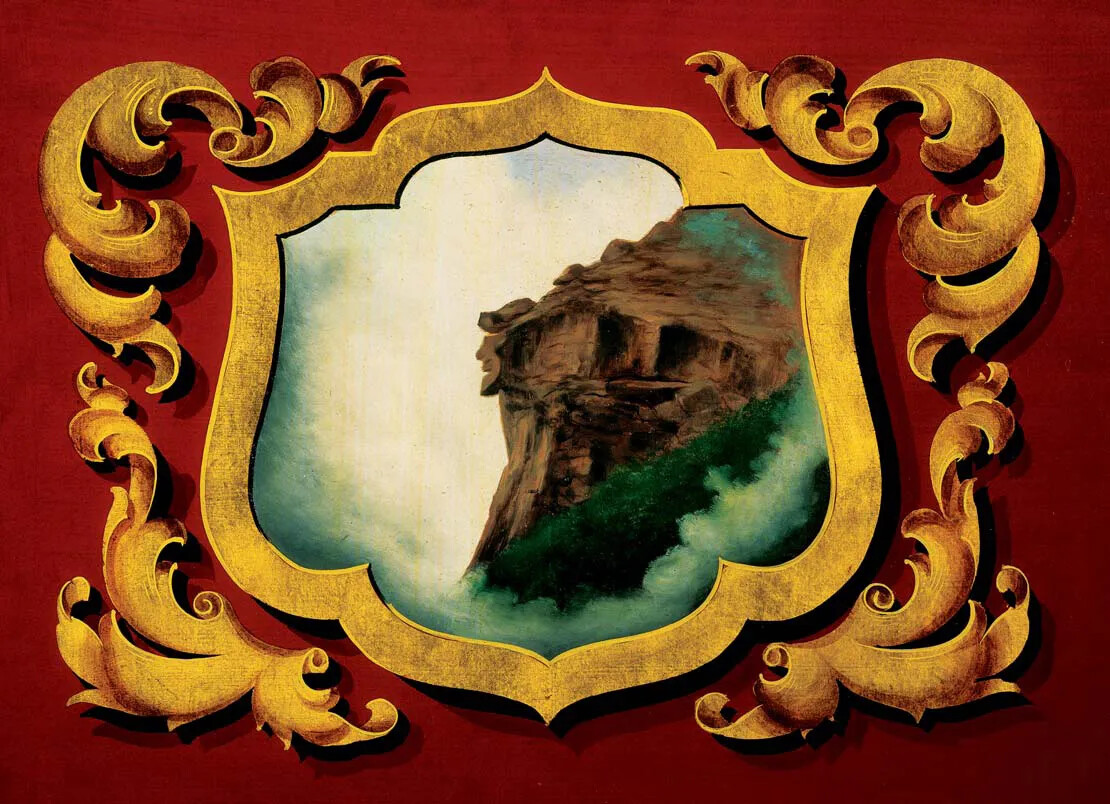
First Concord coach built
An ornate painting shows a picture framed by gold decorations with red background. The picture shows the side of a mountain, and the upper third of the rocky cliff appears to look like the profile of a man.
1831
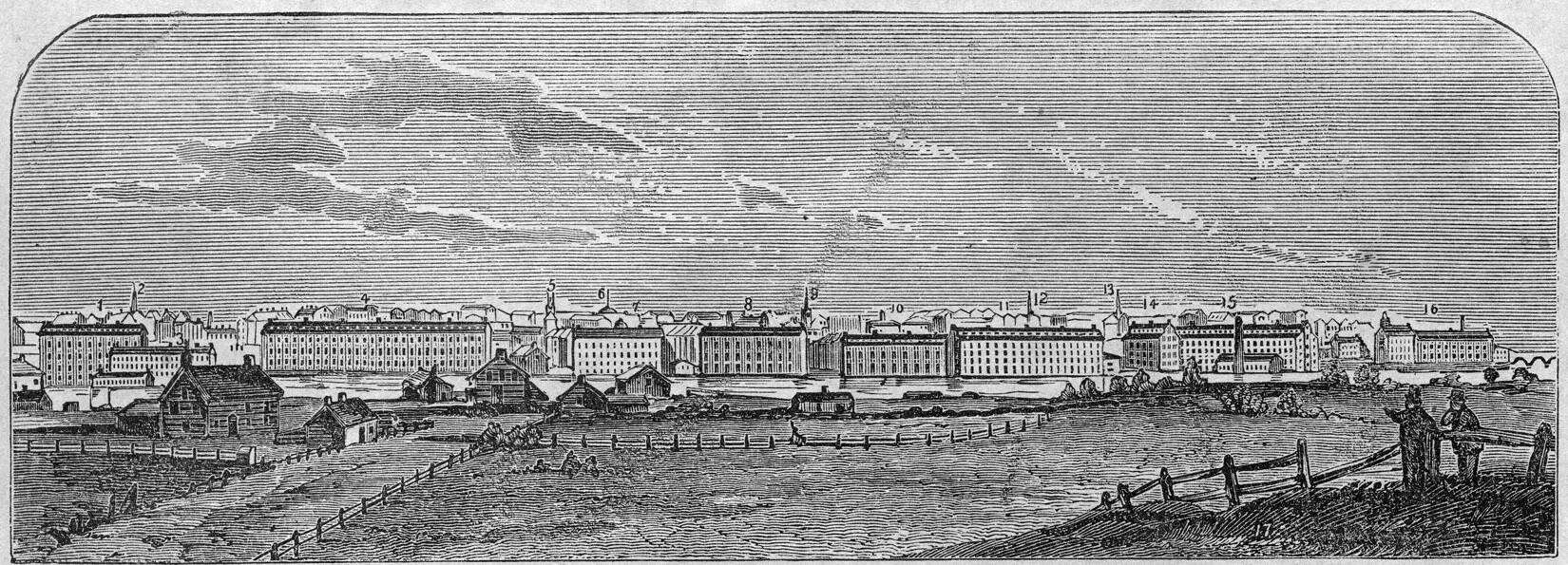
Amoskeag Manufacturing Company founded
A long rectangular drawing shows a town from a distance. In the foreground, fields bordered by fencing and a few houses line a river. Then in the middle of the drawing, long industrial buildings dominate the town along the river. There are more than nine buildings lining the river across the drawing. Behind the industrial buildings, here and there, other aspects of the town peek through. The sky is shown in the top half of the drawing.
1838
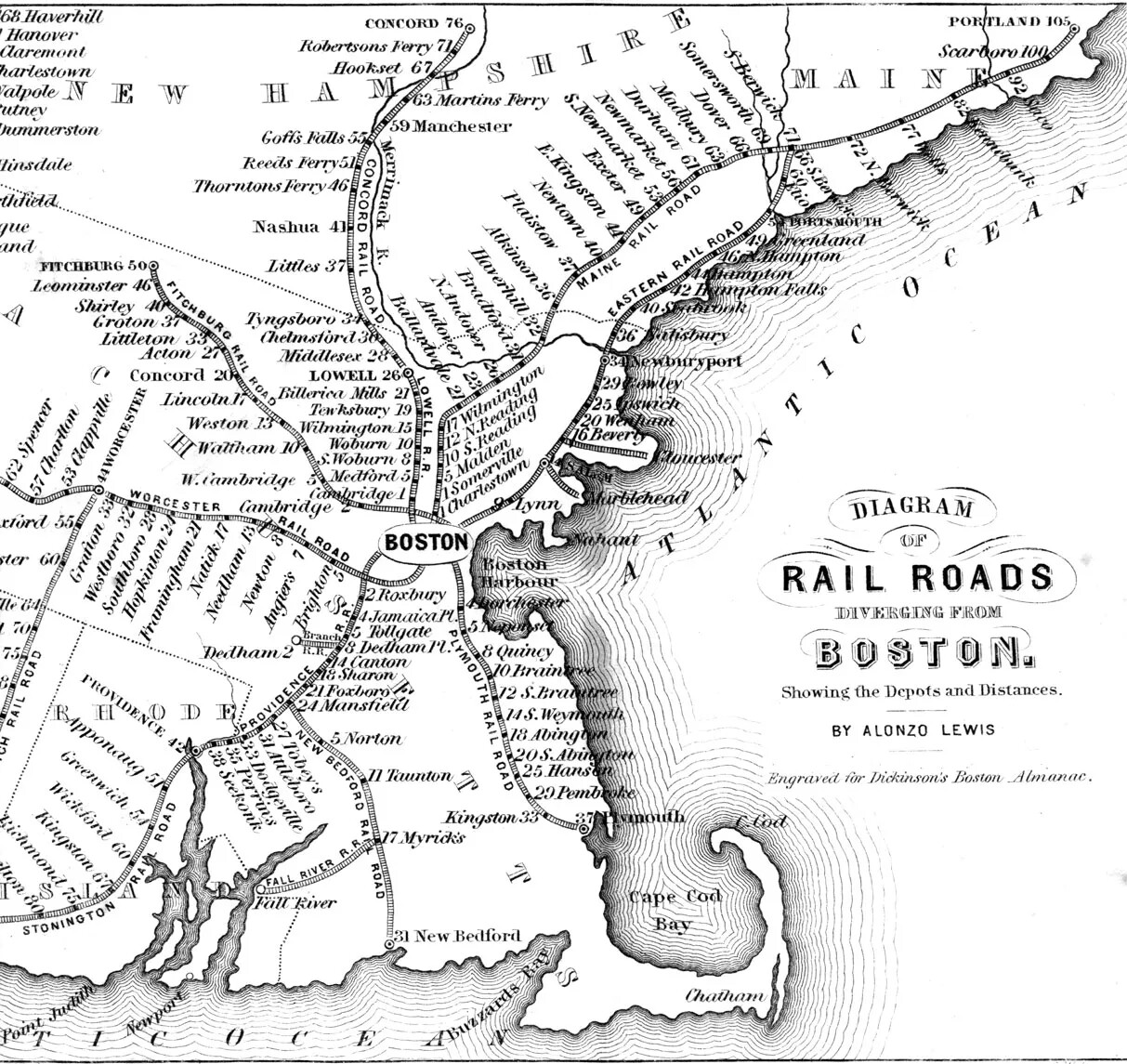
First railroad in New Hampshire
A historic map of southeastern New England is shown. Cape Cod and the Atlantic seashore are prominent. New Hampshire, Massachusetts, Maine, and Rhode Island's borders are noted. Large rivers and ocean features are labeled. The word Boston is written in bold script and circled in the appropriate place. Extending out from Boston are seven lines like spokes of a wheel. Each line has many depots labeled along it. The lines extend as far north as Concord, NH, and Portland, ME; as far west as to travel off the map; and as far south as New Bedford, MA. The title of the map lies in the Atlantic Ocean, and reads "Diagram of Rail Roads Diverging from Boston. Showing the Depots and Distances By Alonzo Lewis."
1844
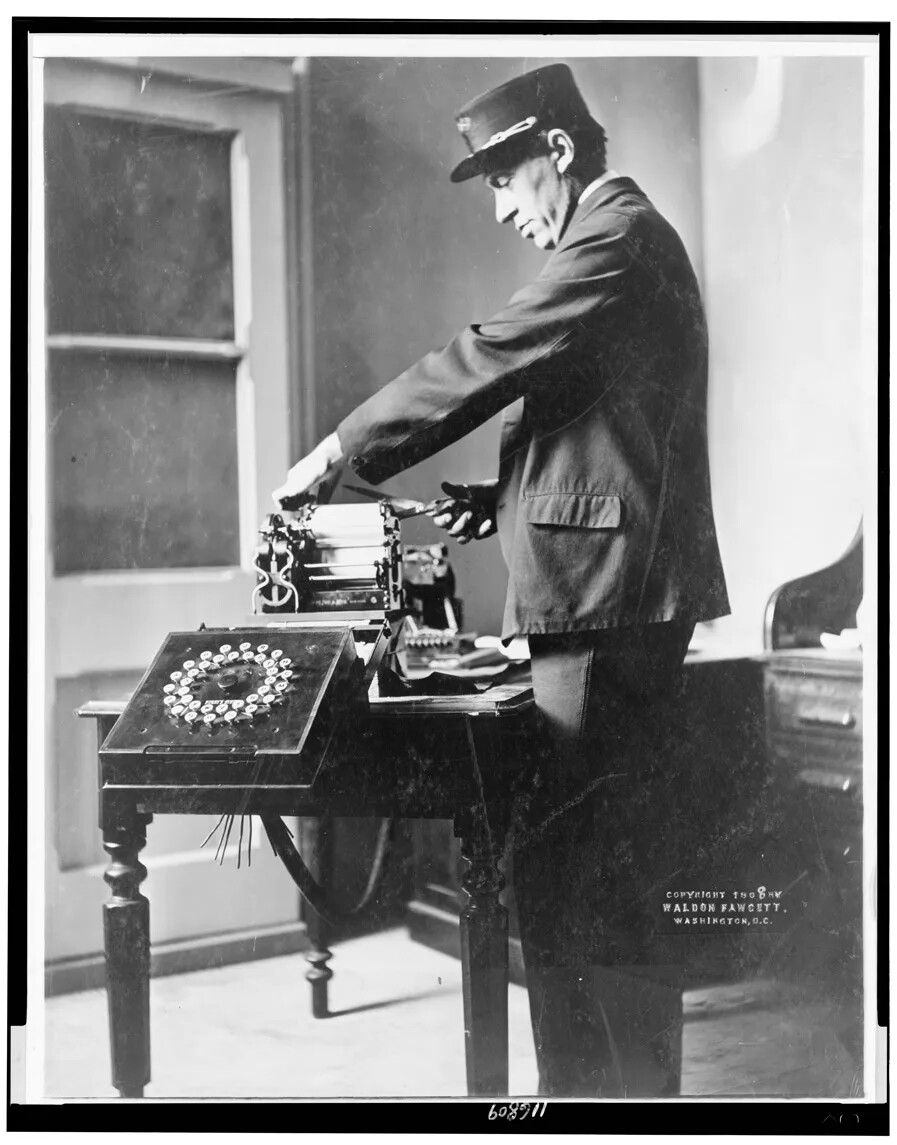
First telegraph communication
In this black and white photograph, a man stands in a room with a window. He wears a uniform with a cap decorated with gold braid. He stands at a desk, cutting paper from a machine on the desk. The machine has rollers and, on the side, a black square at waist height tilted up. The square is roughly a foot on all sides, and has two circles of buttons, one inside another.
1845
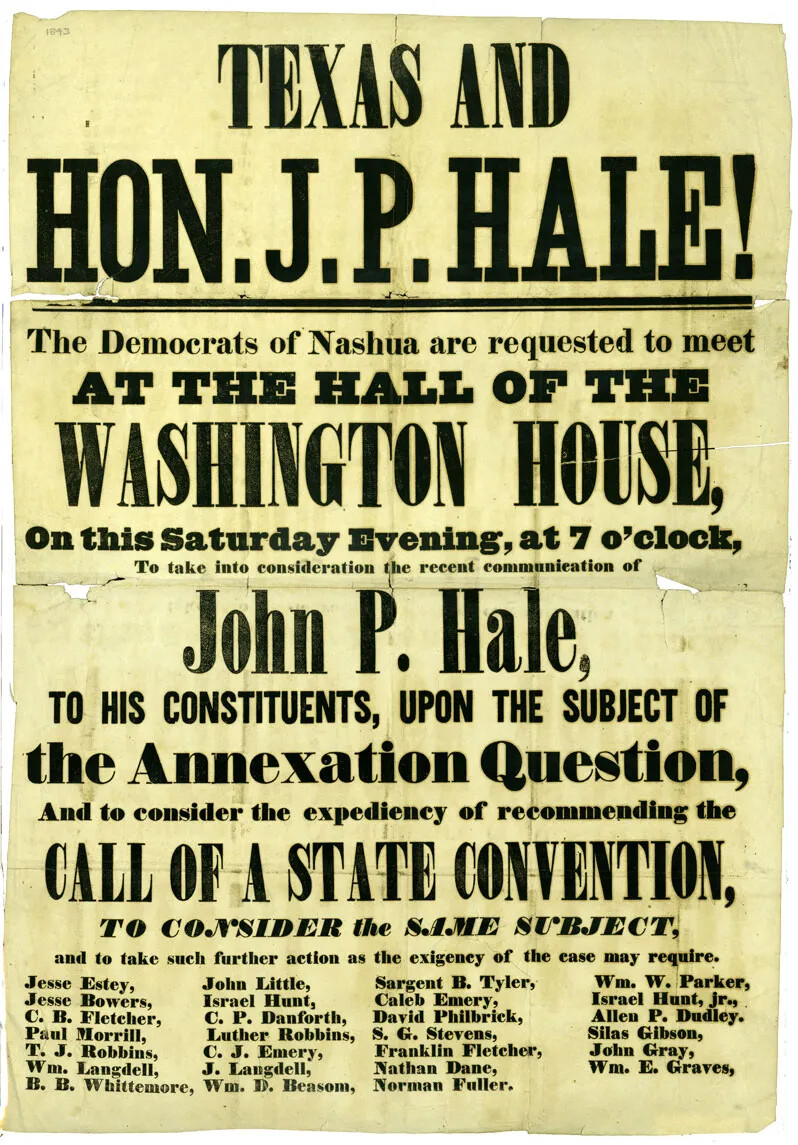
Senator Hale speaks out against slavery
An advertisement with black print on white background announces speech by John P. Hale, using capital letters and bold printing for emphasis on occasion. Details include "Texas and the Hon. J. P. Hale! The Democrats of Nashua are requested to meet at the hall of the Washington House … To take late consideration the recent communication of John P. Hale ... upon the subject of the Annexation Question, And to consider the expediency of recommending the call of a state convention." At the bottom, more than 25 printed names are listed.
1845–1851
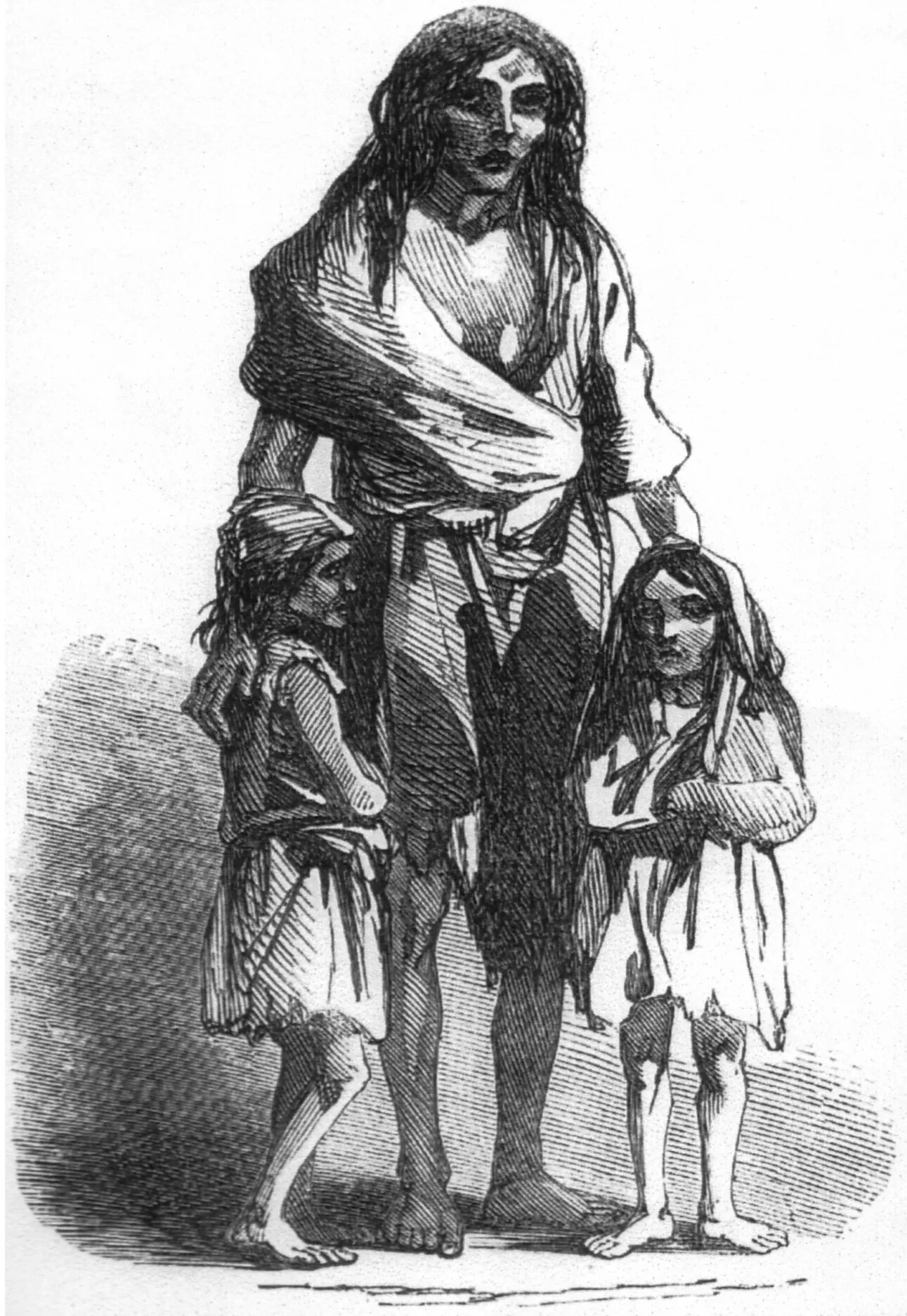
Irish potato famine
A black and white sketch drawing shows a woman in rags standing with long, messy hair. She has her arms around two small children, one on each side of her. The children are also dressed in rags. All three figures show hopelessness on their faces.
1848
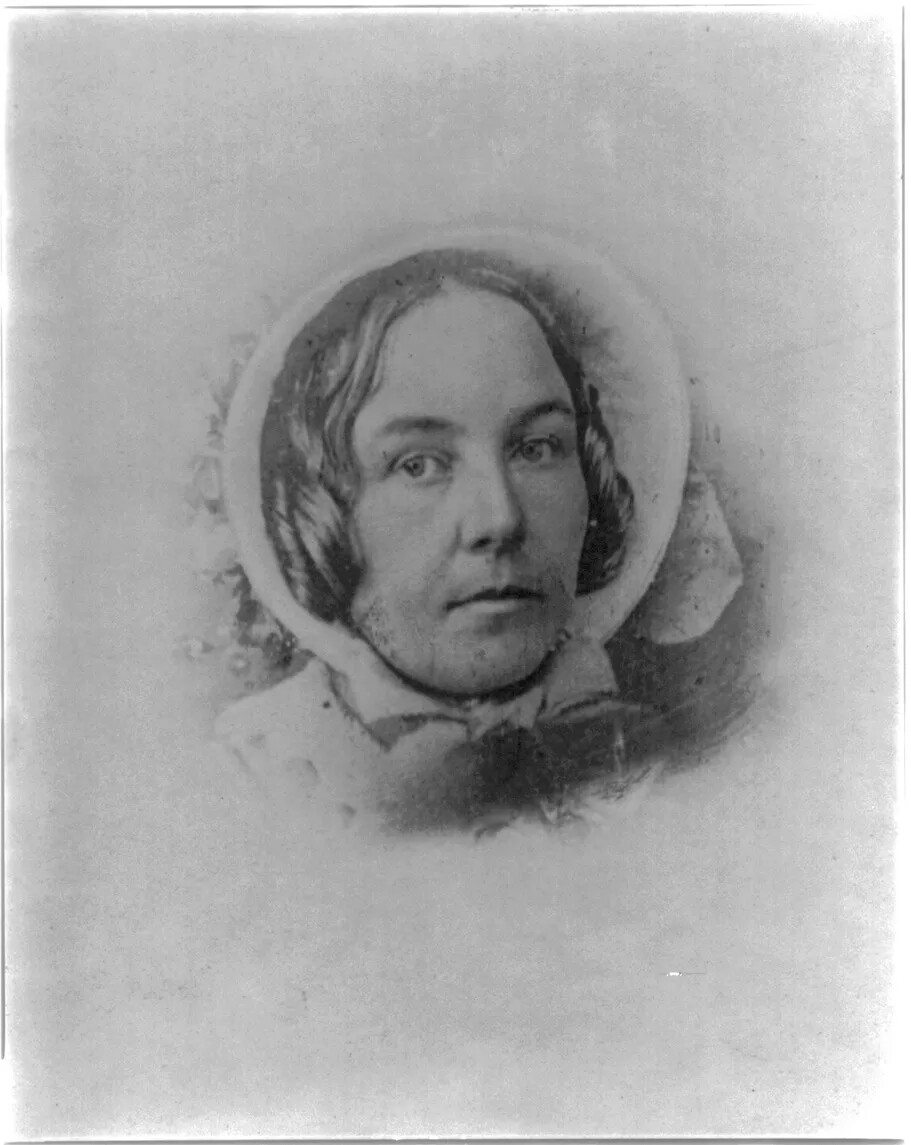
Seneca Falls Convention
An old black and white photograph shows a woman's head in a bonnet. She is looking to the left and her dark hair comes out from the side of the bonnet next to her face.
1849
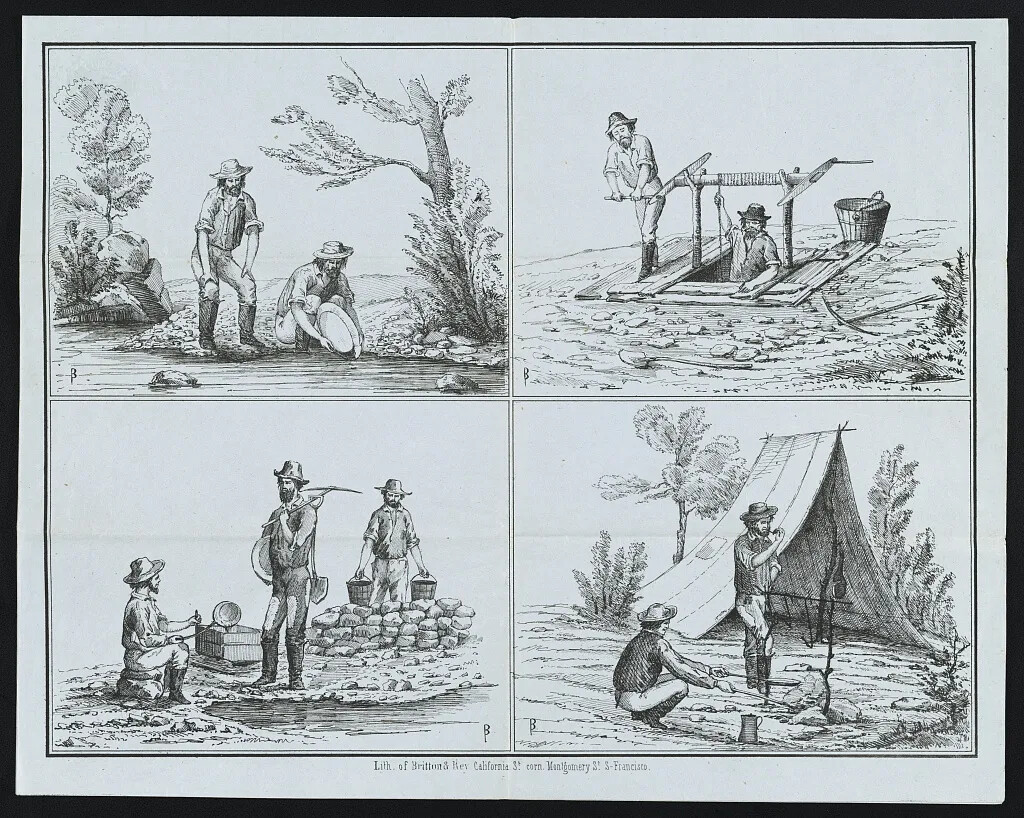
California gold rush
A black and white drawing is divided into four equal rectangles. The left upper section shows two men next to a river lined with trees. One is standing and one is kneeling at the water. The kneeling man is putting a broad, flat pan into the water. The upper right section shows a hillside with a hole in it and two men. There is a bucket, shovel, and pickaxe on the ground next to the hole. The hole has wood around it and a piece of wood with rope tied to it suspended over the hole. One man is standing in the hole holding the rope and the other man is helping to lower the rope. The left lower section shows three men by a river's edge. One man sits on the ground with a pan and large bucket. One man stands with a pickaxe and shovel over his shoulder. One man walks towards a pile of rocks with two buckets in his hand. The right lower section shows two men at a rough campsite. There is a large piece of suspended, patched canvas for a tent. One man cooks something over a small fire while the other man stands at the fire smoking a pipe.
1849
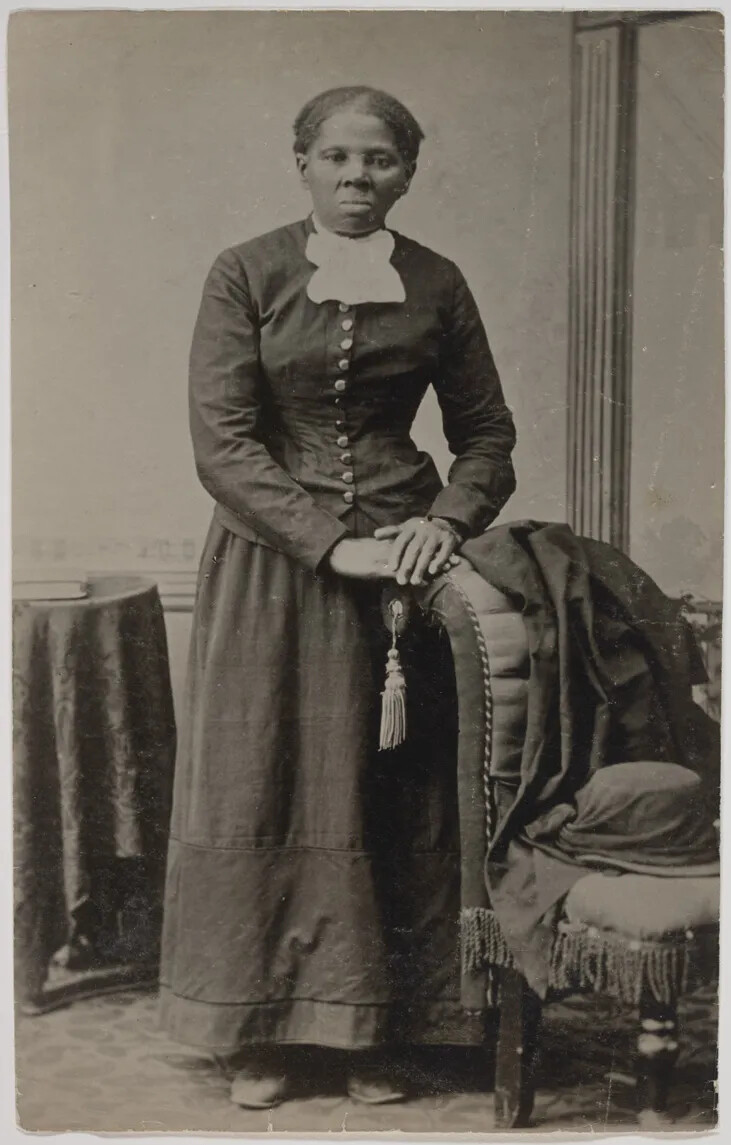
Harriet Tubman escapes from slavery
A formal black and white photograph shows a woman in dark mid-1800s clothing. Her hair is pulled back and she is not smiling. She is standing in a room between a brocade chair and a small, cloth covered table. She rests her hands on the back of the chair next to her. A jacket and woman's bonnet is on the chair.
1852
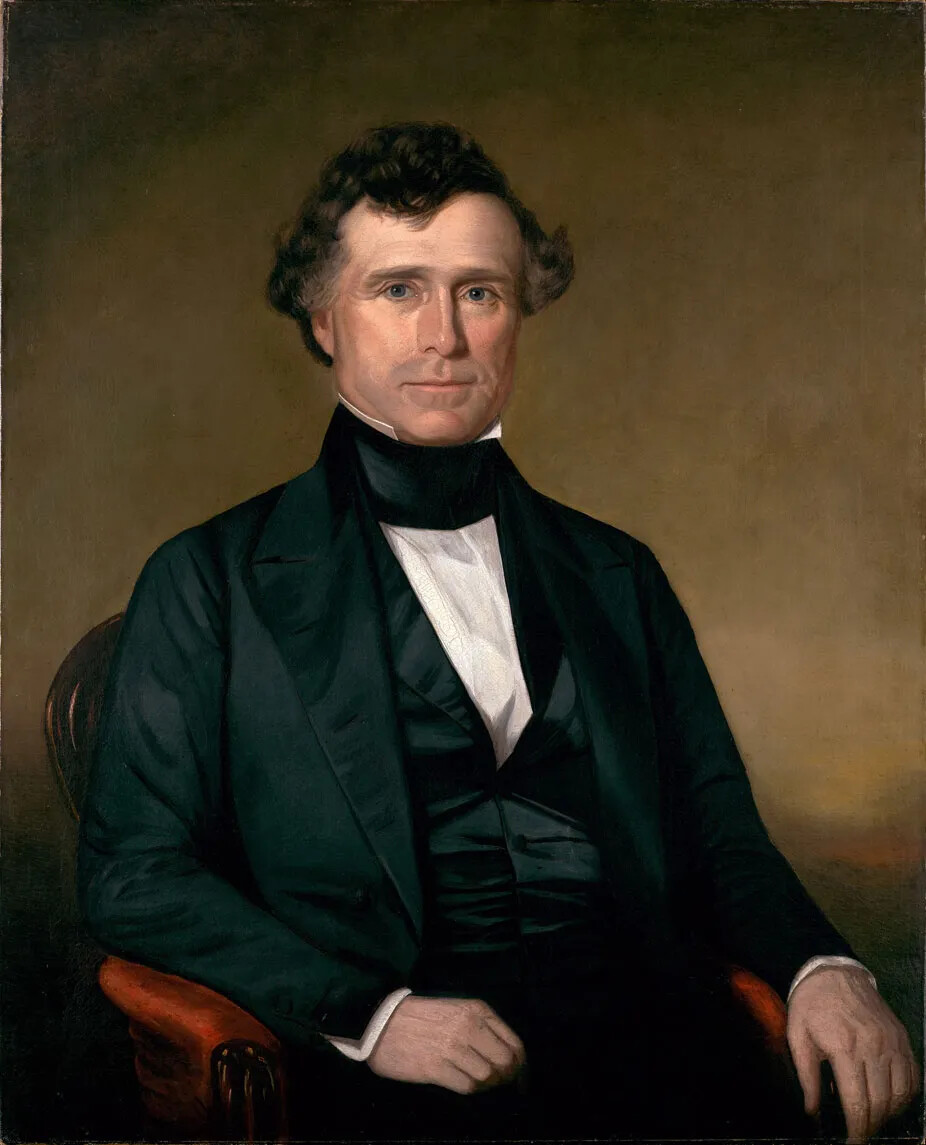
Franklin Pierce elected U.S. president
In a color painting, a man sits on a leather chair against a brown background. He is wearing a black suit in the mid-1800s style with high collar and no tie. His hands rest on the arms of the chair in a casual manner, and he looks directly at the viewer with a small smile. He has short curly brown hair and no facial hair.
1853
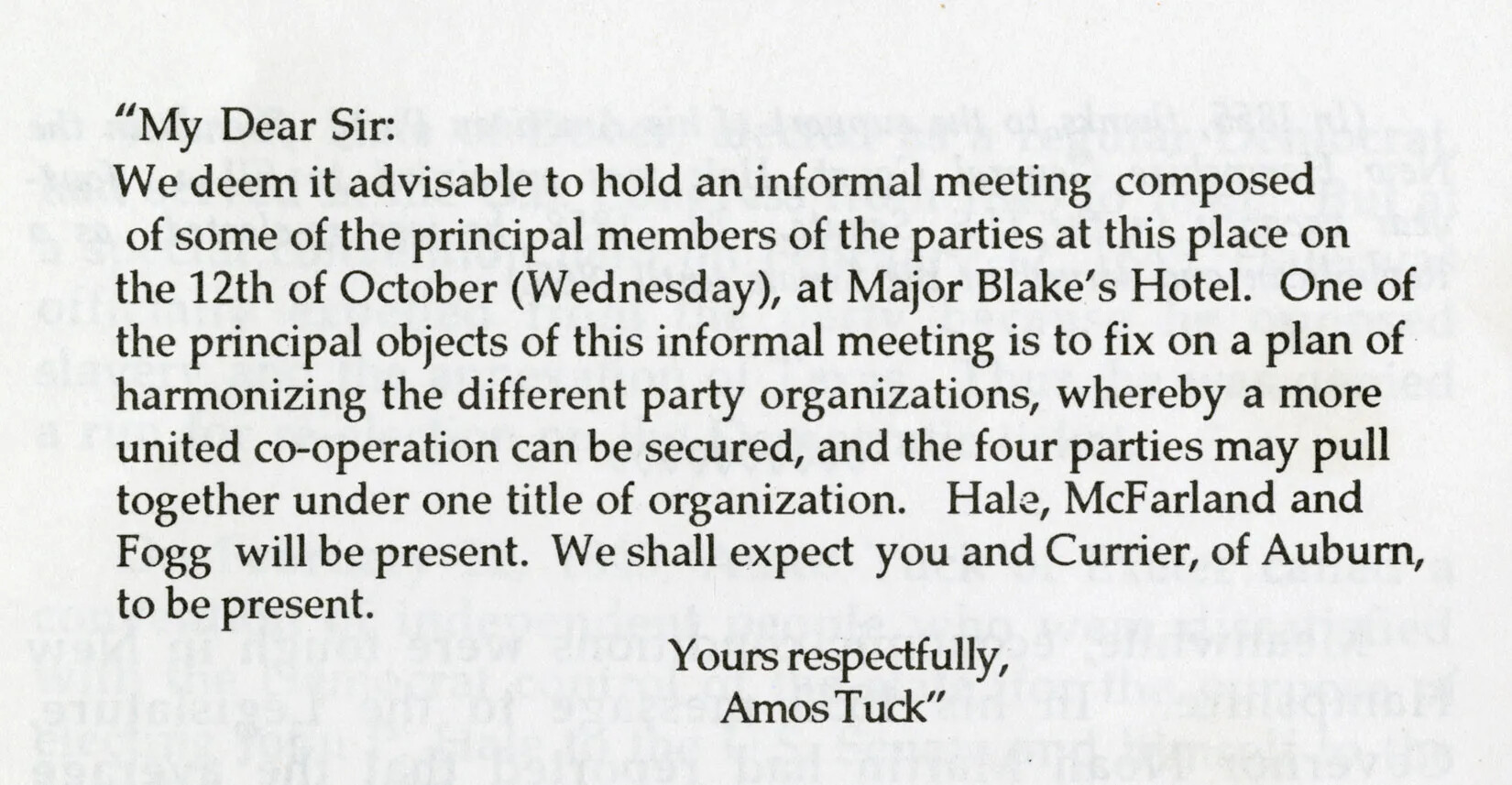
Amos Tuck founds the Republican Party
A typewritten note reads "My Dear Sir: We deem it advisable to hold an informal meeting composed of some of the principal members of the parties at this place on the 12th of October (Wednesday), at Major Blake's Hotel. One of the principal objects of this informal meeting is to fix on a plan of harmonizing the different party organizations, whereby a more united co-operation can be secured, and the four parties may pull together under one title of organization. Hale, McFarland and Fogg will be present. We shall expect you and Currier, of Auburn, to be present. Yours respectfully, Amos Tuck."
1861–1865
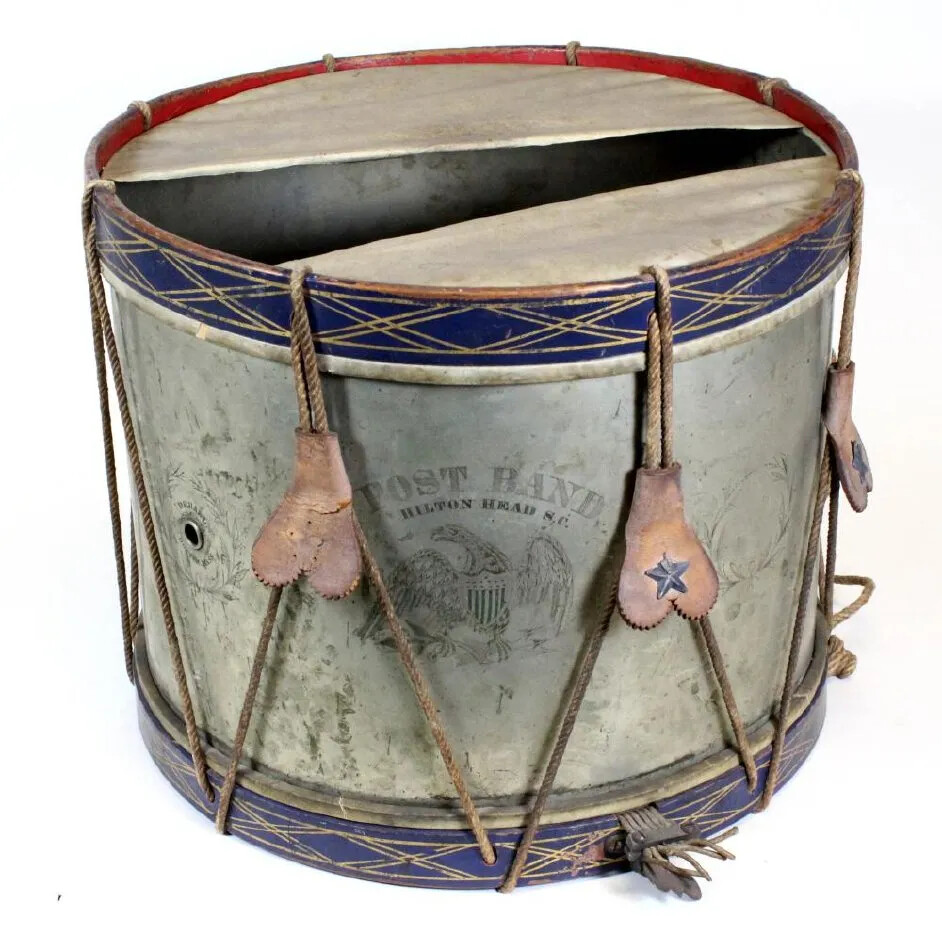
Civil War
A drum is 13.5 inches high and 17 inches in diameter. The sides are nickel-plated brass engraved with seven broken wreaths. In the center of the wreaths is an eagle with outspread wings and shield; it has lettering above. The lettering reads "POST BAND. / HILTON HEAD S.C." There is a maker's mark reading "D.C. HALL. / MANUFACTURER, / BOSTON, MASS." around a  vent hole on one side. On the top and bottom of the drum, there are wooden bands painted dark blue with gilt decorations keeping the parchment heads taught. The top parchment head is torn down the middle.
1863
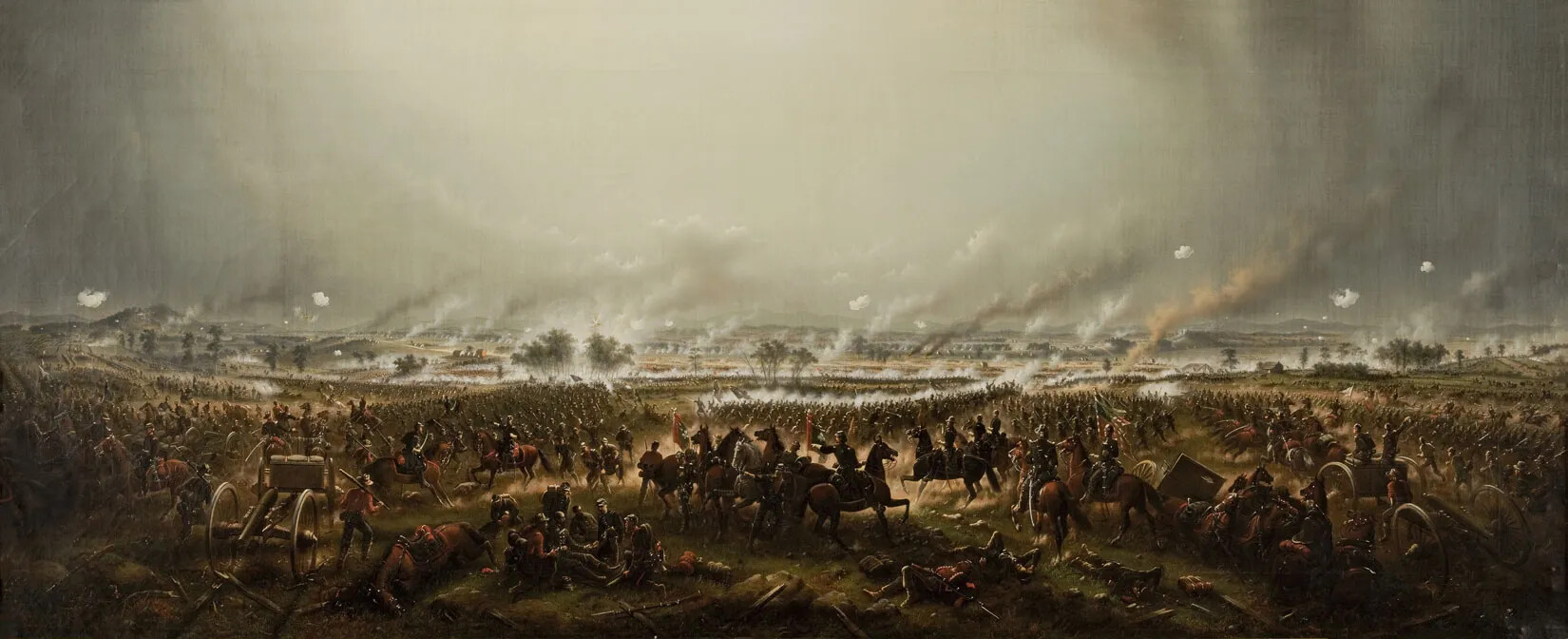
The Battle of Gettysburg
A large, rectangle, color painting of a battle has many details. The sky covers the top half of the painting, and has bright and dark grey parts, but generally is distinguished by the many columns of smoke rising from the battle. The battle covers a large, wide open landscape and the viewer can see far into the distance where the battle ranges. Various details visible include riderless horses, men dead on the ground, Civil War cannons being fired, groups of infantry soldiers fighting at close quarters, men on horseback charging, and battered flags flying.
1867
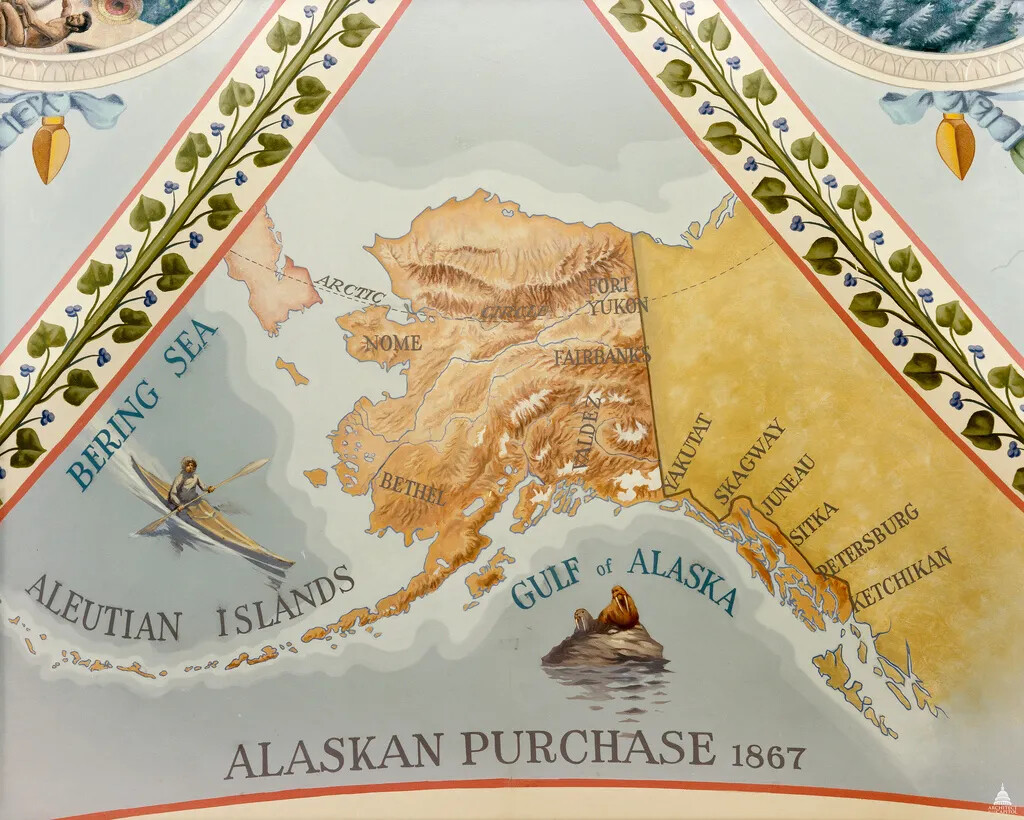
Alaska becomes a U.S. territory
A decorative map shows a close up of the Alaskan purchase connected to western Canada. Alaska is dark orange and shows elevation lines. Canada is dark yellow and bodies of water are various shades of blue. In the water, an Eskimo hunts in a kayak near a seal and walrus. On the map various important towns in Alaska are labeled. The Gulf of Alaska, Bering Sea, and Aluetian Islands are labeled. The map is titled "Alaskan Purchase 1867."
1869
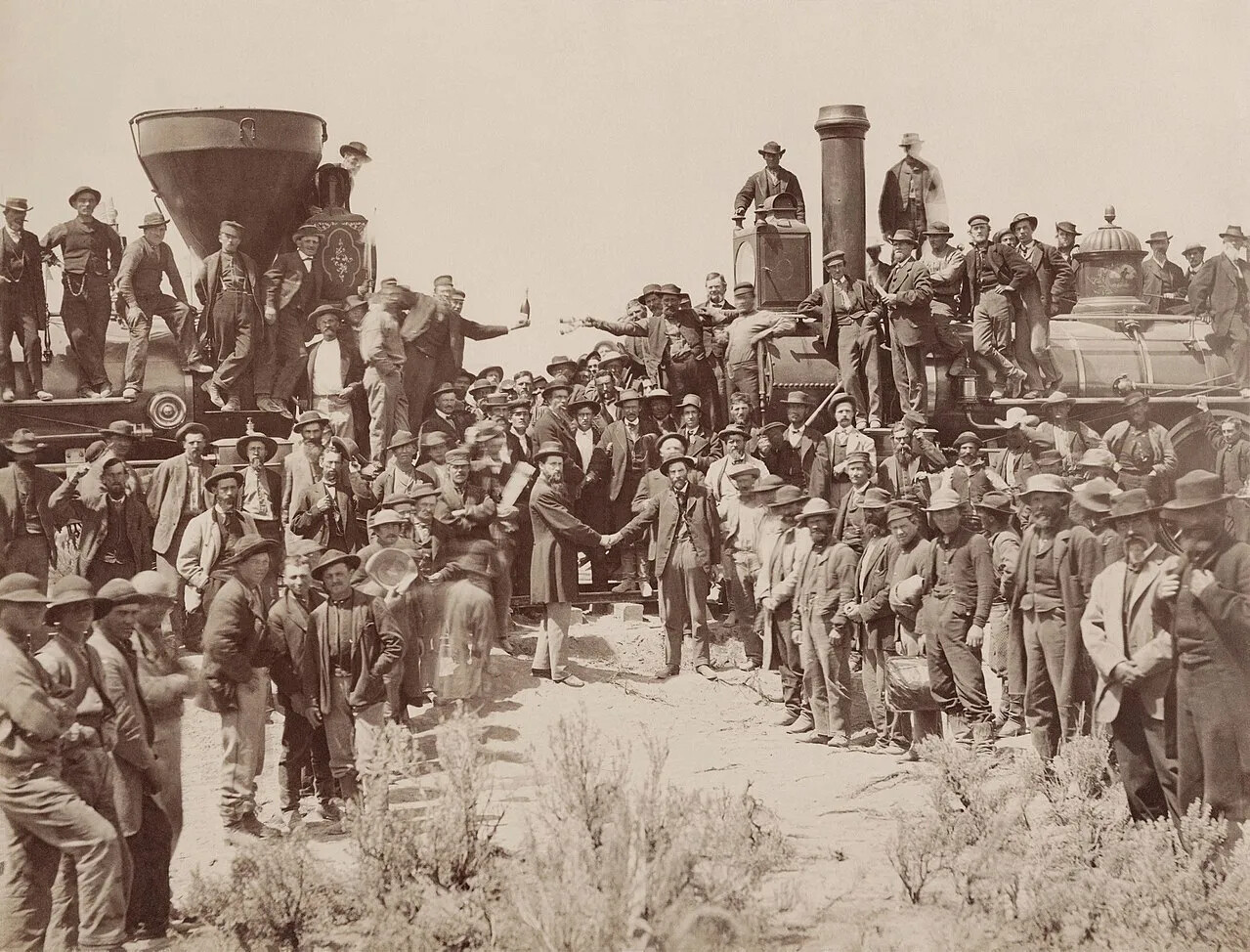
Transcontinental railroad
A black and white photograph shows two railroad engines facing each other. The left exhaust pipe is large and shaped like an inverted funnel, while the other exhaust pipe is straight. There are many men in the photograph, standing on the ground, on the engines, and all around. They generally wear hats and working clothes, and some carry shovels or pickaxes. Some are dressed as conductors on trains. Two men in suits stand in the center and shake hands while everyone watches them or faces the camera.
1869
Cog Railway opens
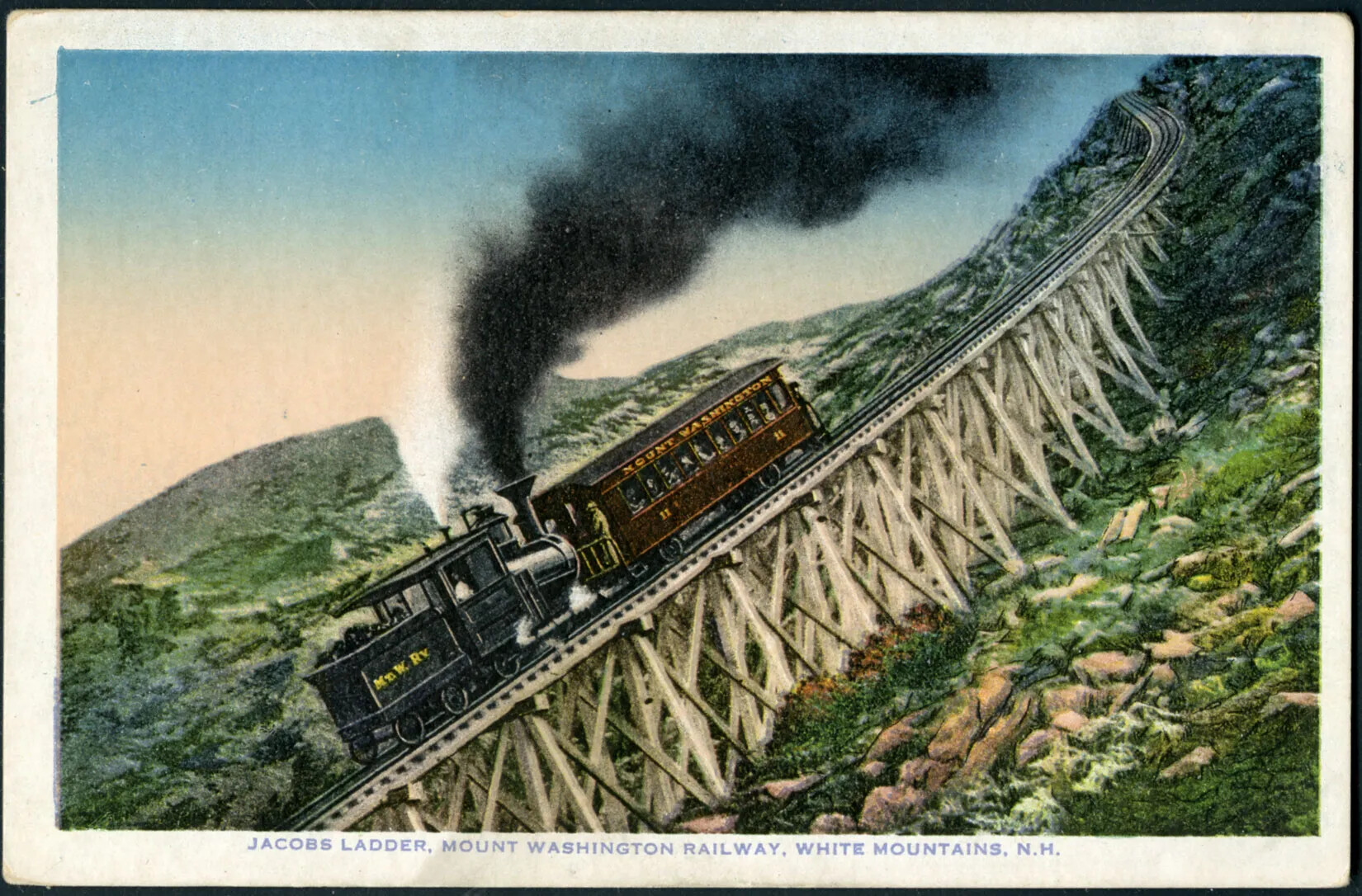
A color postcard of a train with one passenger car has a caption reading "Jacob's Ladder, Mount Washingon Railway, White Mountains, N.H." The train is descending from a very steep part of the tracks on the side of a mountain, which is covered with scrub and rocks. The part of the track the train is on is built up on a small bridge made of timber to keep the track as consistent as possible.
1870
Marilla Ricker tries to vote
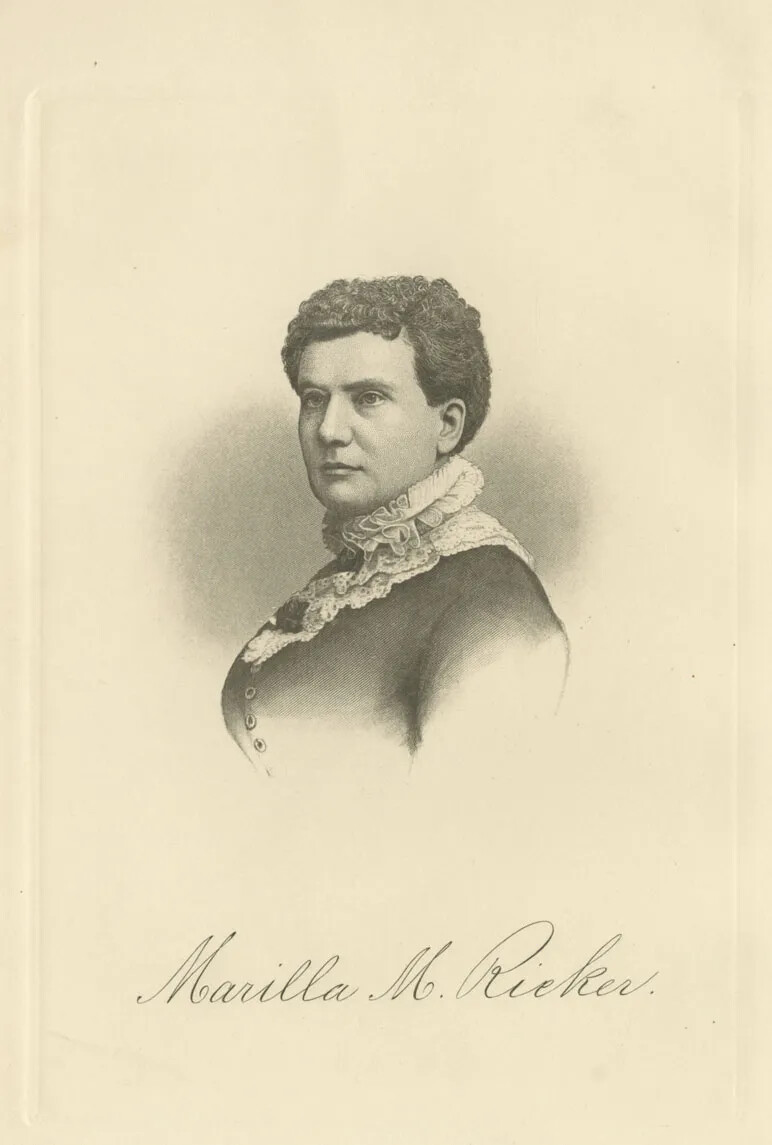
A black and white portrait of a woman shows her head, shoulders, and upper torso. She is dressed in formal 1800s clothing, with a dark dress and lace collar. Her hair is parted on the side and pulled back. She is facing away from the viewer towards the left, but turns her head to look over her shoulder, just off to the left side of center. She is not smiling. At the bottom of the portrait is written "Marilla M. Ricker" in cursive script.
1872
Skiing comes to New Hampshire
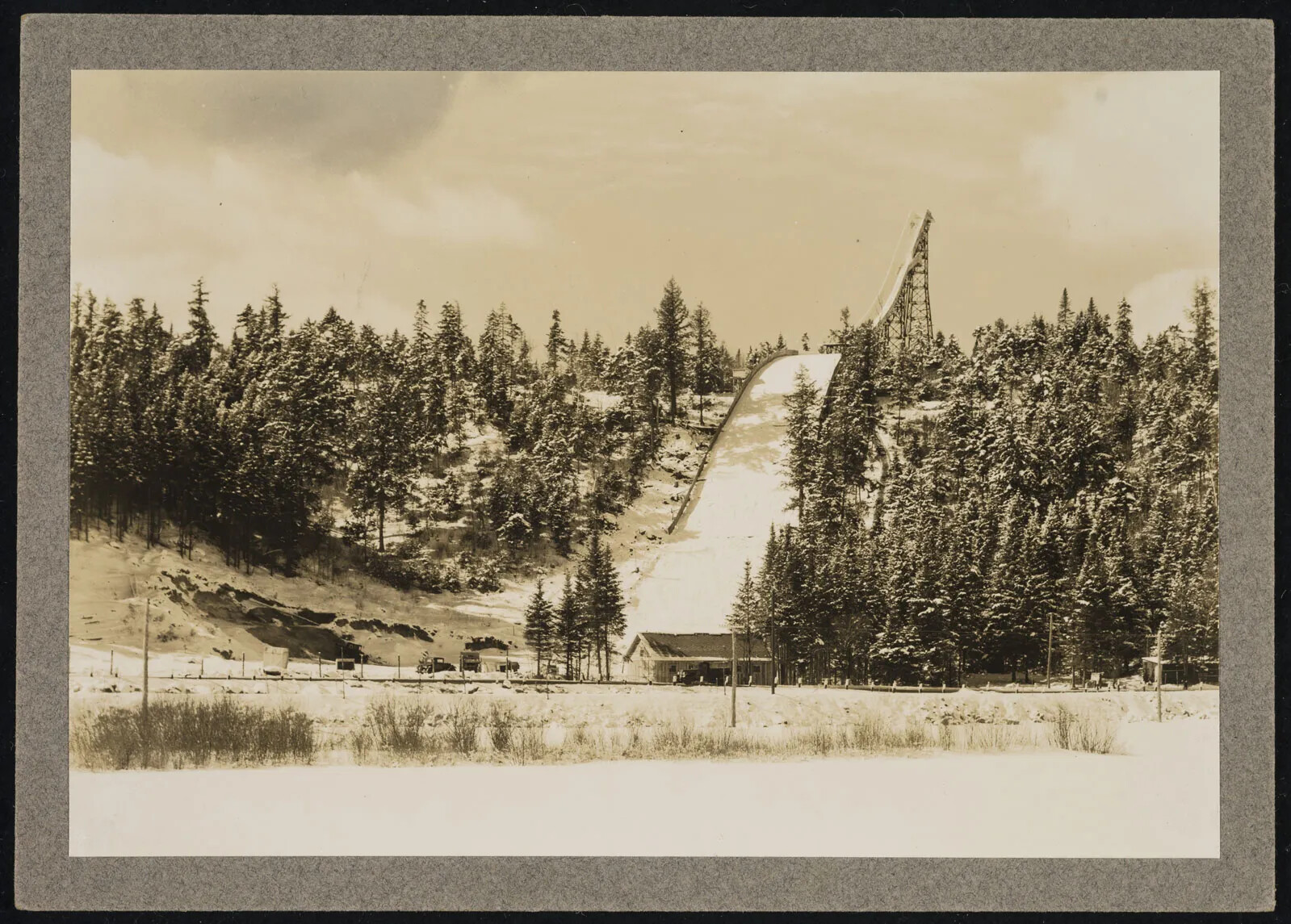
A black and white photograph shows a valley and small hill nearly covered with pine trees in the winter. In the middle of the hill a wide, straight track runs smoothly down the hill, covered with snow. In the distance, a tall tower is built on top of the hill to extend the height of the hill. A narrower, steep track runs down the tower at an angle to meet the track on the hill. A small building sits at the foot of the hill where the track ends.
1879
Light bulb invented
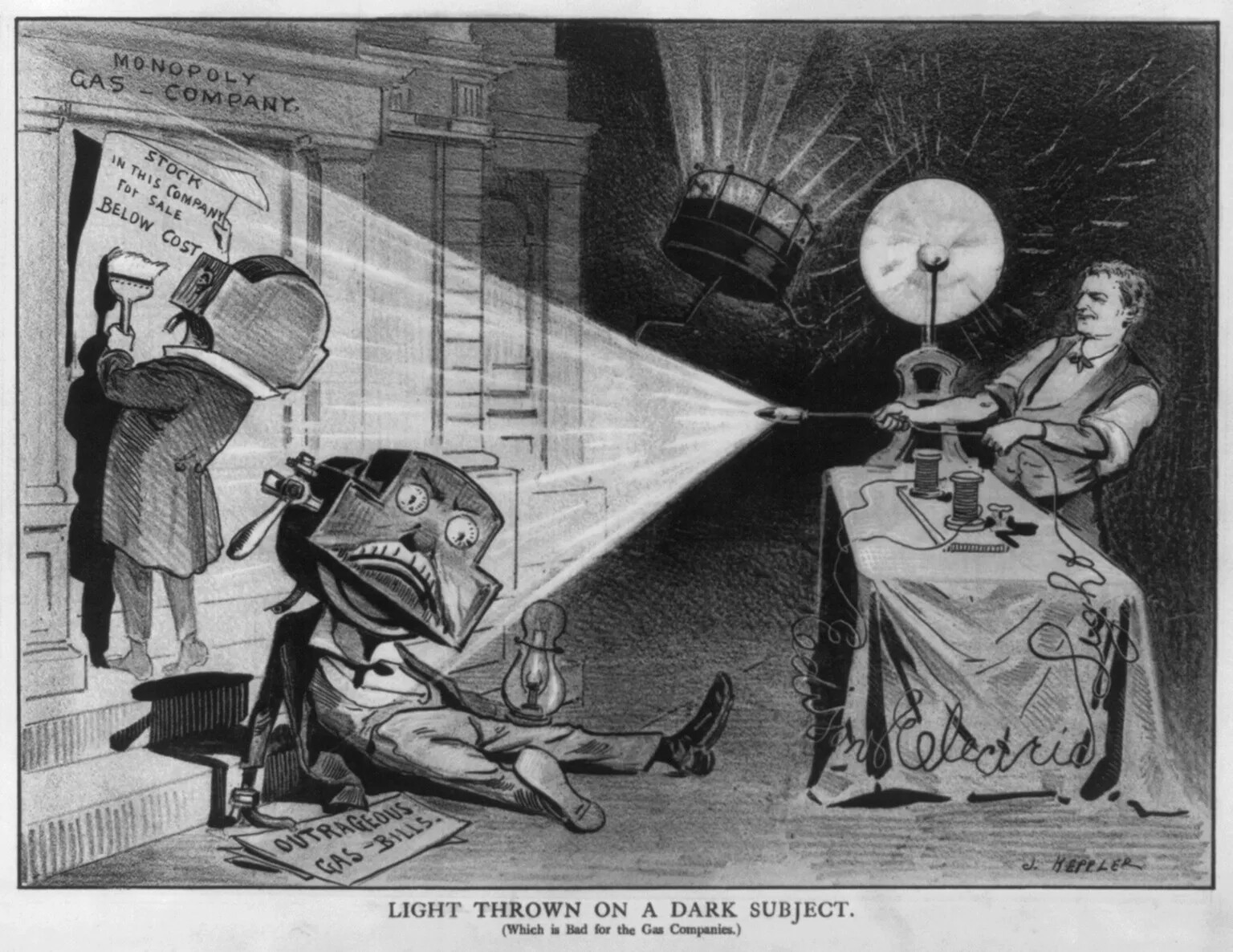
A hand drawn cartoon shows three figures. A man on the right is behind a table and is using wires and various kinds of bulbs. He shines a beam of light to the left side of the cartoon. The two left figures are men-like with gas meters for heads. The light shines on them both. One has fallen on the ground and has an oil lamp in one hand and a sign that reads "Outrageous Gas Bills" in the other. The other figure has his back to the light and is pasting a paper on a building labeled "Monopoly Gas Company." His paper reads "Stock in this company for sale below cost." The caption of the cartoon says "LIGHT THROWN ON A DARK SUBJECT (Which is bad for the gas companies)."
1881
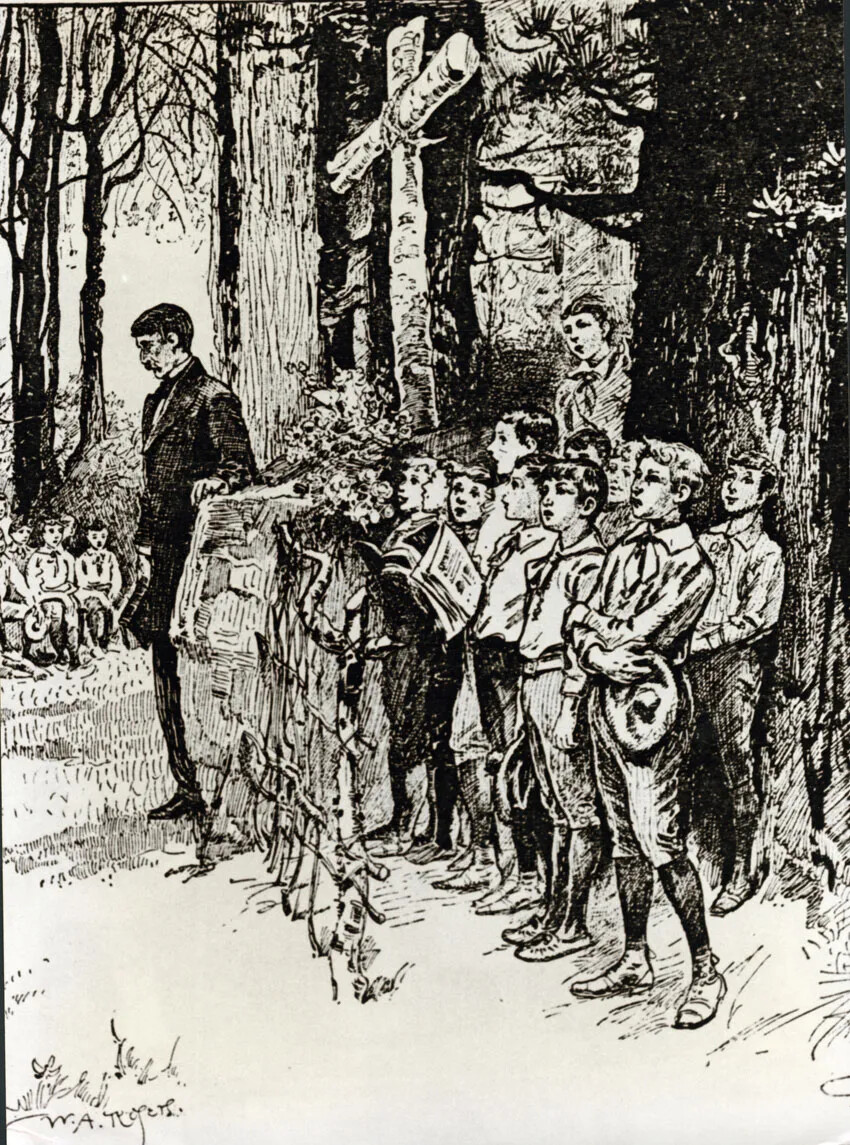
Camp Chocorua opens
A black and white drawing shows people in a woodland scene. There are large trees, showing only their trunks. There is a large cross made from birch tree branches in the center of the drawing. About ten boys are standing under the cross facing left; they have books and their mouths open. They are wearing uniforms with shorts and button down shirts with small ties. A man in a dark suit is standing next to a pulpit made of rock; he is standing solemnly. In the background to the left, seated boys can be seen.
1886
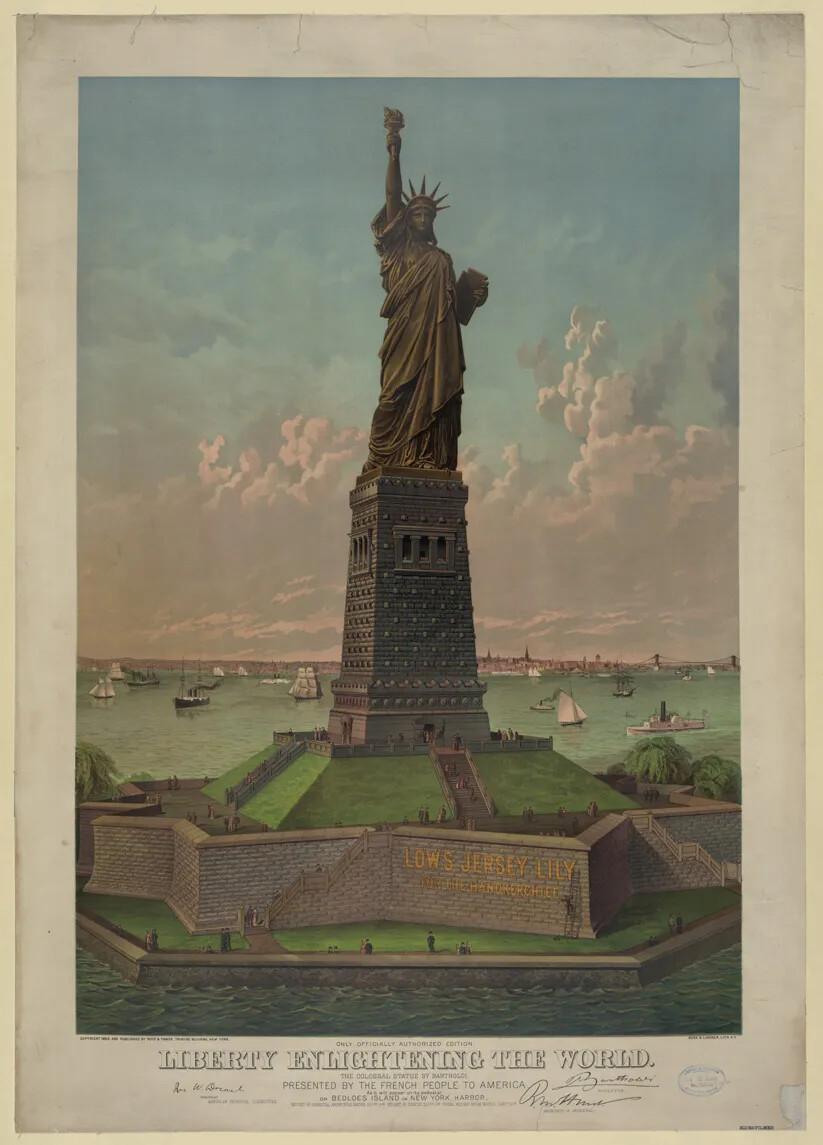
Statue of Liberty
A colorful painting shows a statue of a woman, clothed in robes. She is holding a book in her left hand at her waist. Her right hand is held aloft with a torch in it. She wears a crown of seven spikes. She stands on a square pedestal, which then sits on a slanted lawn supported by star-shaped brick walls. The surrounding scene shows how tall her form and base are, as the water in the background has three-masted ships which seem smaller than her head. There are clouds and blue sky in the background. Underneath the painting, words read "LIBERTY ENLIGHTENING THE WORLD" with additional information given in smaller text.
1899
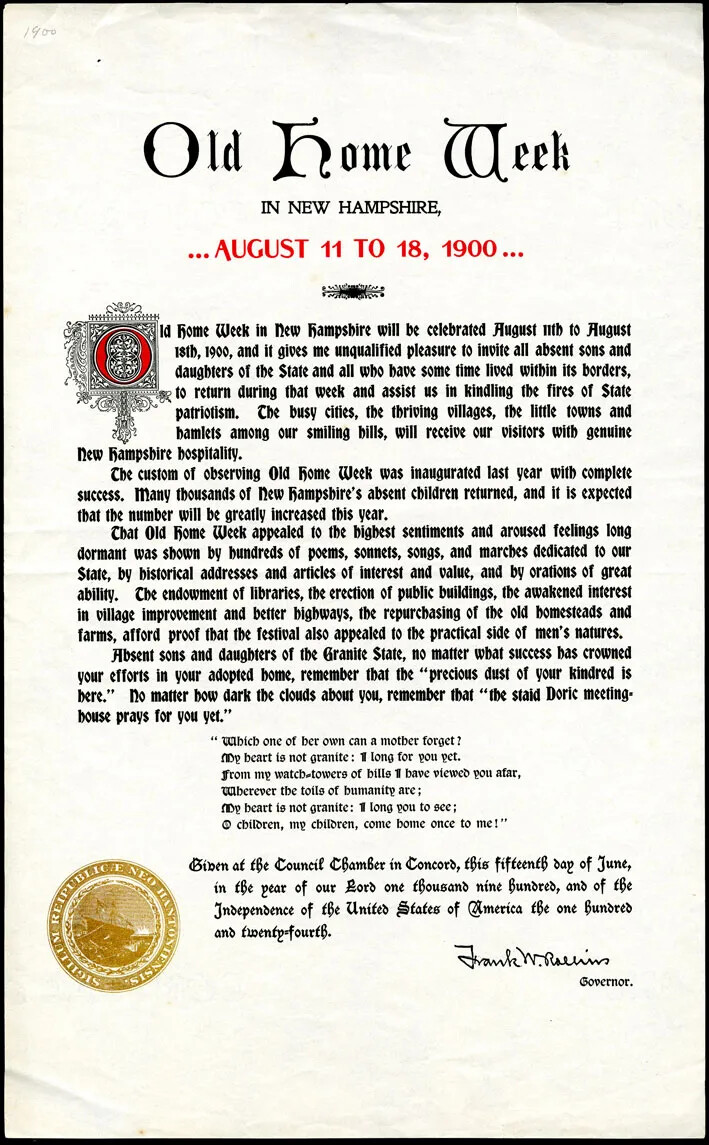
First Old Home Week
A document has ornate printing. It is titled "Old Home Week in New Hampshire … August 11 to 18, 1900 …" Five paragraphs describe the celebration, and include one paragraph of poetry at the bottom. The governor Frank Rollins has signed it, and there is a golden seal of the state at the bottom left corner.
1903
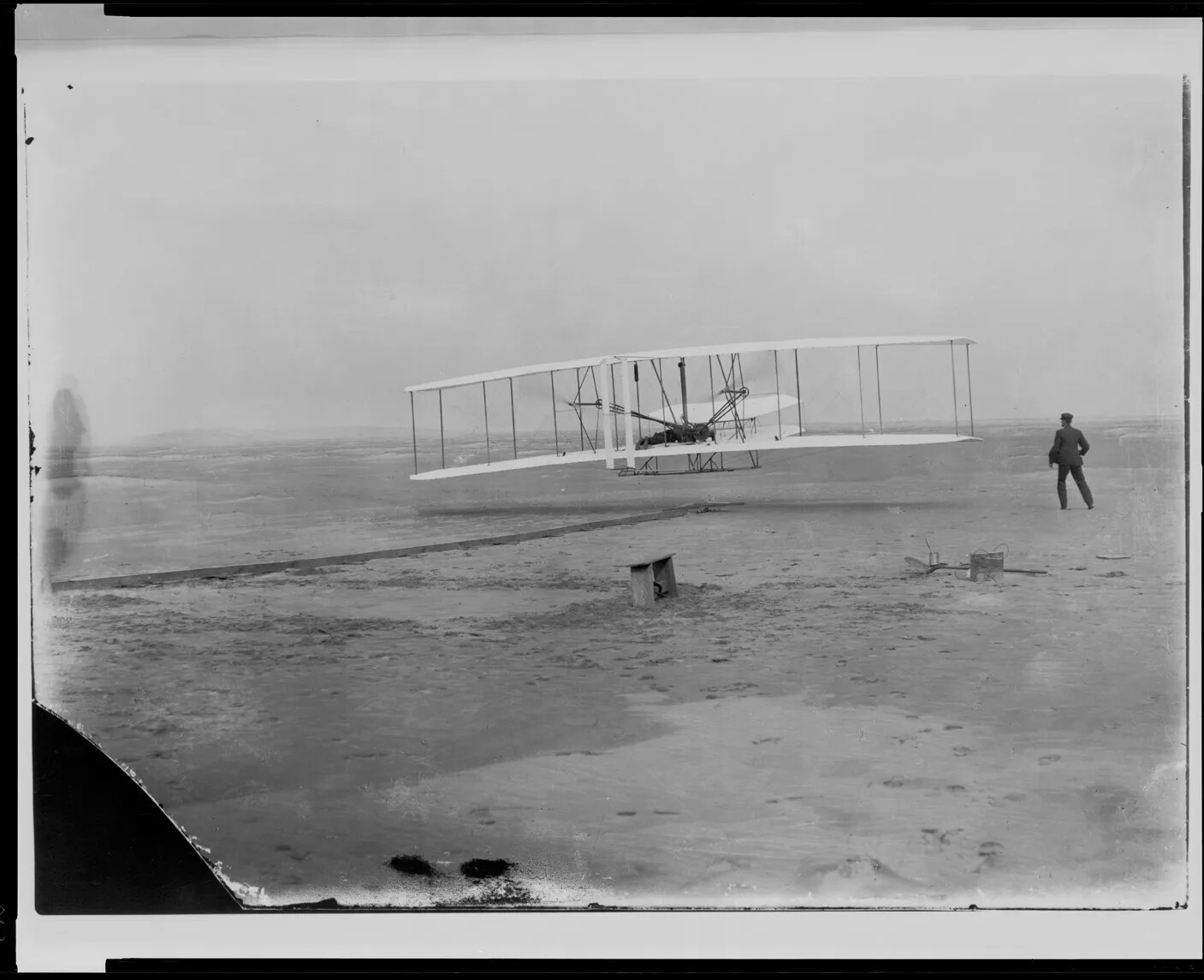
Wright Brothers’ first flight
In a black and white photograph, a biplane is shown with two wings stacked on each other. A small engine is seen along with a small body of the plane behind the wings. The plane is on a beach and a man stands watching it, near a wooden bench.
1903
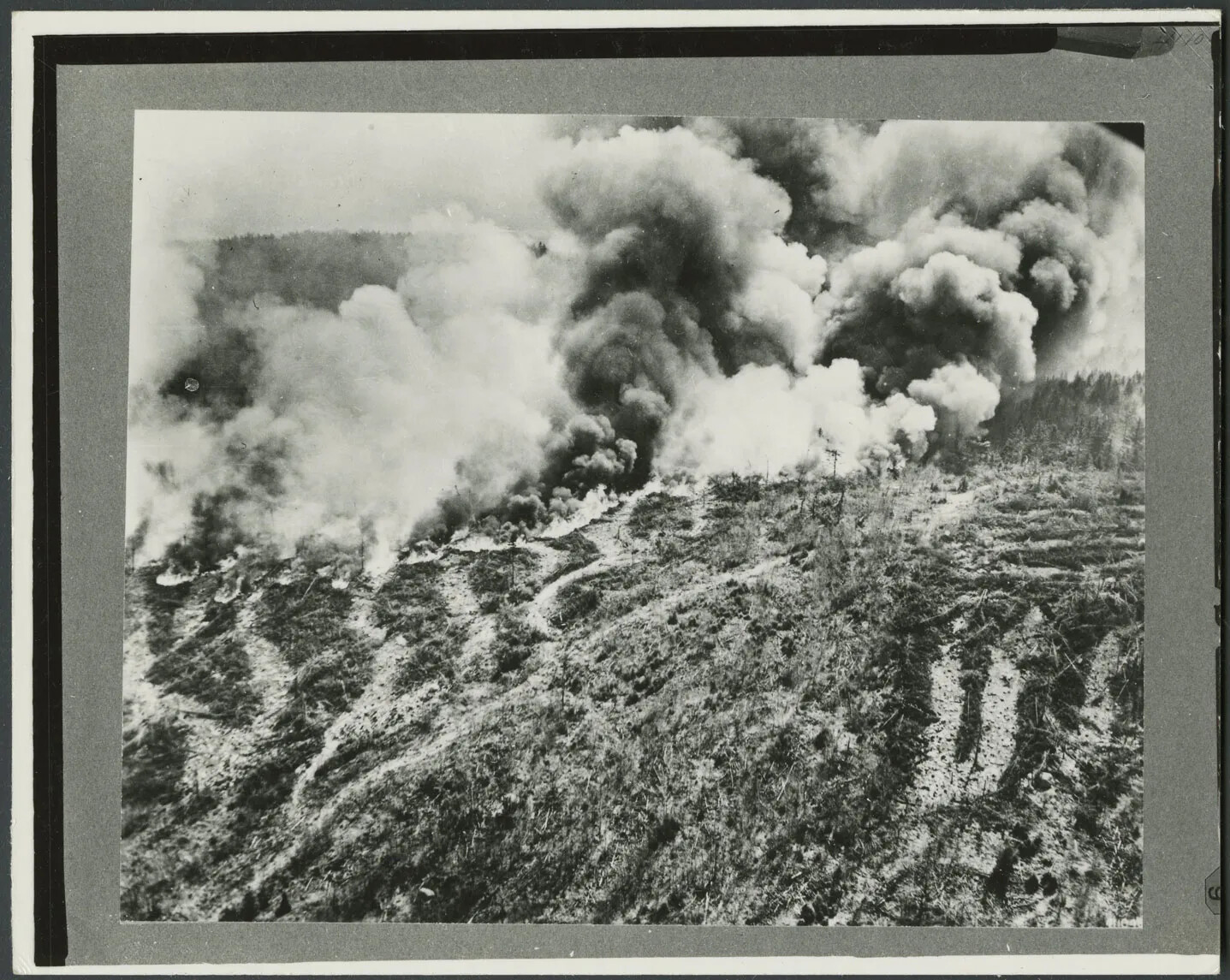
Forest fires burn the White Mountains
A black and white photograph of a wide landscape is seen. The landscape is hilly but not steep; there are trees and brush throughout. There are also several dirt paths across the hill. In a line across the photograph, a wildfire is raging. The smoke reaches far into the sky and is dark and voluminous. Flames are seen across the hill in a thick line.
1909
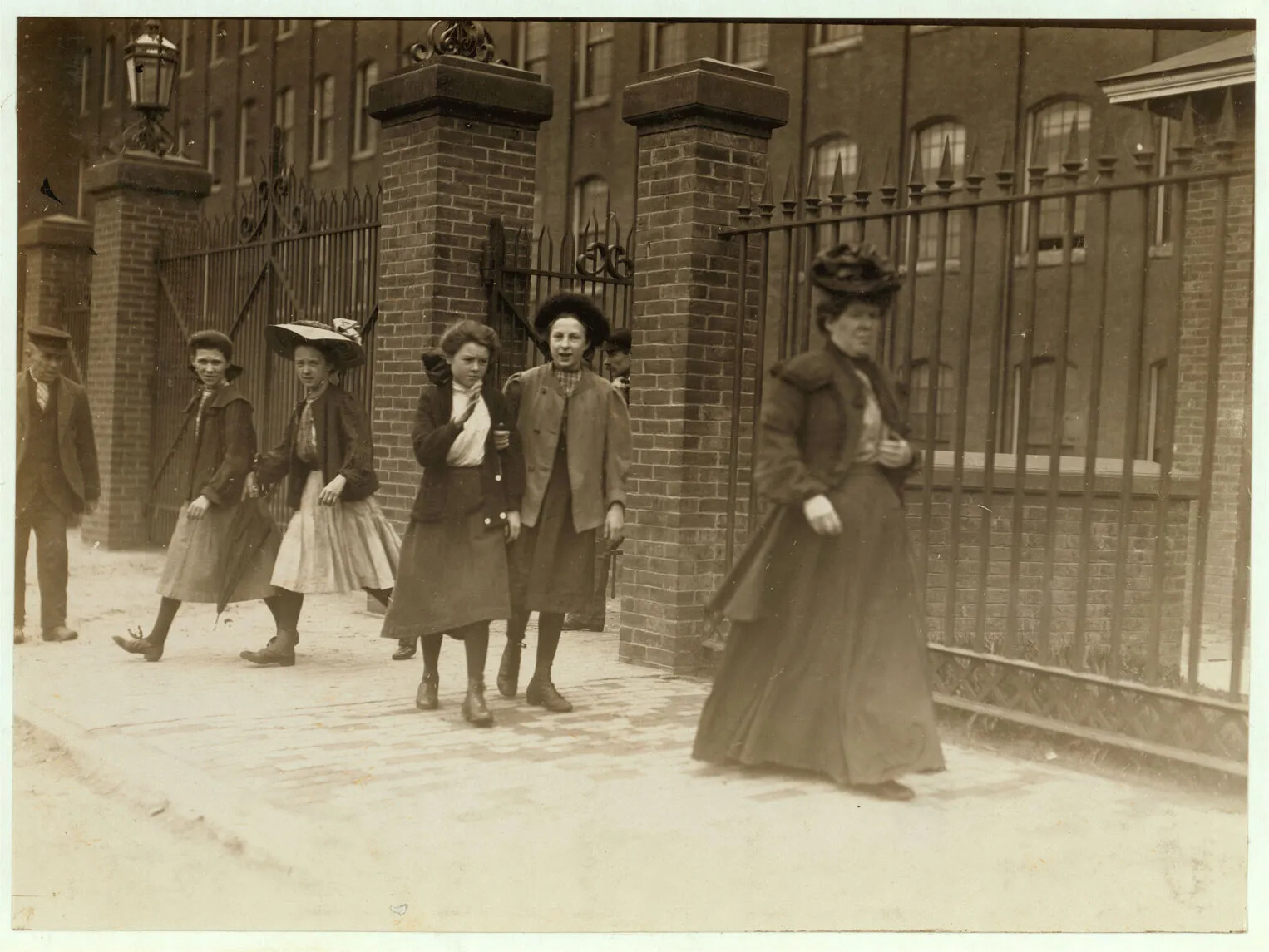
Lewis Hine photographs child mill workers
In a black and white photograph, the outside of a brick building is shown. Wrought-iron gates with tall brick columns fence the building. People are exiting through the gate out to the dusty sidewalk. One women wears long dark skirts, a formal jacket, and a decorative hat. Behind her, four girls just leaving the gate wear shin length skirts, jackets, and hats or bows in their hair. One man wears a dark suit and a casual hat and is watching them all leave.
1909
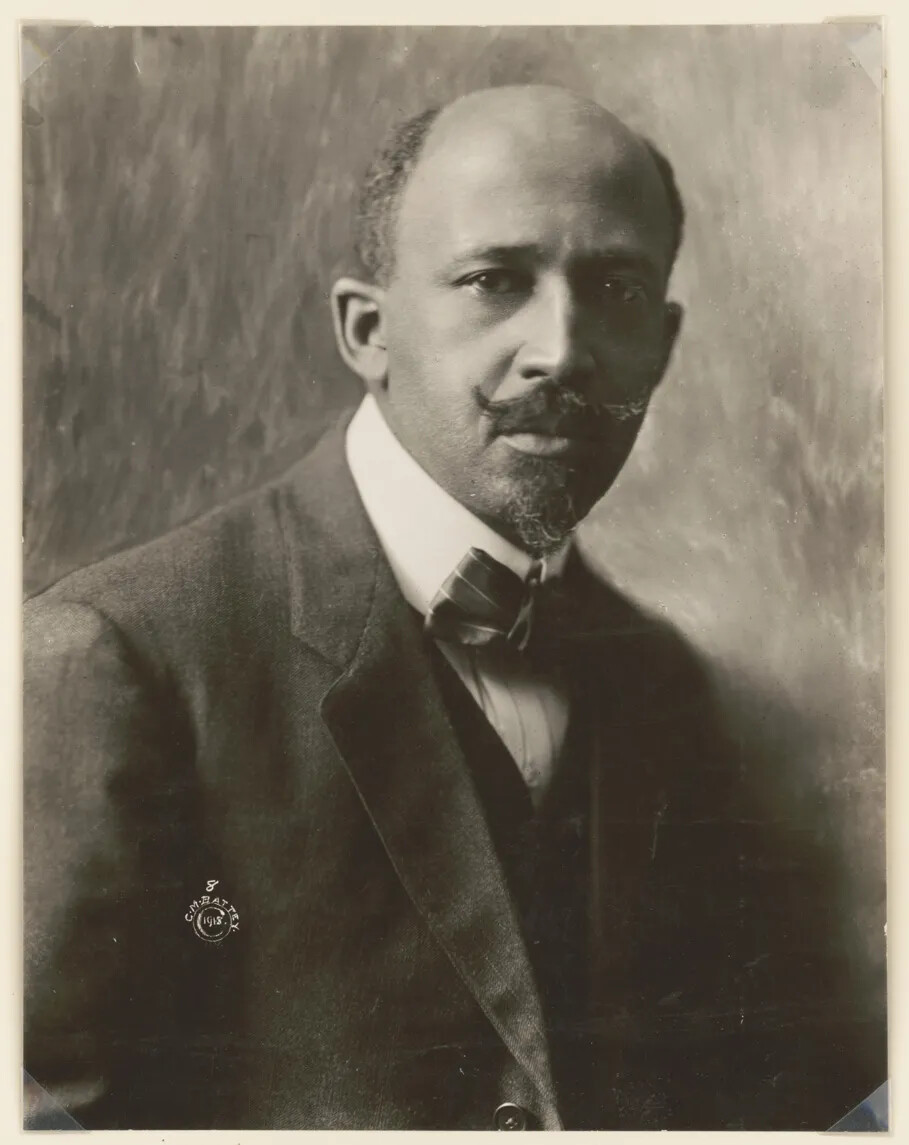
NAACP founded
A black and white photograph shows a man's head and shoulders. His hair is balding on top and he has a mustache curled at the edges. He wears a dark suit with a bow tie. His shoulders are slightly tilted away from the camera, but he looks directly at the viewer.
1913
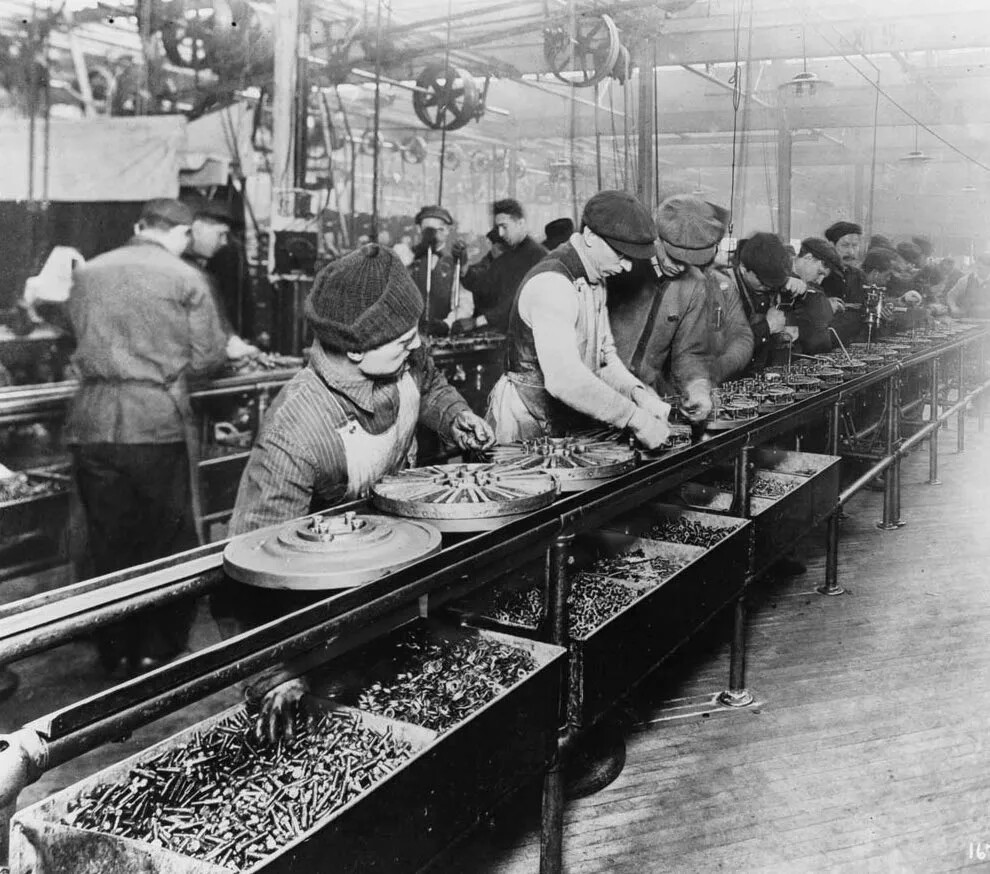
Moving assembly lines
In a black and white photograph, many people work in an assembly line. They are in some sort of factory, and on their line are circular metal pieces, about 18" in diameter. Under the line are boxes of small pieces of metal, and they reach into the boxes to attach pieces to the circular metal. The workers wear hats, and long sleeve shirts or jackets. Some wear aprons. All are looking down at the assembly line
1914–1918
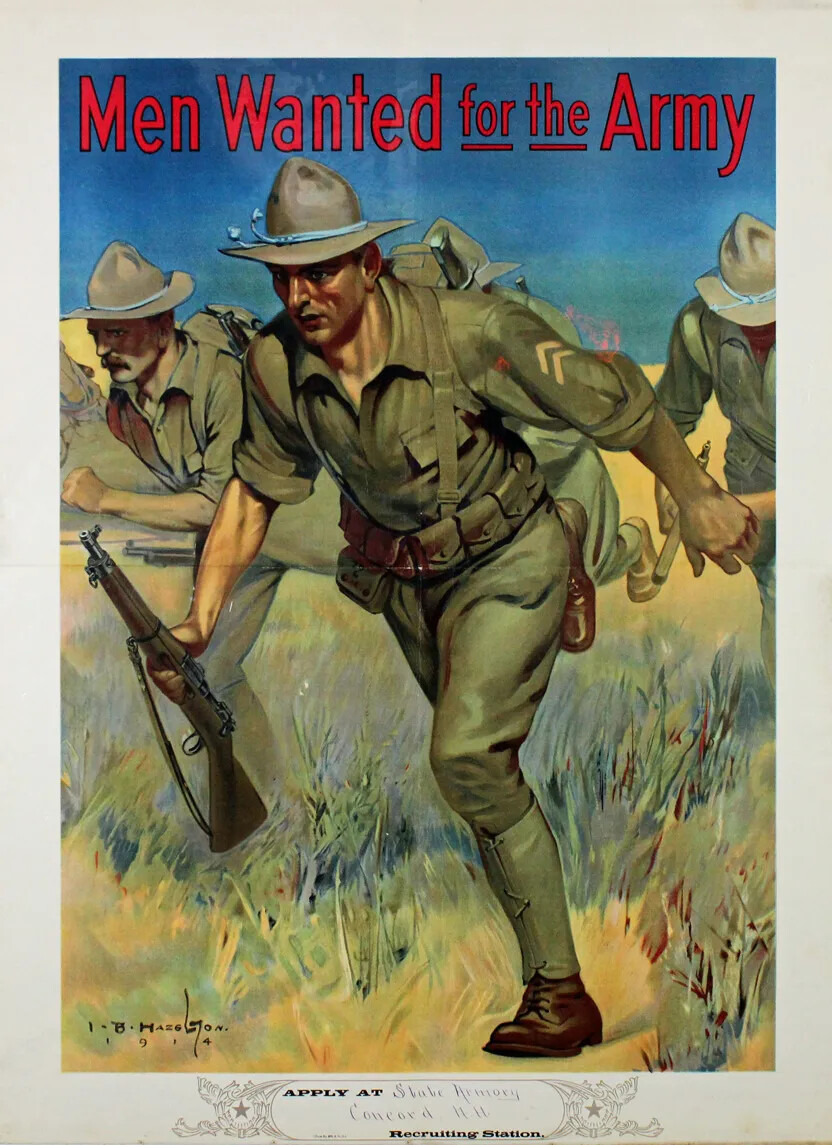
World War I
In a colorful poster, a drawing shows soldiers running through a field. They are wearing wide-brimmed hats, green uniforms with backpacks and belts equipped with gear. They hold rifles. At the top of the poster in red, it reads "Men Wanted for the Army."
1917
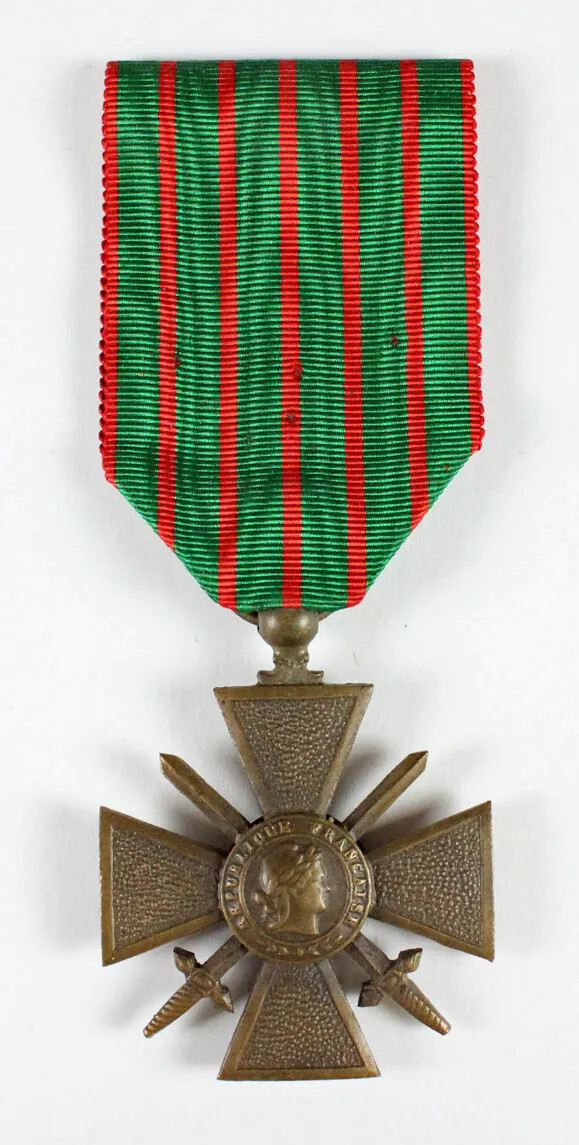
Yankee Division formed
A bronze medal hangs from a wide, green ribbon with narrow red vertical stripes. The medal has an equal-armed cross with crossed swords. There is a medallion in the center with a head in profile and the text "REPUBLIQUE FRANCAISE" circling it.
1918
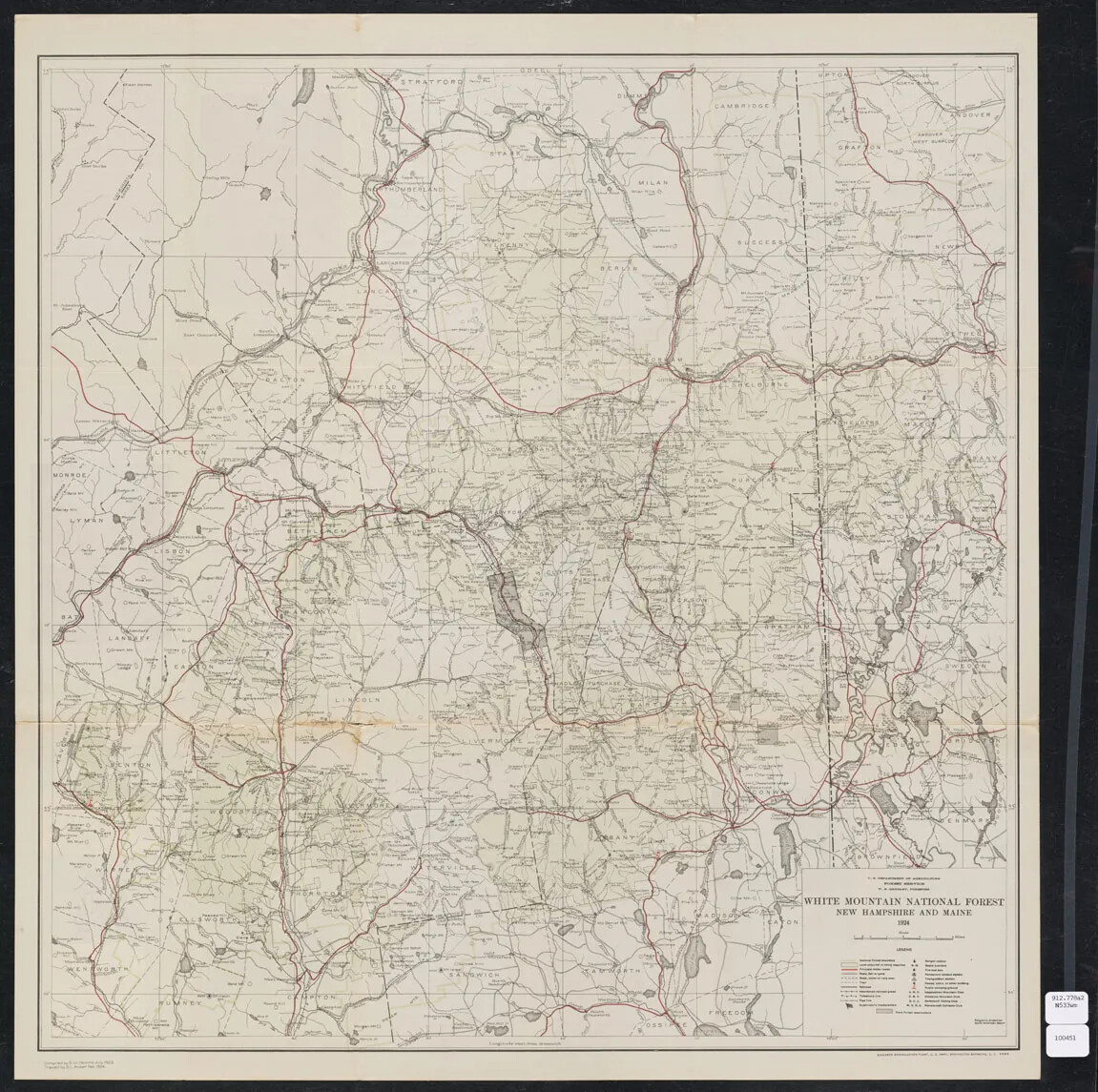
White Mountain National Forest opens
A large black and white square map is shown. It is dense with information, and includes markings for rivers, mountains, lakes, as well as town, county, and landmark notations. On the right is a black dotted border, with New Hampshire labeled to the left and Maine to the right. It is titled "WHITE MOUNTAIN NATIONAL FOREST NEW HAMPSHIRE AND MAINE 1924" in the lower righthand corner. A detailed key is below the title.
1918
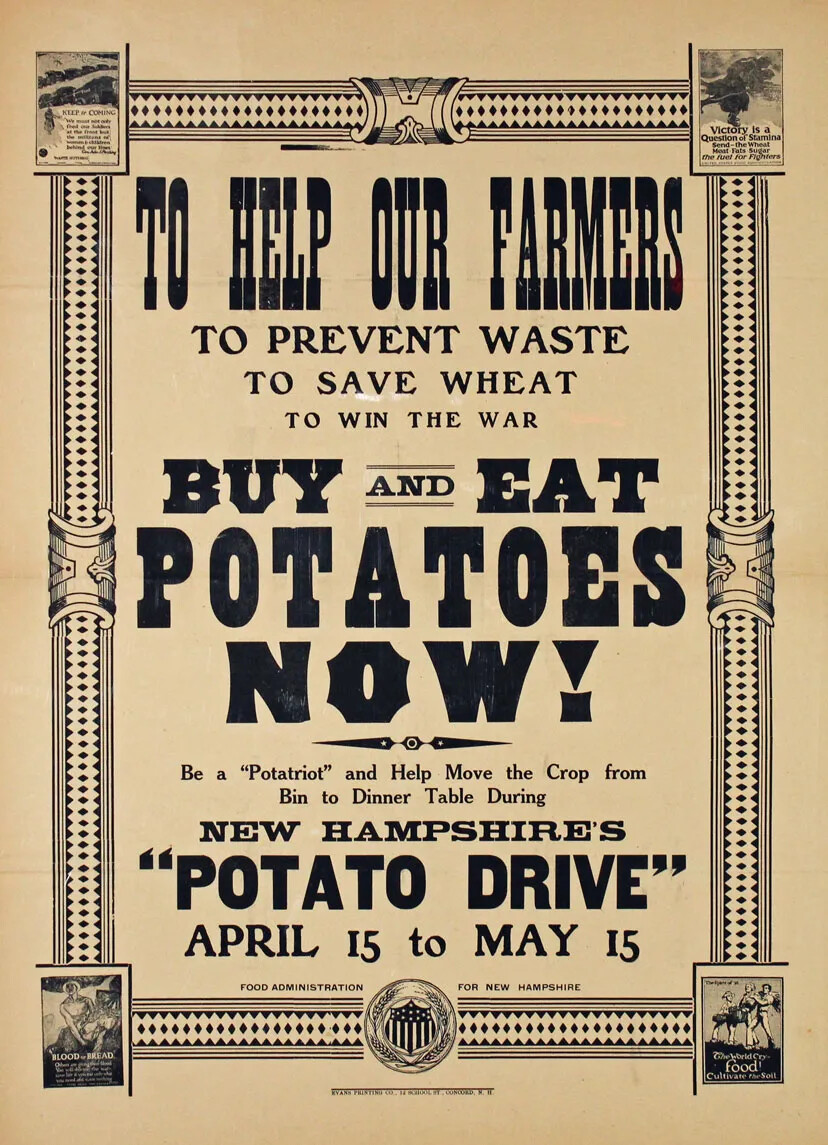
Potato drive campaign
A black and white poster has a border and printing of various sizes. The border has four small corner pictures encouraging public support for food conservation efforts. The text reads in part "TO HELP OUT FARMERS/ TO PREVENT WASTE/ TO SAVE WHEAT/ TO WIN THE WAR/ BUY AND EAT/ POTATOES NOW!"
1920
19th Amendment passes
A black and white photograph shows a broad city street filled with people and no cars, seen from above. People generally wear long skirts or coats and hats. The buildings are decorated with half-circle flags draped from windows. Words in cursive in the lower right hand corner read "Suffragettes Parade 1913 Was. D.C. [illegible]."
1920
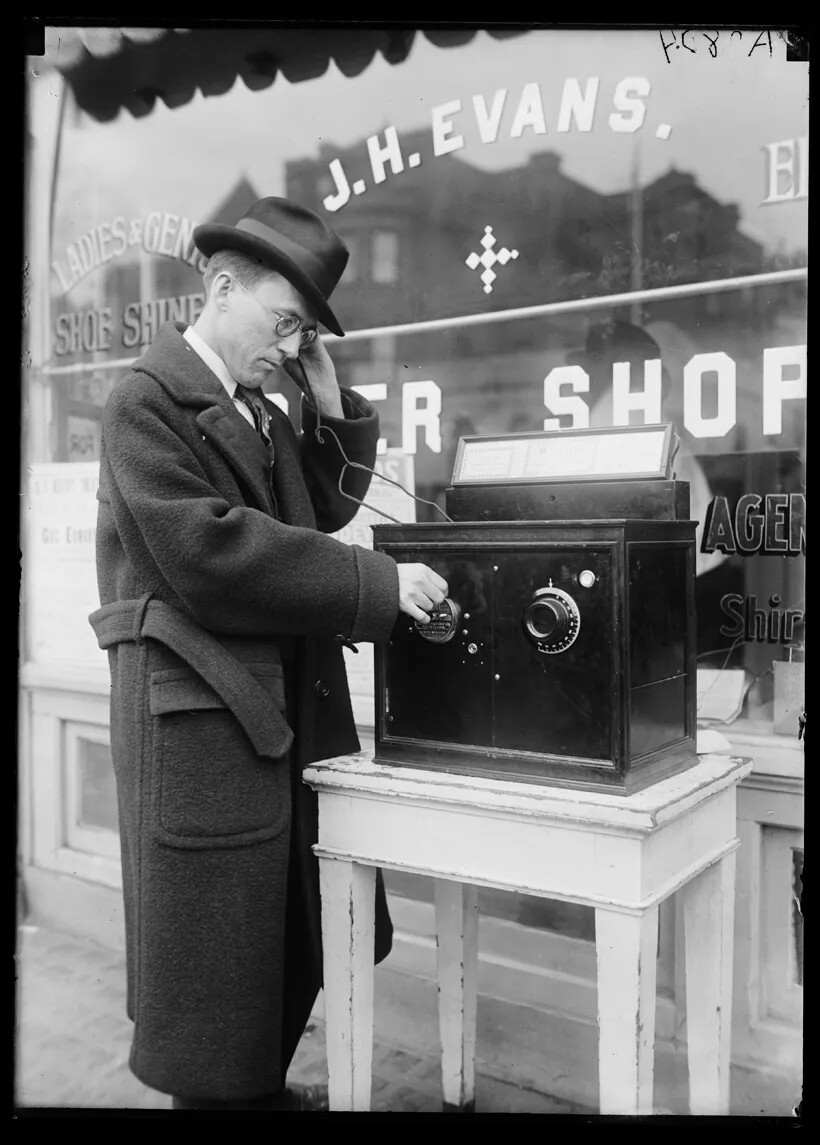
Radio becomes popular
A black and white photograph shows a man in a long coat and hat standing outside a store on a street. Next to him is a table with a large black box on it. On the box are two circles with markings. He is holding something connected with a wire to the black box up to his ear, and touching one of the circles with the other hand. He is looking down at the box..
1923
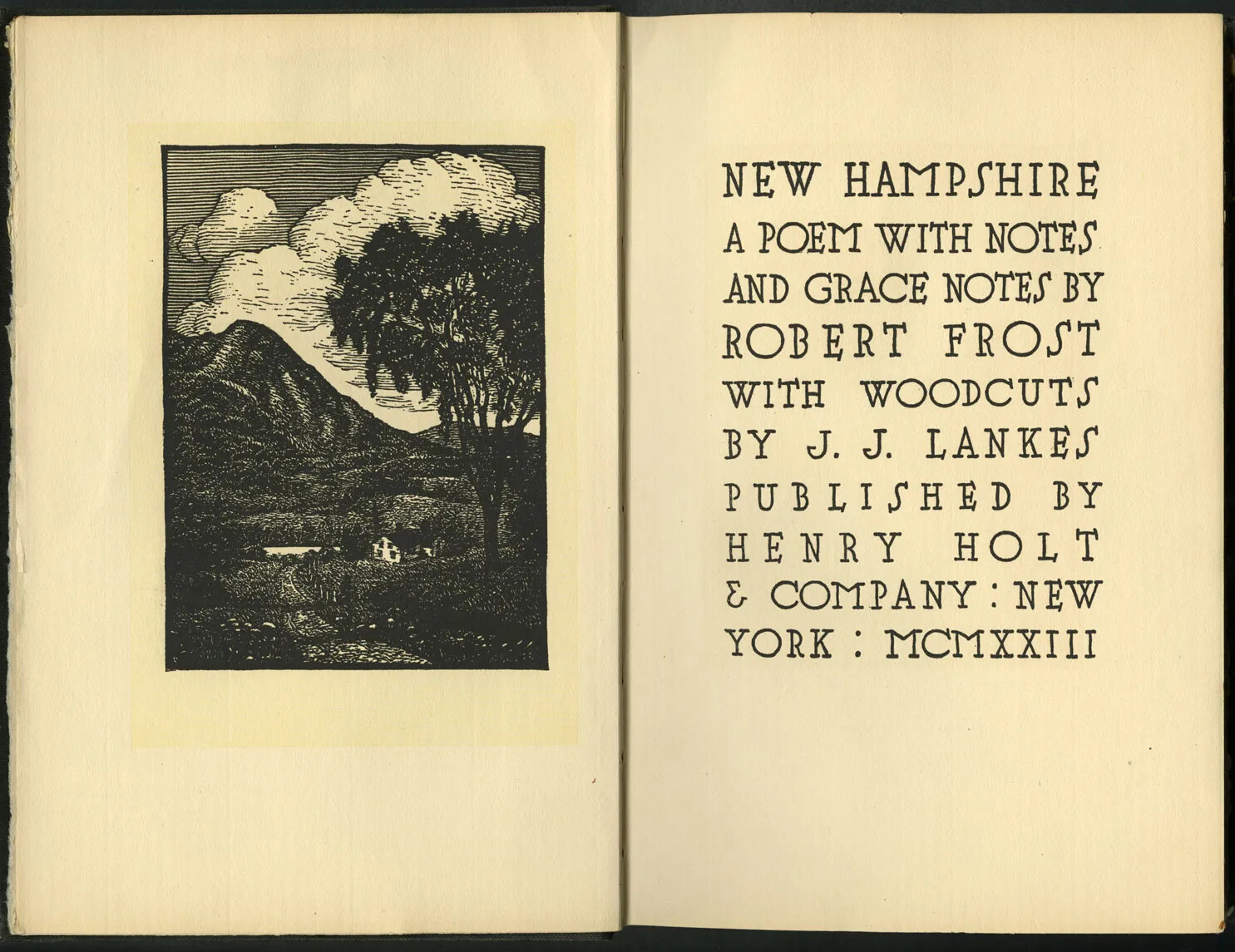
Robert Frost publishes New Hampshire poems
An open book is shown with an illustration and title page. The illustration on the left shows a woodcut of a rural mountain scene. A country lane with a large tree next to it leads to a small house and pond. There are mountains and hills in the background, and clouds in the sky. The title page on the right reads "NEW HAMPSHIRE/ A POEM WITH NOTES/ AND GRACE NOTES BY/ ROBERT FROST/ WITH WOODCUTS/ BY J. J. LANKES/ PUBLISHED BY/ HENRY HOLT/ & COMPANY : NEW/ YORK : MCMXXIII."
1929
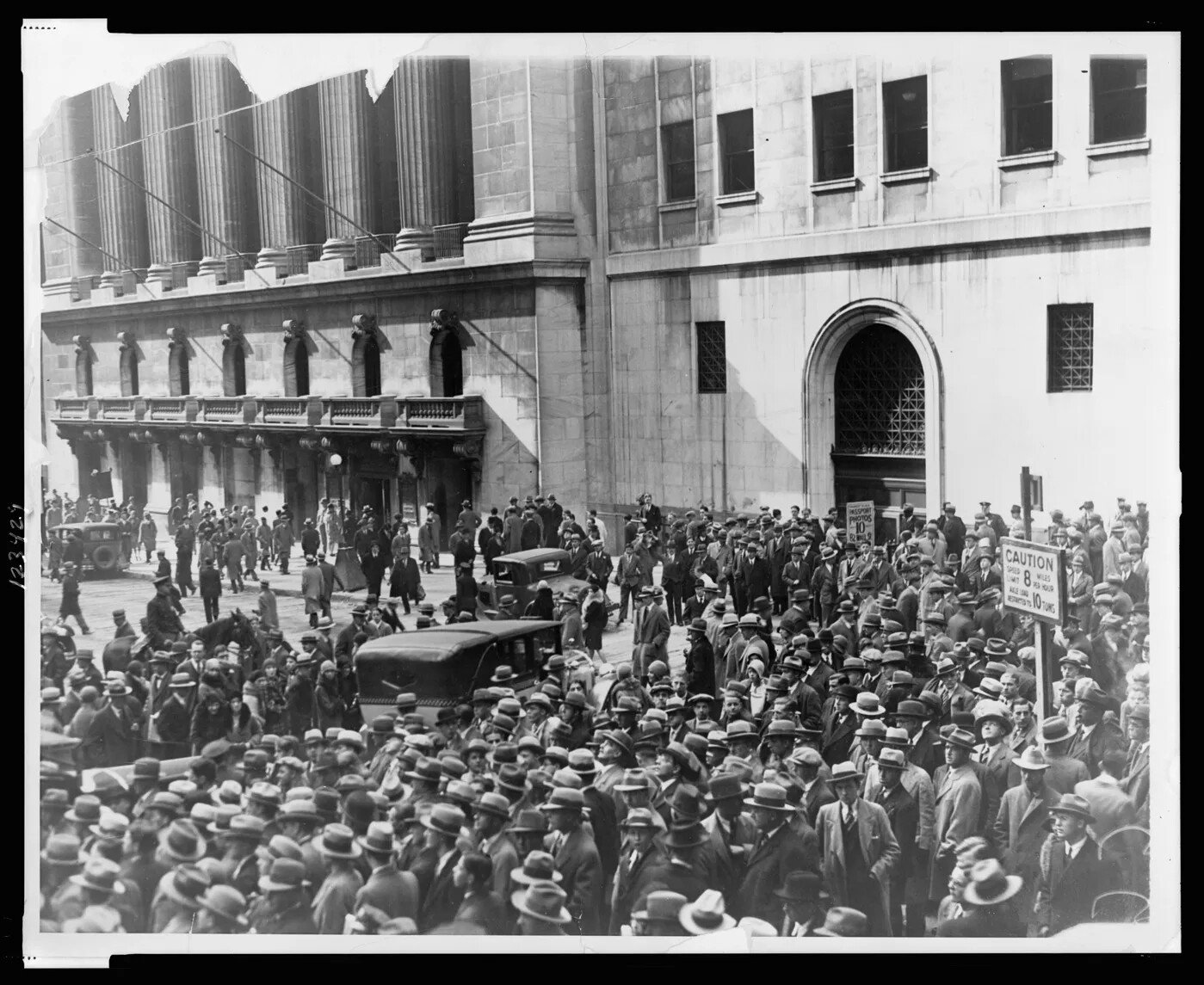
Stock market crash
Part of a large stately building with columns and multiple entrances is seen in a black and white photograph. A large crowd of people have gathered on the street, and most wear wide brimmed hats, suits, and long jackets. Three 1930s cars are among the crowd.
1929
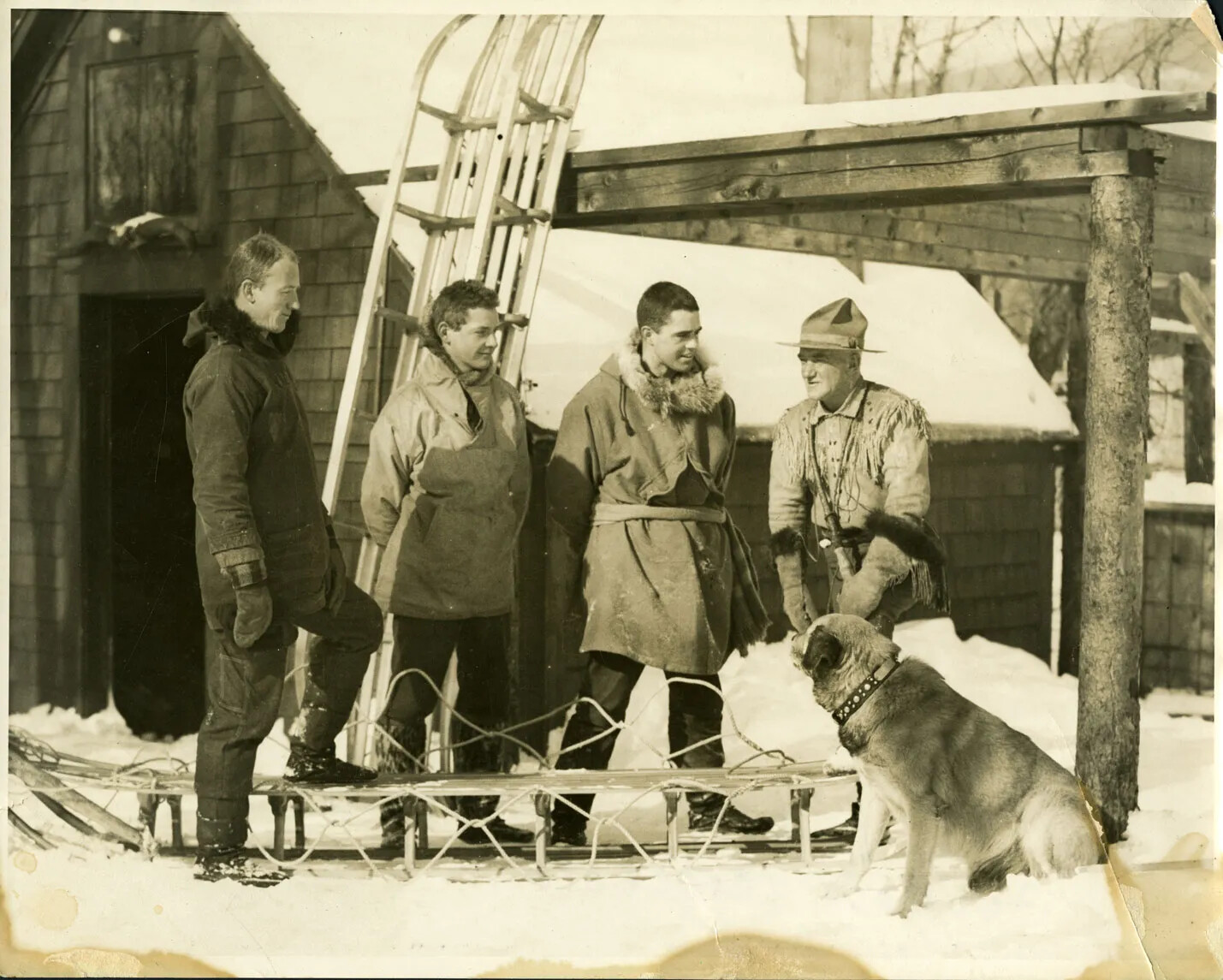
Chinook saves the day
A black and white photograph shows four men and a dog outside. The four men are talking together, and wearing winter outdoors clothes. One man has a hat with a broad rim all around. The dog is sitting looking at the men. There is a barn and lean-to in the background as well as two toboggins. One toboggin is lying in front of the men and one man has his foot on it; the other toboggin is standing up against the lean-to behind them.
1929–1939
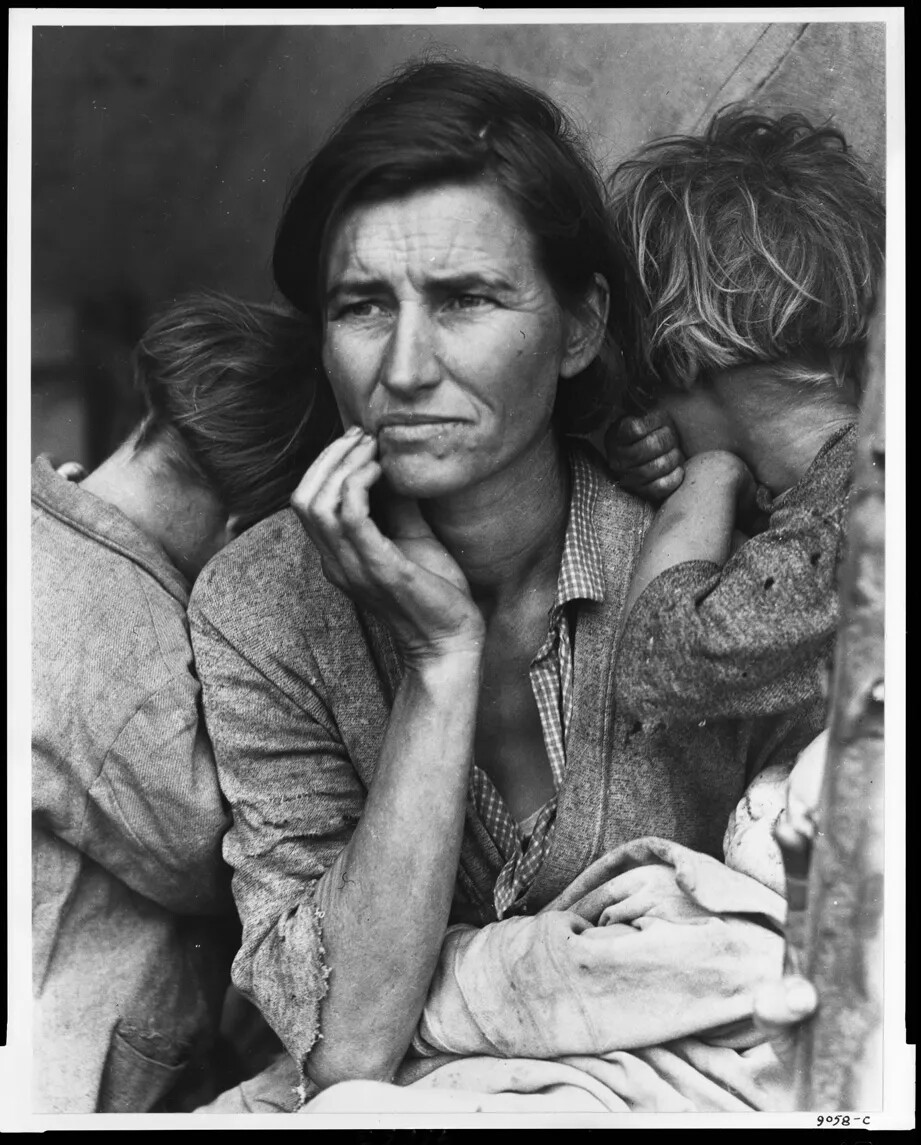
Great Depression
In a black and white photograph, a woman stares off into the distance, looking worried or tired. Her upper torso, shoulders, and head are seen, and her hand is holding her chin. Her hair is loosely pulled back, and she wears a blouse with cardigan. A small child is on either side of her with mussed hair and worn clothing. They have their heads on her shoulders and are facing away from the camera.
1931
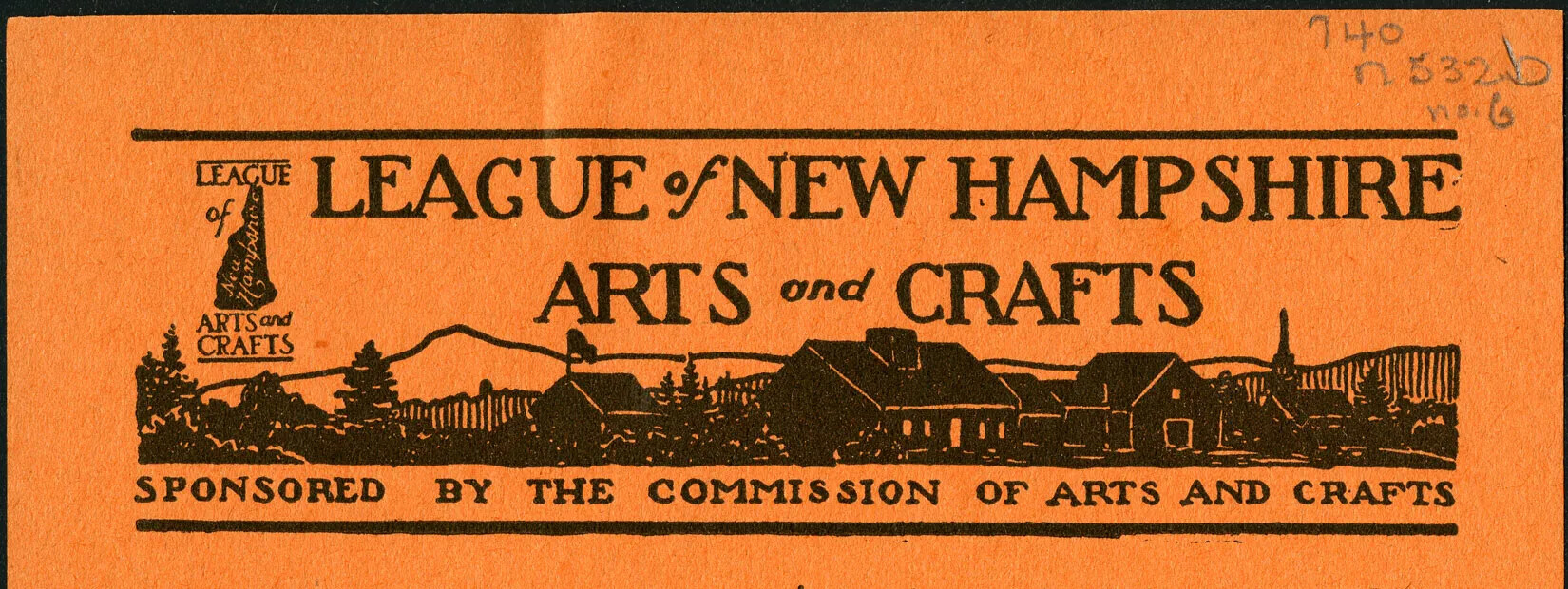
League of New Hampshire Craftsmen formed
A long horizontal light-orange rectangle shows black printing and a woodcut scene of a village. The printing reads "LEAGUE of NEW HAMPSHIRE/ ARTS and CRAFTS" on the top and "SPONSORED BY THE COMMISSION OF ARTS AND CRAFTS" on the bottom. The scene is between the two lines of words and shows several houses, trees, a church, and mountains in the background. In the upper lefthand corner is a small outline of the state of New Hampshire, bordered by the words "LEAGUE of ARTS and CRAFTS."
1934
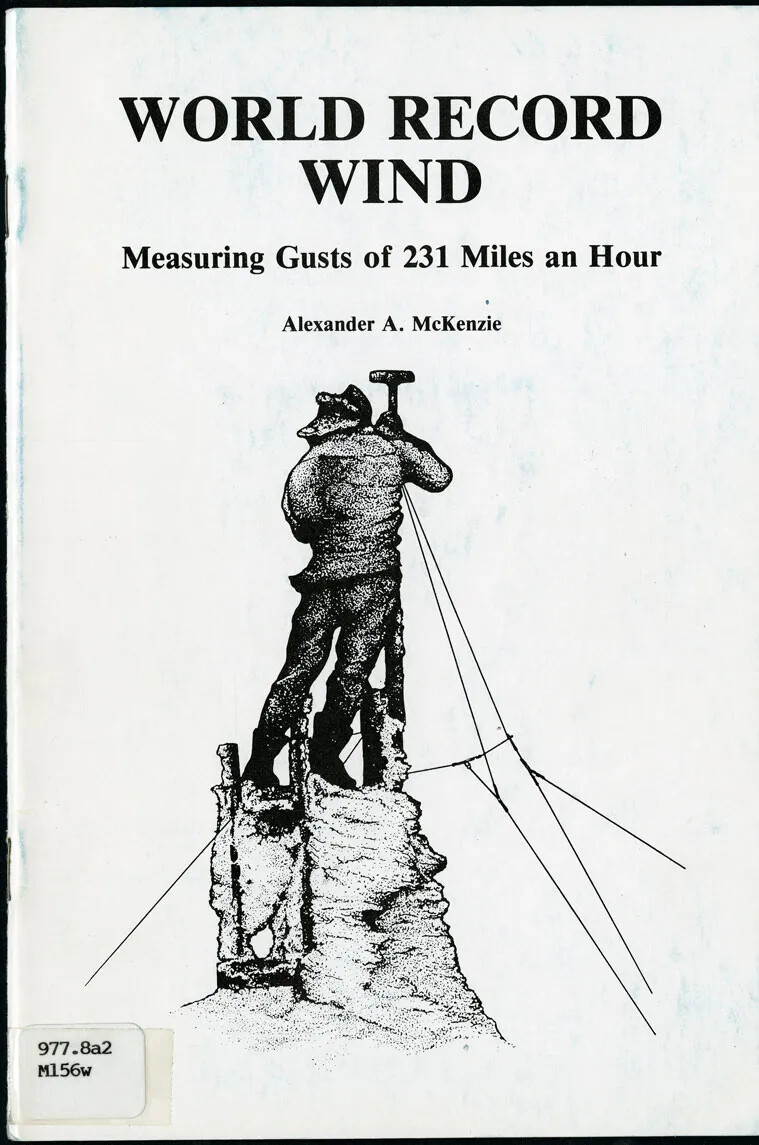
Highest wind speed recorded
A page shows a black and white drawing of a standing man with his back to the viewer, holding onto a pole. The pole is secured to the base with lines, and has a small rectagular box on top. The man wears winter clothing, and is standing on a narrow tower. The text reads "WORLD RECORD WIND/ Measuring Gusts of 231 Miles an Hour/ Alexander A. McKenzie."
1935
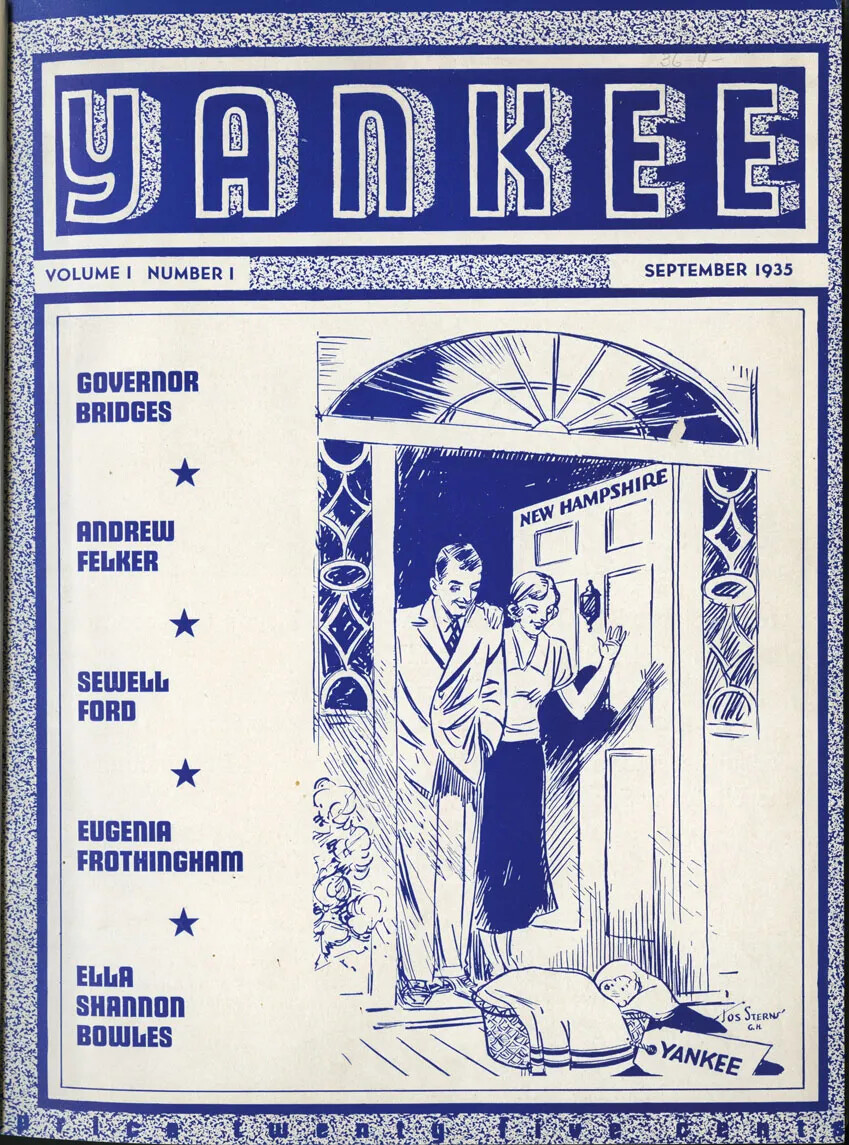
Yankee Magazine founded
The cover of a magazine is white with blue printing and a drawing. The large title at the top says "YANKEE" with "Volume 1 Number 1" and "September 1935" underneath. There is a drawing of a well-dressed man and woman opening a decorative front door which is labeled NEW HAMPSHIRE. They look surprised and pleased at what they find. On their doorstep is a baby in a basket with a blanket over it. The tag on the baby reads "YANKEE." There are five titles to the left of the drawing listing the stories inside.
1936
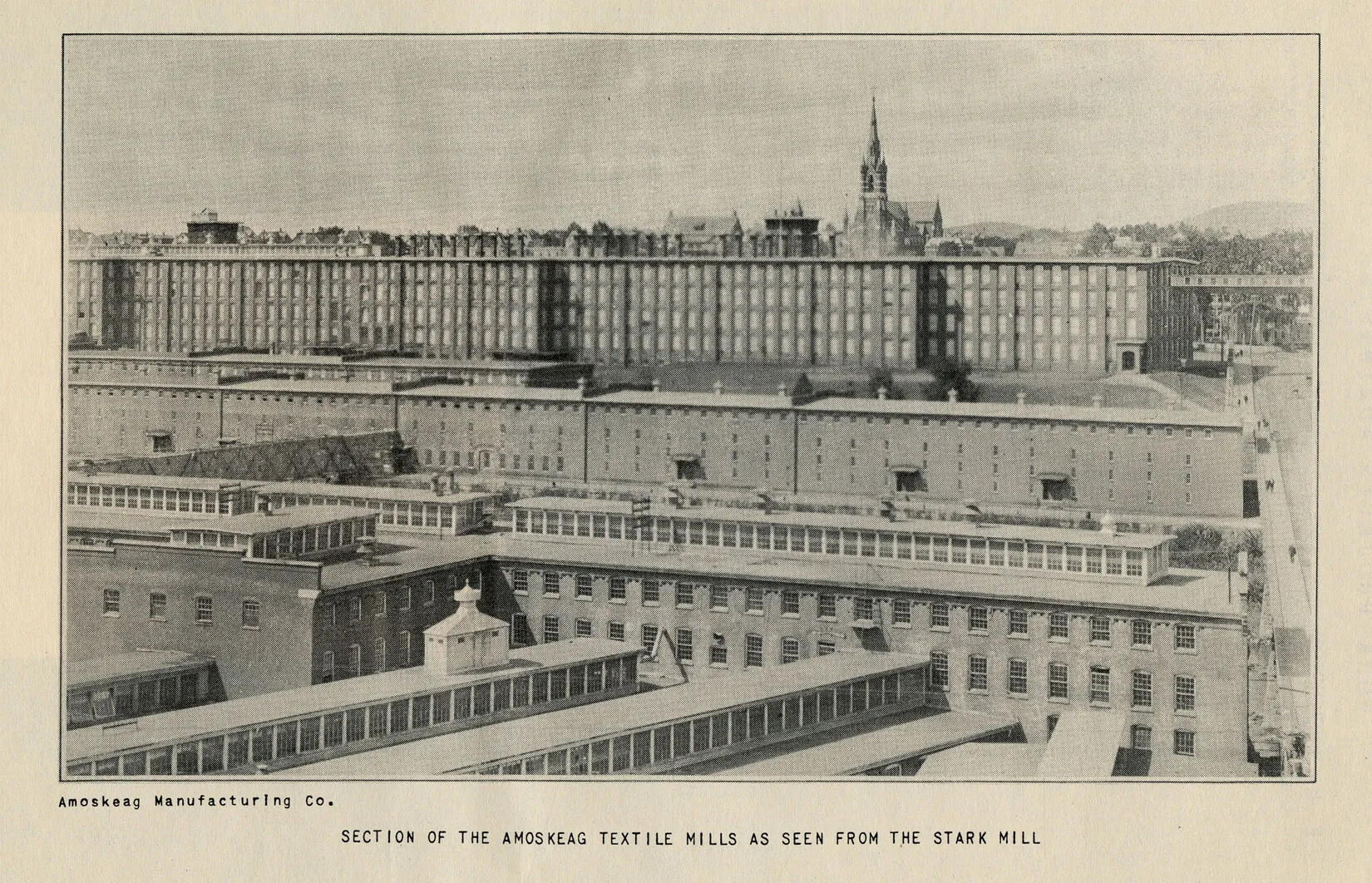
Amoskeag mills close
A black and white photograph shows many mill buildings from a high perspective. In the foreground, they run horizontally and vertically, and in the background there is one long factory building. Behind and on the sides of the buildings, the surrounding town can be seen. The caption reads "SECTION OF THE AMOSKEAG TEXTILE MILLS AS SEEN FROM THE STARK MILL" and on the left, "Amoskeag Manufacturing Co."
1937
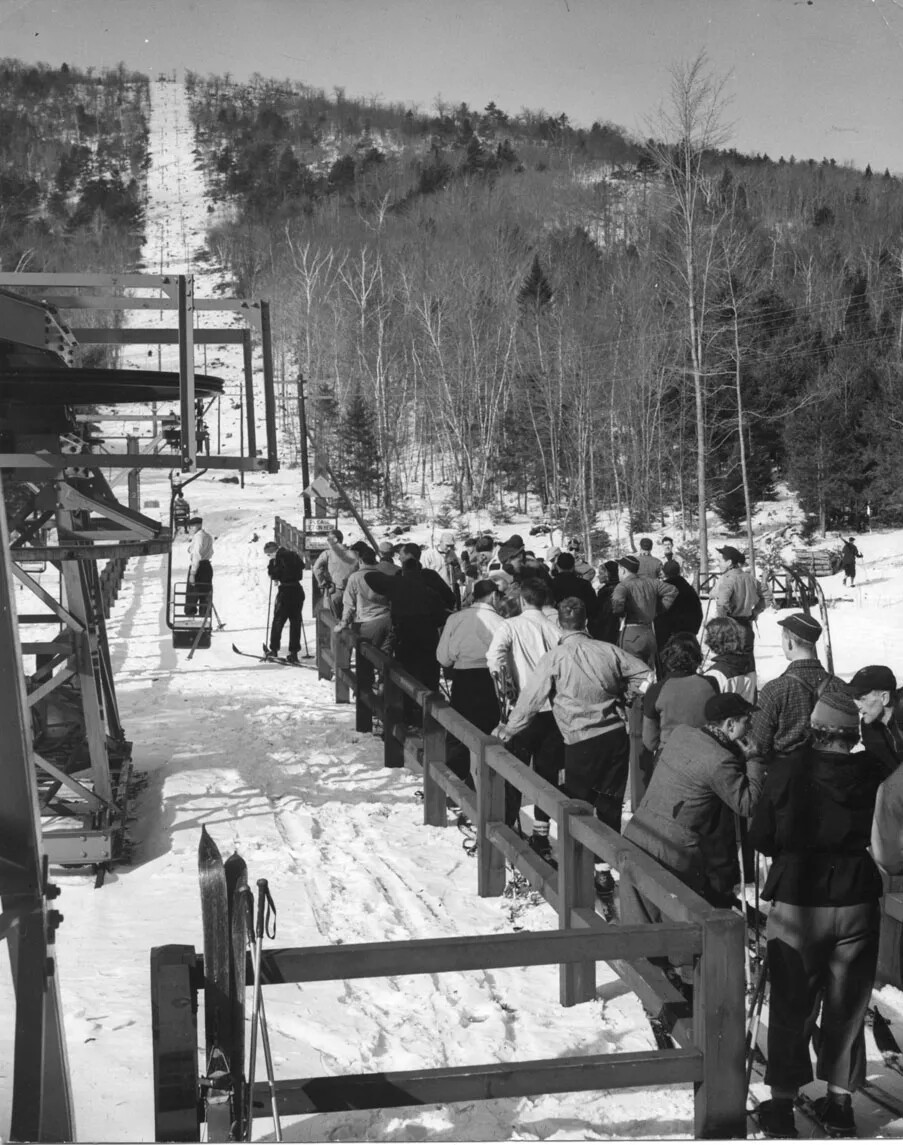
First chair ski lift
A black and white photograph shows a small mountain in the winter. Up the mountain runs a wide, white trail as well as supporting posts and wires for an old chair lift. In the foreground, people in winter clothes line up along a fence. The viewer can see one person getting ready to board the next chair that is coming.
1938
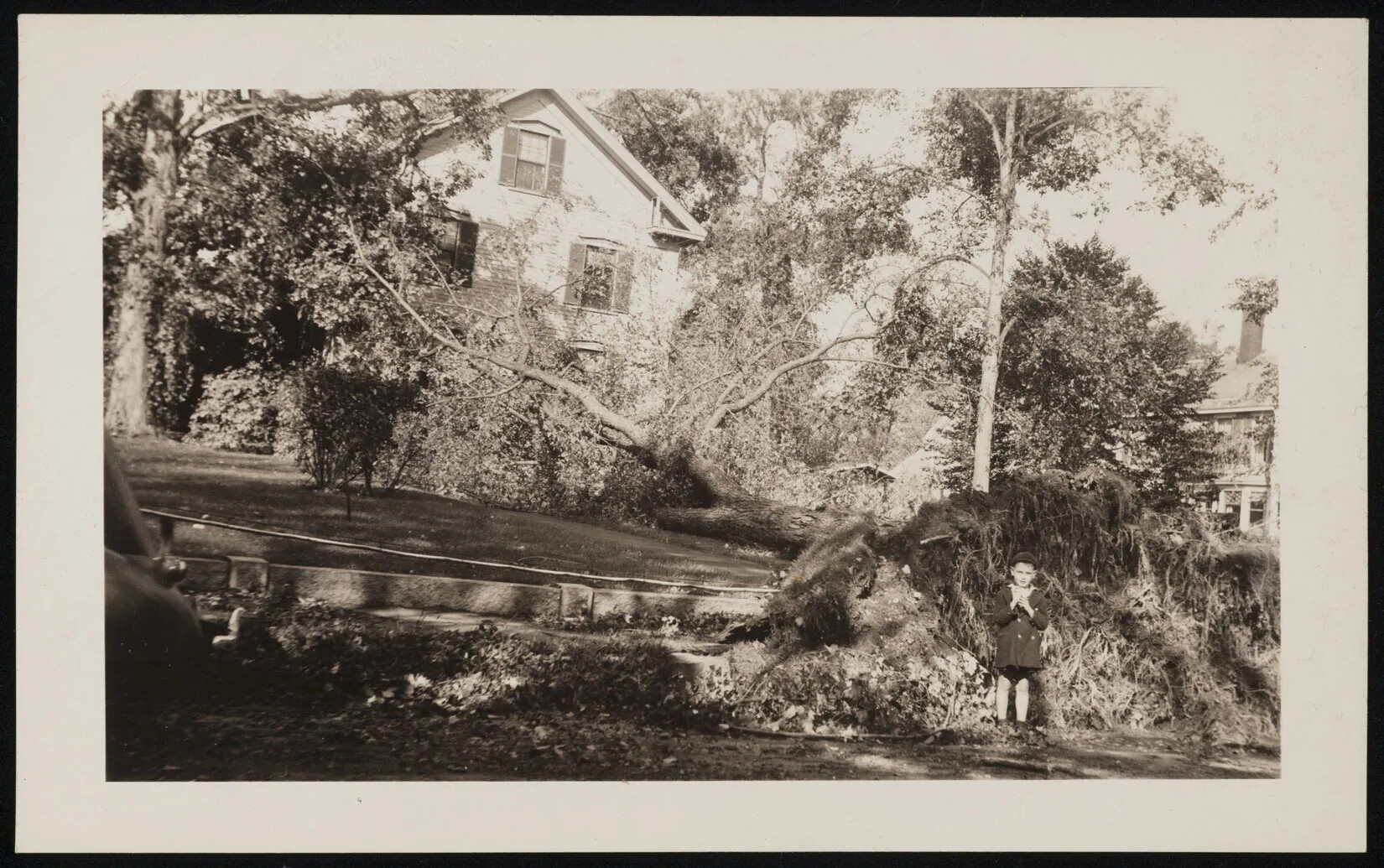
Hurricane of 1938
In a black and white photograph, a suburban house with large lawn is seen. In front of the house, a large tree has uprooted and fallen towards the house, hitting it in some places. A small child in shorts and jacket stands next to the roots of the tree, looking at the viewer.
1939–1945
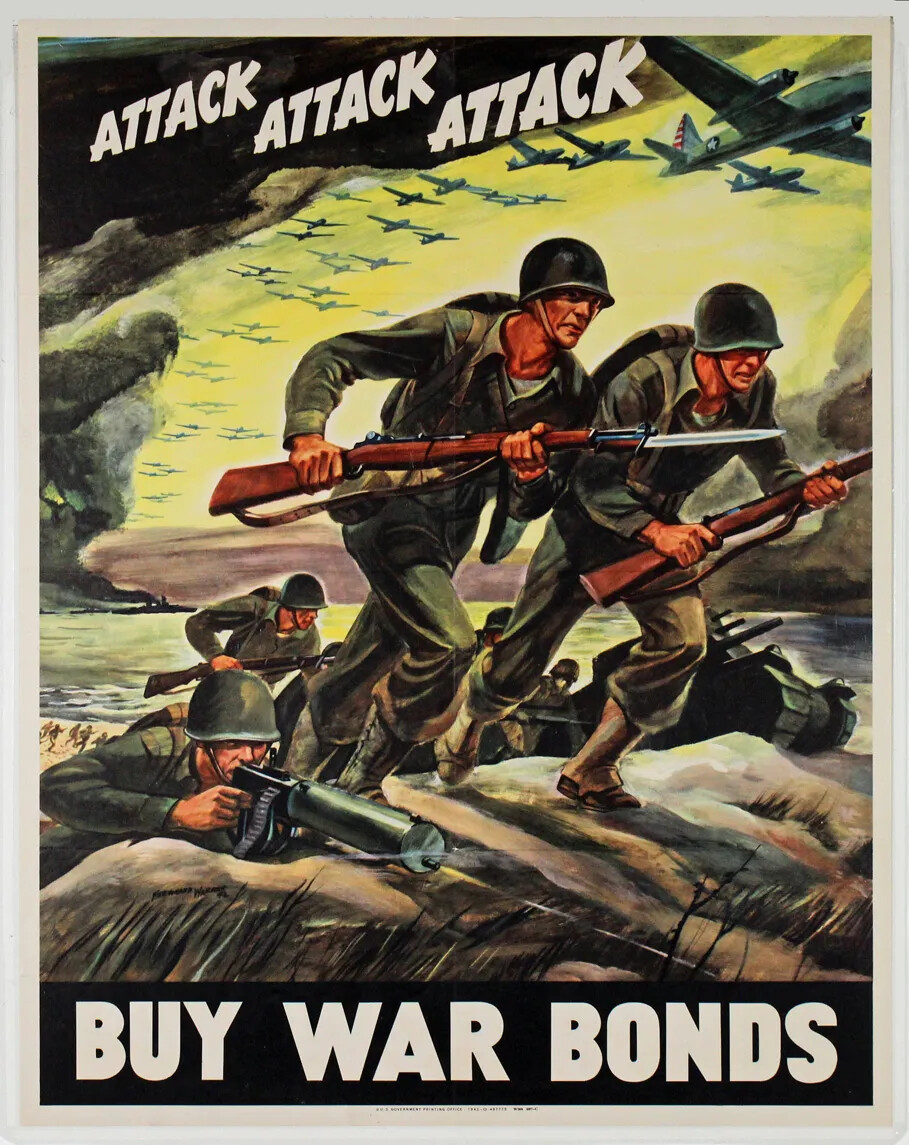
World War II
A colorful poster shows soldiers running up and over a mound of earth. They have helmets, uniforms, backpacks, and rifles with bayonets. Two are on the top of the mound, and more soldiers are running behind them along with a tank. In the distance behind them, there is a beach with more soldiers and boats in the water. Overhead, there are clouds and small airplanes flying in the same direction as the soldiers are running. In the clouds above it reads "ATTACK ATTACK ATTACK" and below, "BUY WAR BONDS."
1947
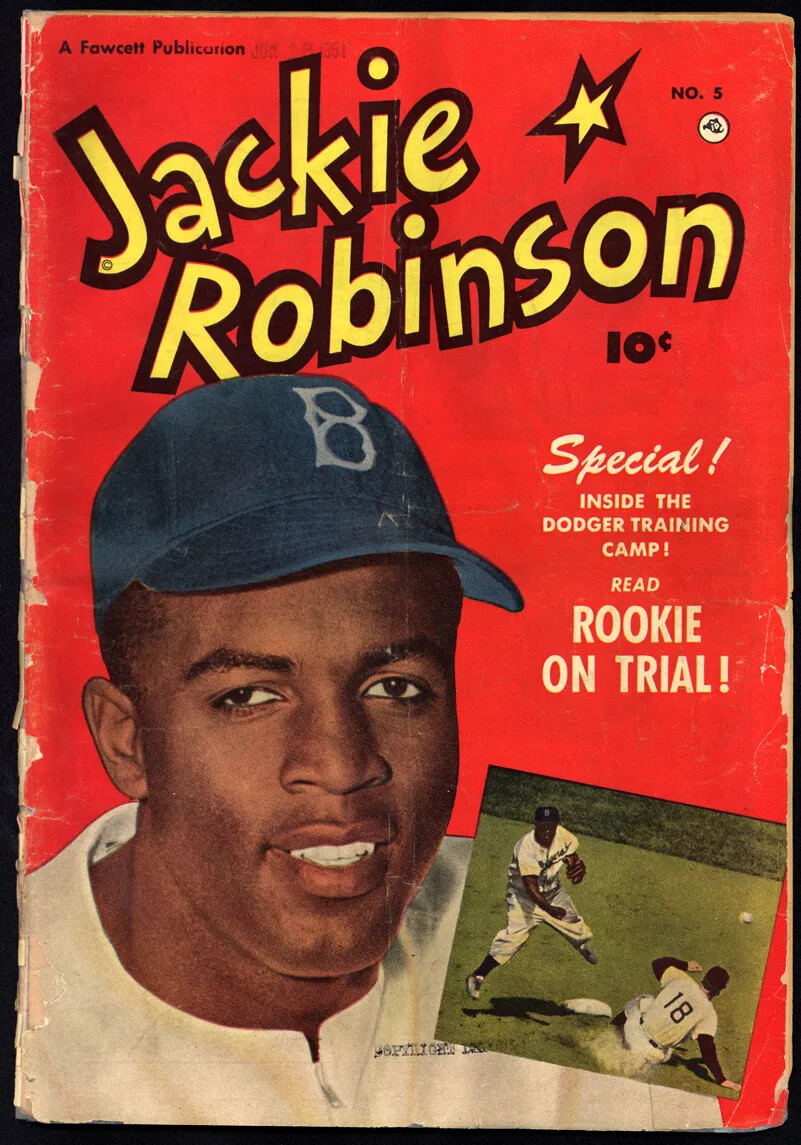
Jackie Robinson plays major league baseball
A red cover of a magazine is seen. A man's head and shoulders encompass most of the cover; he is wearing a blue cap with a "B" on it and a white shirt. A small drawing insert at the bottom shows a man catching a ball while another man slides into a base. In large yellow letters are the words "Jackie Robinson," then below it says "Special! Inside the Dodger Training Camp! Read Rookie on Trial!"
1952
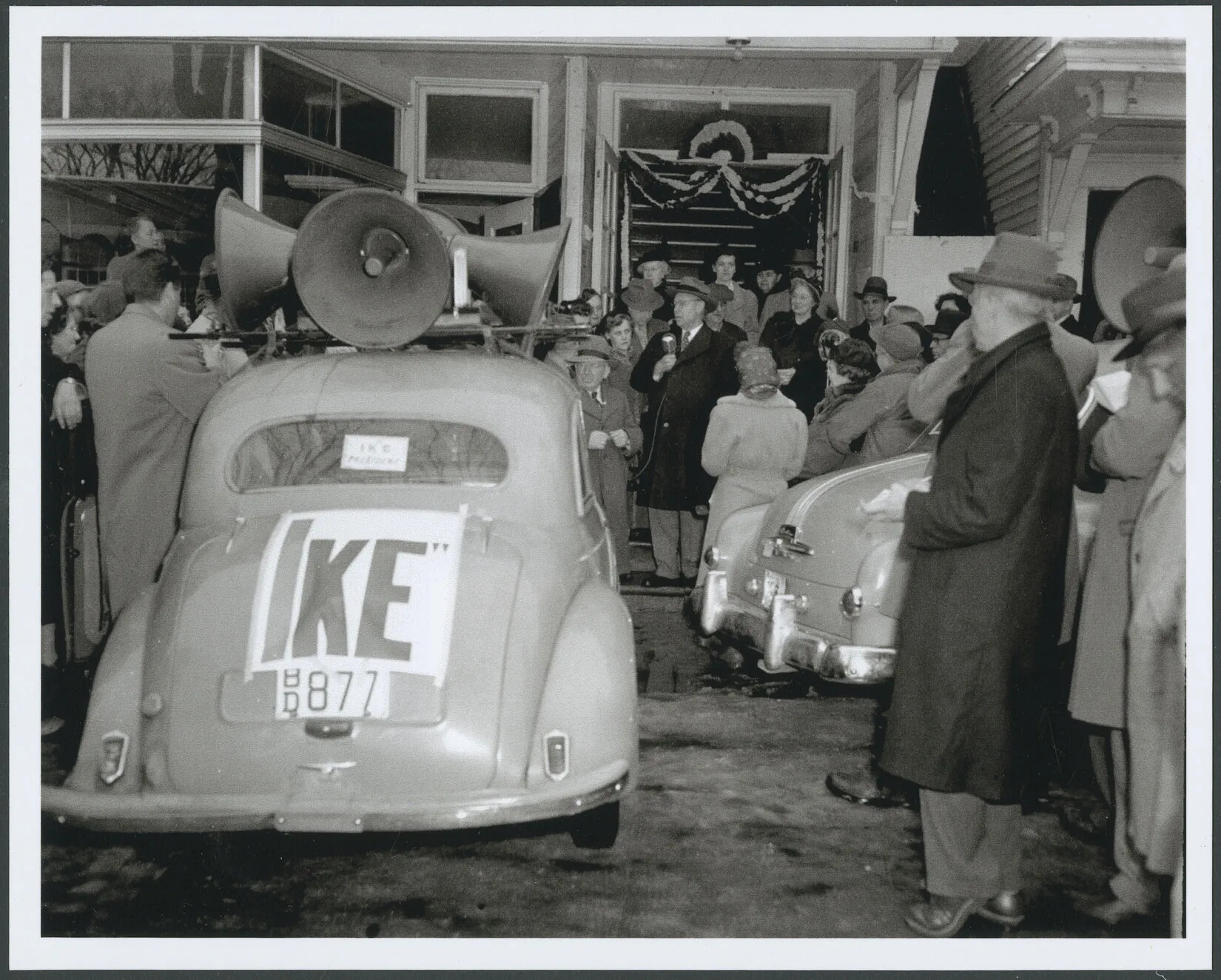
First presidential primary
In a photograph of a street scene a man in an overcoat and hat stands near an open doorway on a sidewalk, holding a microphone and speaking to a crowd of people gathered around him. People wear raincoats, women are wearing hats or scarves over their heads, and men are wearing hats. A car parked at the curb has loudspeakers on its roof and a sign reading "Ike" taped to the trunk.
1953
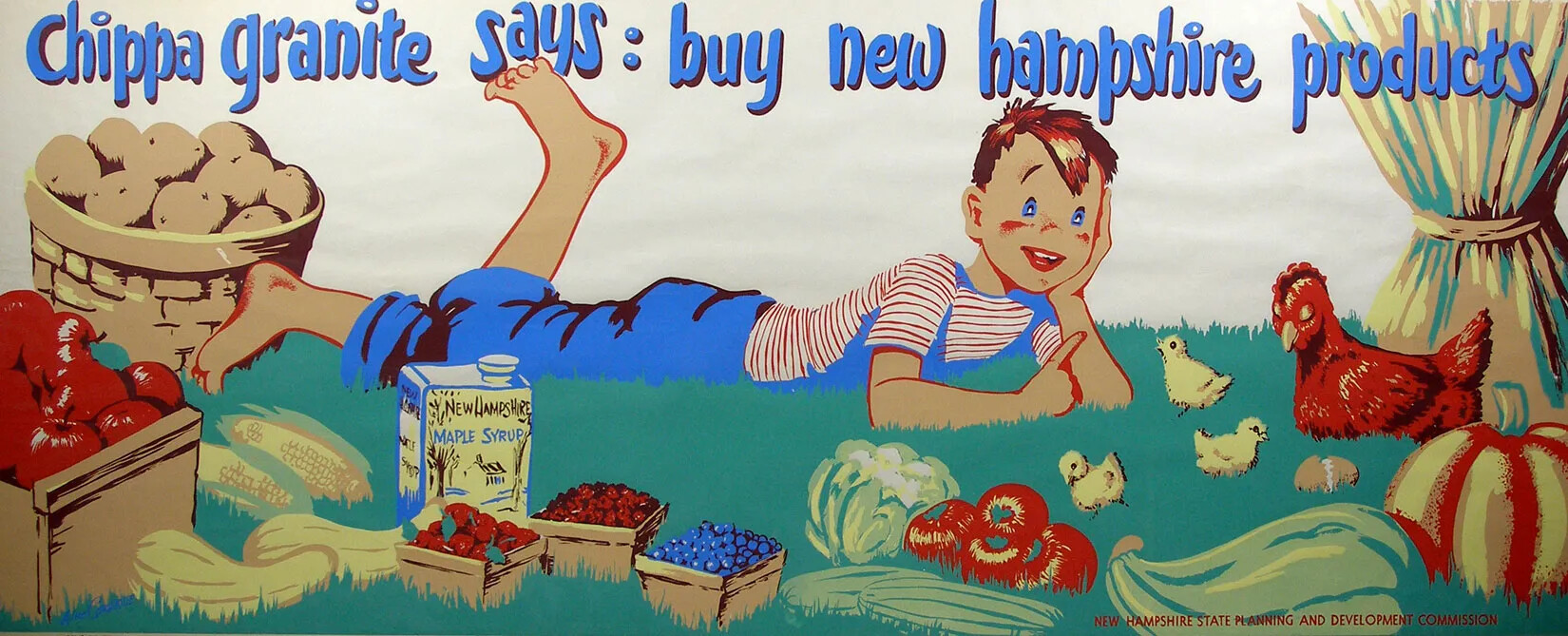
Chippa Granite is created
A colorful rectanglar poster, oriented horizontally, shows a cartoon of a boy lying on his stomach in the grass. He is wearing overalls, a striped short-sleeve shirt, and no socks or shoes. He is smiling, and appears to be talking to three chicks who are walking on the grass next to a mother hen. Around the boy in the grass are various food products, like a basket of potatoes, tomatoes, wheat, apples, berries, and corn. The words above the boy read "Chippa granite says: buy new hampshire products."
1954
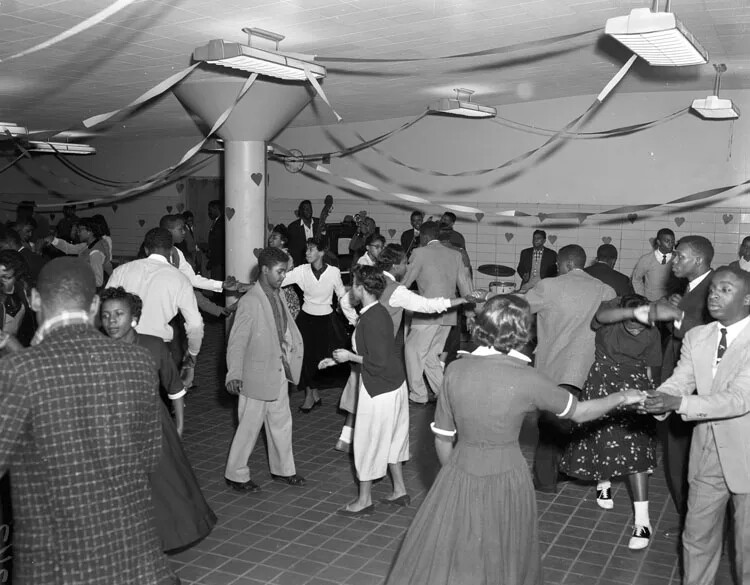
Birth of rock n’ roll
A black and white photograph shows a large room with a pillar and some decorations. Teenangers dance in the room in pairs. Boys wears jackets and ties and girls wears skirts or dresses.
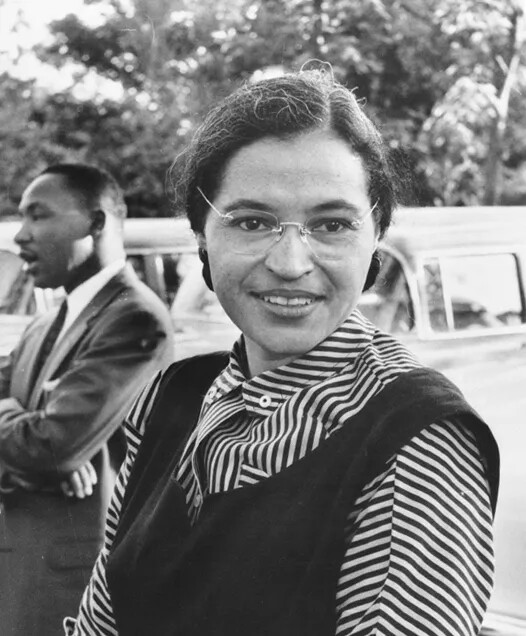
1955
Rosa Parks arrested
In a black and white photograph, a woman looks at the camera with a small smile. She has glasses, a striped blouse with a vest, and her hair pulled back. In the background, there is a car, and a man with a suit and tie, who is talking with his arms crossed.
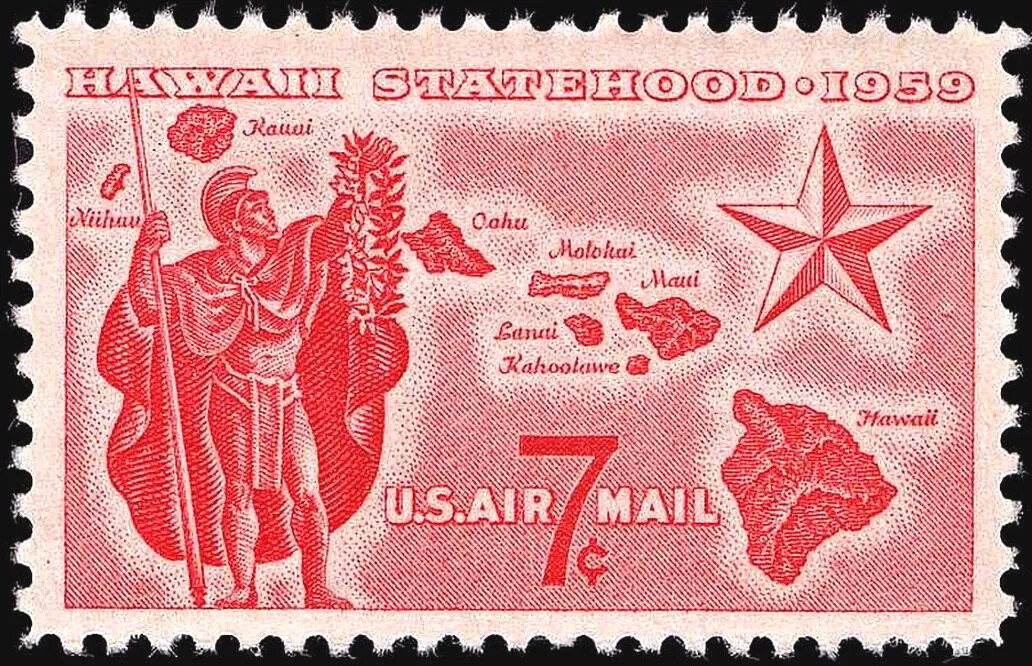
1959
Hawaii becomes the 50th state
A closeup of a white stamp with red print shows a man with a spear, helmet, and cape on the left. He holds up a garland to the right. On the right is a large, five-pointed star. In the middle are islands, arranged in an arc from bottom right to upper left. They are labeled, the biggest one named "Hawaii." The stamp reads "HAWAII STATEHOOD 1959 U.S.AIR MAIL 7¢.".
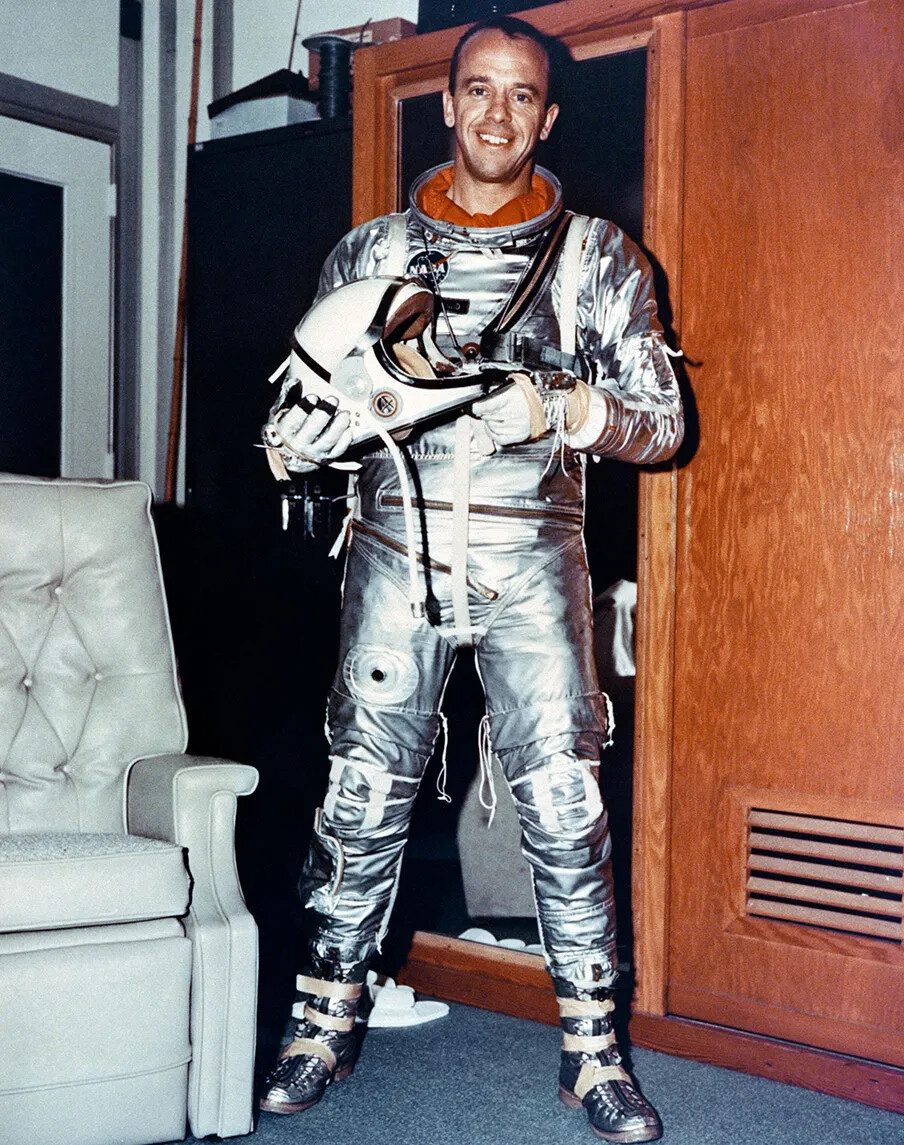
1961
Alan Shepard's space flight
A colored photograph of a white man in an astronaut suit. He looks at the camera, and holds his helmet in his hands.
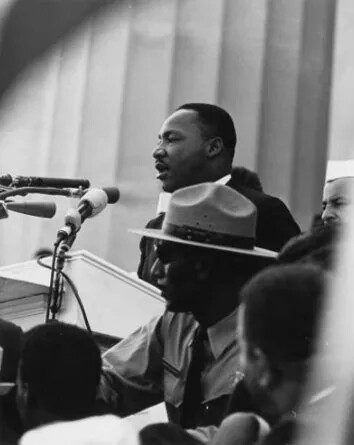
1963
Martin Luther King Jr. speech
A black and white photograph shows a man wearing a suit speaking into several microphones. In front of him is an officer in uniform with large brimmed hat. There are other people listening, and the backdrop is a large column.
1964
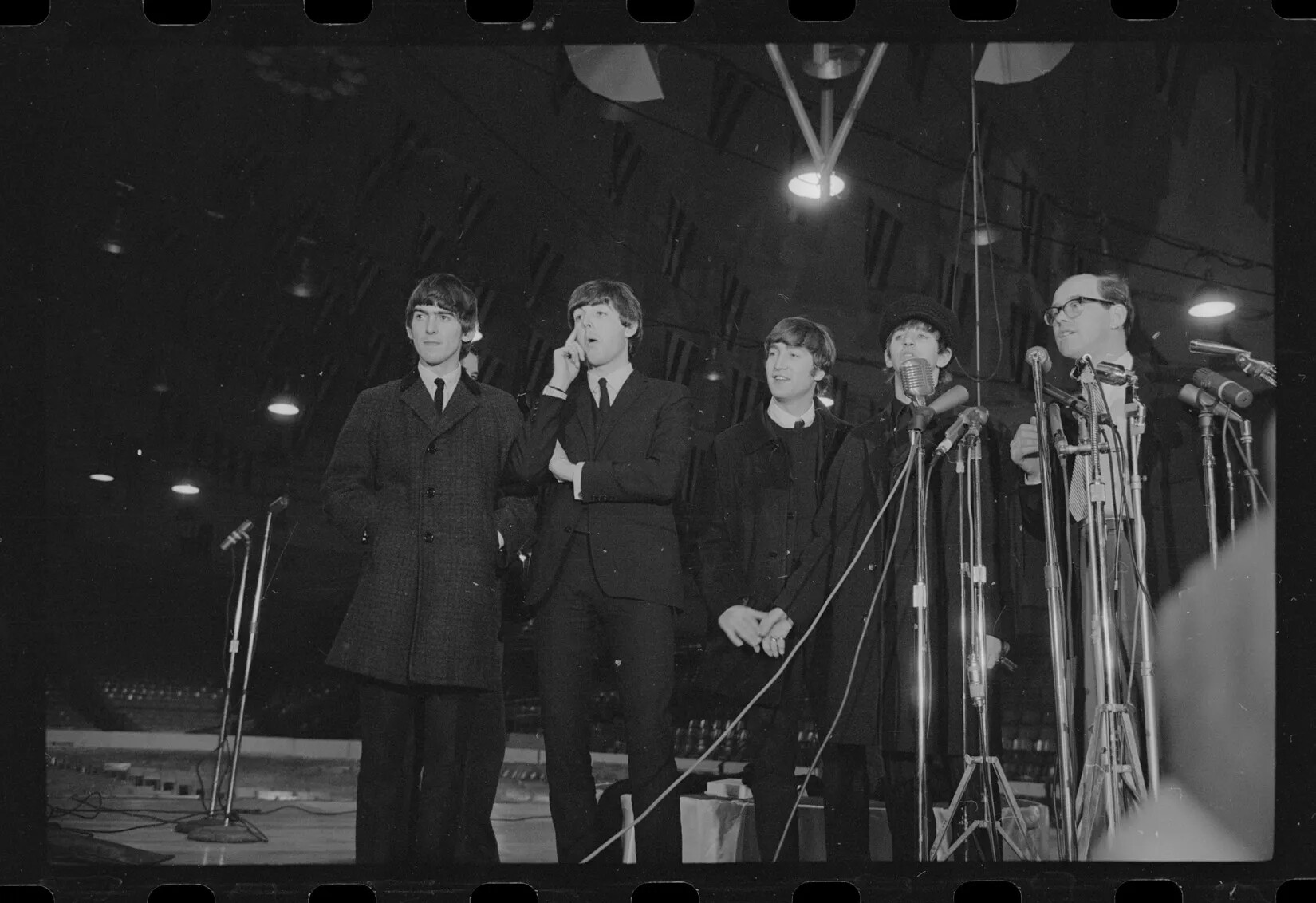
Beatles come to America
Five men in suits and jackets stand in a line facing the viewer in a black and white photograph. In front of the two rightmost men are many microphones on stands. All the men are looking off to the left, and are standing in a large room with flags hanging from the ceiling.
1969
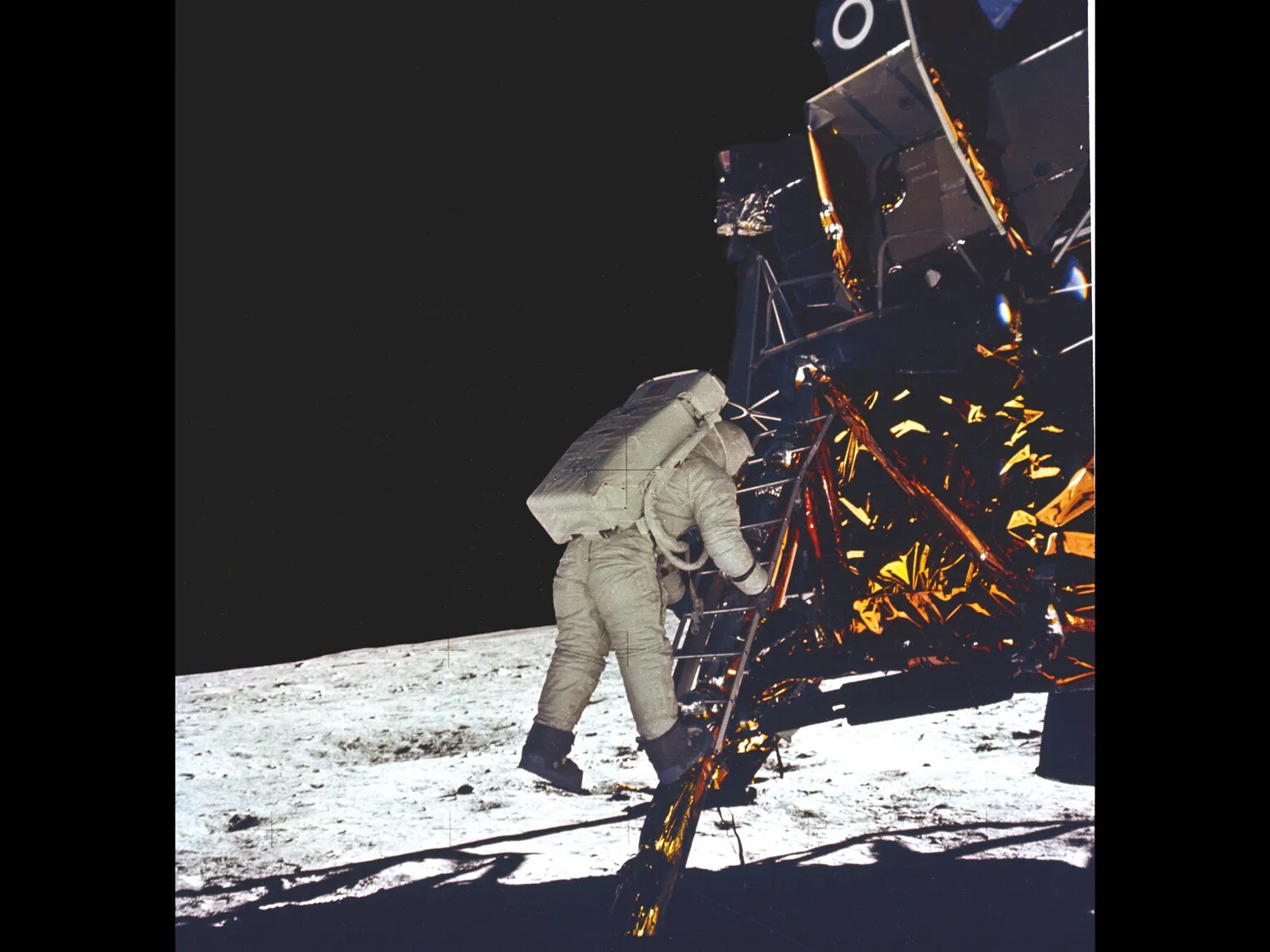
Apollo 11 lands on the moon
In a color photograph, an astronaut with a white spacesuit and large backpack descends a ladder. He is leaving a small spaceship and stepping down to walk on the moon.
1970
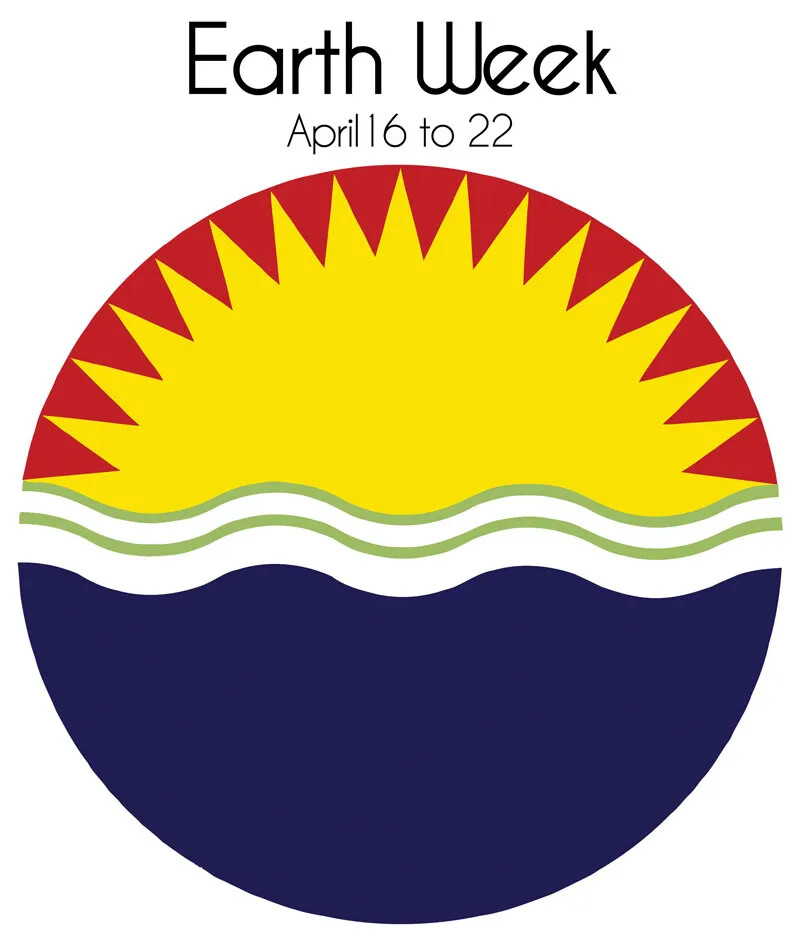
First Earth Day
A circular logo is bisected by two green wavy lines. Below the lines is dark blue. Above the lines, a sunburst is yellow with red behind the rays.
1972
The Pledge
1974
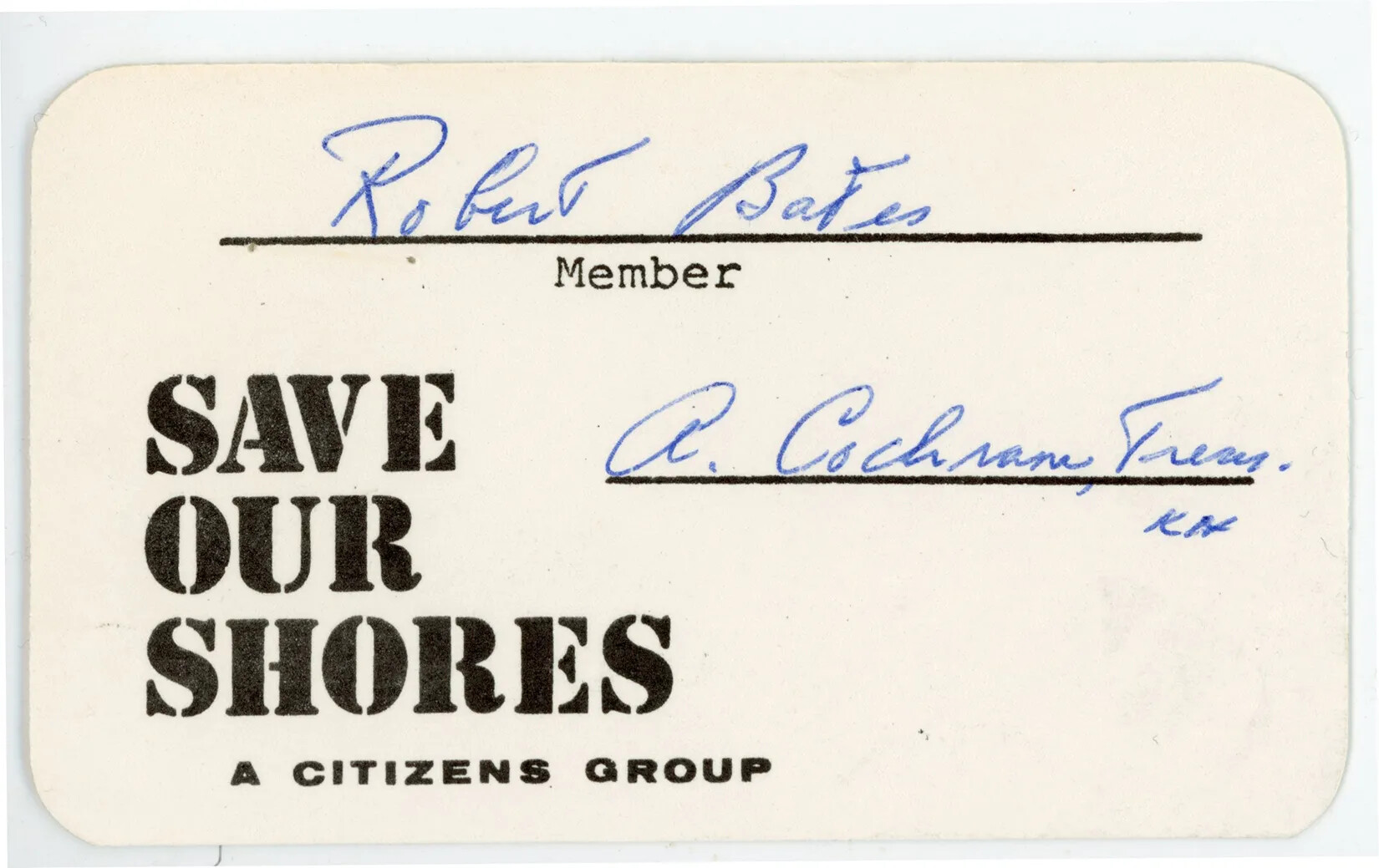
Oil refinery project defeated
A business card with the title "SAVE/OUR/SHORES/A CITIZENS GROUP" in the lower left-hand corner. On the upper border of the card is a blank line with a signature written in blue ink. Beneath the line is the typed word "Member."
1980
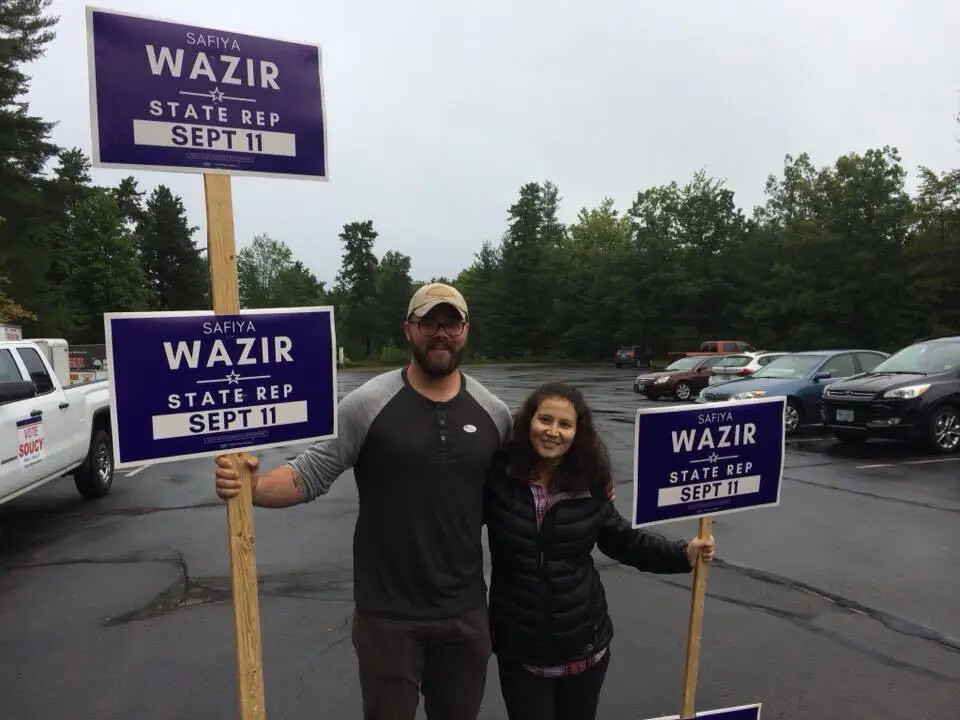
Refugee resettlement communities
Two people stand in a parking lot in a color photograph. A woman wears a black jacket and smiles, and a smiling man wears a cap, and casual pants and shirt. He holds two signs that are the same stacked on each other on a wooden pole, and she holds one of the same sign. The signs read “SAFIYA/ WAZIR/ STATE REP/ SEPT 11.”
1986
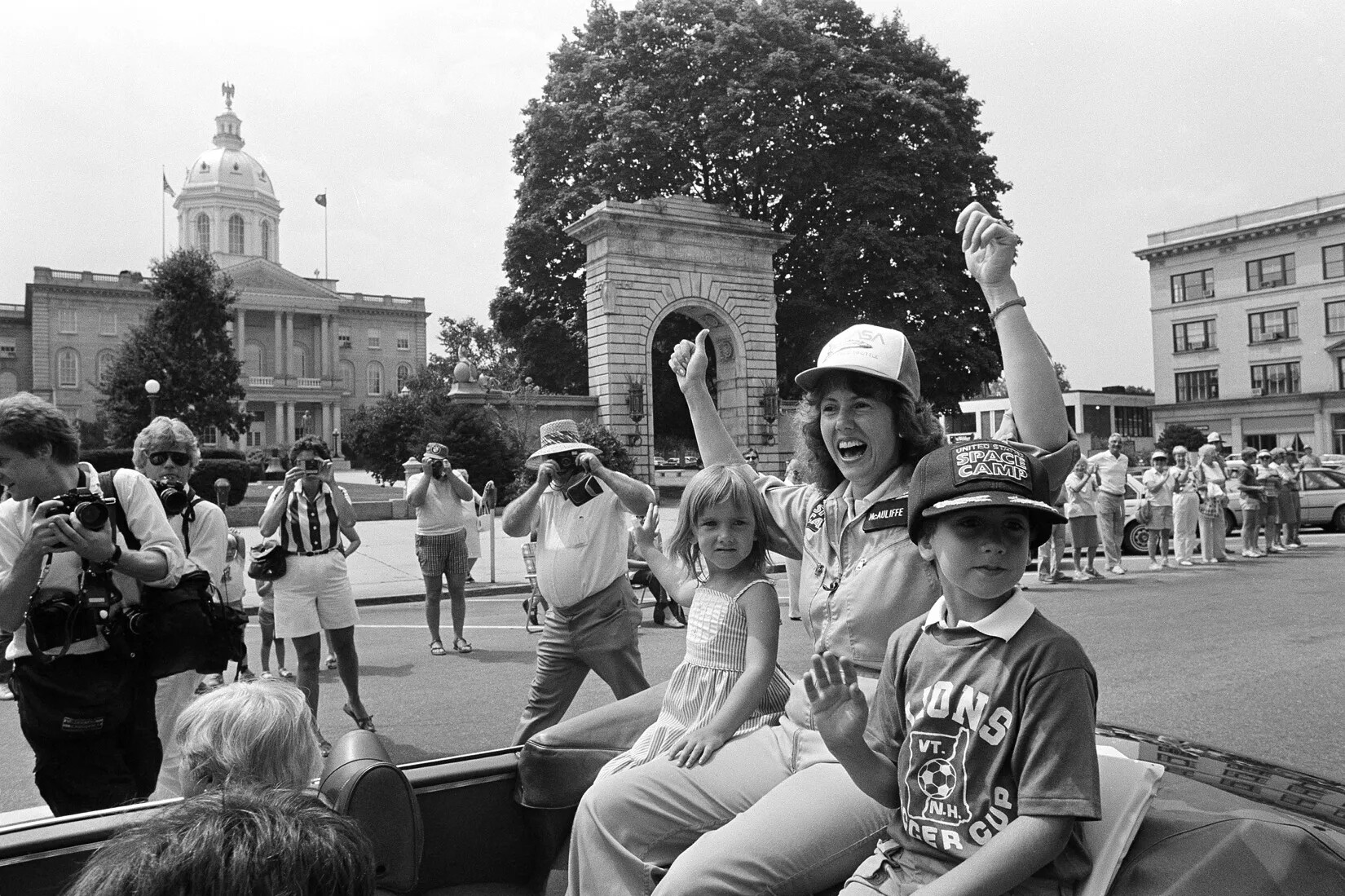
Challenger tragedy
A black and white photograph of a woman and two children riding in an open-top car. The woman has both her arms raised and she is smiling. The two children, a girl to the woman's left and a boy to the woman's right, each wave with one hand. There are crowds of people watching the car pass in the background. In the background of the left-hand side of the photograph is a group of photographers with cameras of varying sizes. Behind this group of people is a large archway and a three-story building with a dome. Two levels of column-lined porches jut out from the center of the building and is crowned by a pointed roof.
1990
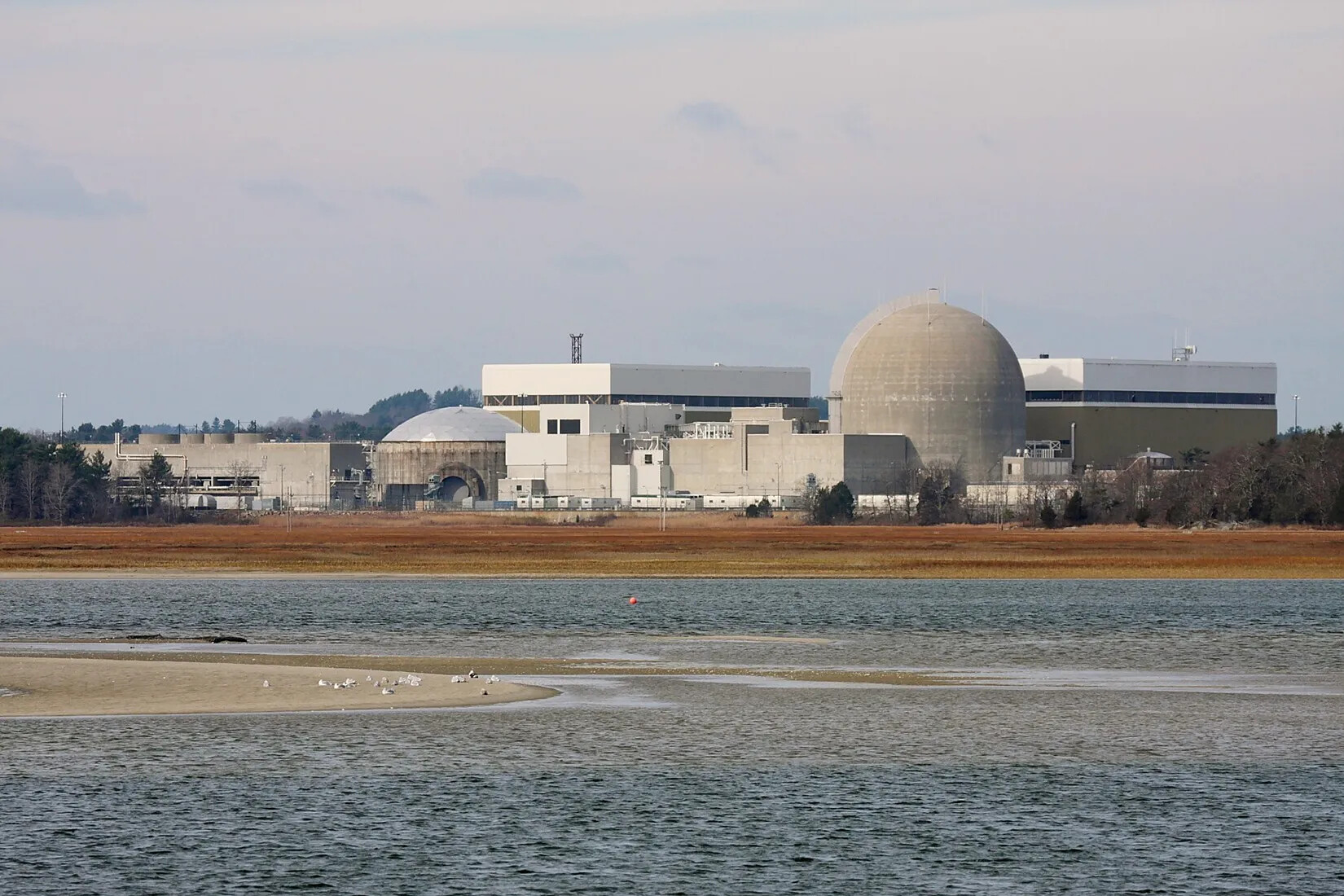
Seabrook Nuclear Power Plant opens
A colored photograph of several multi-storied buildings and domed buildings next to a large body of water.
1990
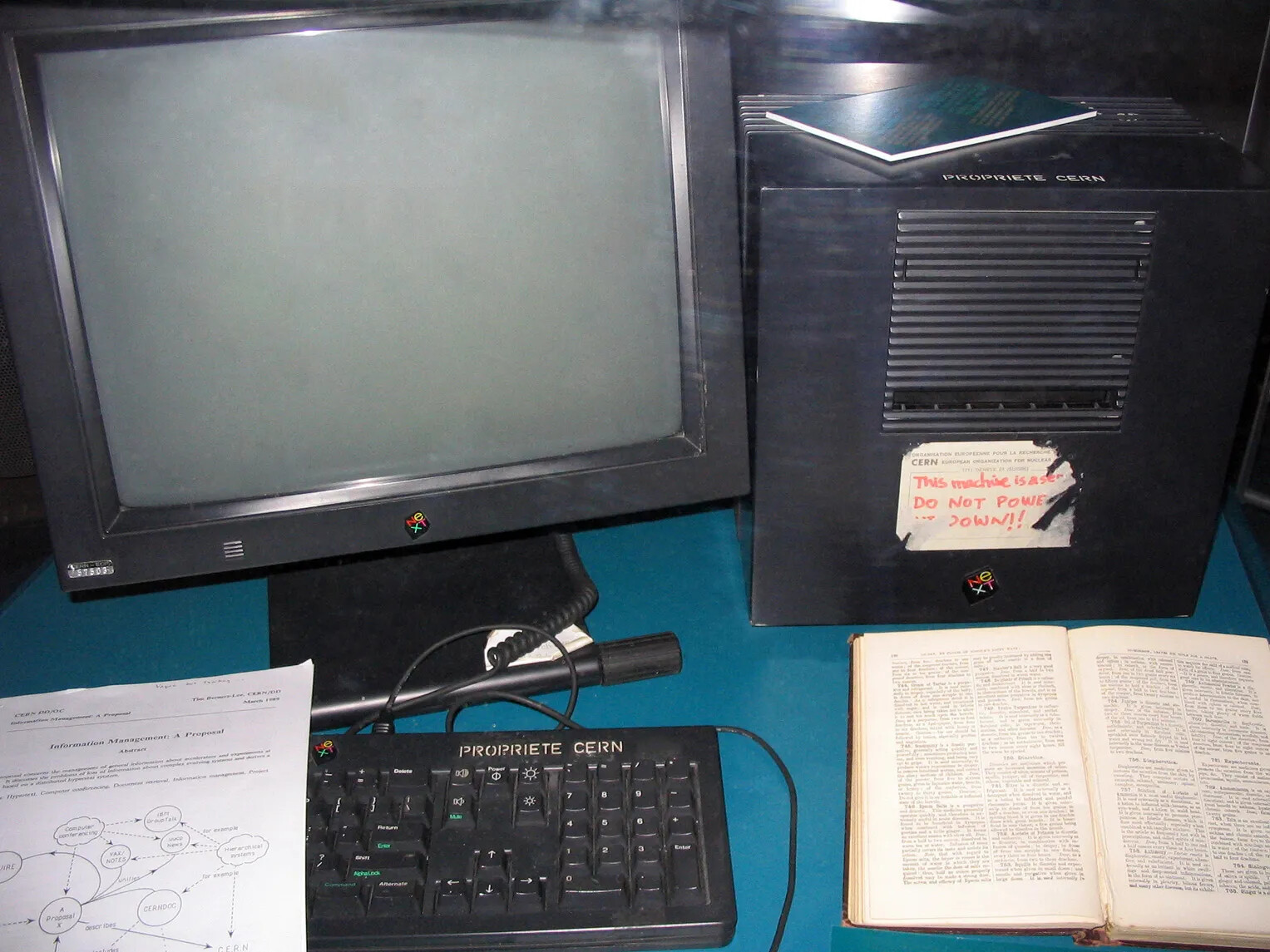
Internet invented
A color photograph of a black computer monitor is seen. It sits on a blue desk with part of a keyboard, covered by a piece of paper with typing, visible below. On the keyboard reads "PROPRIETE CERN."
2001
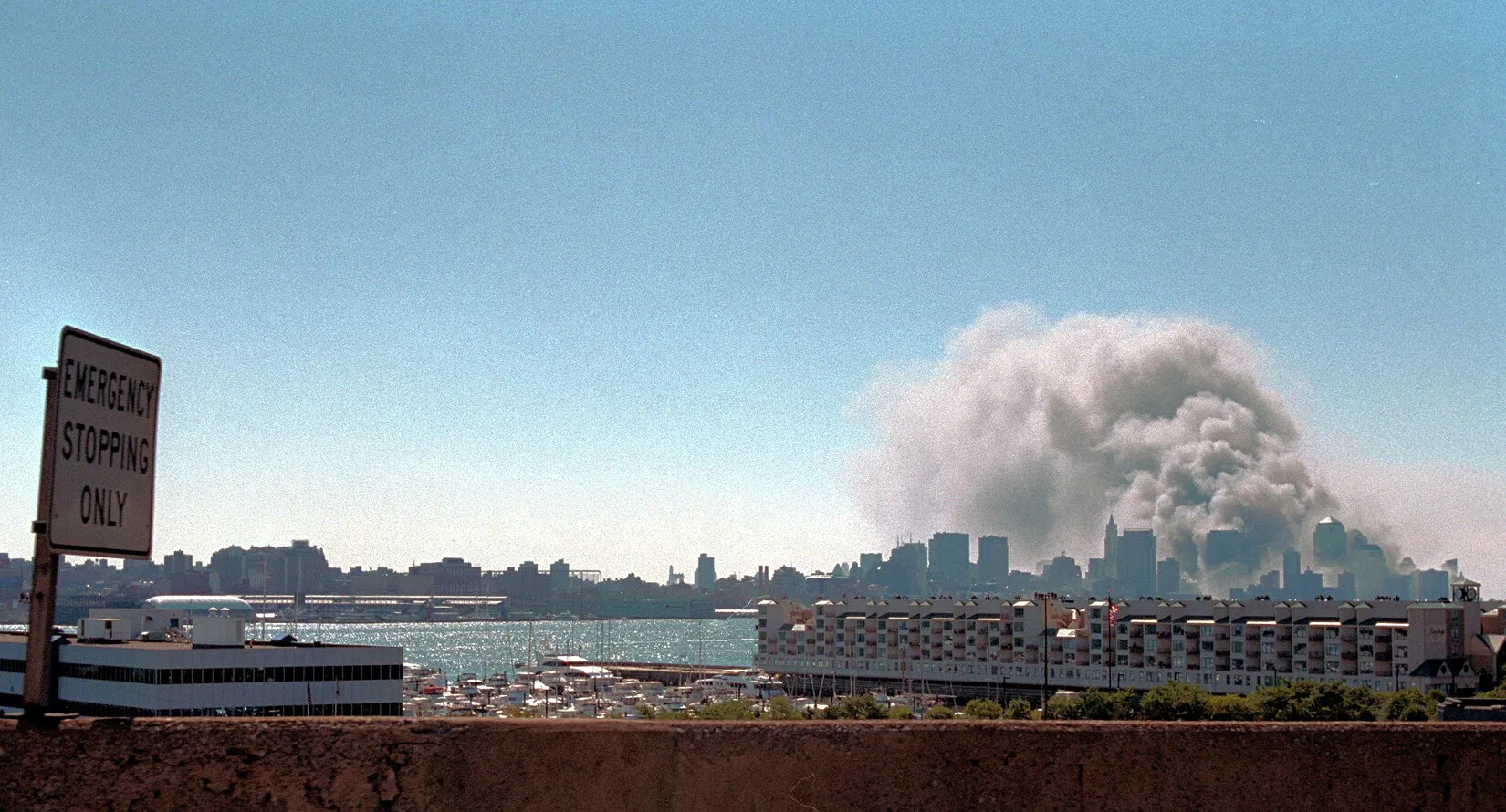
September 11 attacks
A distant view of a city is shown in this color photograph. In the foreground is a low concrete railing with a sign "EMERGENCY STOPPING ONLY" to the left. Then there are two large buildings and a body of water. In the distance, the viewer can see skyscrapers. Large plumes of smoke are rising from the skyscrapers on the left into the blue sky..
2001
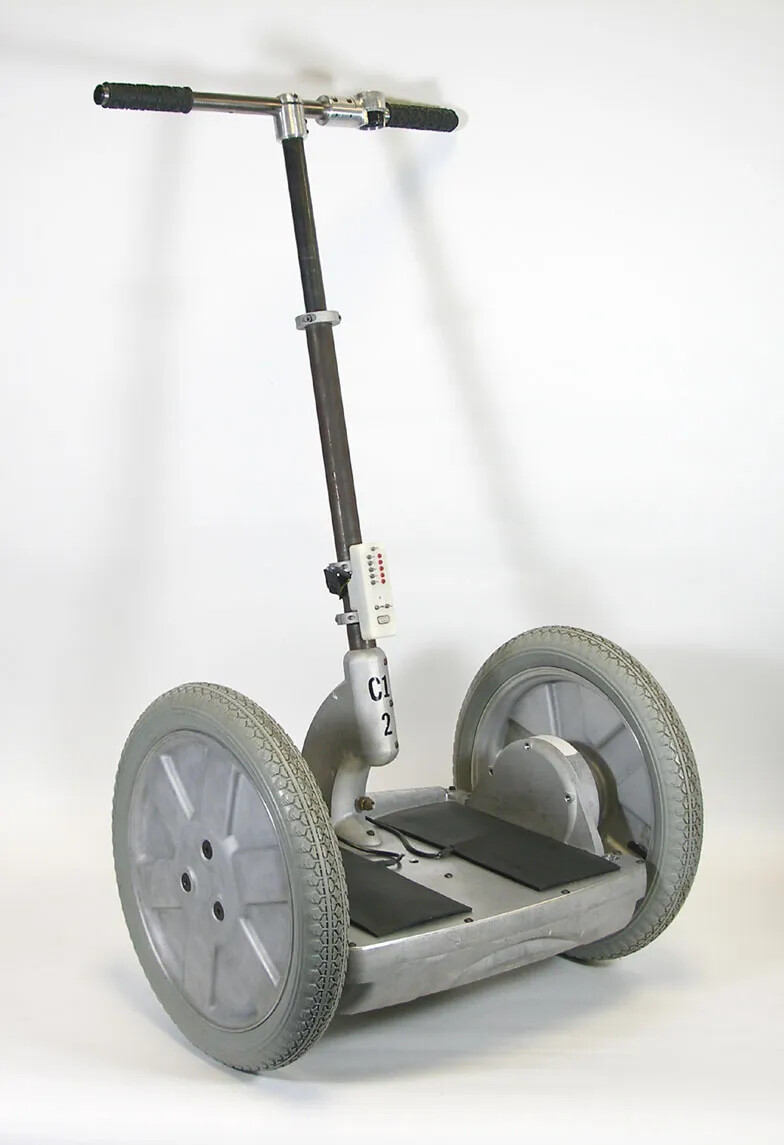
Segway is unveiled
An aluminum deck, 17" wide x 15" deep, has two black rubber foot pads. It is supported by aluminum wheels with gray rubber tires, 16" in diameter. An adjustable steel column supports steel handlebars that have two black rubber handle grips. There is a control knob on the right handlebar and a white plastic control box at the bottom of column, with switches and red lights. A red nylon cord runs from a red "kill switch" at the bottom of the column to a black nylon strap on handlebar.
2003
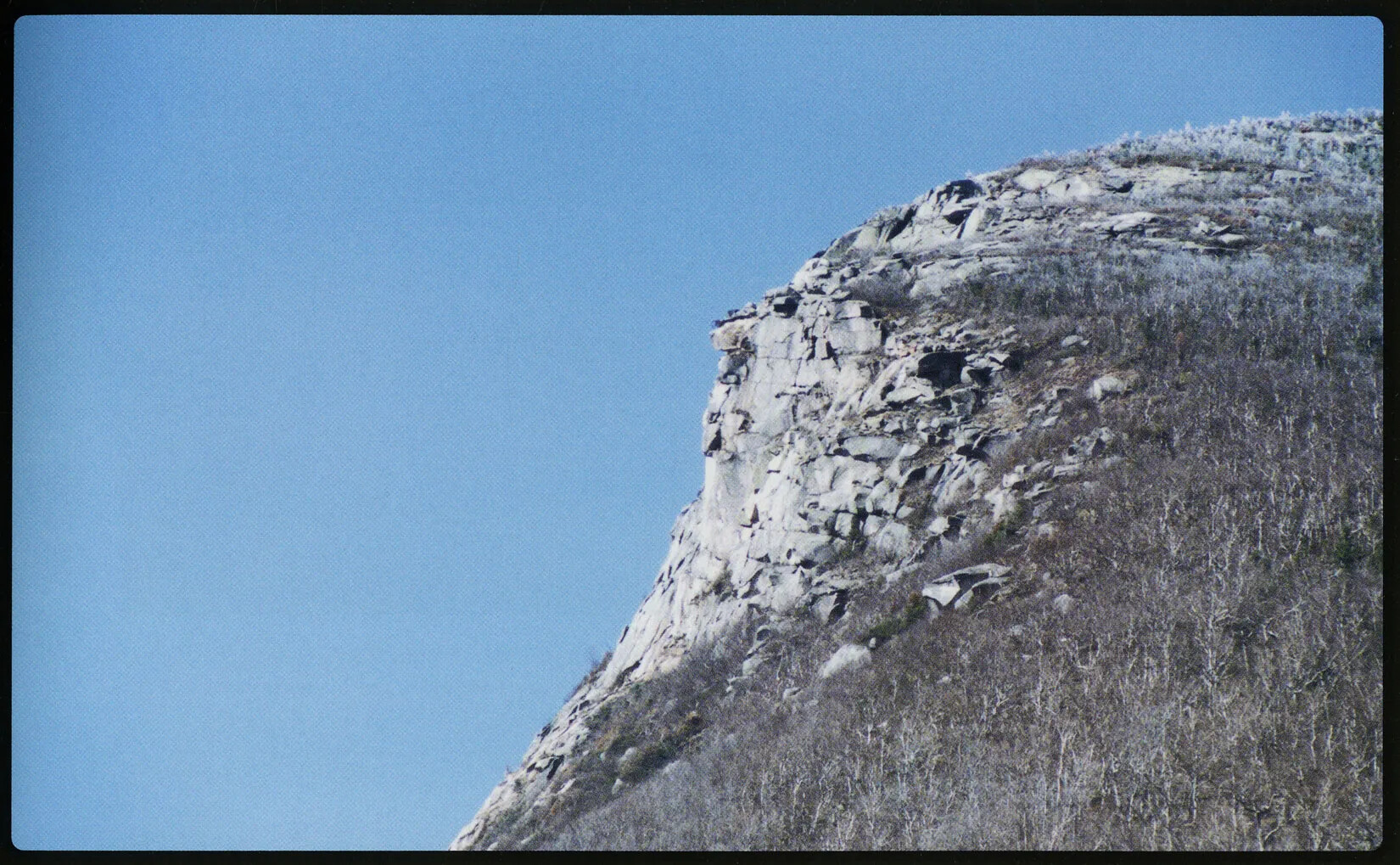
Old Man of the Mountain falls
The edge of a rocky mountain is seen in this color photograph. There are sparse trees leading to the rocky cliff, which has granite slabs of no particular formation.
2012
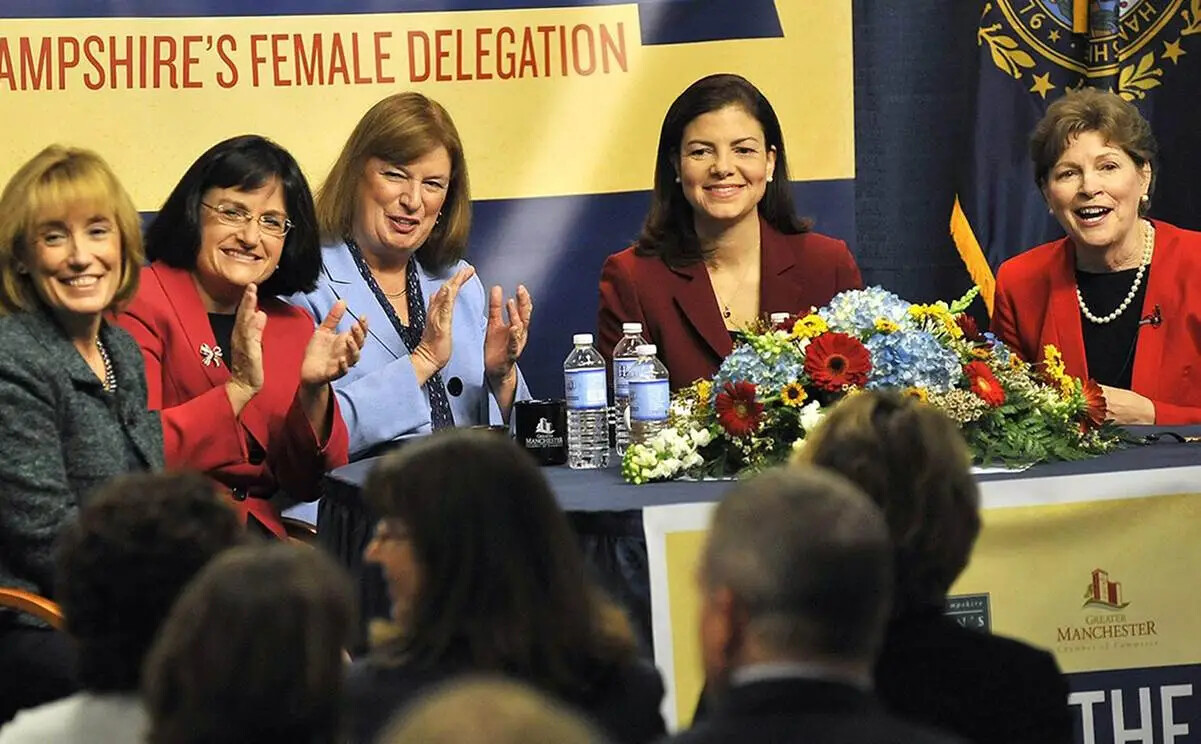
Women represent New Hampshire
In a color photograph, five women sit at a table wearing suits, all facing an audience. Two are clapping and all are smiling. On the table in front of them is a large arrangement of flowers and some water bottles. Behind them are the words "AMPSHIRE'S FEMALE DELEGATION" on a sign which continues out of the photograph.
2015
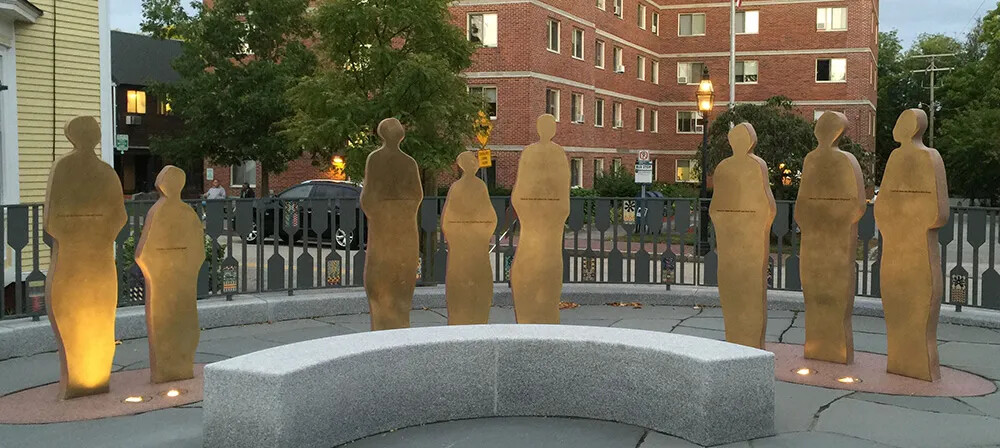
African Burying Ground Memorial Park opens
Photo by Jerome Meadows and Roberta Woodburn, 2015, Black Heritage Trail of New Hampshire
2018
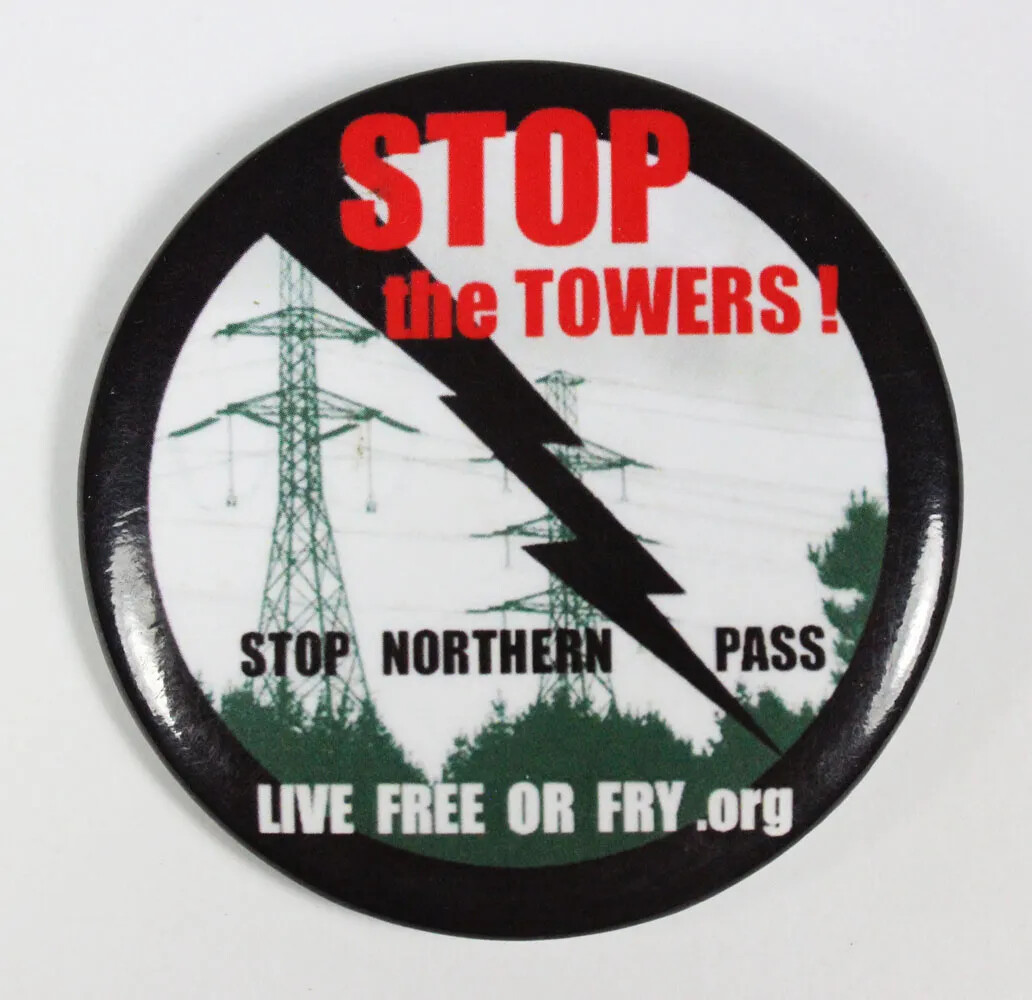
Northern Pass stopped
A circular button outlined in black. Diagonally across the button is a black lightning icon. Text typed onto the button read, from top to bottom: "STOP/the TOWERS!" in red text, "STOP NORTHERN PASS" in black text, and "LIVE FREE OR FRY .org" in white text.