
Primary Source Set - Mount Washington

At 6,288 feet, Mount Washington is the highest mountain in northeastern North America. Located in the Presidential Range of the White Mountains National Forest, the area surrounding the summit and the summit itself, belongs to the Mount Washington State Park. This park is visited each year by over a quarter of a million people from all over the world. On a clear day, visitors to the summit can see into Maine, Vermont, Massachusetts, and New York, and sometimes even into Canada.  


Background

The first written record of the mountain by Europeans was made by Italian explorer Giovanni da Verrazzano in 1524, after he viewed it from the Atlantic Ocean. Originally known as “Agiocochook” or “the place of the Great Spirit” by the Abenaki, the mountain was considered the home of the gods and subsequently never climbed. In 1642, Darby Field of Durham became the first European to climb the mountain. He may have been motivated by rumors that there were gems at the summit. When Field’s quest failed to turn up any precious stones, the English settlers lost interest in the mountain. It was officially named Mount Washington in 1784 by geographer Manasseh Cutler, in honor of the beloved general from the American Revolution.

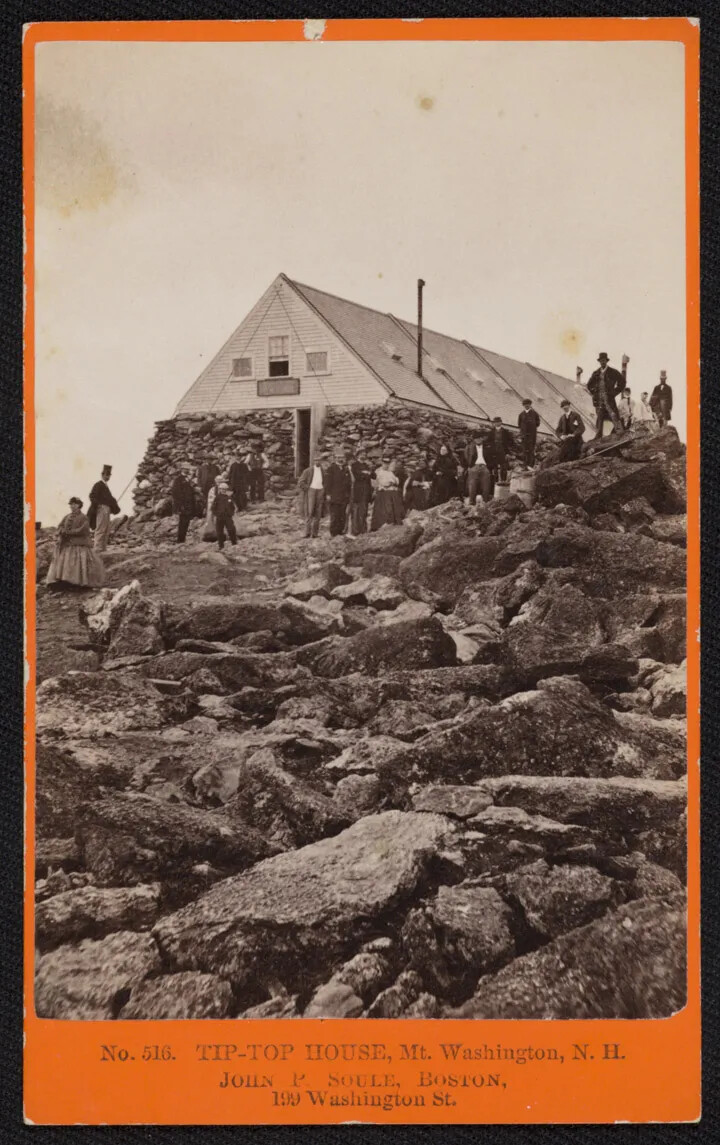
In 1819, Abel Crawford and his son Ethan Allen Crawford built a footpath from Crawford Notch to the summit of the mountain, which is now the oldest maintained footpath in the United States. The summit remained largely undeveloped until the mid-1800s, when it began attracting large numbers of tourists. In 1852, the Summit House opened its doors on Mount Washington’s peak and was soon followed by the Tip Top House. Although the Summit House was destroyed in a fire in 1908, hikers today can still visit the Tip Top House, now a state historic site and museum.

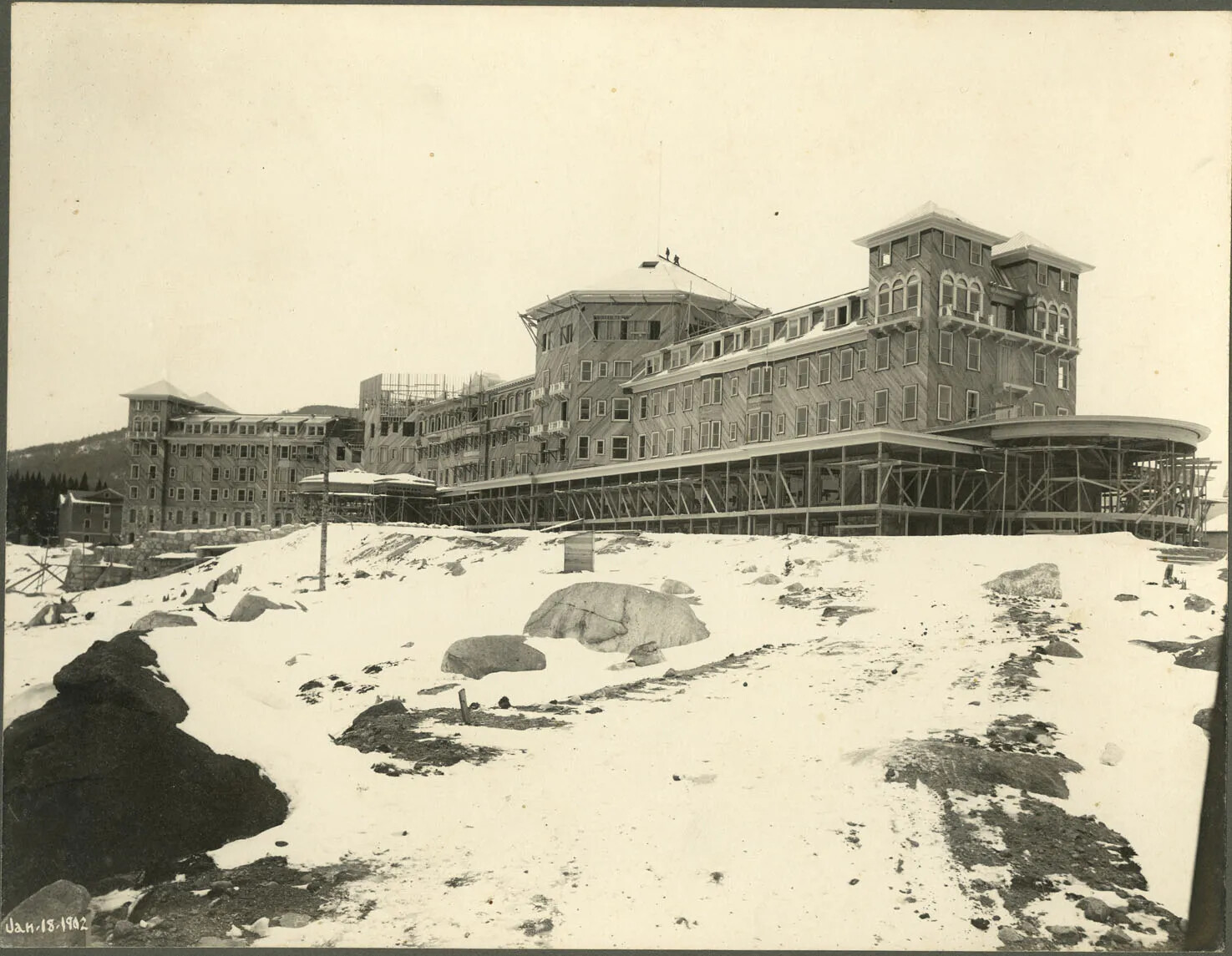
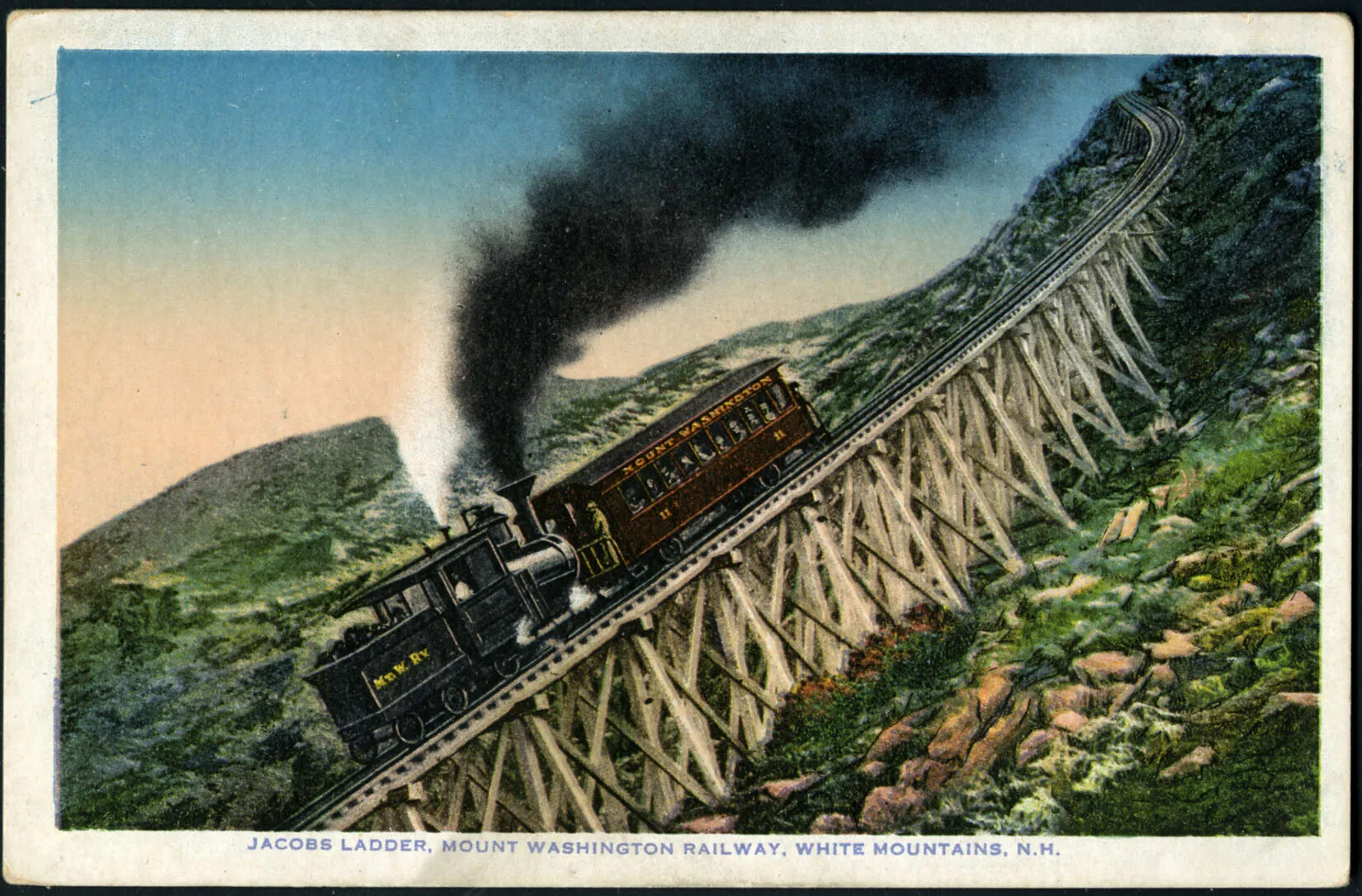
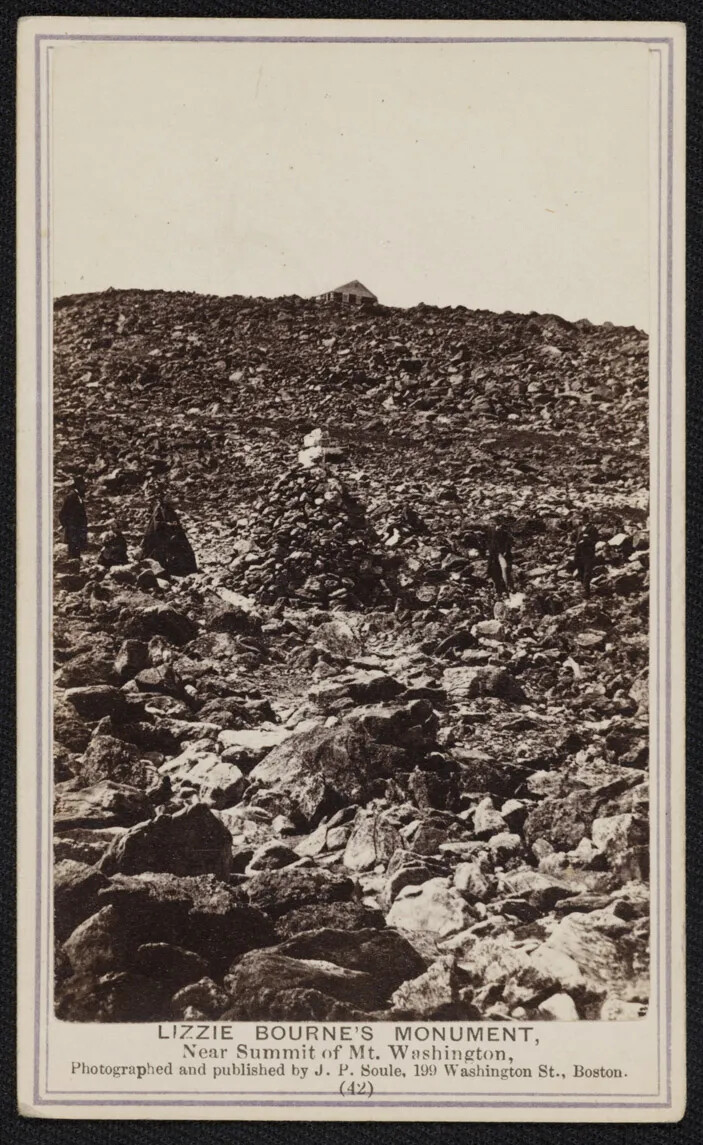
Climbing the mountain on foot was no easy feat for visitors in the mid-1800s, and deaths were not uncommon among hikers who were caught by surprise by the changeable weather. The 1855 death of Lizzie Bourne, a young woman who perished just feet from shelter at the summit during a sudden storm, brought a great deal of attention to Mount Washington. A carriage road was completed in the early 1860s, and later that same decade, in 1869, the Cog Railway opened to the public. This mountain-climbing train, invented by businessman Sylvester Marsh, offered visitors a fast, risk-free way to ascend to the summit and enjoy the views. It has been a popular tourist destination ever since, especially after the 1902 construction of the luxurious Mount Washington Hotel, nestled at the foot of the mountain.

Mount Washington is also known for its weather extremes. The highest temperature ever measured at the summit was 72º F and the lowest was -47º F. The highest wind speed ever (231 miles per hour) was recorded by a team of scientists at the Mount Washington Observatory on April 12, 1934. The weather observatory, founded in 1932, is a nonprofit institution that monitors the subarctic climate of the mountain. It has adopted the slogan, “Home of the World’s Worst Weather.” The weather station is staffed continuously by two alternating crews who live at the observatory in one-week shifts. The crews perform research experiments, conduct educational programs, issue daily radio reports, and take hourly weather observations. These observations are then sent to the National Weather Service to help forecast the weather for the rest of the region.

Mount Washington’s views and climate continue to fascinate tourists and remain popular with hikers and sightseers from New Hampshire and beyond.

This primary source set guide can be used in several ways to explore the story and significance of Mount Washington. It is not necessary to use all sources in a set to create a meaningful inquiry.


Additional Resources

  • Gosselin, Guy, Ten Years on the Rock Pile: A Collection of Stories, Some Hilarious, Some Tragic, About Life at the Summit of Mount Washington (Lincoln: University of Nebraska Press, 2011).
  • Noyes, Nathaniel, Temperature of the Weather at the Summit of Mount Washington, New Hampshire (Summit House, Mount Washington: Nathaniel Noyes, 1854).
  • "Mount Washington: One Prodigious Hilltop," New Hampshire Magazine (June 2019), https://www.nhmagazine.com/mount-washington/, with 100+ things everyone should know about Mount Washington.
  • Timeline of New Hampshire History, New Hampshire Historical Society, nhhistory.org/Timeline.
  • Weather Channel, Weather Channel Epic Conditions: Episode 5: New Hampshire (2007), DVD, 22 min.

Focus Questions

In addition to our general suggestions for using primary source sets, consider giving students one of the following prompts for an inquiry using this primary source set about Mount Washington.

  • 1
    How has Mount Washington been important for the people of New Hampshire?
  • 2
    How has shifting technology changed people's relationship with Mount Washington?
Audiovisuals in this Primary Source Set:

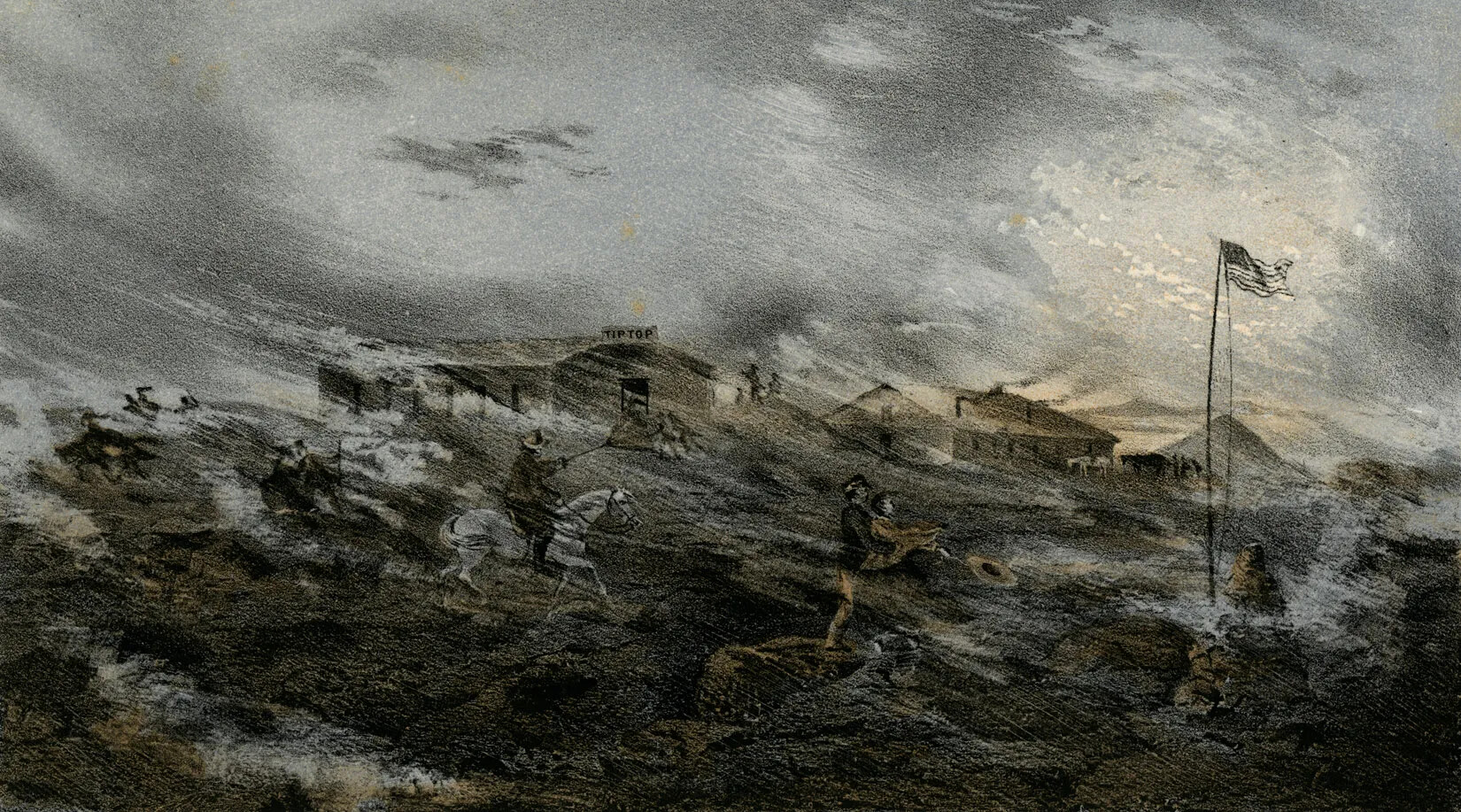
A colored lithograph of people caught in the middle of a storm on rugged terrain. The wind of the storm is pushing everything in its path to the right. There are two buildings in the background and an American flag on a flag pole in the right-hand corner.
Mason Presents: Mount Washington
Mason Presents: Wind on Mount Washington

Biographies in this Primary Source Set:

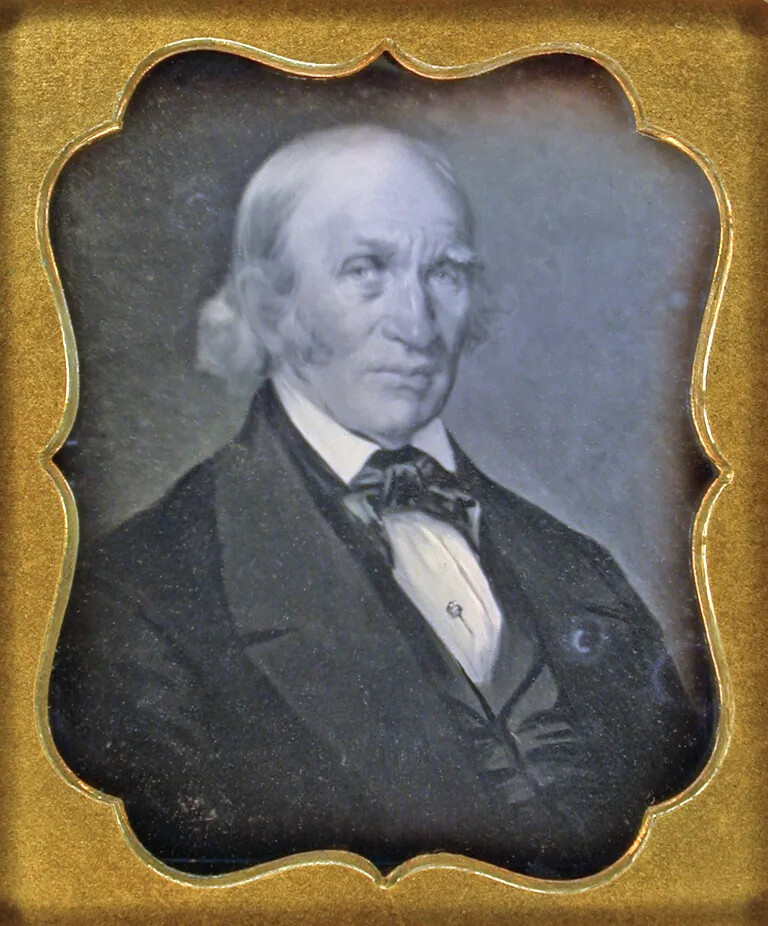
A black and white photograph of a white man in a high-collared shirt, necktie, vest, and jacket. The photograph is centered in a gold frame with inwardly curved edges.
Abel Crawford
A solid black image of a moose, with white capital letters inside reading "SORRY, NO PICTURE AVAILABLE."
Ethan Allen Crawford
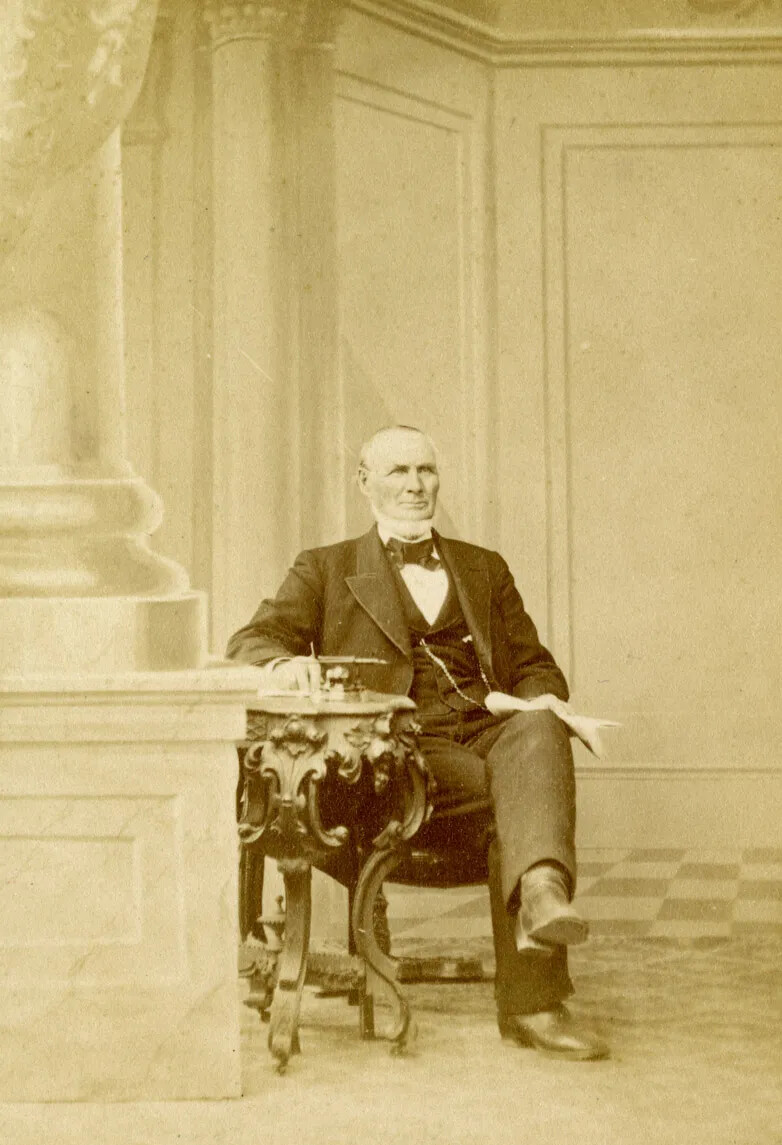
A black and white photograph of a man in a high-collared shirt, necktie, vest, jacket, pants and boots with his legs crossed. His left arm rests on a table with curved and ornately decorated legs. His right arm rests on his lap, and he is holding a bunch of folded papers.
Sylvester Marsh

Documents in this Primary Source Set:

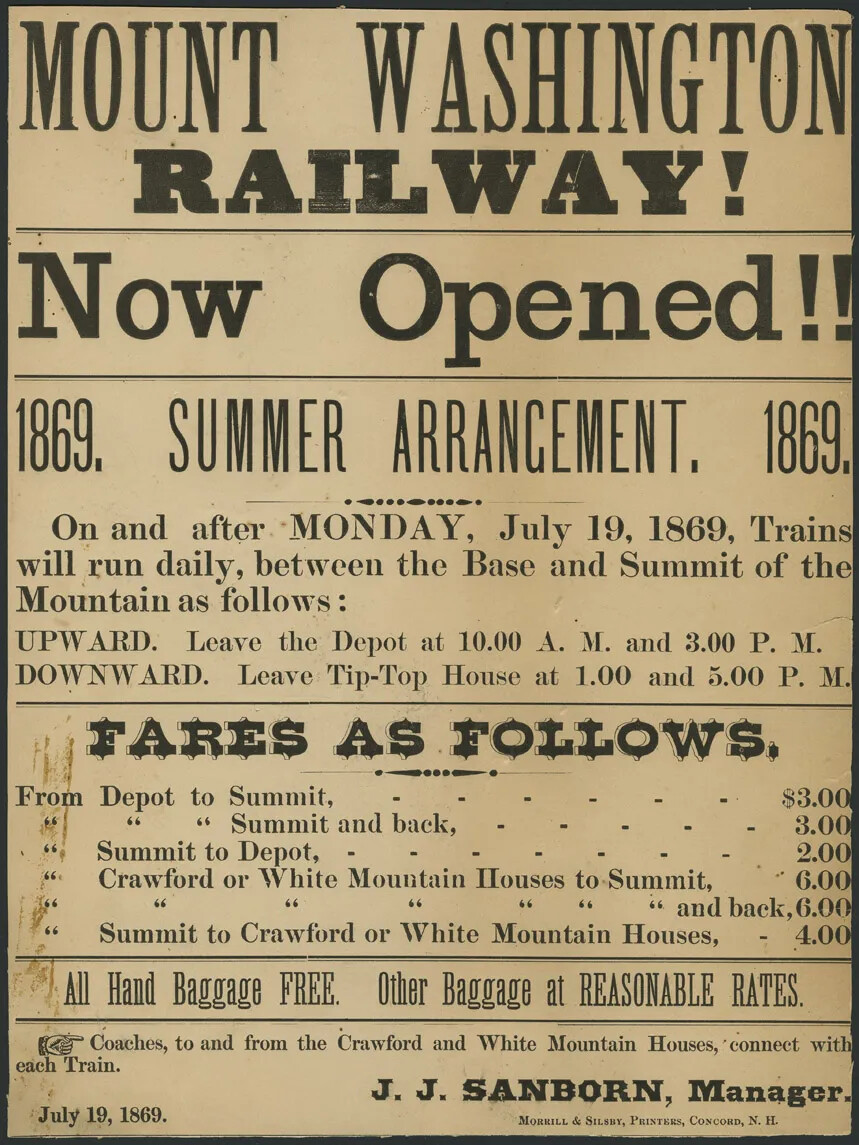
A long vertical document with text typed in black ink on white paper. The text of the document is in many different fonts and sizes. The title of the document, centered along the upper border, reads "MOUNT WAHSINGTON/RAILWAY!/Now Opened!"
Cog Railway Advertisement
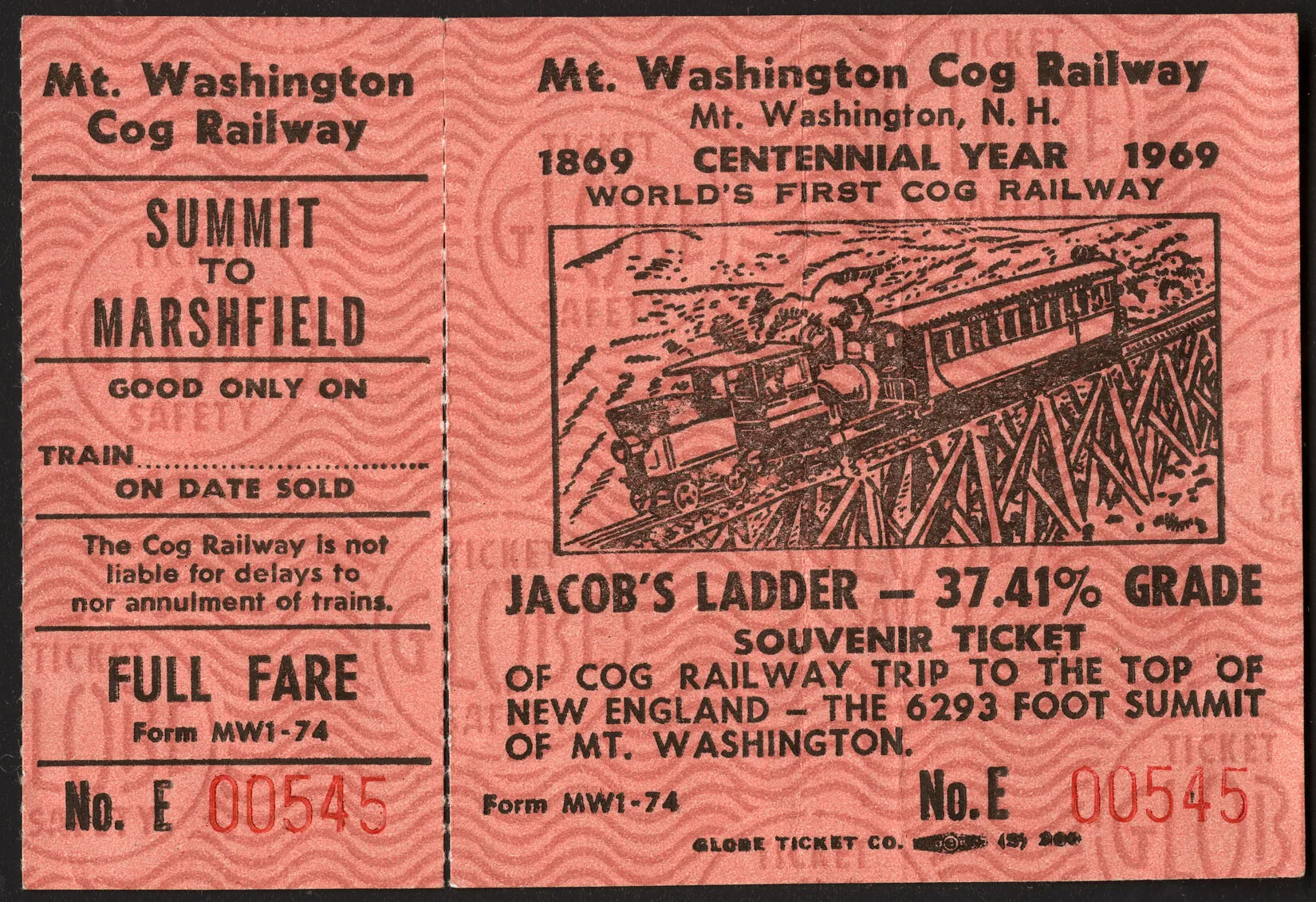
A small, horizontal document on red paper with black text. The text on the document is typed in different fonts and sizes. The document is divided into two halves, though the right side is wider than the left side. The right side includes a drawing of a train engine tugging along a single passenger car on an elevated set of train tracks. The title of the document, placed above the drawing reads "Mt. Washington Cog Railway/Mt. Washington, N.H./1869 Centennial Year 1969/WORLD'S FIRST COG RAILWAY."
Cog Railway Ticket

Explainer Videos and Virtual Field Trips in this Primary Source Set:

Virtual Field Trip: Mount Washington, Up, Up, and Away!

Maps & Charts in this Primary Source Set:

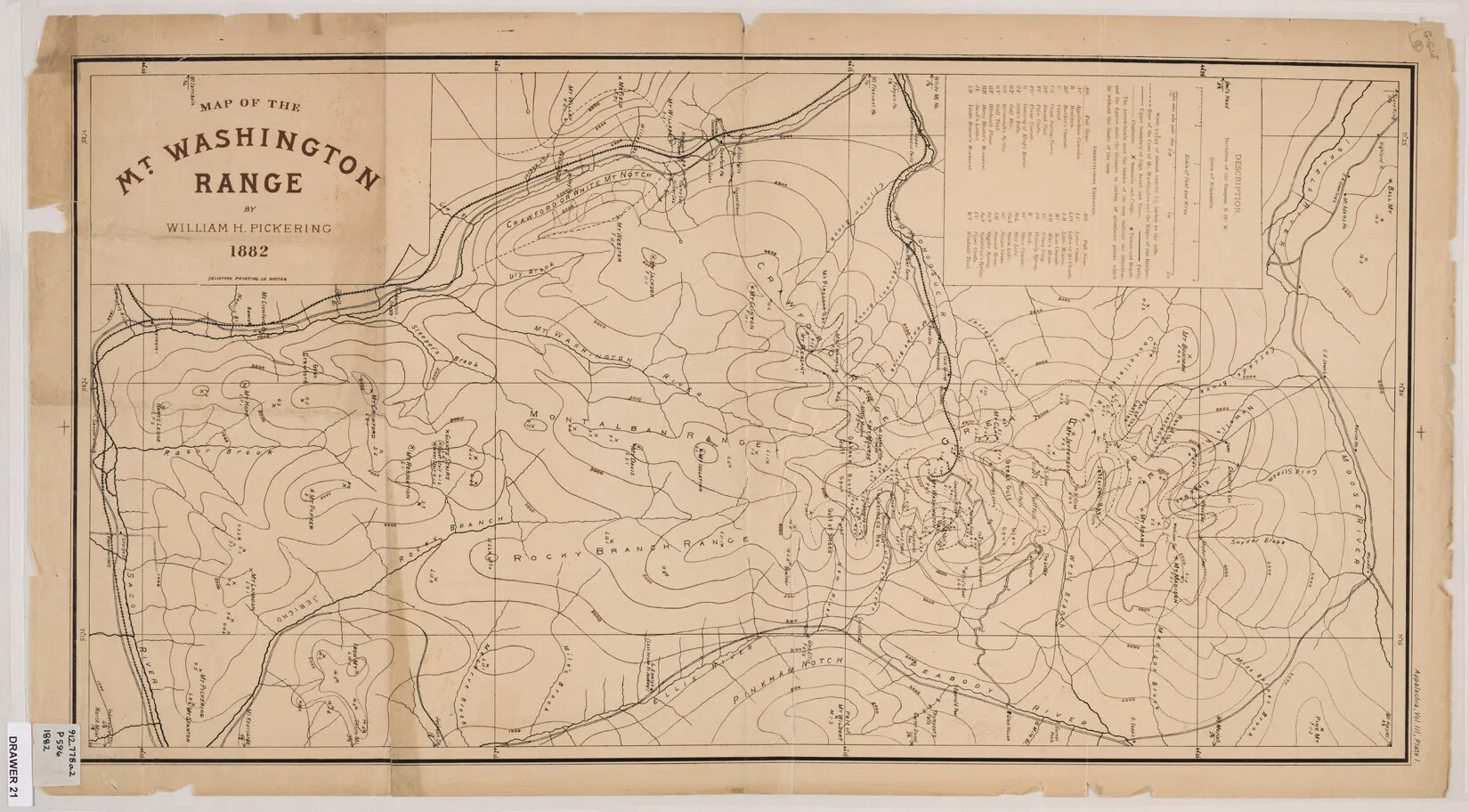
A long horizontal document of a map with lots of squiggly lines and circles. The lines of latitude and longitude are marked on the edges of the map. The title of the map, placed in the upper left-hand corner, reads "MAP OF THE/MT. WASHINGTON/RANGE/ BY/WILLIAM H. PICKERING/1882", and is typed in black ink on the white paper. There is a map key with symbols and small text placed sideways in the upper right-hand corner.
Mount Washington Range
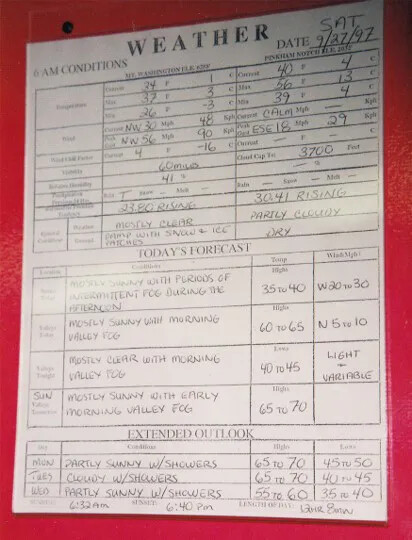
A large white chart with black text that is both typed and hand-written. There are three sections on the chart, each with its own title. In descending order, the titles read "WEATHER/6 AM CONDITIONS DATE SAT/9/27/97"; "TODAY'S FORECAST"; and "EXTENDED OUTLOOK."
Mount Washington Weather Board

Objects in this Primary Source Set:

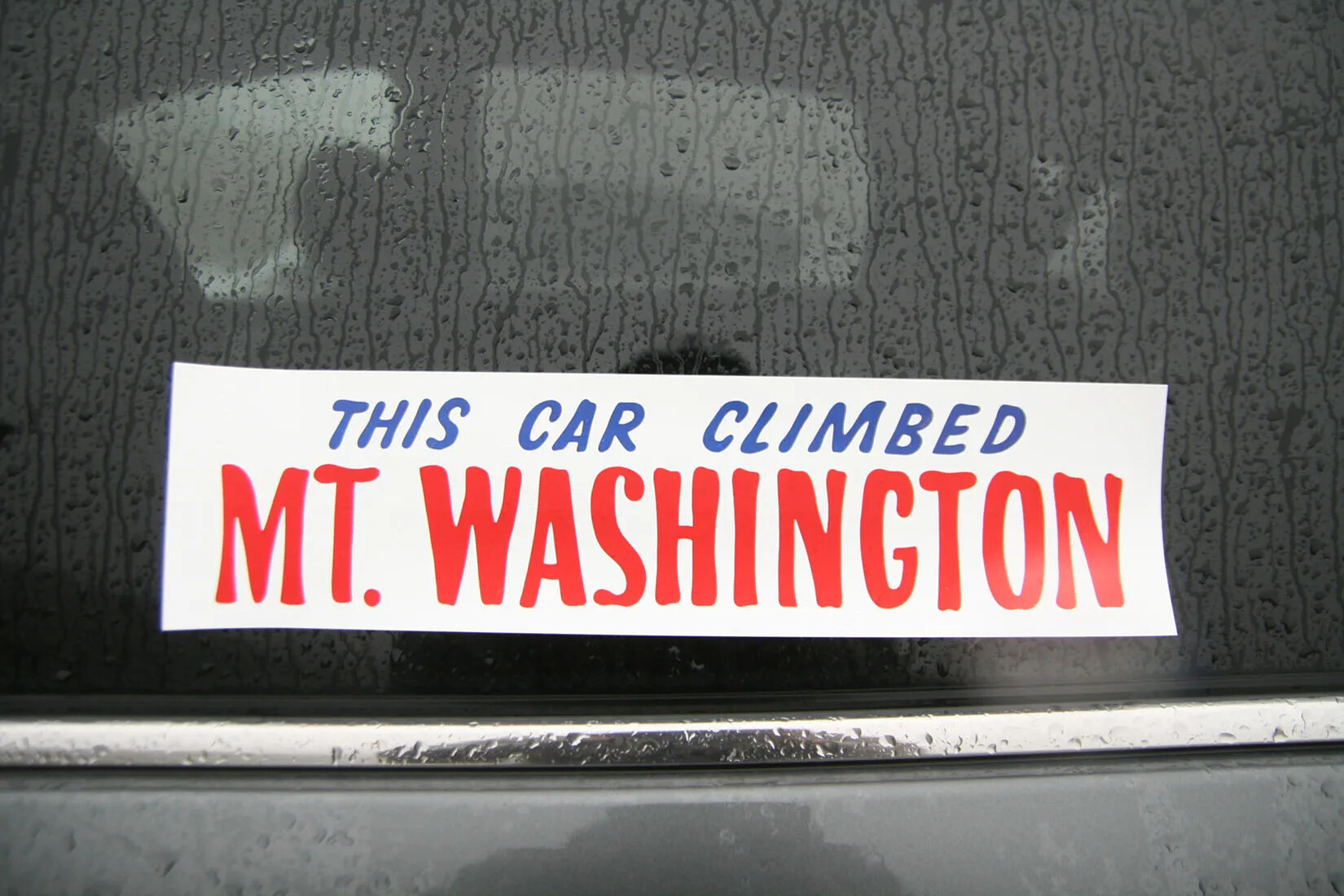
A small, horizontal white sign with blue and red text. The blue words read "This Car Climbed/" and the red words read "MT. WASHINGTON."
"This Car Climbed Mt. Washington" Sticker
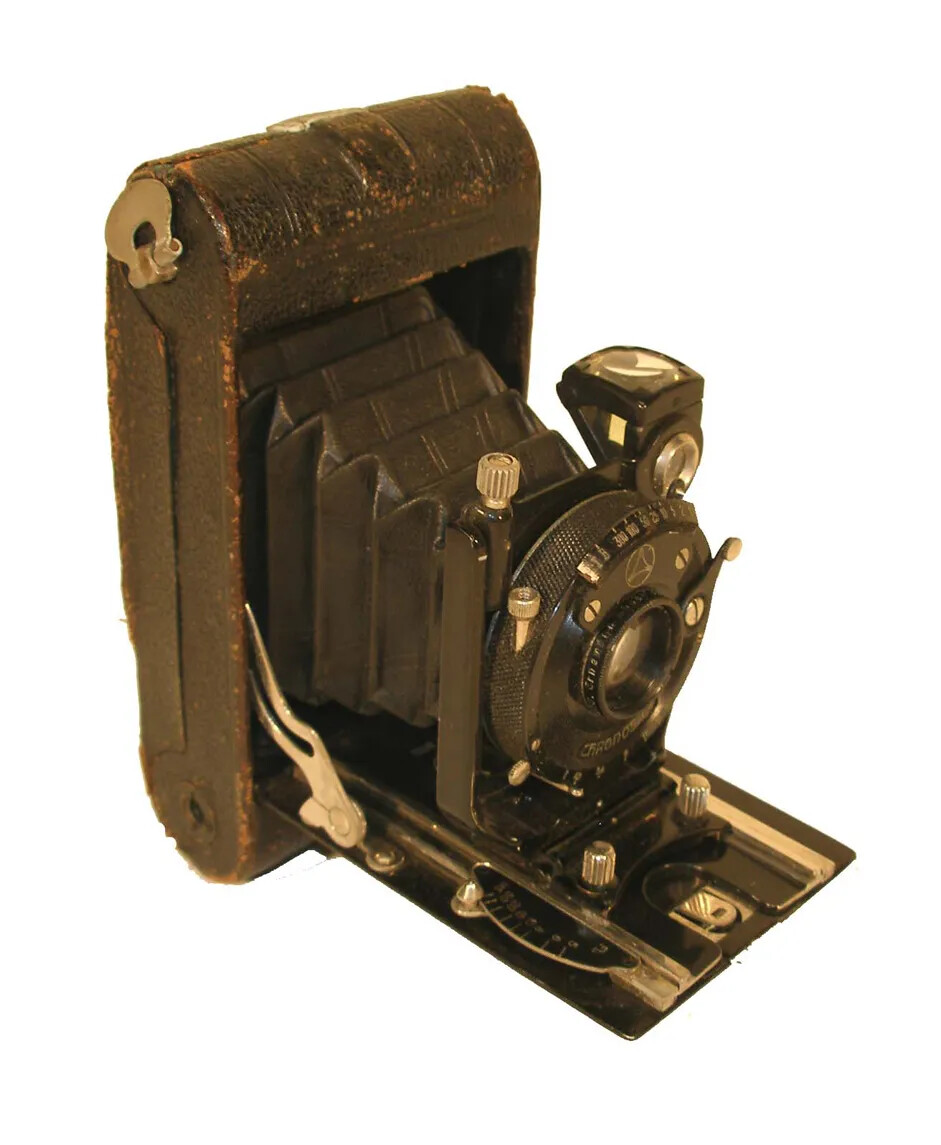
A small brown camera with a large, extendable lens.
Camera
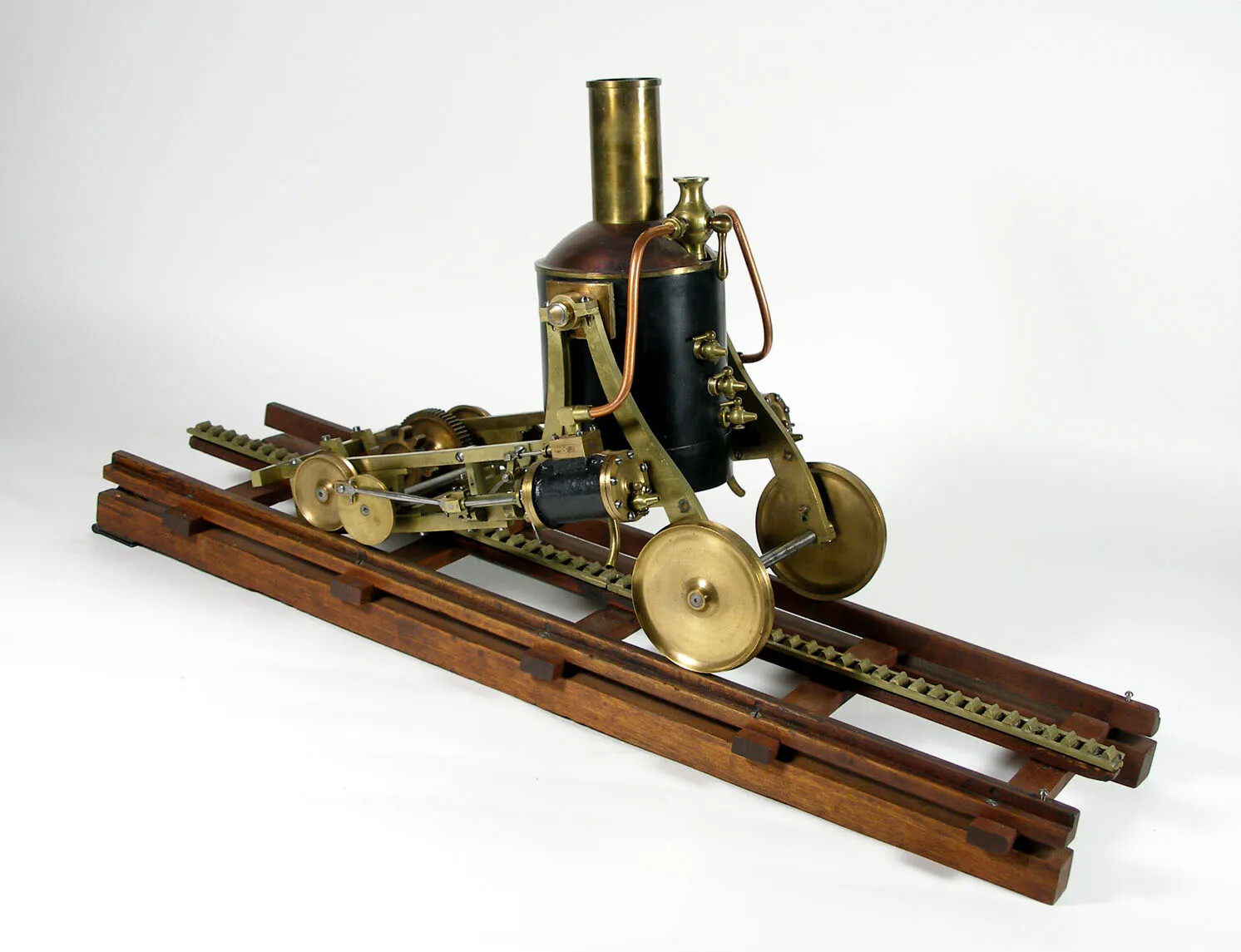
A model of a train engine, placed at an upwards angle on a set of wooden tracks. The train engine has a black core and copper-colored wheels, gears, and smoke stack.
Cog Railway Model
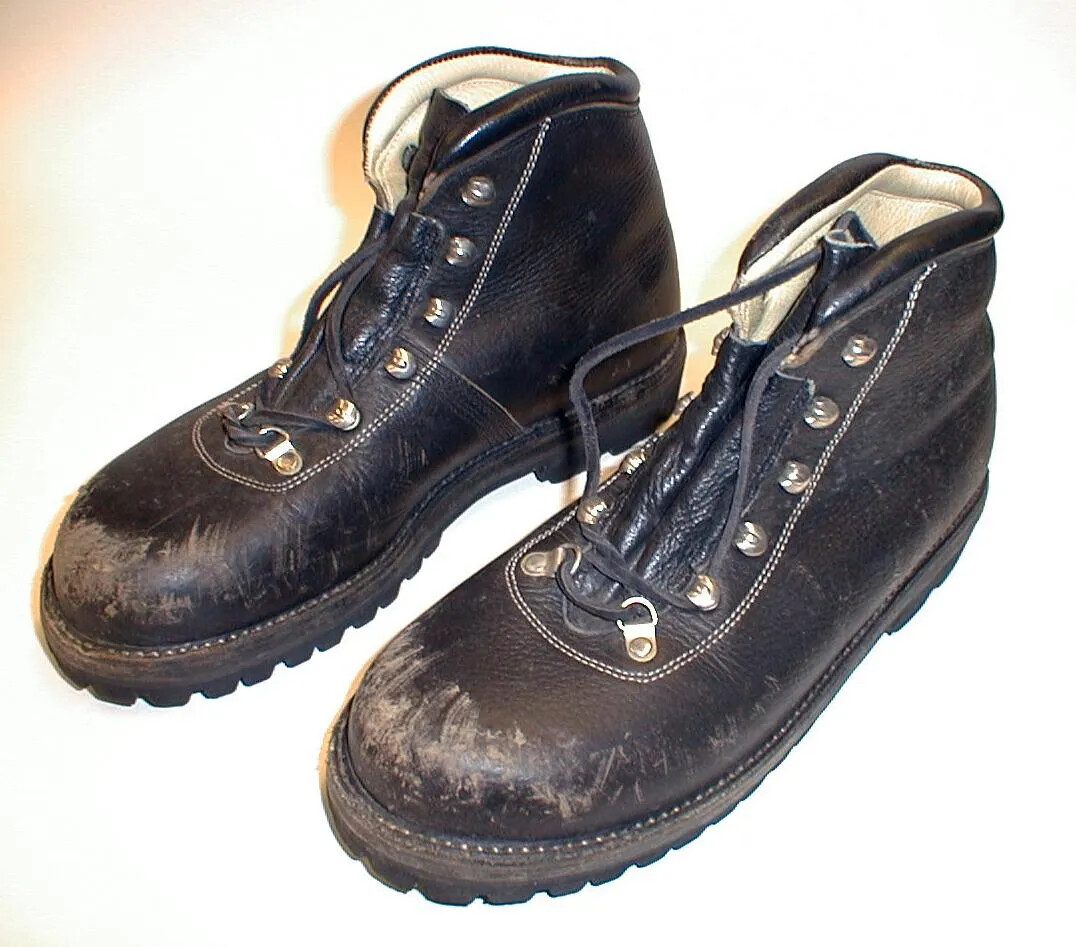
A pair of black leather hiking shoes with shoe laces. The shoes have rounded toes and high ankles.
Hiking Boots

Photographs & Prints in this Primary Source Set:

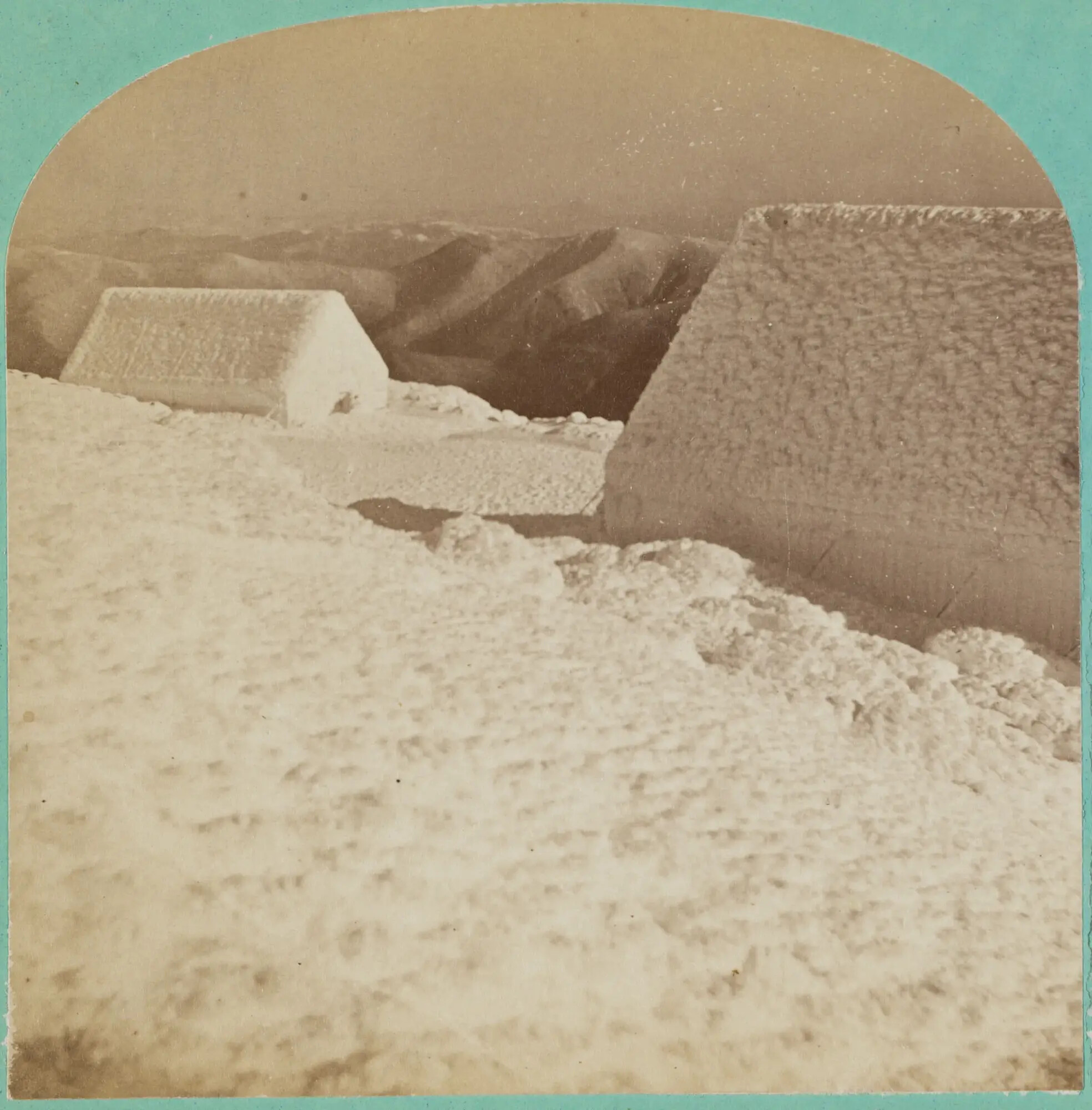
A black and white carte de viste of two buildings completely covered in snow. In the background is a mountain range. On the left-hand border, the words "Summit of Mount Washington, Winter of 1870-71./Entered according to Act of Congress in the year 1871, by Clough & Kimball, in the office of the/Librarian of Congress, at Washington" are typed in black ink. On the right-hand border, the words "CLOUGH & KIMBALL, CONCORD, NH" are typed in elaborate writing in black ink. The circled number "1085" is written in blue ink on the top right-hand corner.
Buildings on Mount Washington in Winter
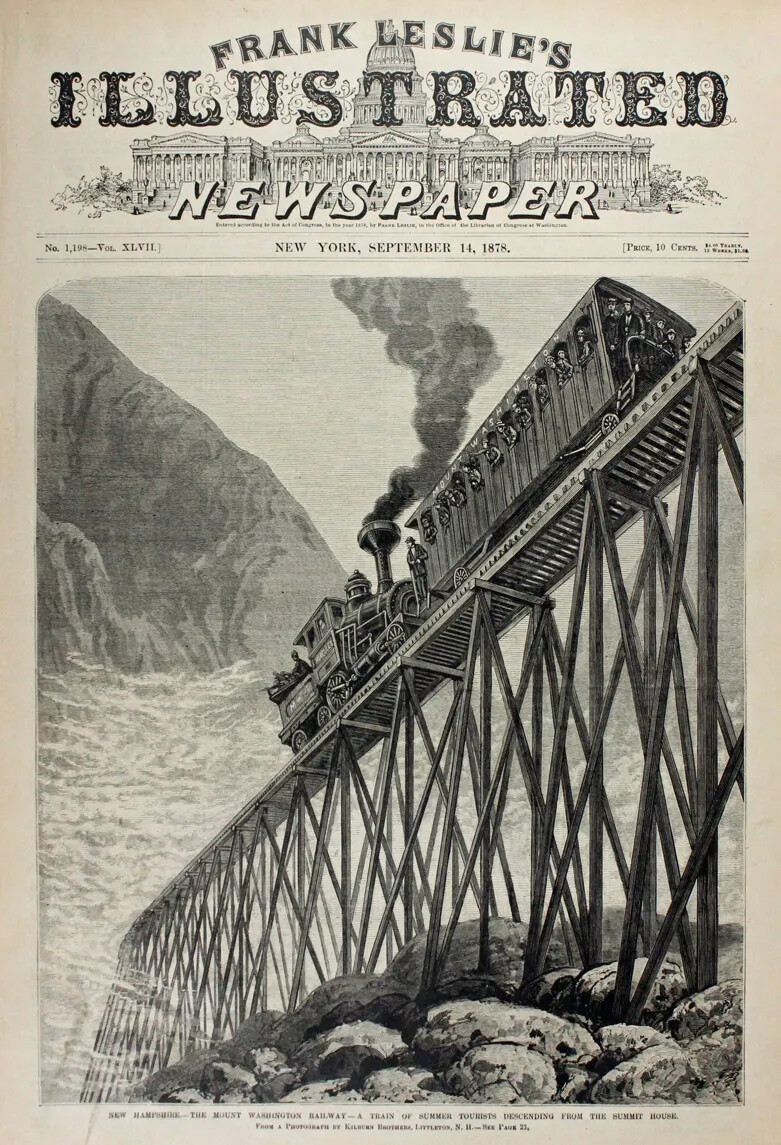
A document with a black and white engraving on white paper of a train engine pulling a single passenger car down a steep set of elevated railway tracks in a mountain region. The title of the engraving, placed centered above the engraving and written in black ink, reads "FRANK LESLIE'S/ILLUSTRATED/NEWSPAPER."
Cog Railway Descending Mount Washington
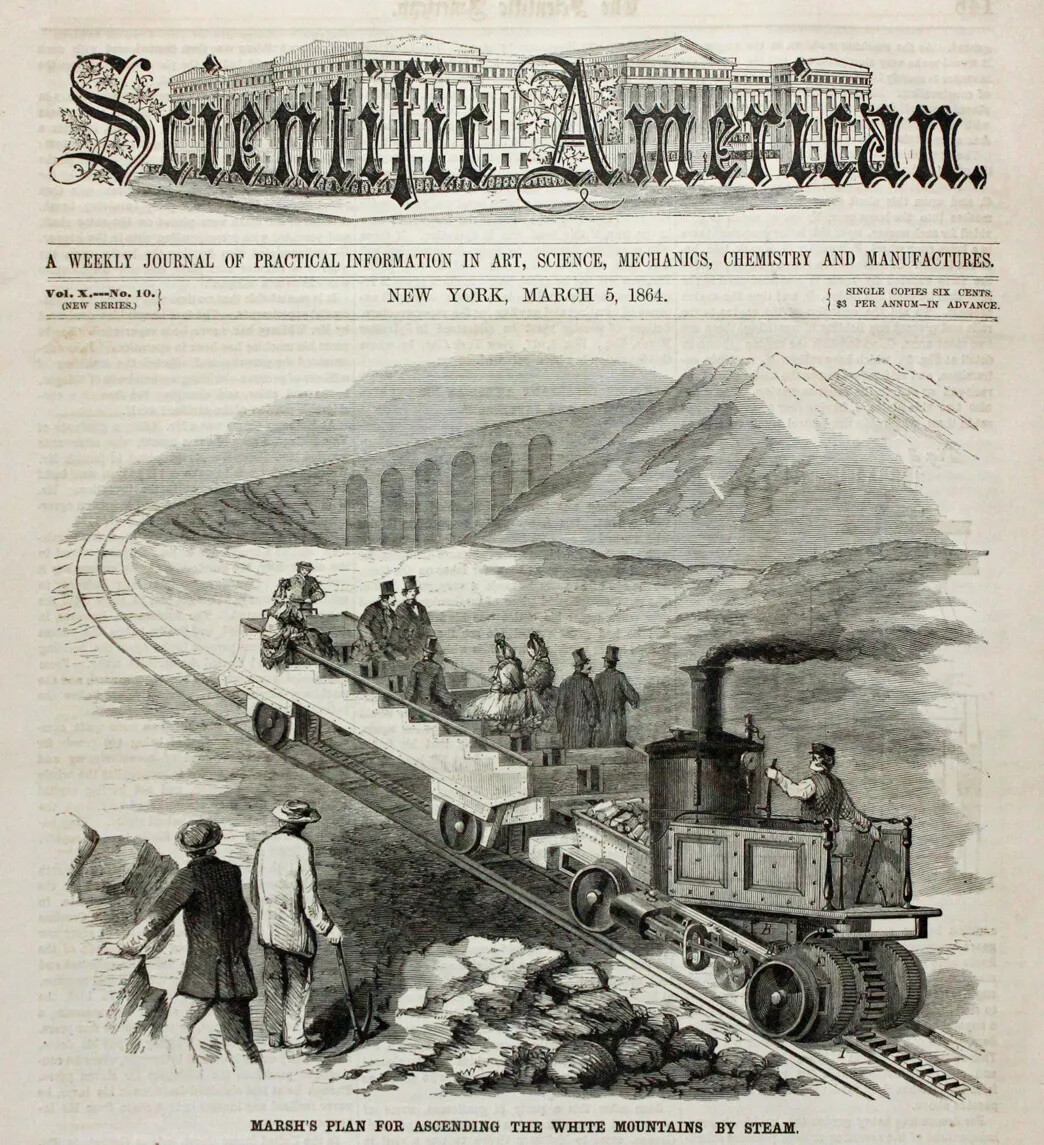
A document with black text typed on white paper. In the center of the document is a black and white drawing of a train engine pushing an open-air passenger car up a set of steep train tracks. People stand or sit in the passenger car and a man standing behind the engine works the machine. Two men stand to the left of the train tracks and watch it go past. Above the drawing, centered along the upper border, are the words: "Scientific American/A WEEKLY JOURNAL OF PRACTICAL INFORMATION IN ART, SCIENCE, MECHANICS, CHEMISTRY AND MANUFACTURES."
Cog Railway Illustration
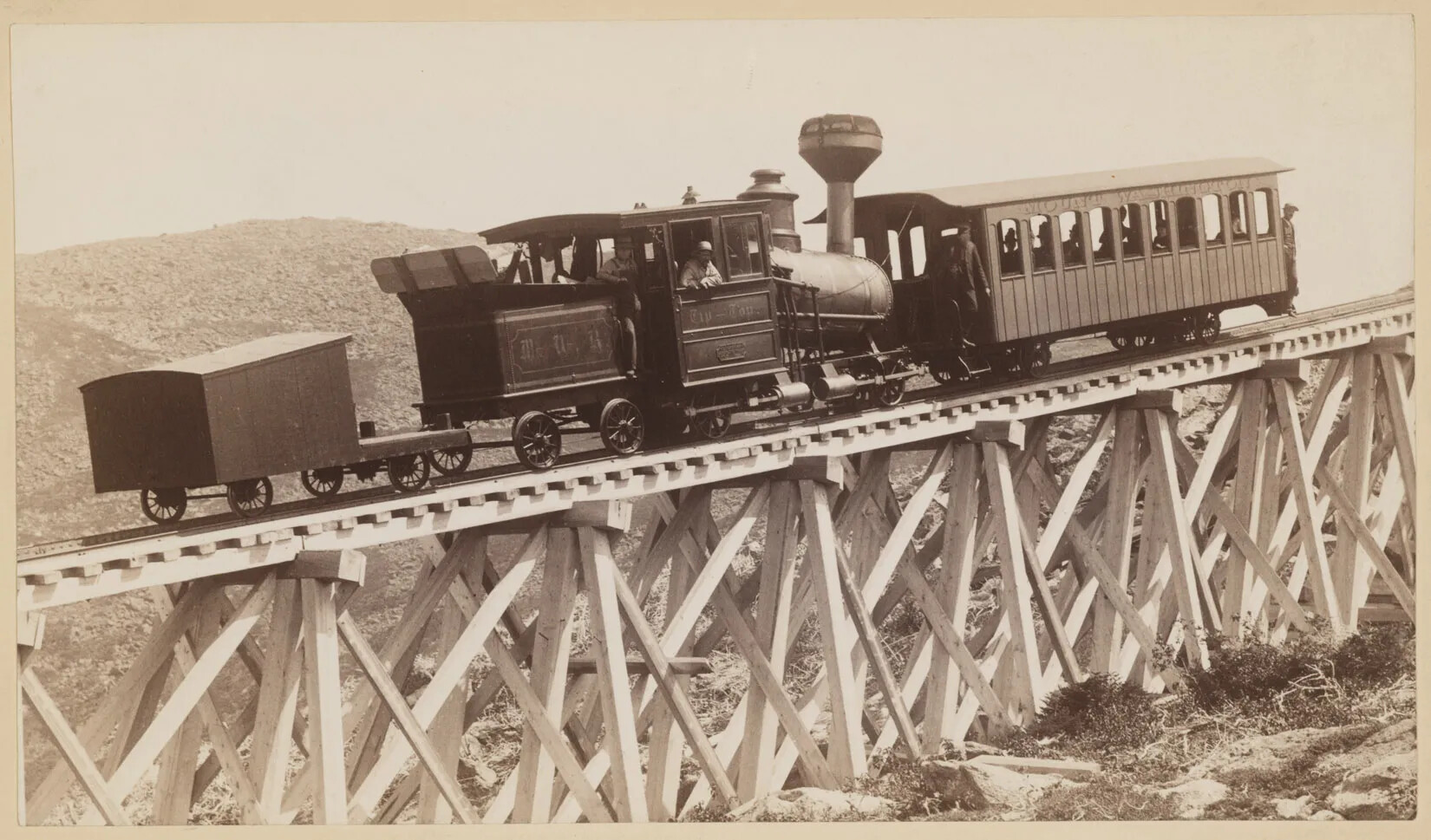
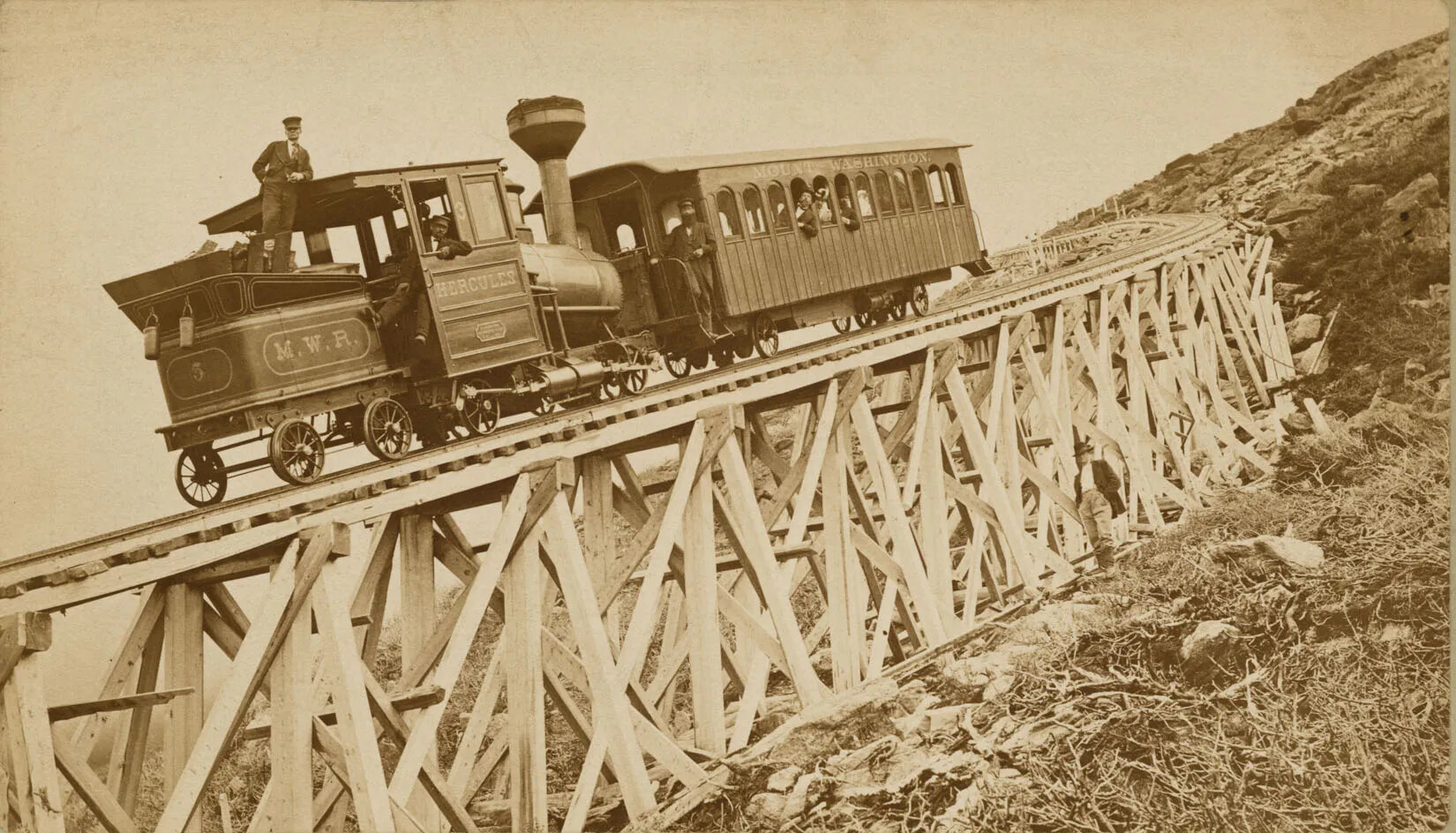
A black and white photograph of a train engine pushing a single passenger car up a set of elevated railway tracks in a mountain region. The train tracks are held up by many criss-crossed wooden beams.
Cog Railway on Jacob's Ladder
A black and white photograph of a large, multi-storied building that is under construction. There are tarps and scaffolding covering different parts of the building. The building sits on top of a snow covered hill.
Construction of the Mount Washington Hotel
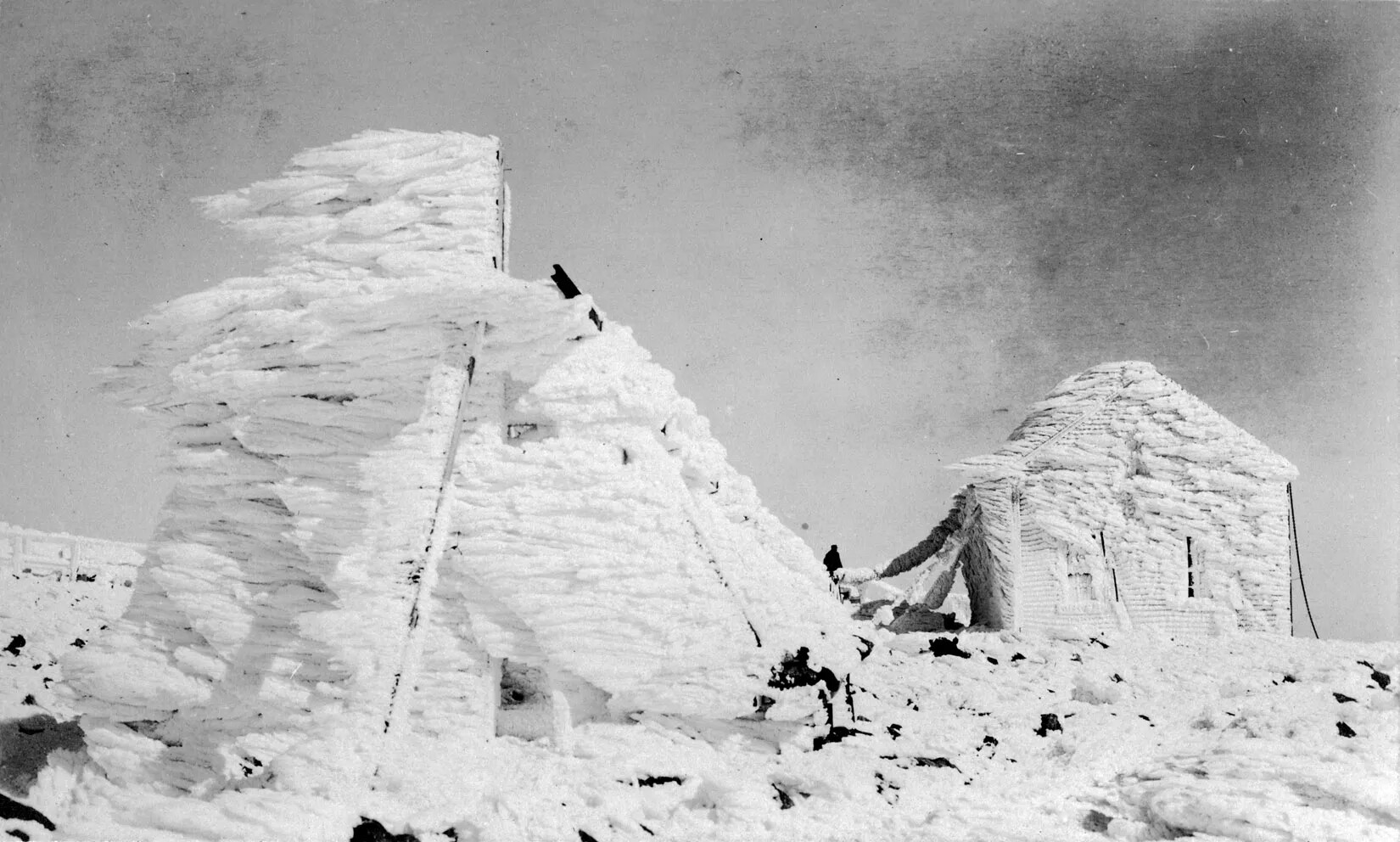
A black and white photograph of several poles and buildings encrusted in snow and ice. The snow and ice on these items have been pushed by the wind towards the left, and remain froze there.
Frost on Mount Washington
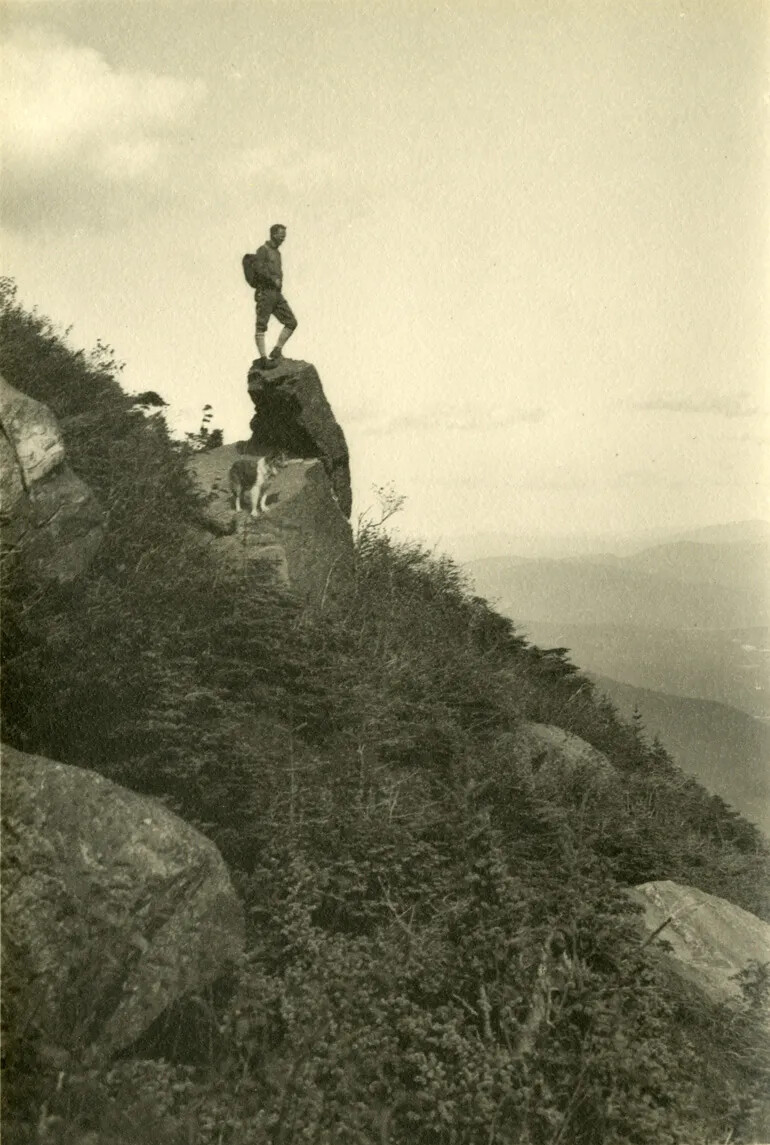
A hiker and a dog stand on a rock at the tree line on the side of a mountain in a black and white photograph.
Hiking on Mount Washington
A color postcard of a train with one passenger car has a caption reading "Jacob's Ladder, Mount Washingon Railway, White Mountains, N.H." The train is descending from a very steep part of the tracks on the side of a mountain, which is covered with shrub and rocks. The part of the track the train is on is built up on a small bridge made of timber to keep the track as consistent as possible.
Jacob's Ladder on the Cog Railway
A black and white photograph of a rocky terrain, in the center of which is a tall rock pile. There are several people on either side of the rock pile, looking at it. Behind the rock pile is a steep hill, at the top of which is a small house.
Lizzie Bourne's Monument
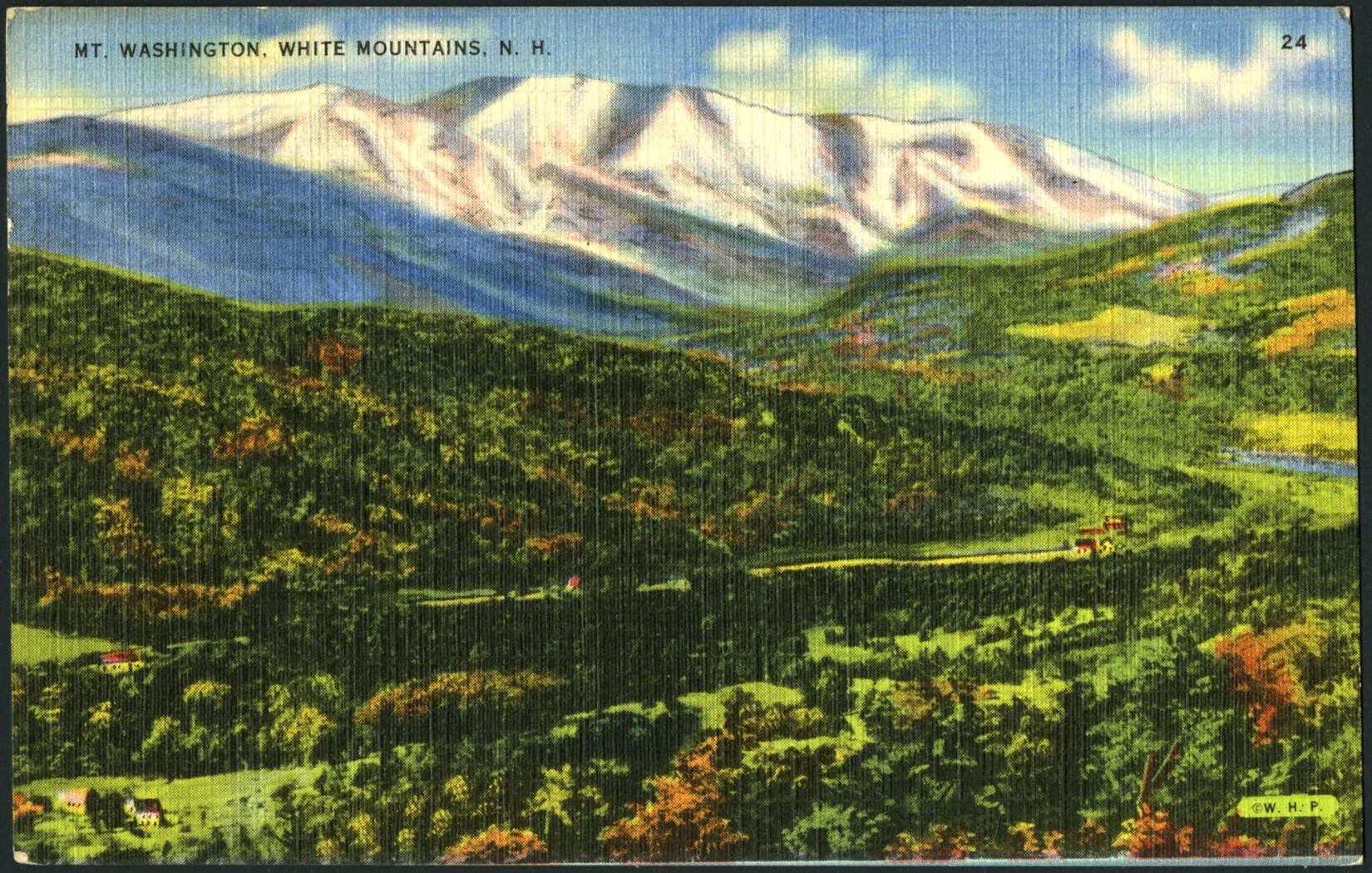
A colored postcard of a mountain landscape. The postcard mainly shows a green landscape, filled in with trees of slightly different colors. In the background, a group of tall white mountains frame the top part of the postcard. The title, placed in the top left corner, reads “MT. WASHINGTON, WHITE MOUNTAINS, N. H”.
Mount Washington
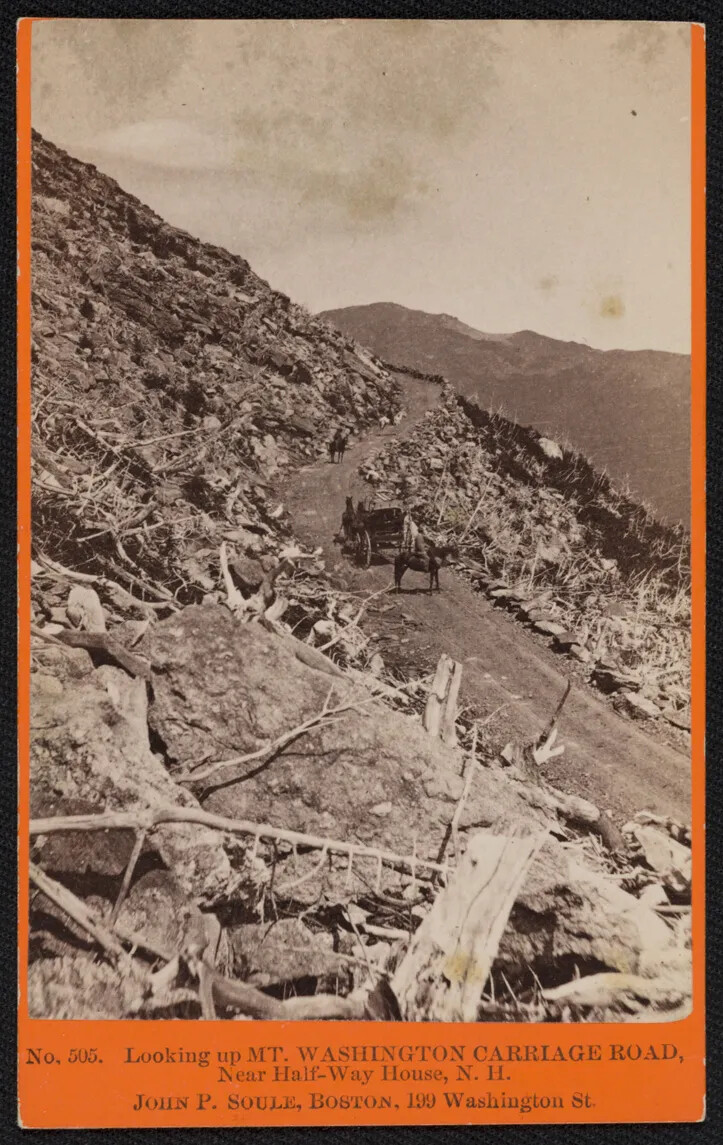
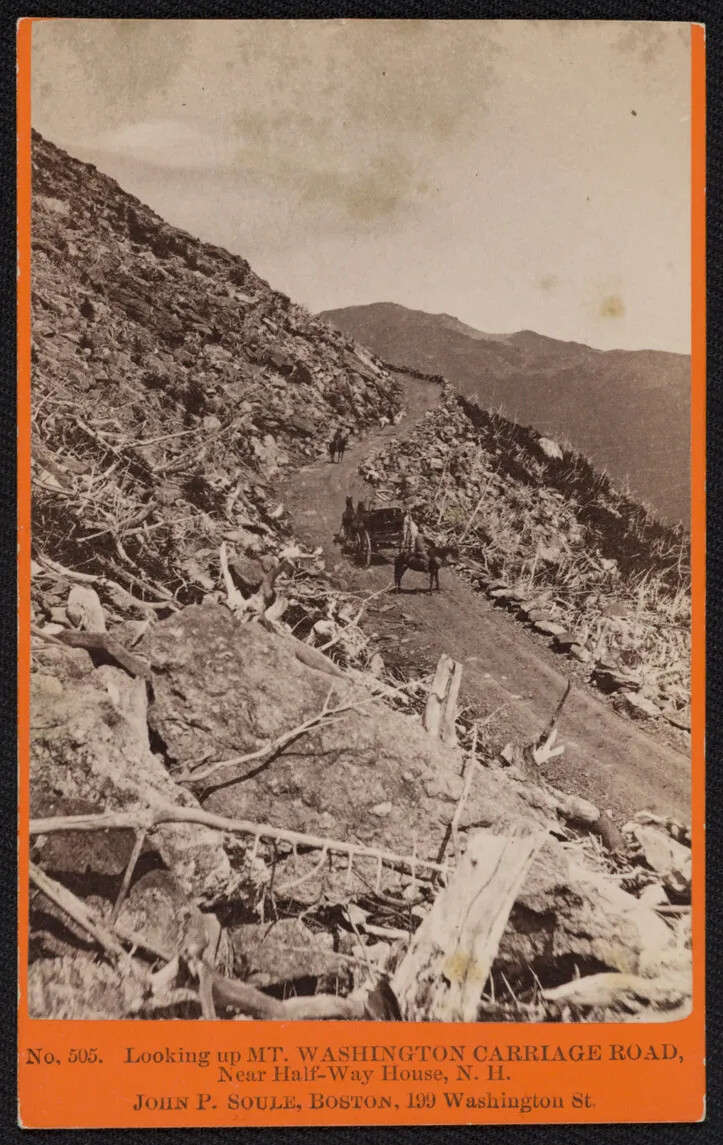
A black and white photograph of a horse-drawn carriage travelling along a dirt road. The road curves through the sloped side of a mountain. The road is lined with downed trees and large rocks. The photograph is outlined in orange, with black text placed along the bottom orange border. Those words read: "No. 505. Looking up MT. WASHINGTON CARRIAGE ROAD,/ Near Half-Way House, N.H./JOHN P. SOULE, BOSTON, 199 Washington St."
Mount Washington Carriage Road
A black and white photograph of a train with one passenger car. The train is descending from a very steep part of the tracks on the side of a mountain, which is covered with scrub and rocks. The part of the track the train is on is built up on a small bridge made of timber to keep the track as consistent as possible.
Mount Washington Cog Railway at Jacob's Ladder
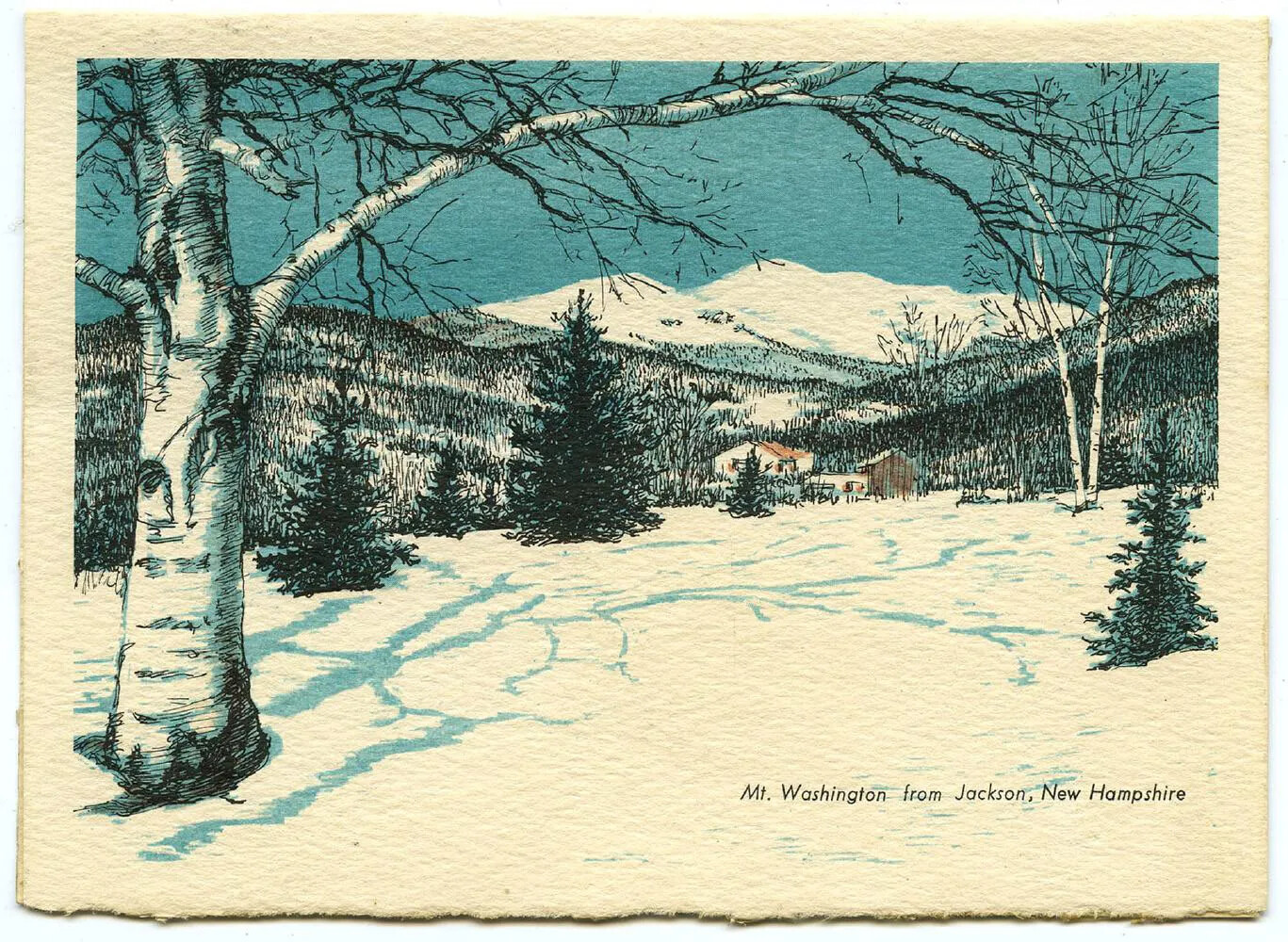
A colored greeting card of a open field and mountain range in the snow. The field is scattered with white trees and pine trees. The mountains closest to the viewer are covered with black tree outlines, and the mountains farther behind them are snow-capped. In the lower right-hand corner are the words "Mt. Washington from Jackson, New Hampshire" typed in black ink.
Mount Washington Greeting Card
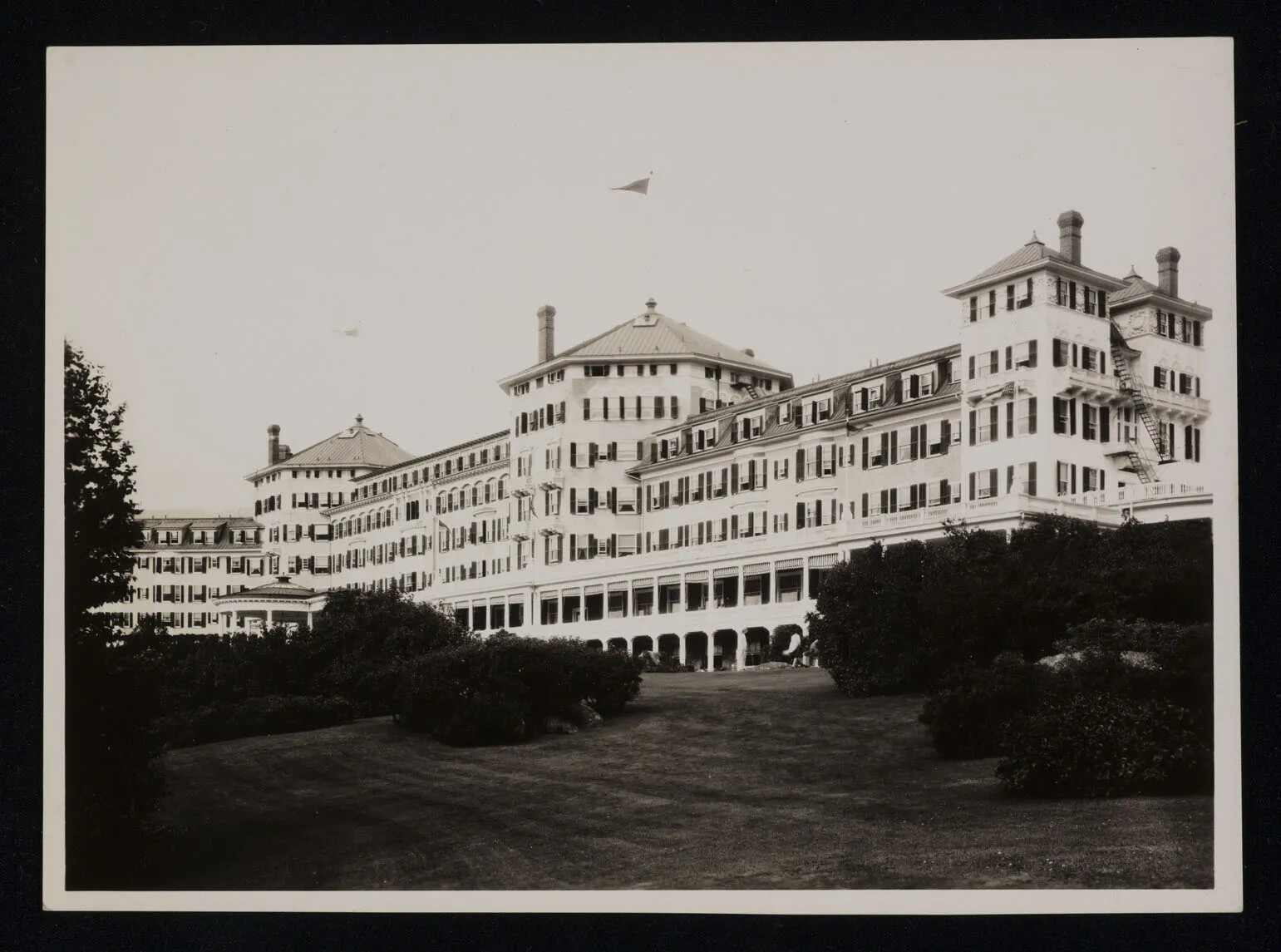
A black and white photograph of a large building. The building hasa long covered porch, and several circular and rectangle towers. In front of this building is a grassy area and several bushes.
Mount Washington Hotel
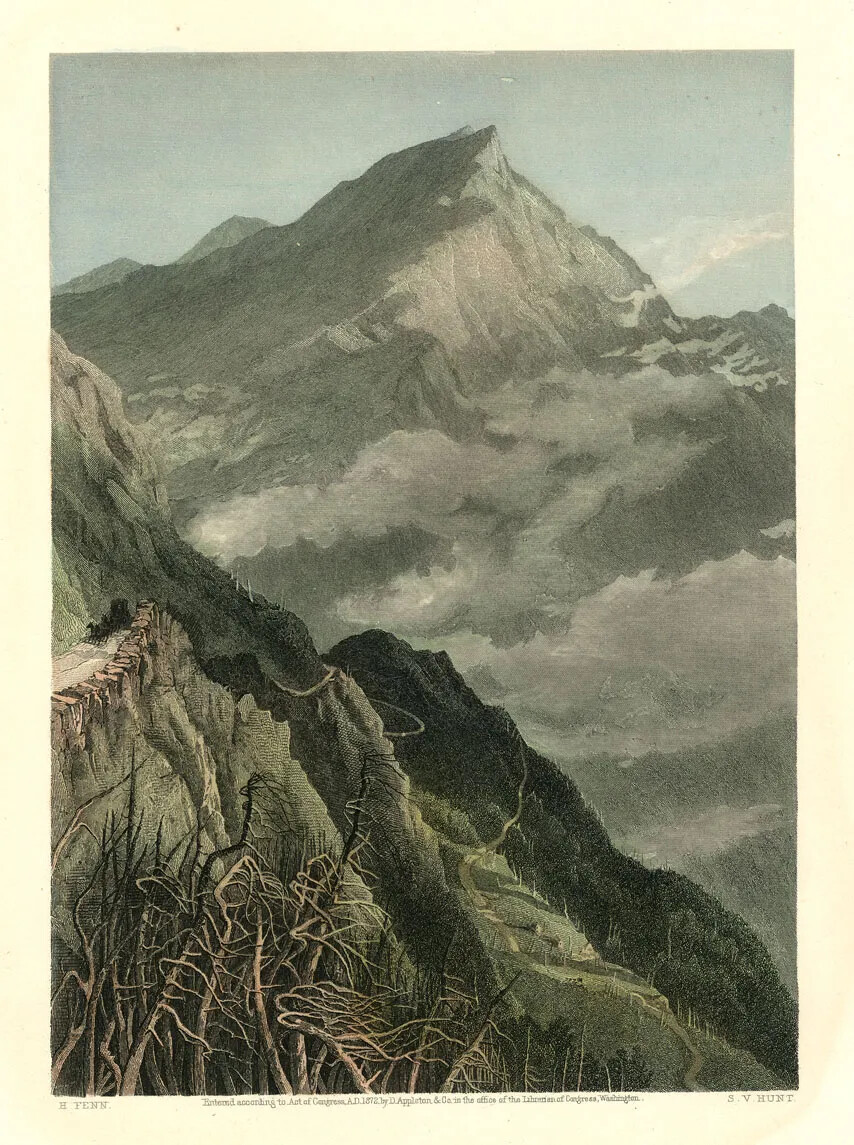
A colored vertical painting of a mountain range. There is a large gray mountain with white and gray clouds floating in front of it in the background of the painting, and the sloped side of another mountain in the foreground. There is a curving path carved into the sloped mountain side, on which a small horse-drawn carriage travels along the left side of the painting.
Mount Washington Road
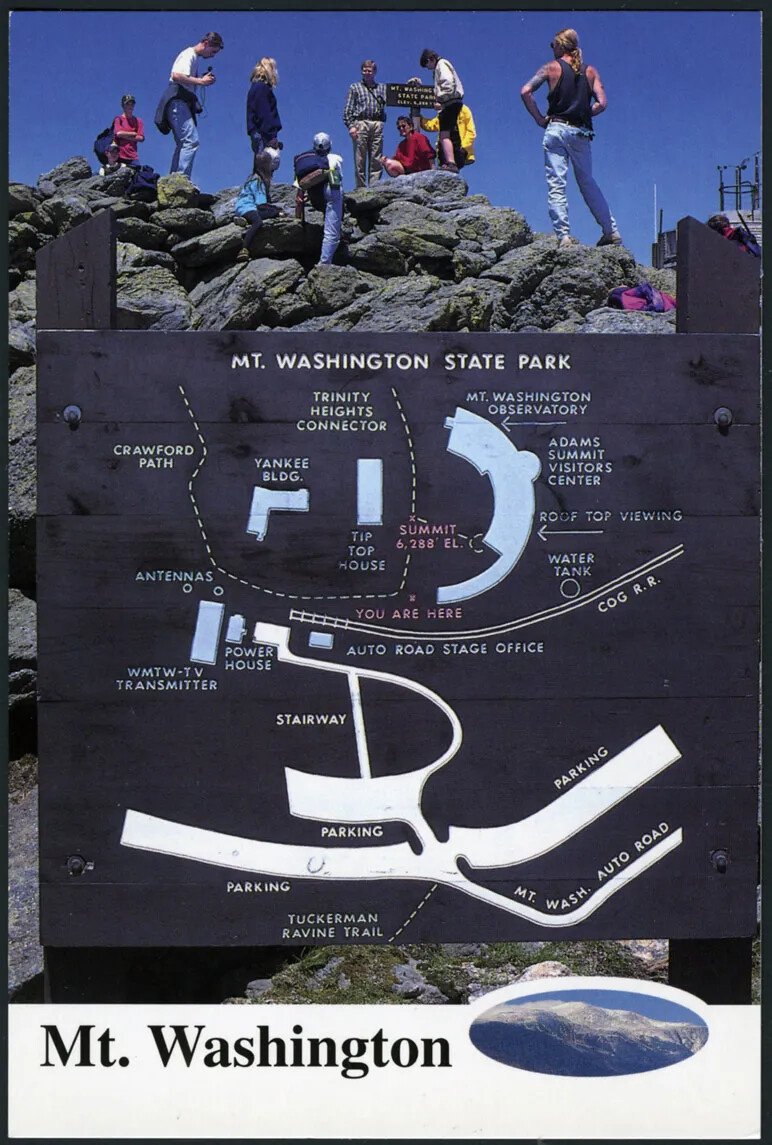
A colored vertical postcard of a large wooden sign with several drawings and text. The top of the sign reads "MT. WASHINGTON STATE PARK." Behind the sign is a tall pile of large rocks with nine adults standing at various levels on the rocks, facing away from the camera. The title of the postcard, placed along the center of the bottom border, reads "Mt. Washington." The the right of the titleis a oval-shaped photograph of a snow-covered mountain top.
Mount Washington State Park
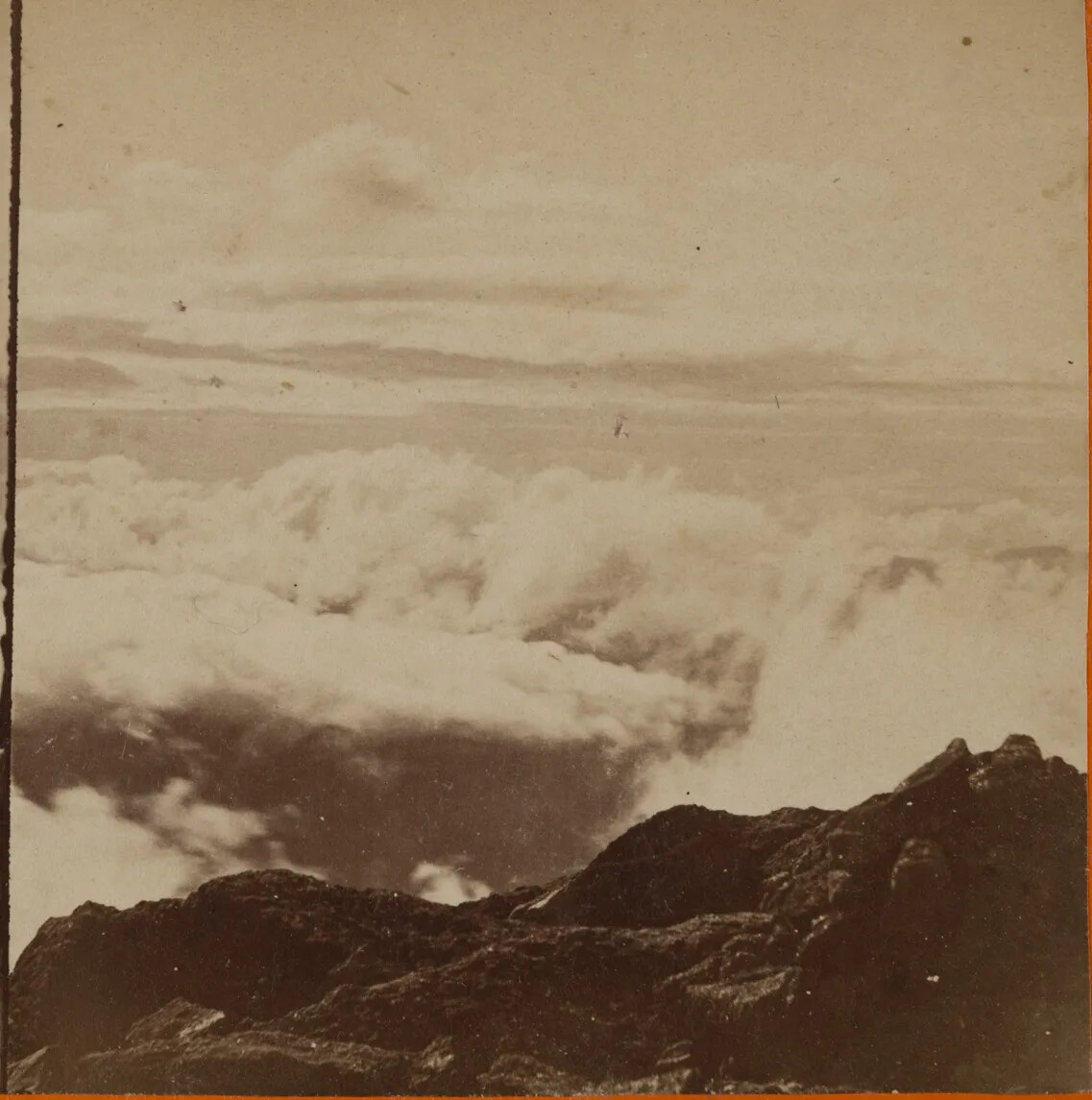
A black and white steroscope image shows a rocky summit of a mountain. Beyond the mountain are layers of clouds below the viewer.
Mount Washington Summit View
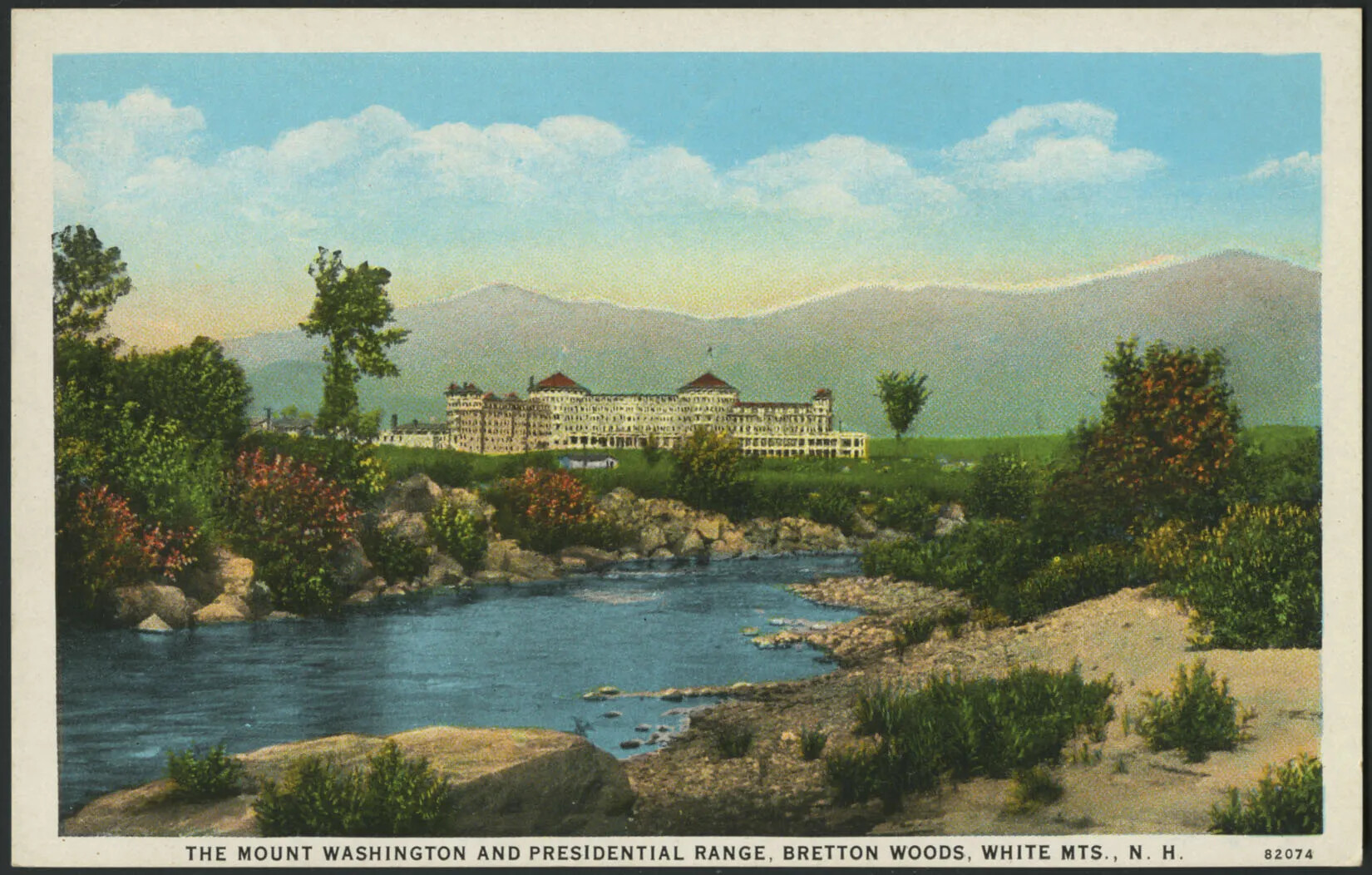
A colored postcard of a large white building with red roofs capping its two main towers. The building sits towards the back of the postcard, with a mountain range in the background. In front of the building, a green and rocky landscape surround a river, which runs through the postcard’s center. The title of the postcard, displayed along the base of the postcard, reads “THE MOUNT WASHINGTON AND PRESIDENTIAL RANGE, BRETTON WOODS, WHITE MTNS., N. H”.
Presidential Range with Mount Washington Hotel
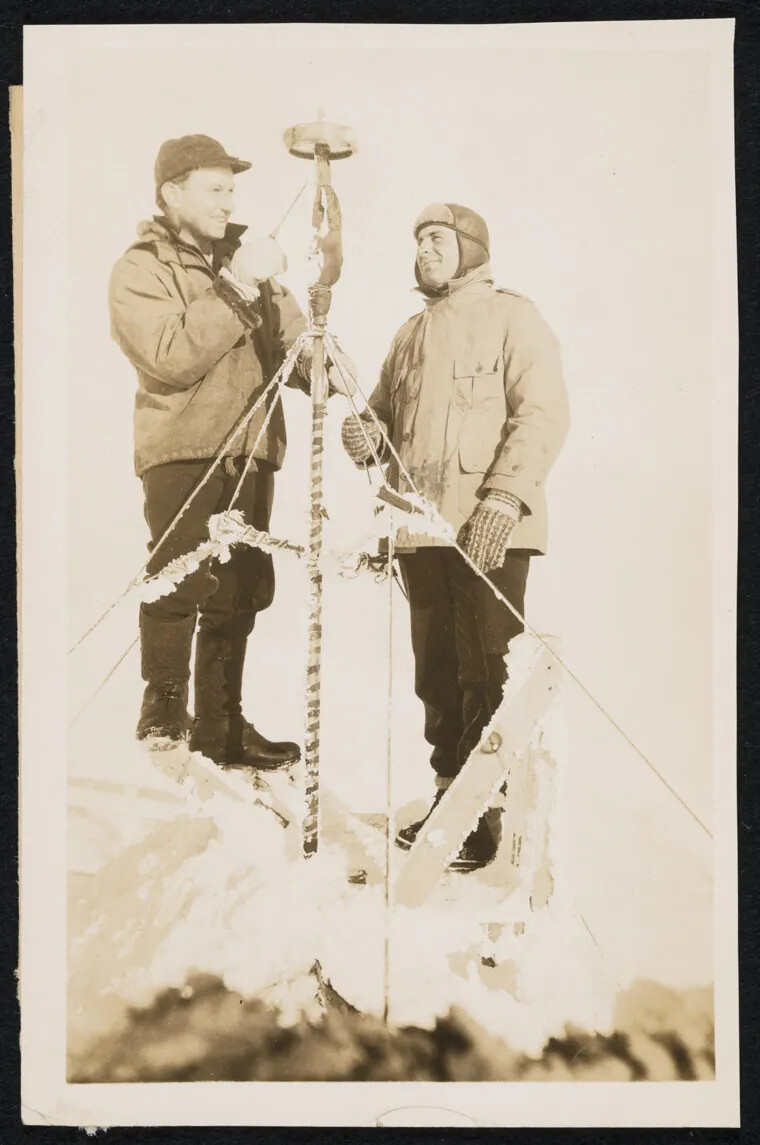
A black and white photograph of two men in snow coats and gear standing on either side of a tripod. Both men look at the tripod, and are standing at the top of a hill.
Scientists on Mount Washington
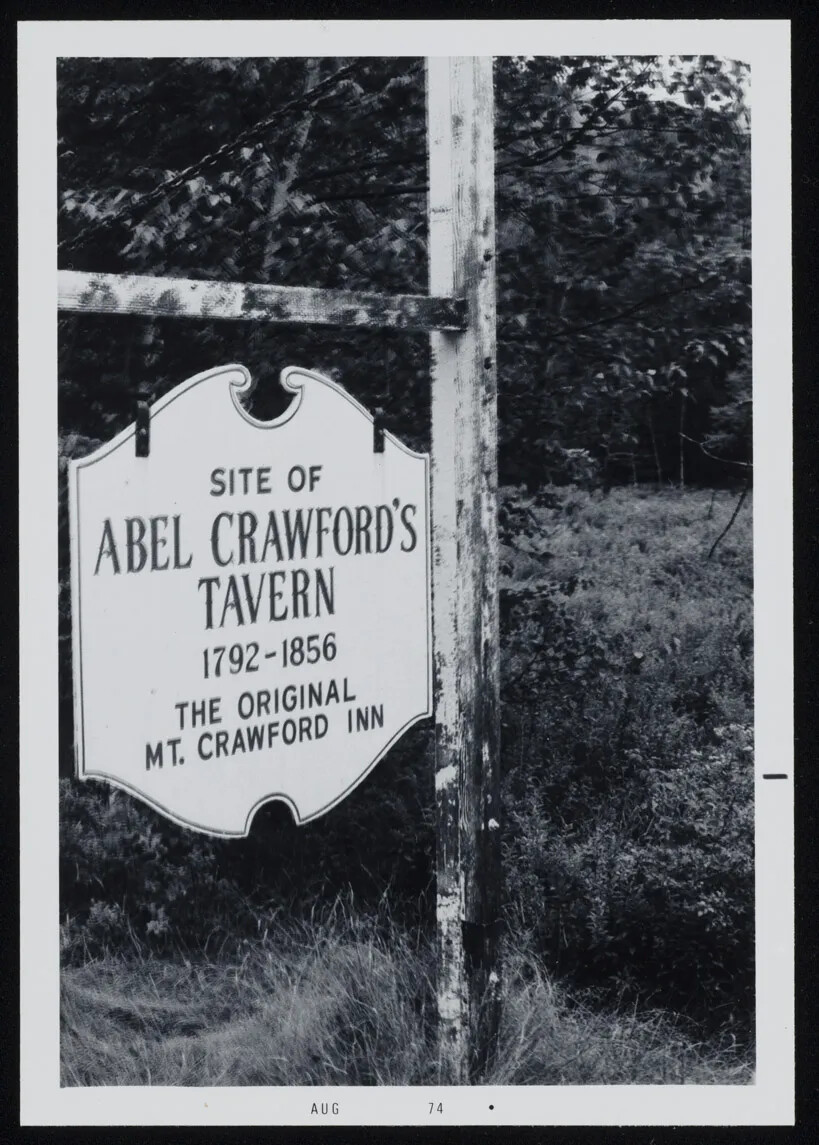
A black and white photograph of a sign hanging on a wooden post in the middle of a wooded area. The sign is white and has black text. The sign reads: "SITE OF/ABEL CRAWFORD'S/TAVERN/1792-1856/THE ORIGINAL/MT. CRAWFORD INN."
Site of Abel Crawford's Tavern
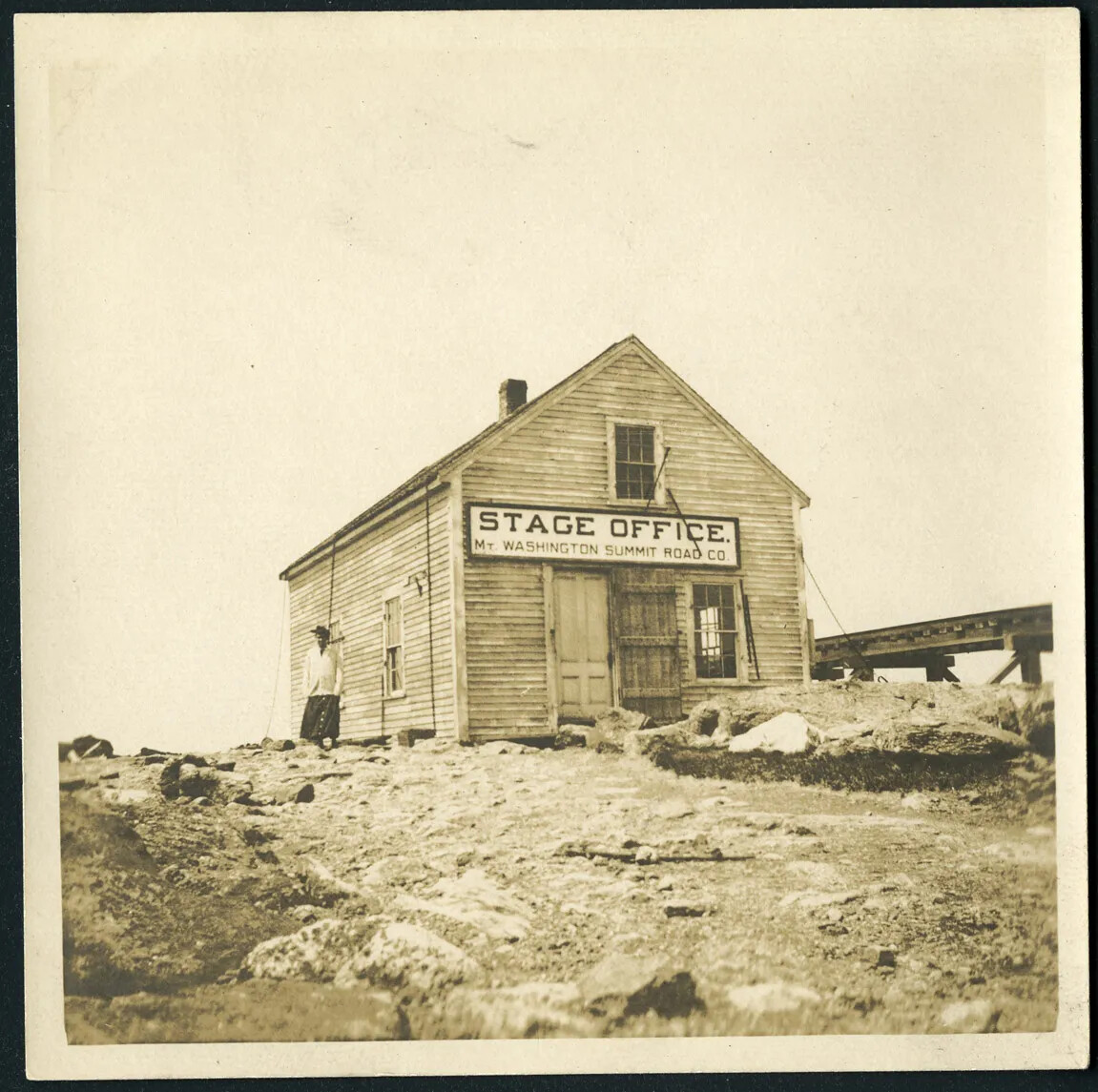
A black and white photograph of a two-storied house on top of a hill. A sign placed above the door reads "STAGE OFFICE/MT. WASHINGTON SUMMIT ROAD CO." A woman stands to the left of the house.
Stage Office, Mount Washington Summit
A colored lithograph of people caught in the middle of a storm on rugged terrain. The wind of the storm is pushing everything in its path to the right. There are two buildings in the background and an American flag on a flag pole in the right-hand corner.
Storm on Mount Washington
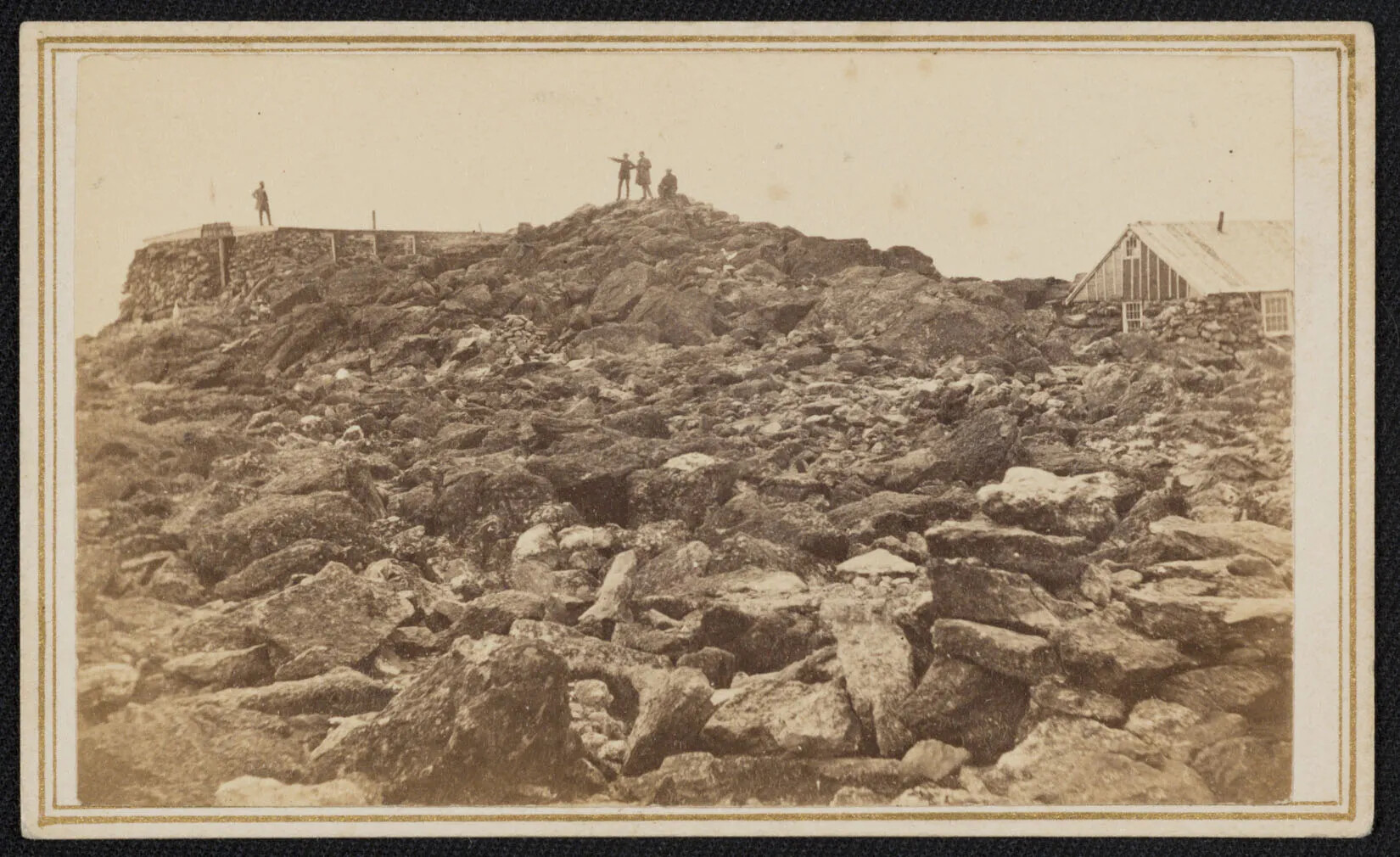
Black and white photograph of a rocky landscape. In the upper right corner, a small building sits half hidden in the rocks. Three people stand on top of a large pile of rocks. A single person stands alone further to their left.
Summit of Mount Washington
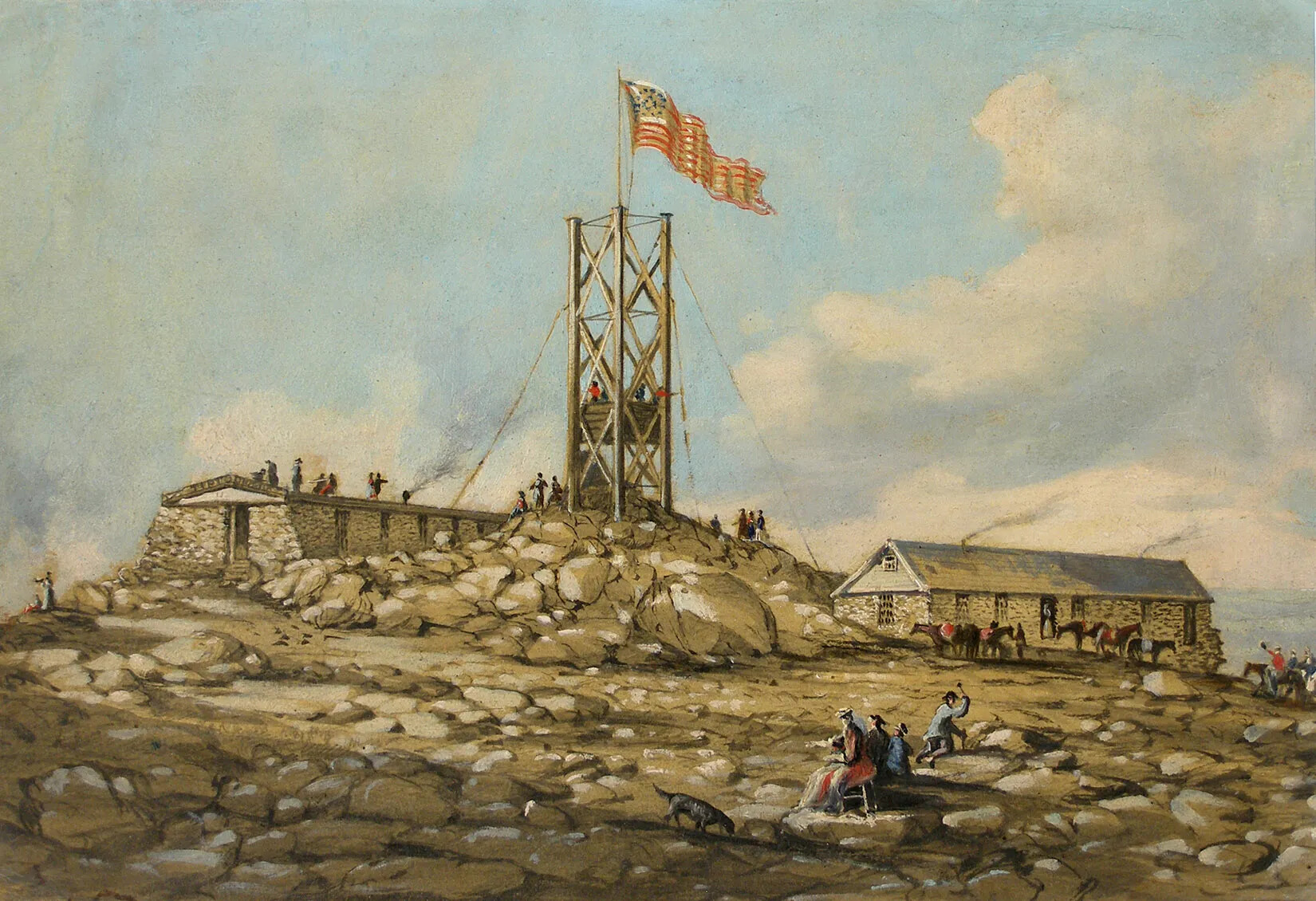
A colored painting of two low-lying buildings and a tall metal tower with an American flag on top. The tower is placed on top of a large rock pike. There are groups of people standing around each of the buildings and tower. Surrounding these buildings is a rocky terrain.
Tip-Top House and Summit House
A black and white photograph of a dirt road that curves along the rocky terrain of a mountain side. On the road are two people on horse back and one horse-drawn carriage. The photograph is framed by an orange border. Beneath the photograph are the words " No. 505 Looking up MT. WASHINGTON CARRIAGE ROAD/Near Half-Way House, N. H./JOHN P. SOULE, BOSTON 199 WASHINGTON St." written in black text.
Traveling on the Mount Washington Carriage Road
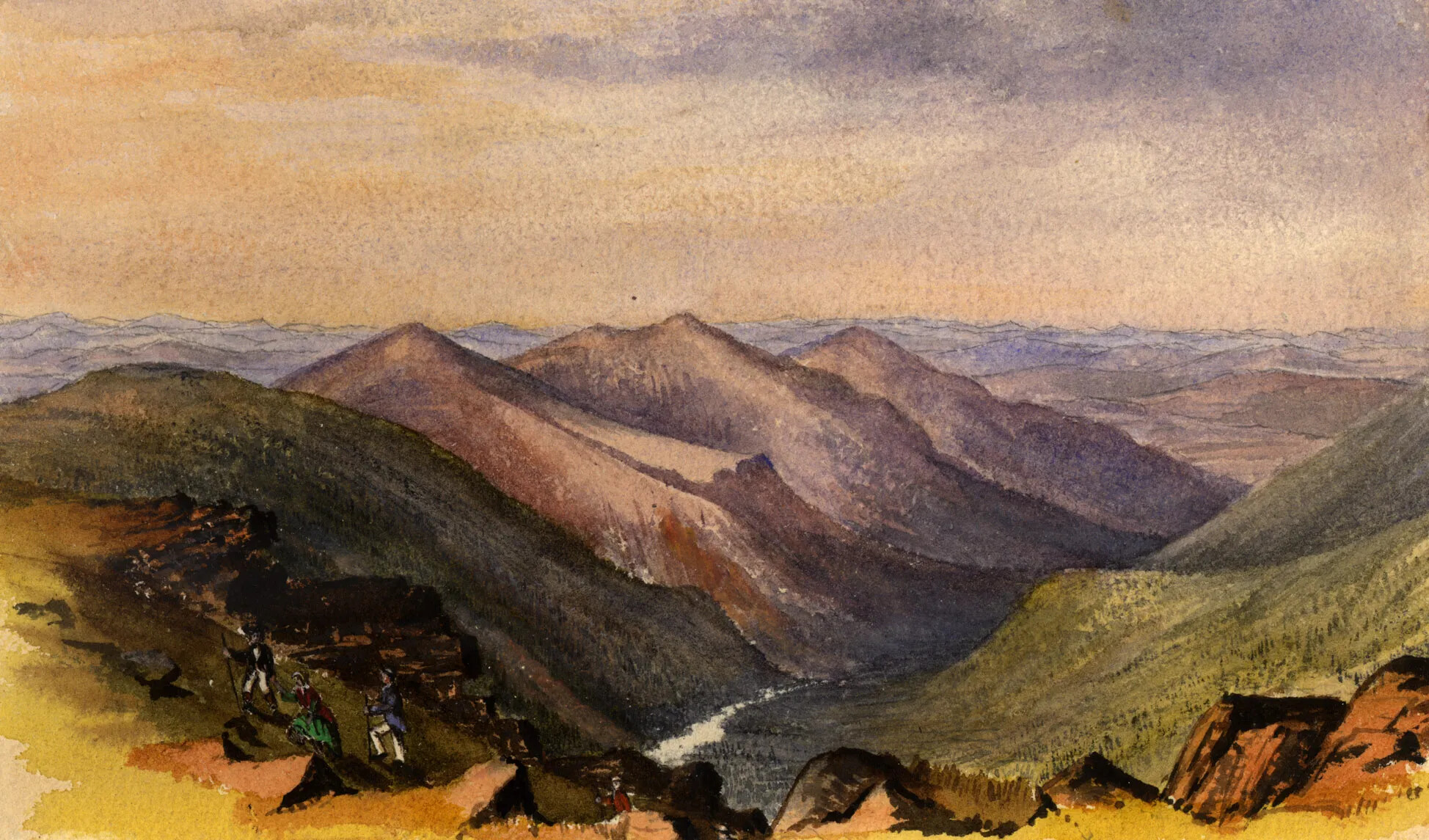
A colored watercolor of a mountain range. There are four people hiking uphill with hiking sticks in the foreground of the painting.
View of Mount Washington
A black and white photograph of a large group of people looking at the camera, who are standing in front of a two-storied building. The first floor of the building is built out of rocks. In front of the group of people are piles of large rocks.The photograph is framed by an orange border. Beneath the photograph are the words "No. 516. TIP-TOP HOUSE, Mt. Washington, N.H./JOHN P. SOULE, BOSTON/199 Washington St." written in black ink.
Visitors to Tip-Top House