
Primary Source Set - John Stark

One of the most revered figures in New Hampshire history, John Stark was a Revolutionary War general and the author of what became the state motto, “Live free or die.”


Background

A native of Londonderry, Stark was an experienced backwoodsman who explored far beyond New Hampshire’s colonial settlements in the middle of the eighteenth century. He knew the native Abenaki people well, having spent time as their captive in Canada when still a young man. Stark first gained recognition for serving as second in command of Roger’s Rangers during the French and Indian War.

When the American Revolution broke out in 1775, Stark emerged as a natural leader of New Hampshire troops when they played a pivotal role at the Battle of Bunker Hill. Stark also served under George Washington at Princeton and Trenton. With a mercurial temper, Stark earned a reputation as being difficult to work with but a hardened and skilled commander. His men were fiercely loyal to him. When the British launched a campaign through New York and Vermont in the summer of 1777, prompting Vermont to send a frantic plea to its New England neighbors for troops, New Hampshire was the only state to respond, sending Stark and a contingent of New Hampshire men to southwestern Vermont to protect the local populace.

Once there, the Americans engaged a combined British-German force in what became known as the Battle of Bennington. Stark’s victory there was a decisive blow to the British campaign and earned him the sobriquet, the “Hero of Bennington.” In the years that followed, Stark remains New Hampshire’s most famous native son and a symbol of Granite Staters’ stubbornness and determination.

This primary source set guide can be used in several ways to explore the life of John Stark. It is not necessary to use all sources in a set to create a meaningful inquiry. Rather, educators are encouraged to select—or have their students select—the sources best suited to your project.


Additional Resources

  • Battle of Bennington, a special bicentennial issue of Historical New Hampshire 32 (Winter 1977): 165–227. 
  • John Stark Papers, New Hampshire Historical Society, Concord, NH. 
  • New Hampshire Division of Historical Resources, Exterior Statues and Memorials at the New Hampshire State House Complex, www.nh.gov/nhdhr/publications/esm/stark.html
  • Polhemus, Richard, and John Polhemus, Stark: The Life and Wars of John Stark, French and Indian War Ranger, and Revolutionary War General (Delmar, N.Y.: Black Dome Press, 2014). 
  • Rose, Ben Z., John Stark: Maverick General (Waverly, M.A.: TreeLine Press, 2007). 
  • Stark, Caleb, Memoir and Official Correspondence of Gen. John Stark (Concord: G. Parker Lyon, 1860). 
  • Timeline of New Hampshire History, New Hampshire Historical Society, Found at nhhistory.org/Timeline

Focus Questions

In addition to our general suggestions for using primary source sets, consider giving students one of the following prompts for an inquiry using this primary source set about John Stark.

  • 1
    Why is John Stark a hero to the people of New Hampshire?
  • 2
    What items would you use to represent John Stark's most important contributions to the state of New Hampshire?

Biographies in this Primary Source Set:

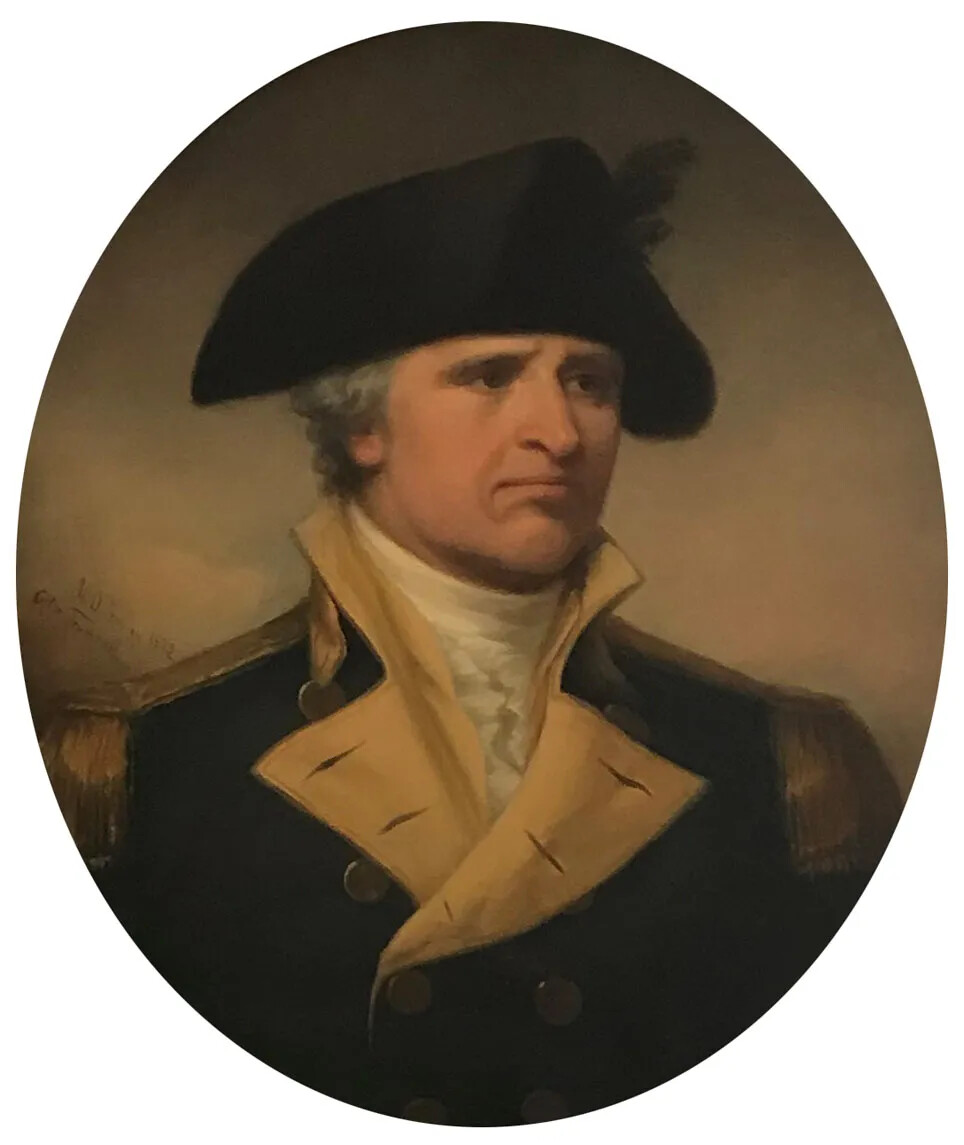
A circular, colored portrait of a white man looking off to the right. He wears a blue coat with a yellow collar and a black tri-cornered hat.
John Stark

Documents in this Primary Source Set:

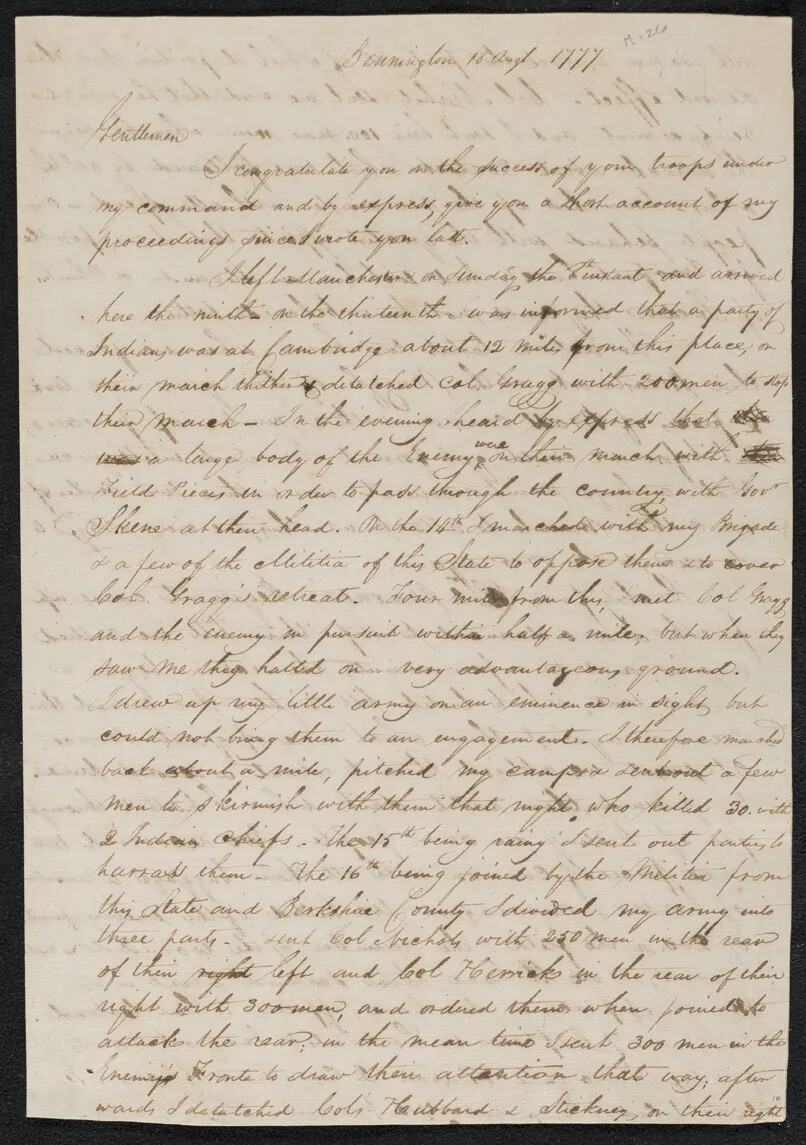
A page of handwritten script is shown. The script is elaborate and precise, and there are about 30 lines. The line at the top reads "Bennington 18 Aug 1777."
Battle of Bennington Report
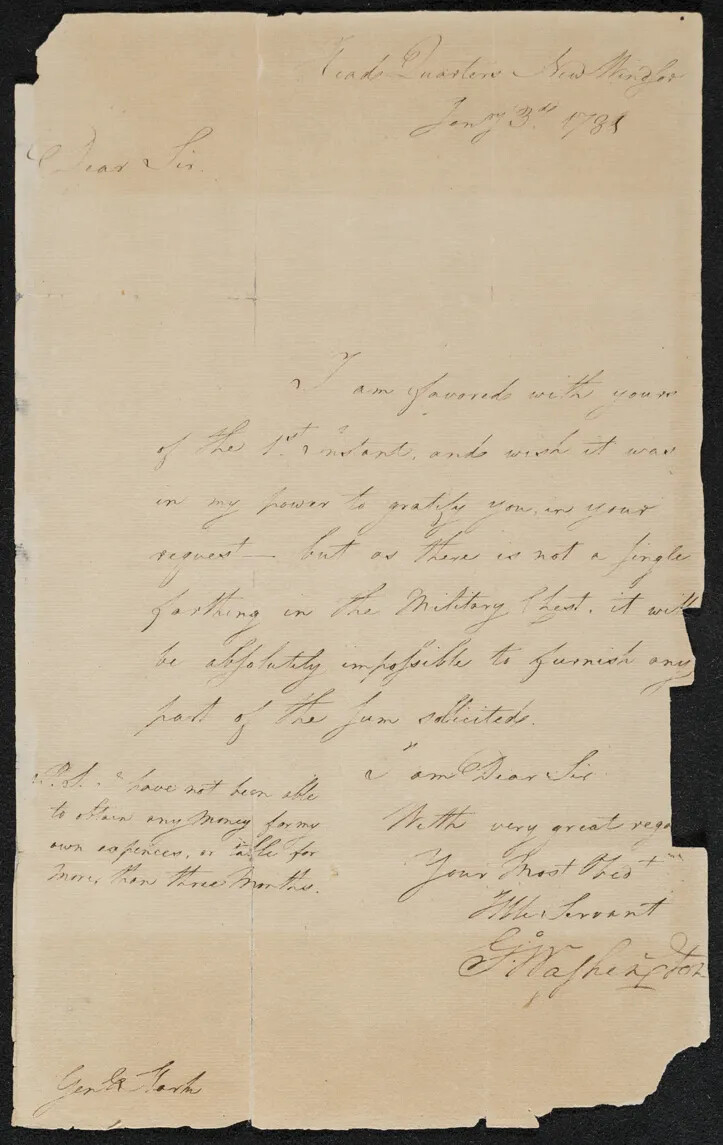
A piece of yellowed paper is torn at some edges, and shows handwritten script. The date and place are at the top, then after "Dear Sir," there are seven lines of communication before a signature with a smaller note next to it.
George Washington's Letter to John Stark
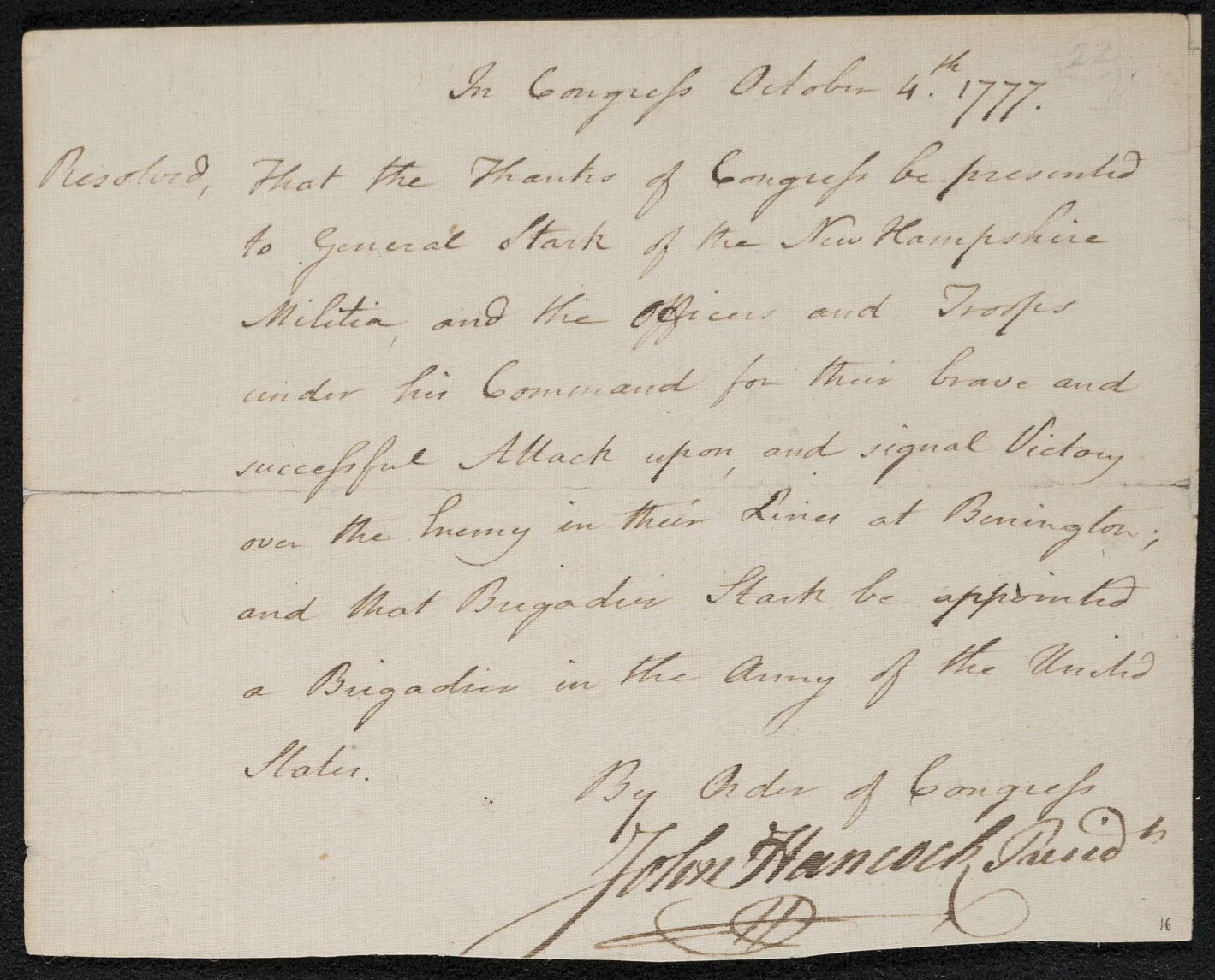
A handwritten note has nine lines of text written in a precise script. At the top it is dated 1777, and at the bottom signed "John Hancock" with a flourish below.
John Hancock's Letter to John Stark
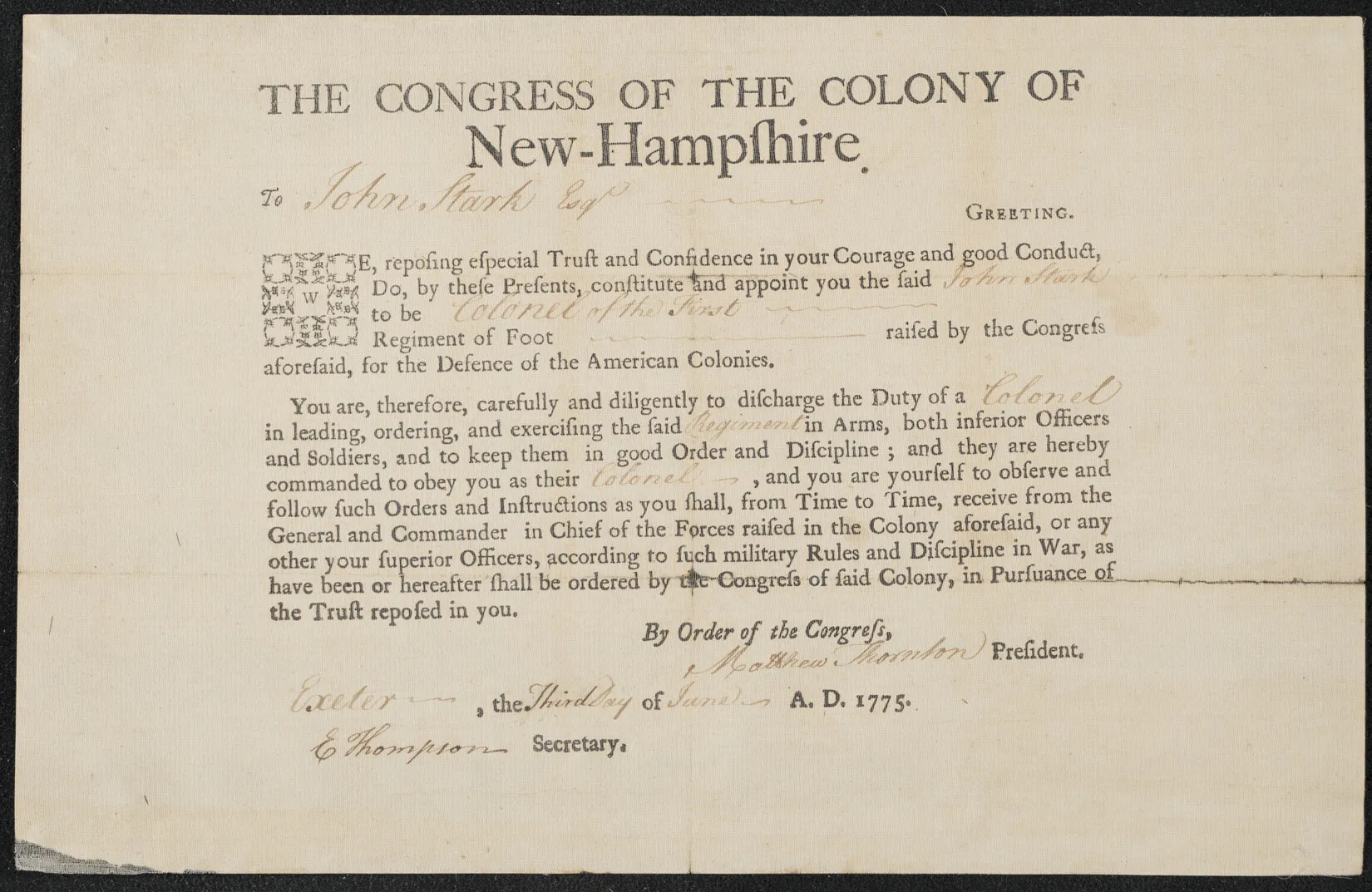
A printed piece of paper is shown with several words written in by hand. It is titled "THE CONGRESS OF THE COLONY OF NEW-HAMPSHIRE." It is two paragraphs long and gives "John Stark the Colonel of the First Regiment of Foot" appointment, dated June 3, 1775.
John Stark's Military Commission
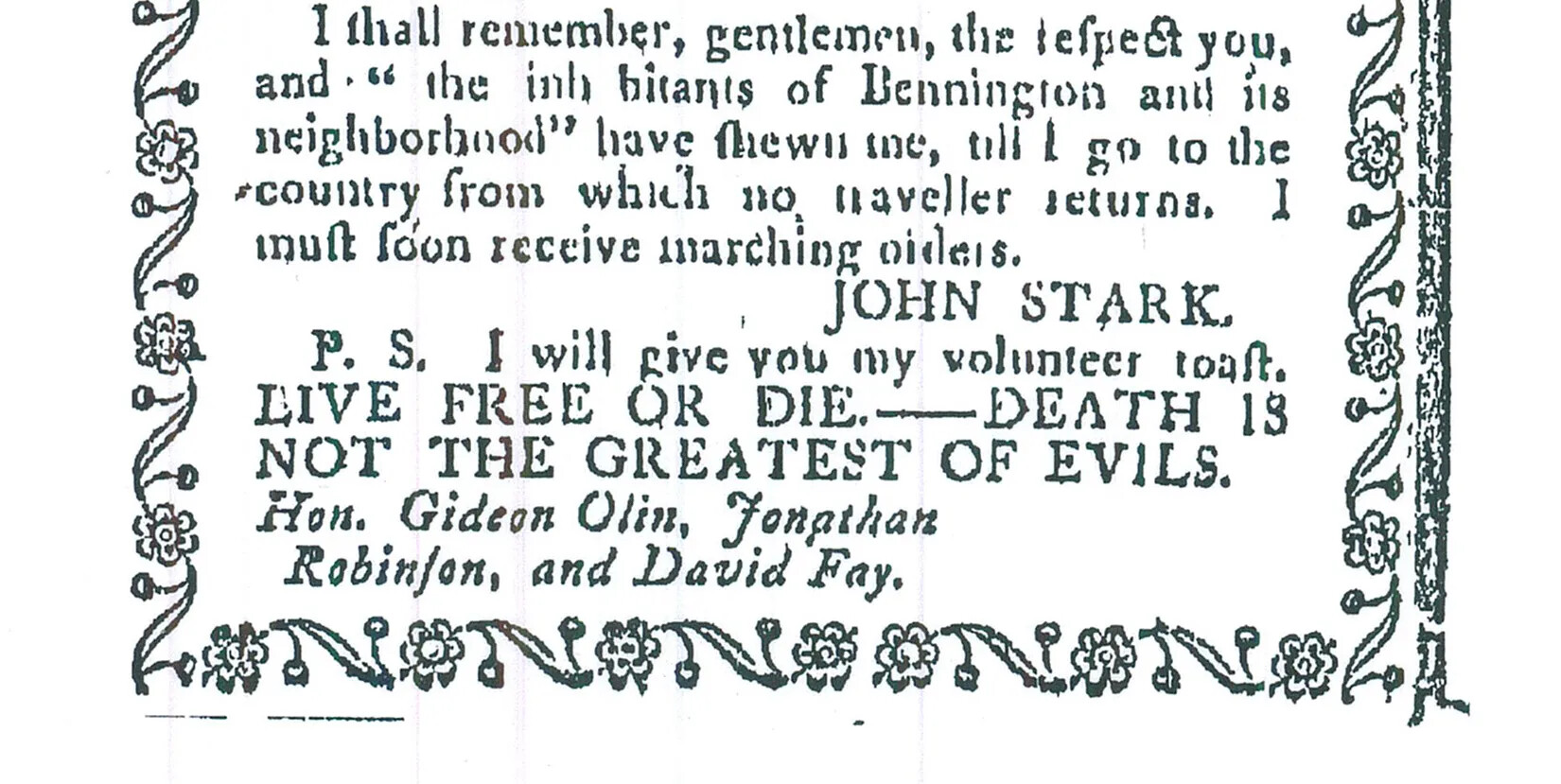
A black and white printing of a piece of writing is bordered by small swirling decorations. Under the signature is a P.S. It reads "I will give you my volunteer toast. LIVE FREE OR DIE. --DEATH IS NOT THE GREATEST OF EVILS."
Live Free or Die
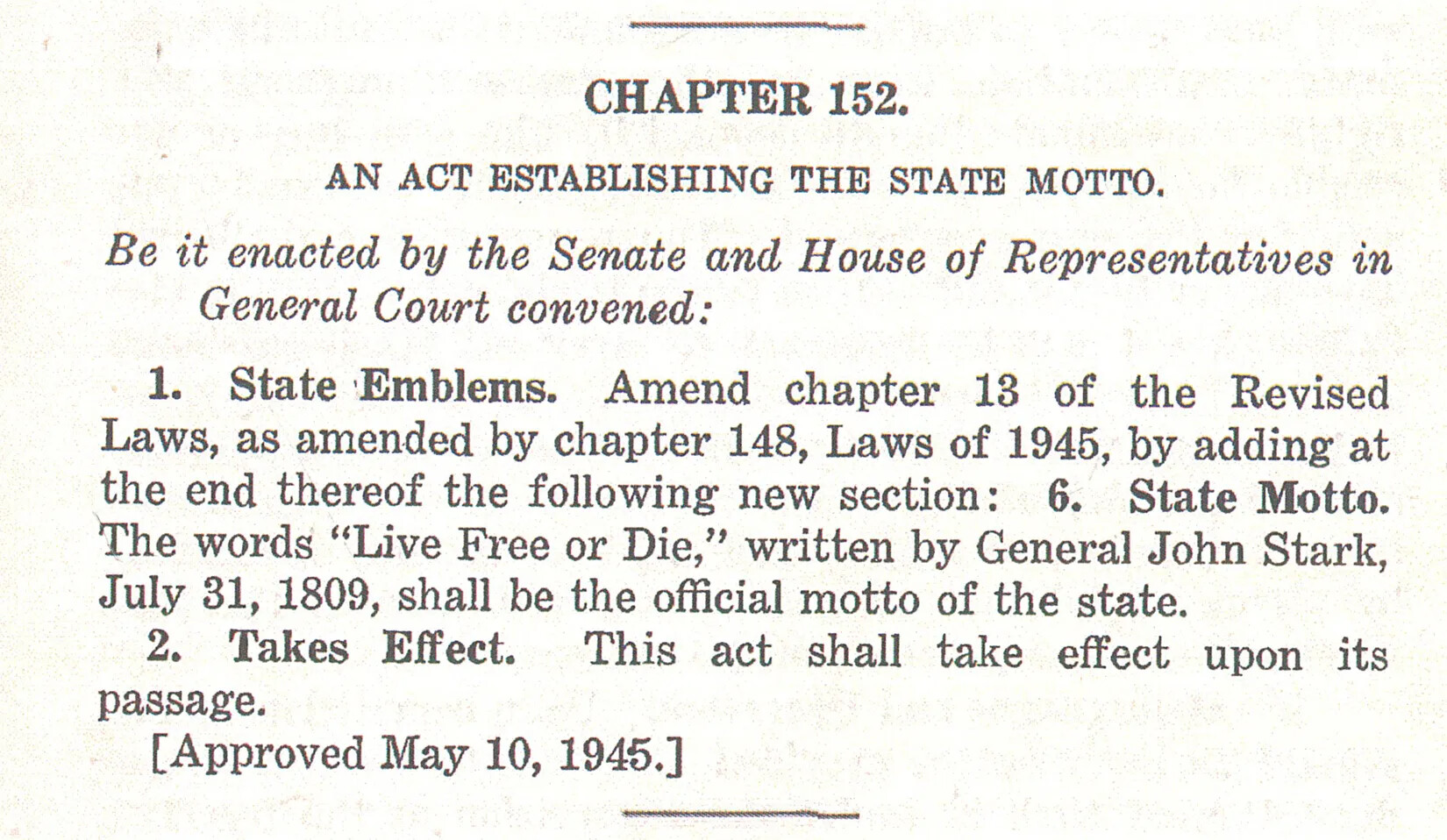
A typewritten passage shows "An act establishing the state motto." Included in the act is the sentence '6. State Motto. The words "Live Free or Die," written by General John Stark, July 31, 1809, shall be the official motto of the state.' It was approved by the Senate and House of Representatives on May 10, 1945.
State Motto Law
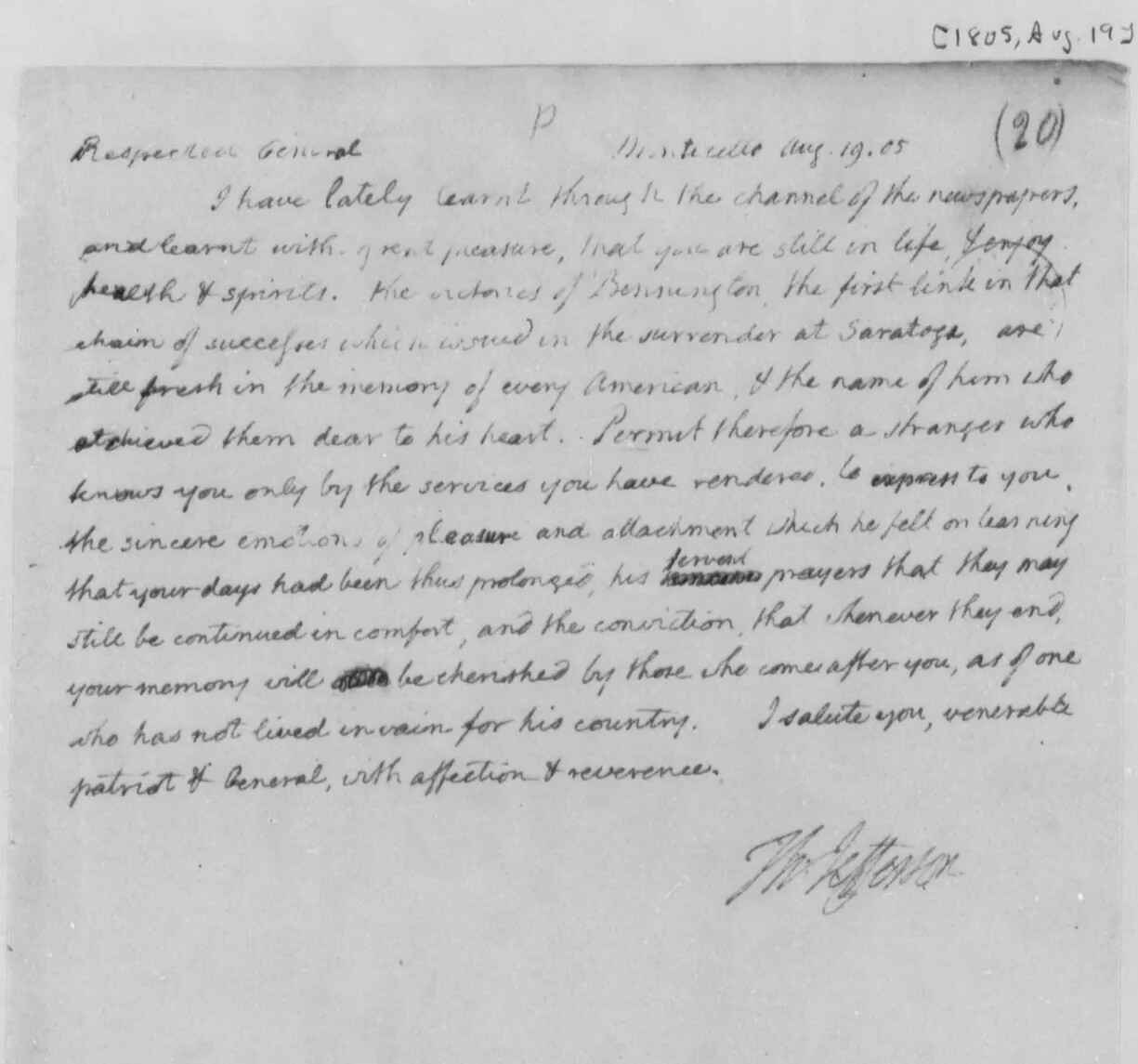
A piece of writing has a brief greeting and date, then 13 lines of script before a signature at the bottom. A few words are crossed out and written over.
Thomas Jefferson's Letter to John Stark

Explainer Videos and Virtual Field Trips in this Primary Source Set:

Virtual Field Trip: John Stark, Revolutionary Hero

Maps & Charts in this Primary Source Set:

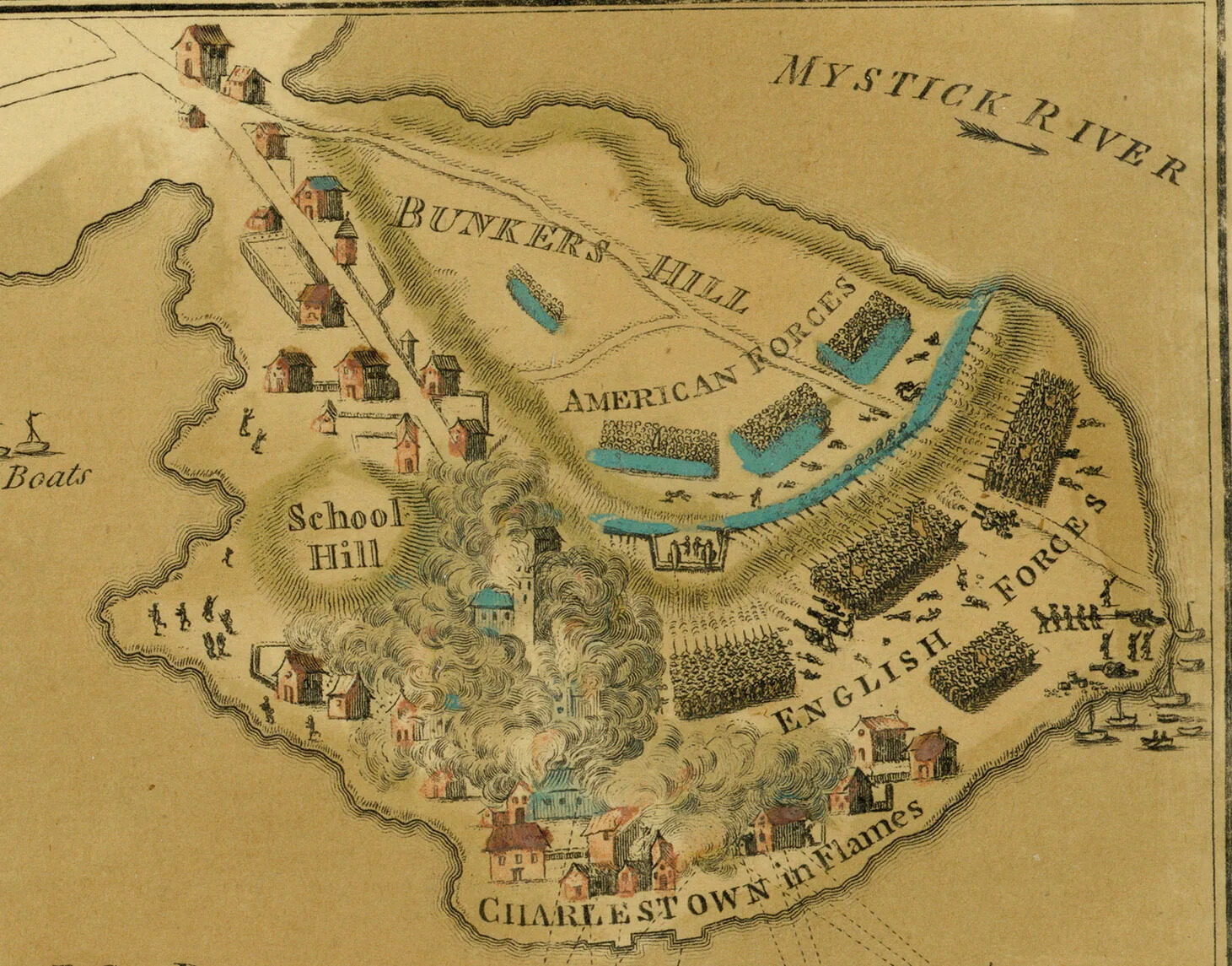
A color drawing is shown of a penninsula titled "Bunker's Hill." On the map, "Mystick River," "School Hill," and "Charlestown in flames" are also marked. The bottom right of the penninsula shows four bodies of English forces attacking three bodies of American forces, who are in the upper right of the penninsula behind a barricade. Charlestown, drawn with houses covered by smoke and fire, is in the bottom left, and an ordered street with a few houses on it is in the upper left. The street leads off the penninsula.
Battle of Bunker Hill Map
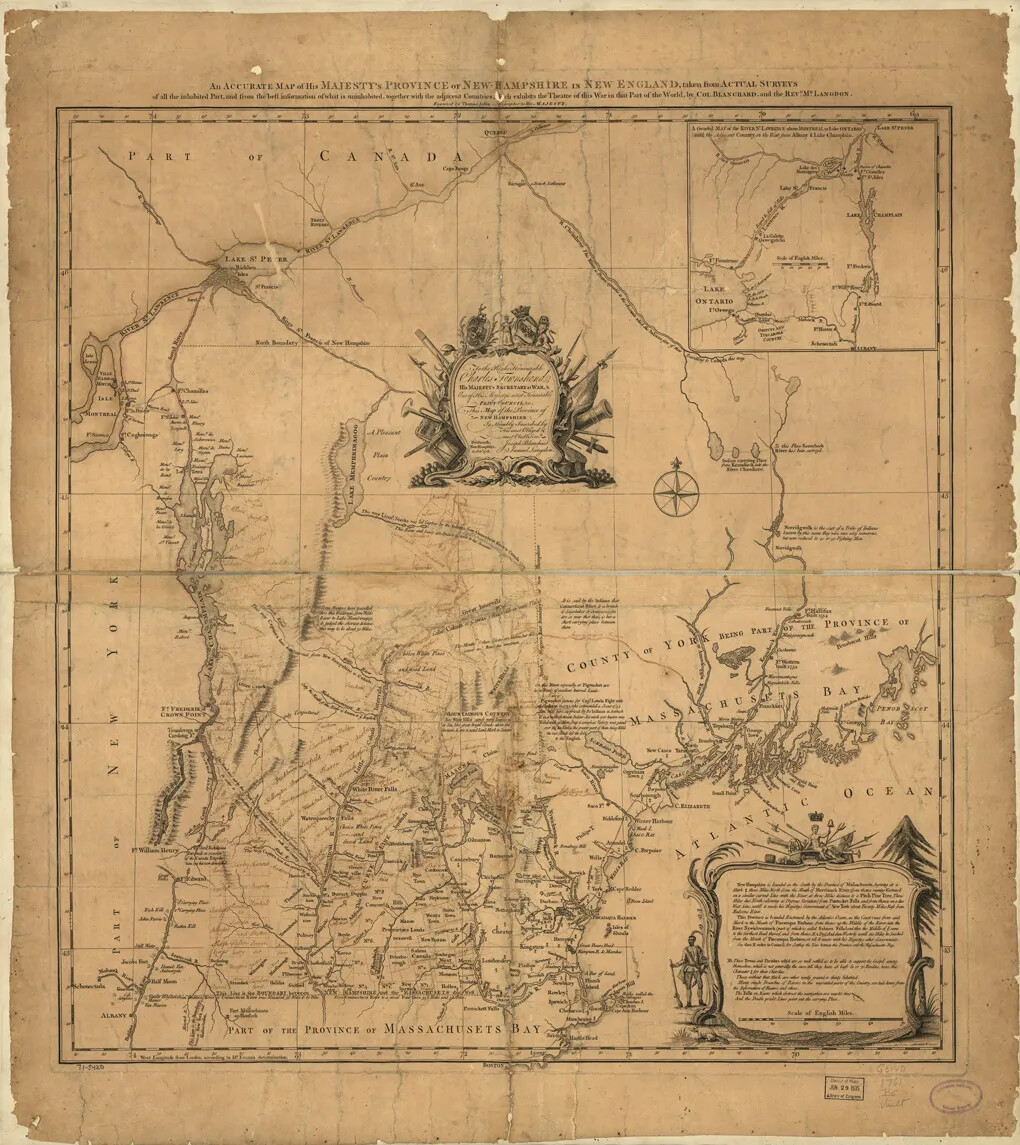
A historic map shows the province of New Hampshire. The borders of the provinces surrounding New Hampshire are noted, as well as part of Canada. The map is quite detailed, with rivers, bodies of water, and towns labeled. There are additional comments on the map of a local nature, for instance noting the path Lieut. Stark took while kidnapped by Native Americans. Two elaborately bordered notes tell of of the province of New Hampshire and the dedication of the map to "the Right Honourable Charles Townshend, His Majesty's Secretary of War." An inset detail in the upper right corner of the map shows the area around Montreal.
Map of New Hampshire, 1761
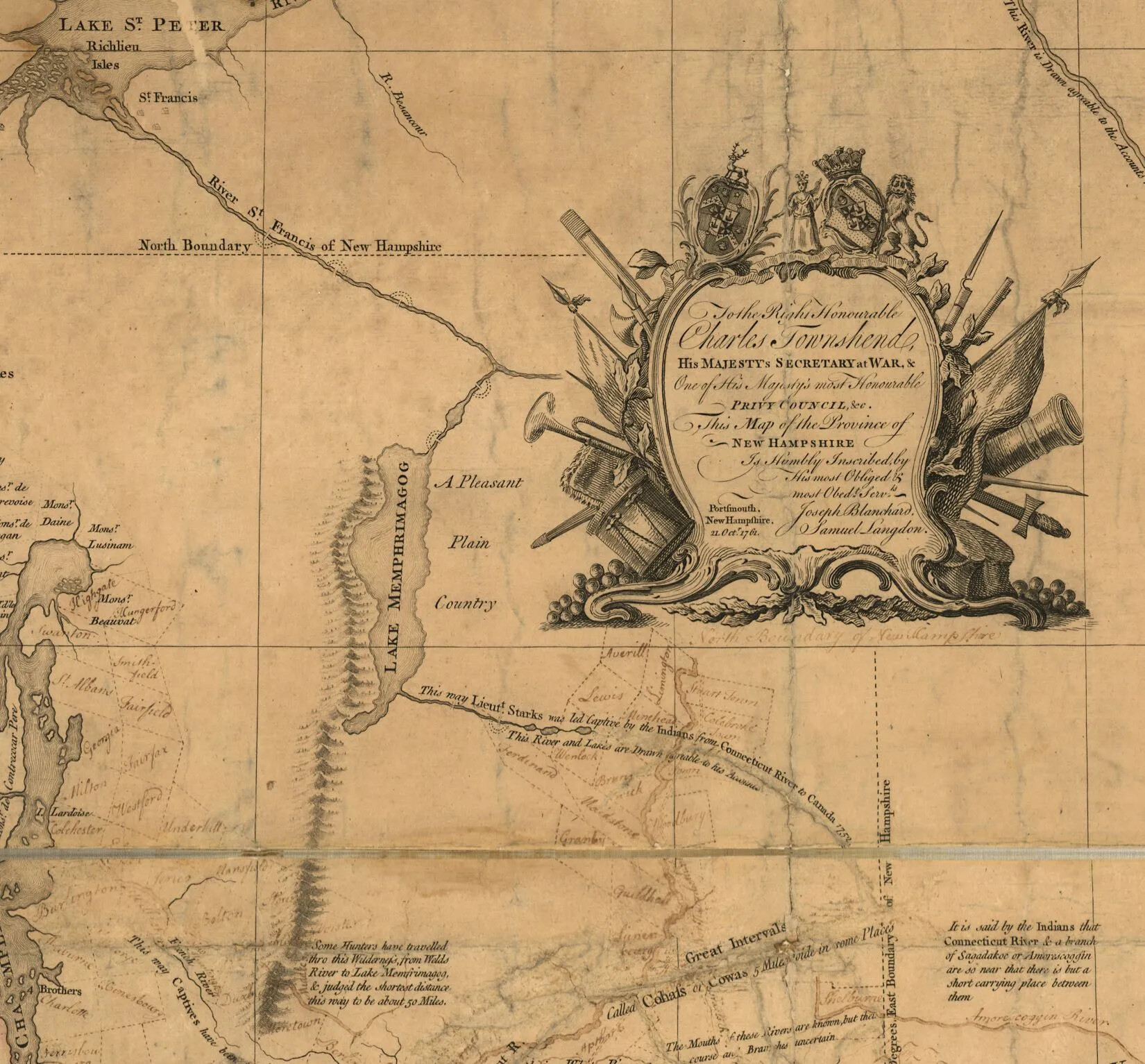
Detail of a historic map shown. Boundaries of territories are marked in dotted lines, and lakes and rivers are labeled. A particular line winds through the detail, and on it is written "This way Lieut. Starks was led Captive by the Indians from Connecticut River to Canada 1752." In the middle of the detail is an inscription bordered by the points of weapons of war dedicating the map to "the Right Honourable Charles Townshend, His Majesty's Secretary of War."
Map of New Hampshire, 1761 (Detail)

Objects in this Primary Source Set:

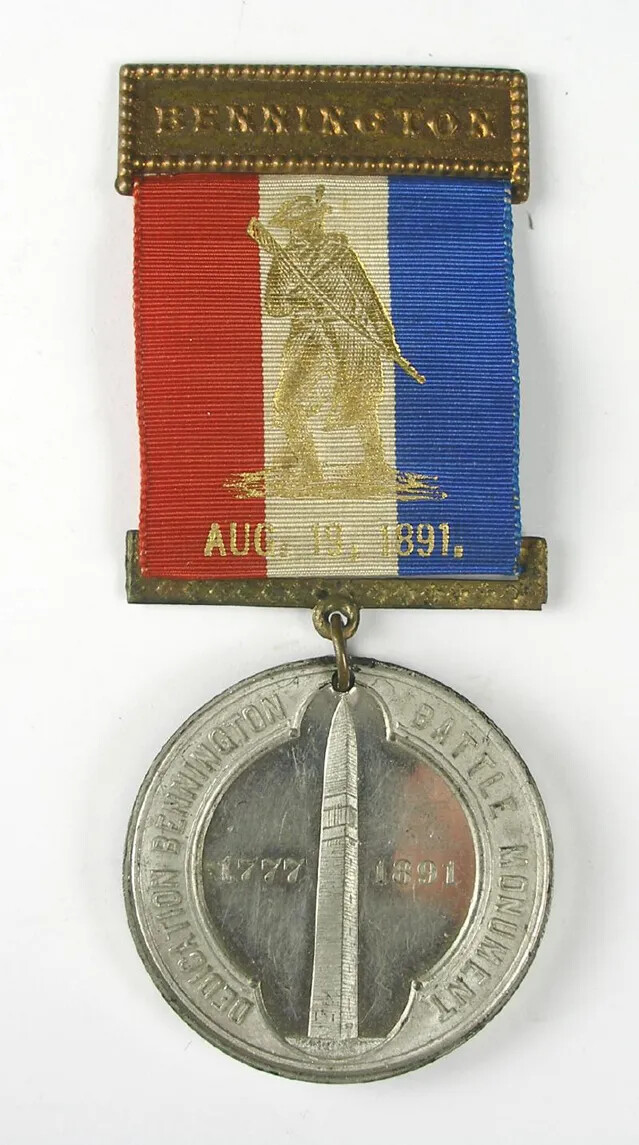
A medal hangs from a red, white, and blue ribbon. At the top of the ribbon is a metal rectangle enscribed with "BENNINGTON." On the ribbon is a soldier holding a musket, under which it says AUG 19, 1891. The medal is silver, enscribed with "DEDICATION BENNINGTON BATTLE MONUMENT" around the edge and a tall obelisk monument in the middle. Left of the obelisk says "1777" and "1891" on right.
Bennington Medal (front)
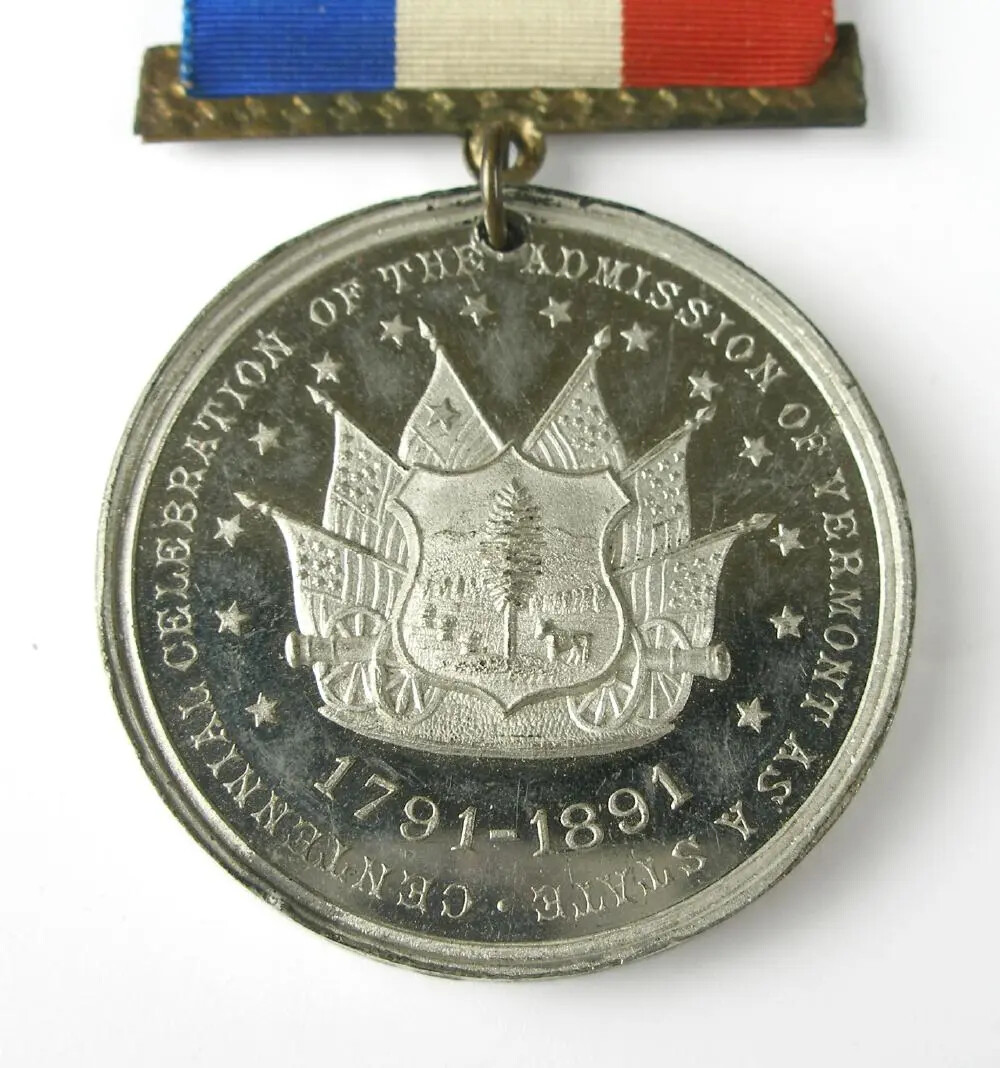
A silver medal shows image of flags, cannons, and shield with "1791-1891" below. There is lettering around perimeter which reads "CENTENNIAL CELEBRATION OF THE ADMISSION OF VERMONT AS A STATE".
Bennington Medal (reverse)
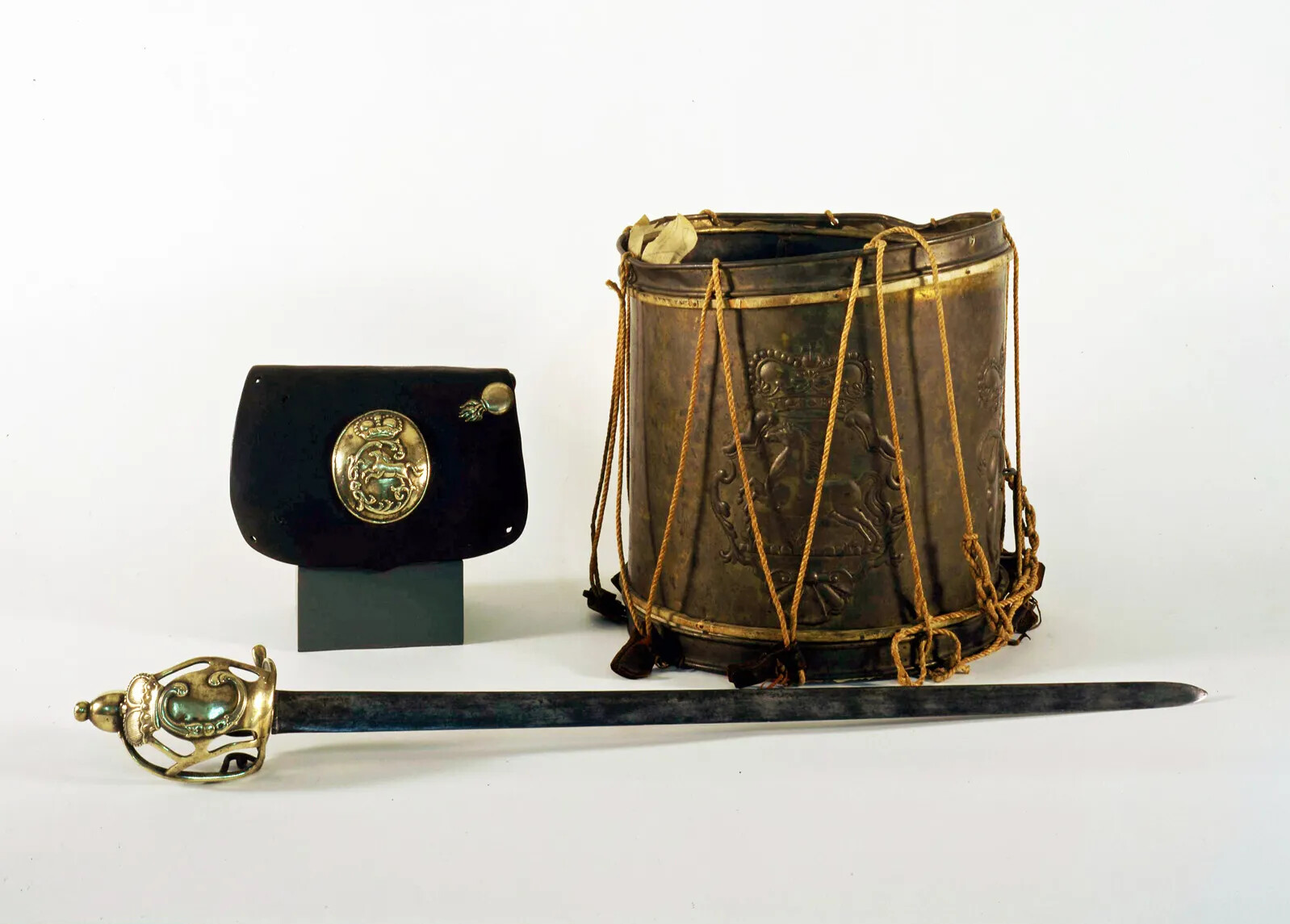
Three items are shown. A sword with decorative golden handle lies horizontally. A black square pouch with golden seal in the middle and a round circle in the upper left hand corner stands next to it. The last item is a drum, showing signs of age. It is made of metal with a seal embossed on it, and the top drum head is torn off. There is twine woven through the top and bottom hoops to keep the drum together.
Hessian Drum, Sword, and Cartridge Box
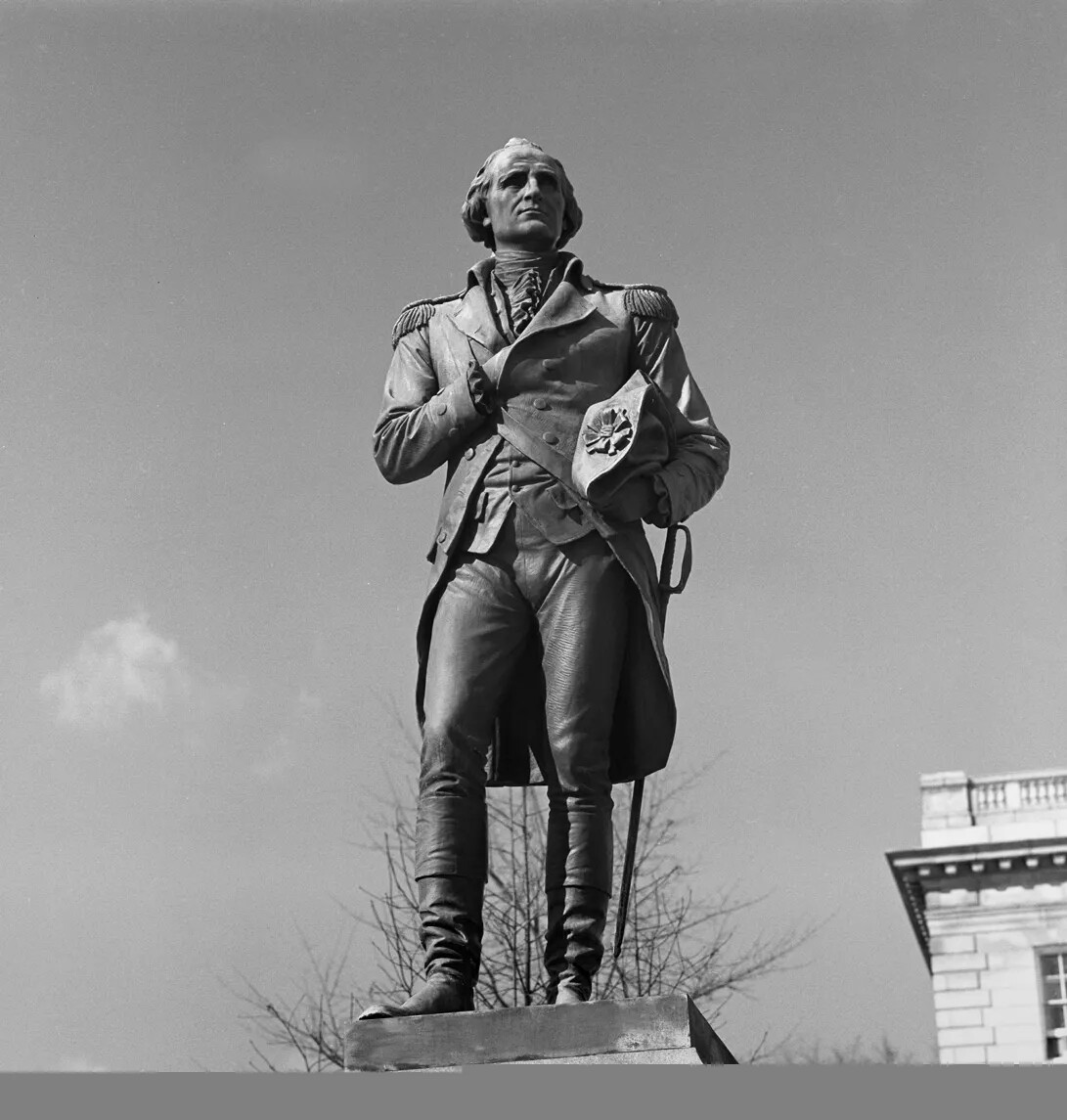
John Stark Statue
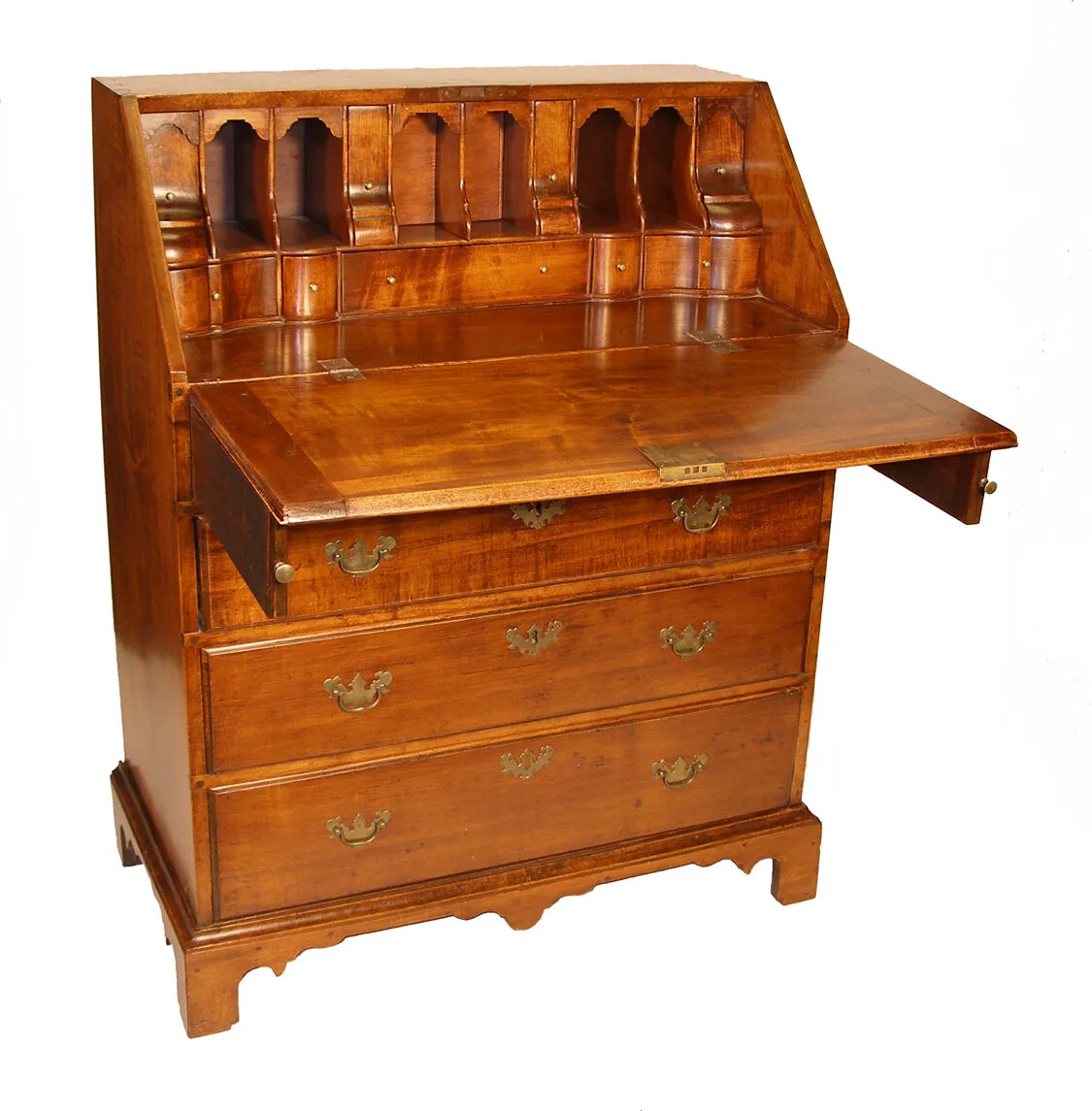
A wooden desk has a sloped lid that opens and is supported on its sides to make a writing surface. Below the opened lid are four drawers. Each drawer has two brass handles with elaborately shaped plates. Desk interior has five drawers of various widths with a series of paired pigeonholes on top. There are vertically oriented drawers in between the series of pigeonholes. There are small brass knobs on interior drawers. The desk stands on four straight feet.
John Stark’s Desk
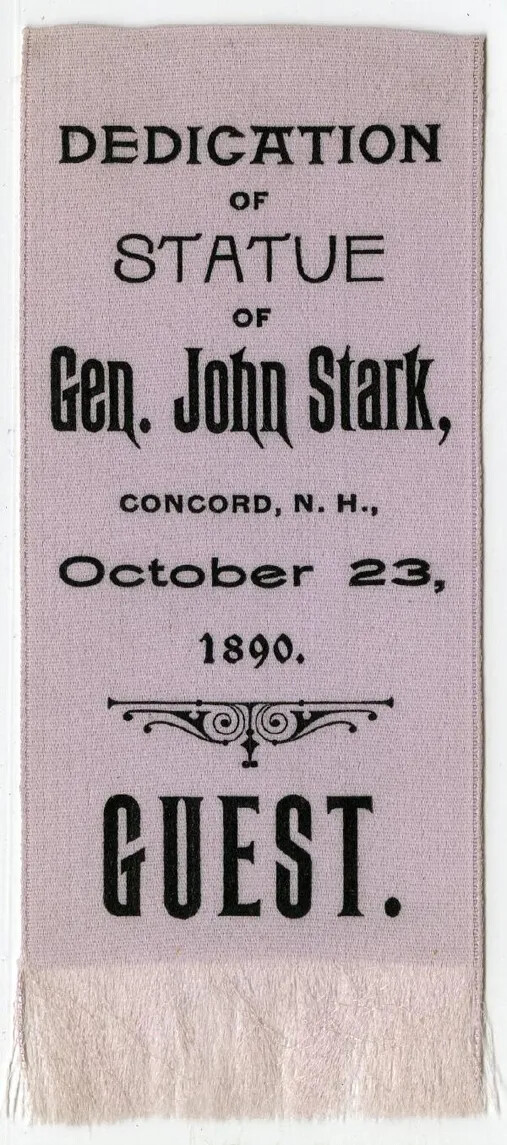
A light purple ribbon reads "DEDICATION OF STATUE OF Gen. John Stark, Concord, N.H., October 23, 1890. GUEST."
Ribbon Celebrating John Stark's Statue

Photographs & Prints in this Primary Source Set:

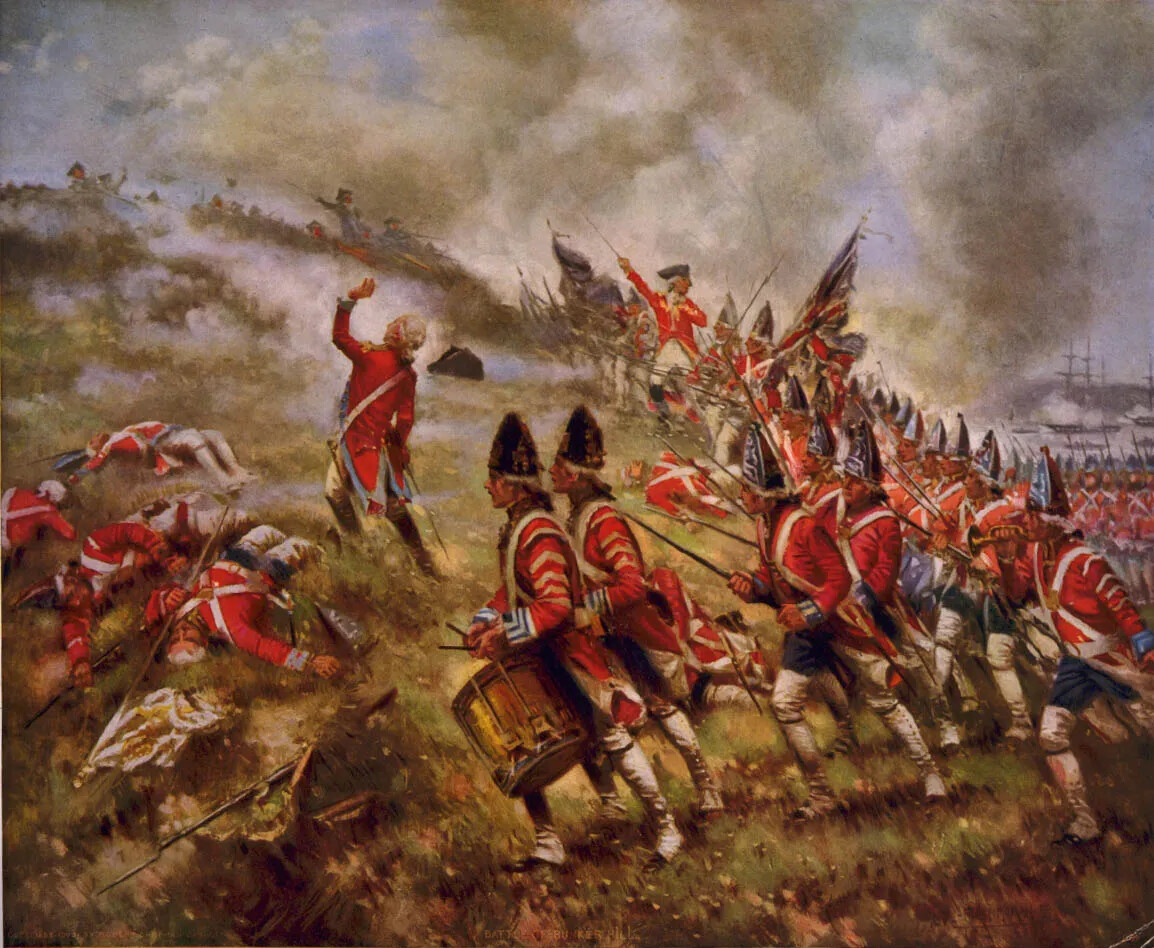
A colored painting of a large group of soldiers in red and white uniforms advancing up a steep hill. Two soldiers are carrying drums, while the rest carry muskets. One solider on the right-side of the painting carries the British flag. Ships firing their cannon are seen in the distance on the right-hand side of the painting. The sky is filled with smoke and mist. On the left side of the painting, several soldiers lie on the ground.
Battle of Bunker Hill
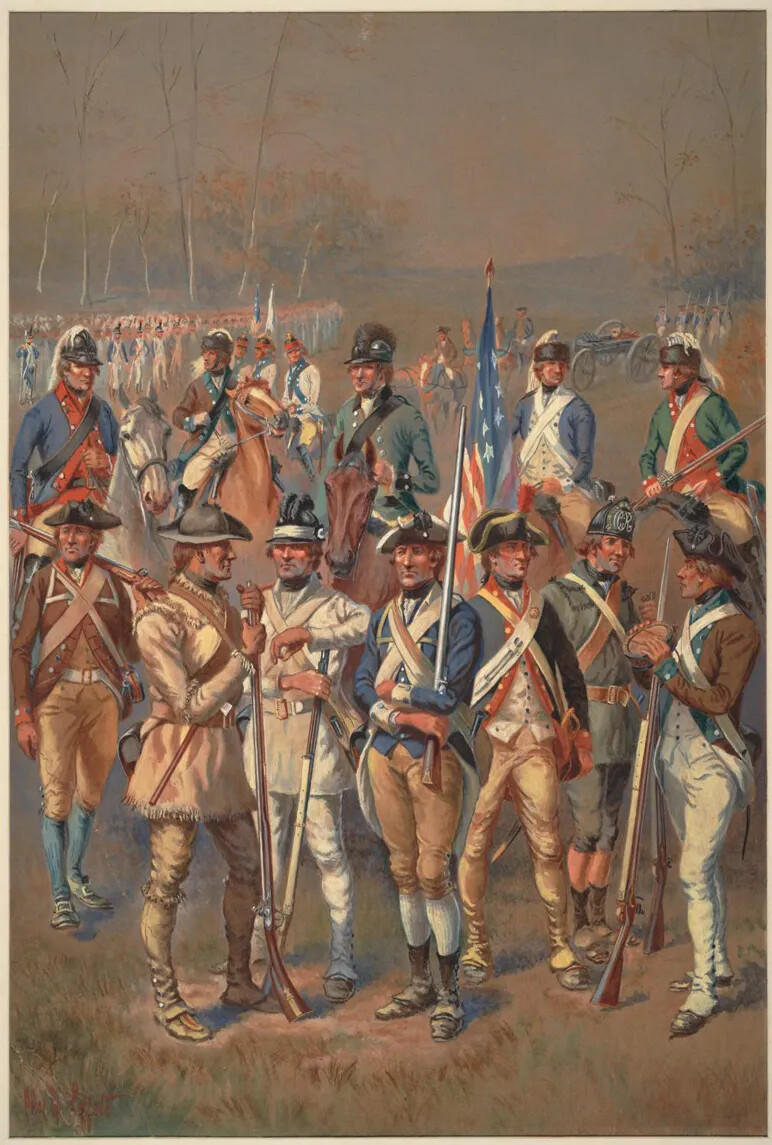
A colored painting of a group of man standing in two rows. The men in the first row stand, while the men in the second row ride horses. All of the men wear different colored hats, coats, and pants. An American flag is held upright by one of the men at the center of the painting. Behind this group is a larger group of men standing in organized diagonal lines.
Continental Army Soldiers
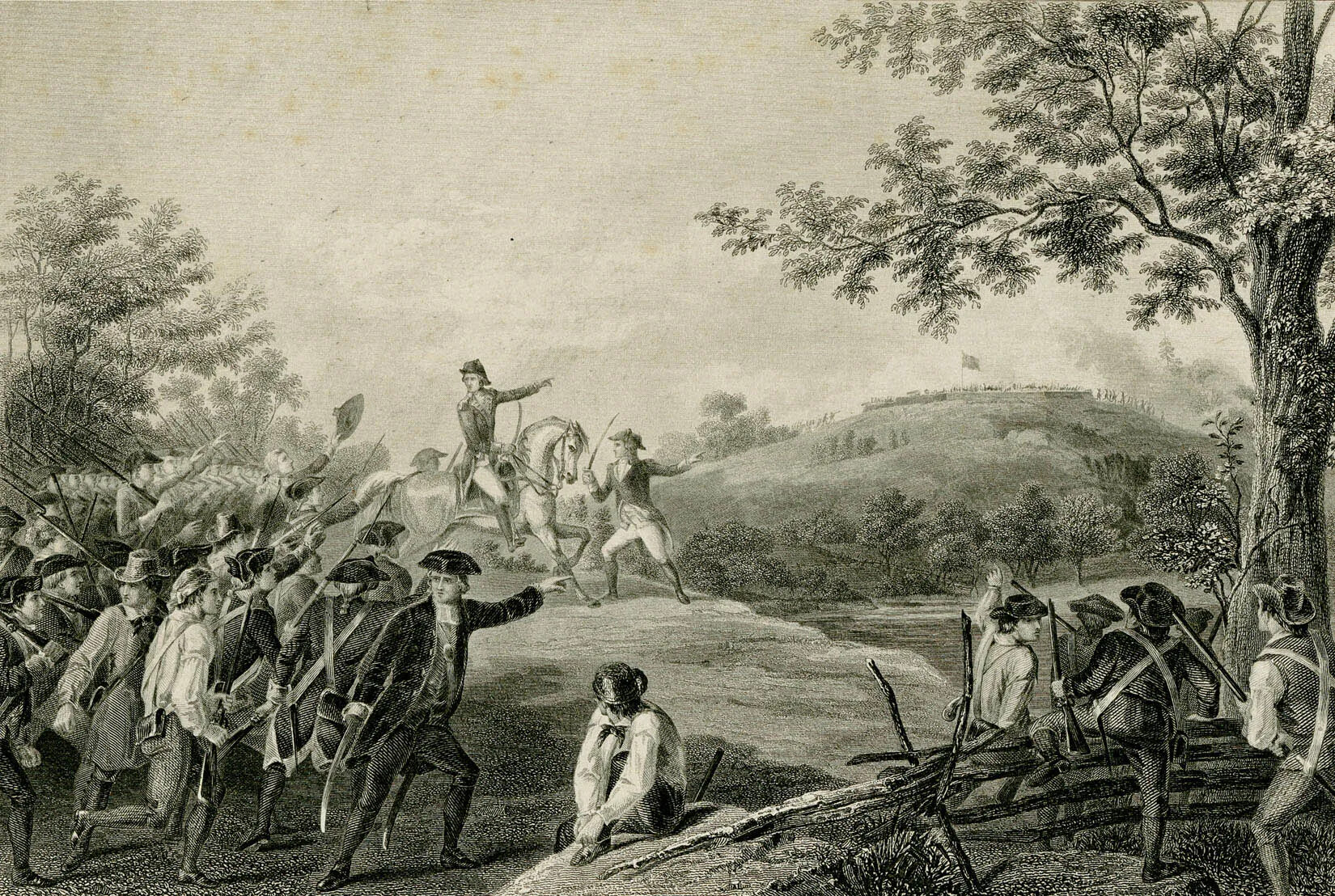
A black and white drawing of a group of men standing on the left side of the drawing, looking and pointing at a hill positioned on the right side of the drawing. On the hill is a fort-like building, with a large flag raised over it. At the center of the drawing, looking at the group of men behind him, with his right arm raised towards the hill, is a man riding a horse.
General Stark at Bennington
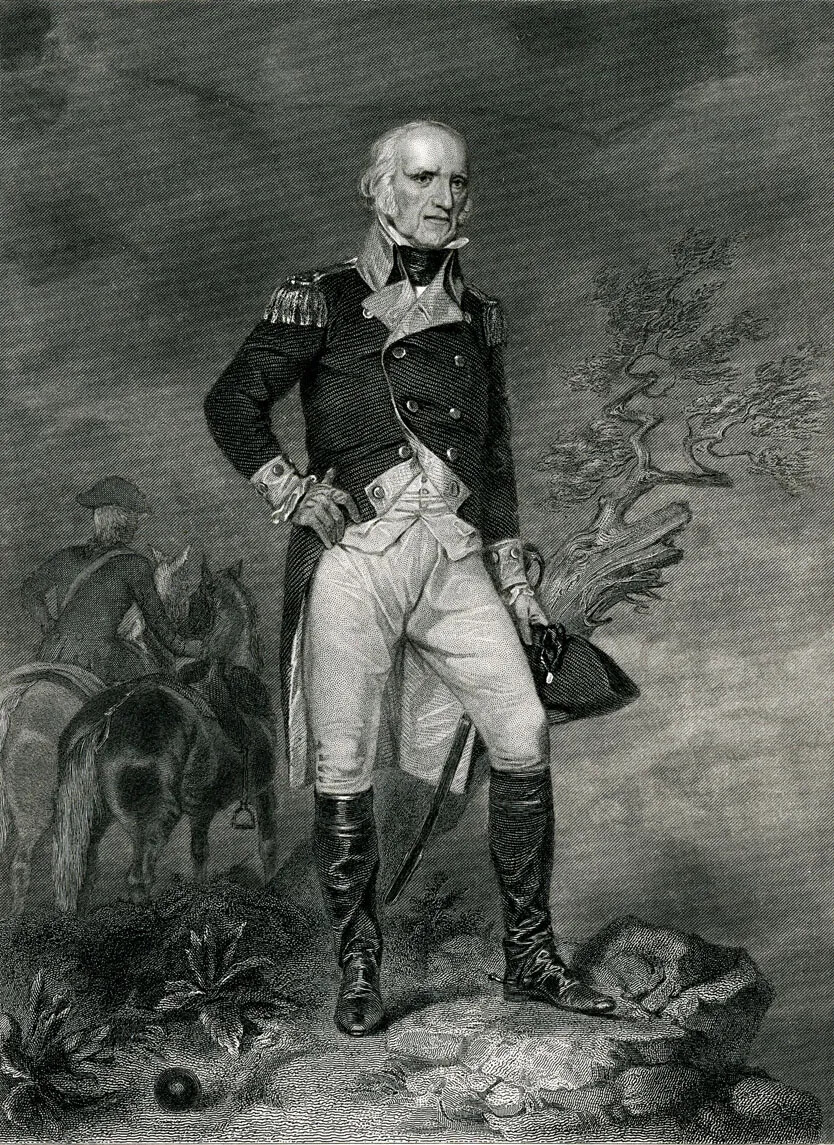
A black and white painting shows a man in military dress standing on a blurred landscape, which has a man and a horse walking away and a tree. The man who is the subject of the painting has one hand on his hip and one foot forward. He has grey hair which is short on the sides, and he is bald on top. He has a sword hanging from his hip, and holds his hat in his hand. His uniform is decorative with tassles at the shoulders, white pants, and high black boots.
John Stark