
Primary Source Set - Amoskeag Manufacturing Company

Once the largest textile mill in the world, the Amoskeag Manufacturing Company dominated the textile industry in the 19th and early 20th centuries. It was one of the great industrial giants of its day, and its impact on New Hampshire’s development was profound. The company made Manchester the largest city in both New Hampshire and northern New England, a distinction the city still holds today even decades after the Amoskeag mills closed.


Background

Manchester began as a small farming village located several miles east of the Merrimack River. It was originally called Derryfield. The town’s potential as an industrial center was first recognized by Samuel Blodget, local businessman, inventor, and entrepreneur who built a canal-and-lock system on the Merrimack River near the Amoskeag Falls. When Blodget’s canal system opened in 1807, it allowed boats travelling between Concord and Nashua to bypass the steep falls completely, thereby providing for water travel north of the falls, which opened this area of the state to development. At that time, water travel was the most efficient way to transport goods and people, so the navigability of the Merrimack, the largest river in central New Hampshire, was of prime importance. Within a few years, through the construction of other canals and locks, the Merrimack would link Concord to Boston, opening up for central New Hampshire all sorts of possibilities for trade and industry.

Blodget envisioned the creation of a massive factory complex on the banks of the Merrimack, as he was intrigued by the developments in mechanization that had turned England into an industrial leader and were just starting to appear in the United States. He proclaimed that the spot around the Amoskeag Falls would someday become the “Manchester of America,” a water-powered textile center comparable to Manchester, England. While Blodget did not live to see his vision of an industrial complex realized, the town of Derryfield voted to change its name to Manchester in 1810, as a memorial to Blodget’s dream.

Inspired by Blodget’s successes and the power of the Merrimack River, a group of men led by Benjamin Prichard established the Amoskeag Cotton and Woolen Manufacturing Company, the precursor to the Amoskeag Manufacturing Company, in 1814. The first structure of this mill was actually on the opposite banks of the Merrimack from Manchester in land that was owned by Goffstown at the time. As production grew, so too did the need to expand the company’s physical footprint, and buildings spread to the islands in the Merrimack and onto the east side of the river. The company imported new technologies from England that allowed the process of generating textiles to become more and more mechanized and encouraged further growth. Nevertheless, the Amoskeag Company floundered in these early years. It was only after the faltering business had been bought out by a group of Boston investors in 1830 that it began its meteoric rise, fueled by a a massive investment of Massachusetts capital. Between 1838 and 1915, the Amoskeag Manufacturing Company constructed a total of 40 mill buildings, a dozen or so of which still stand in the city today.

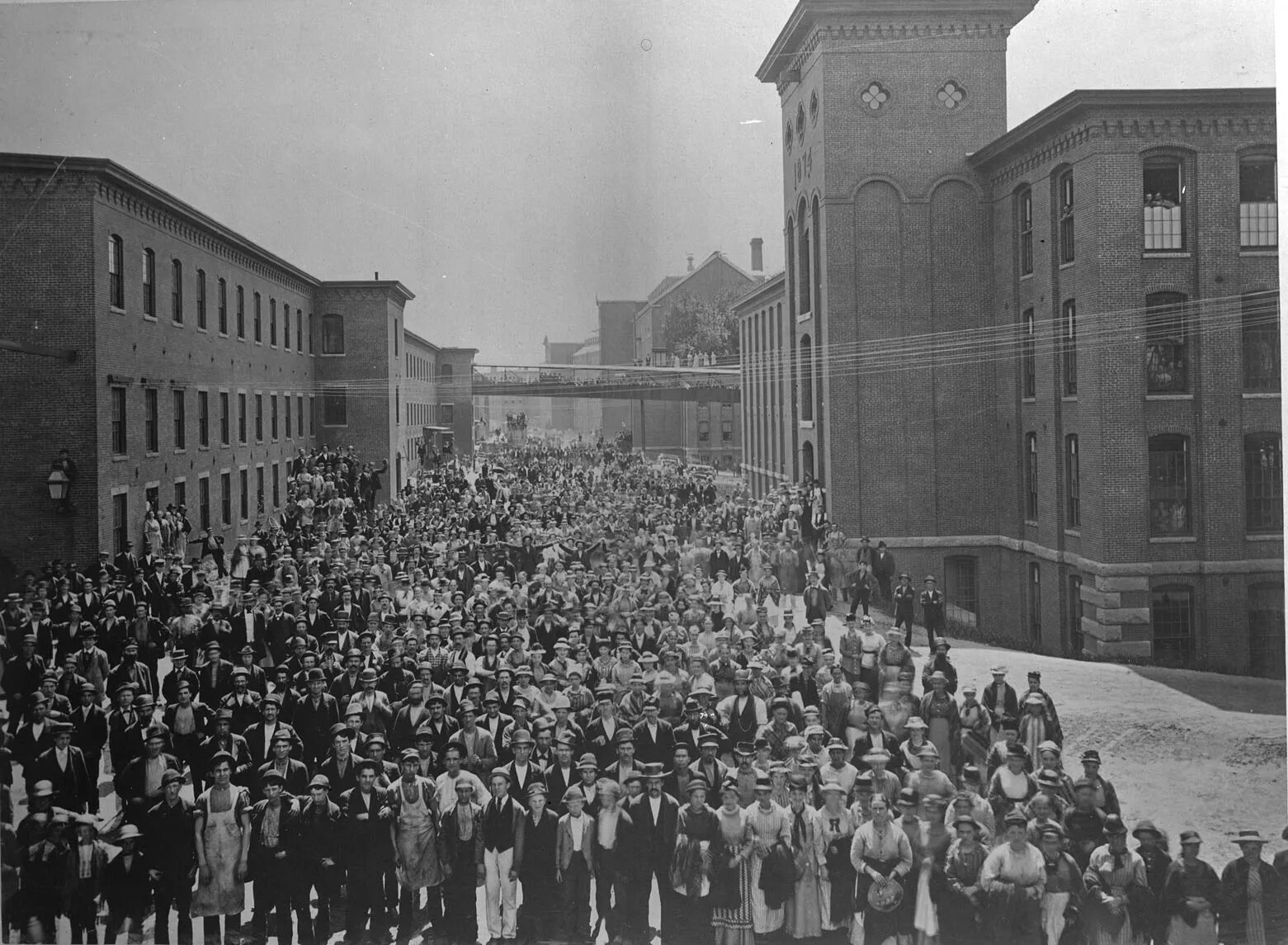
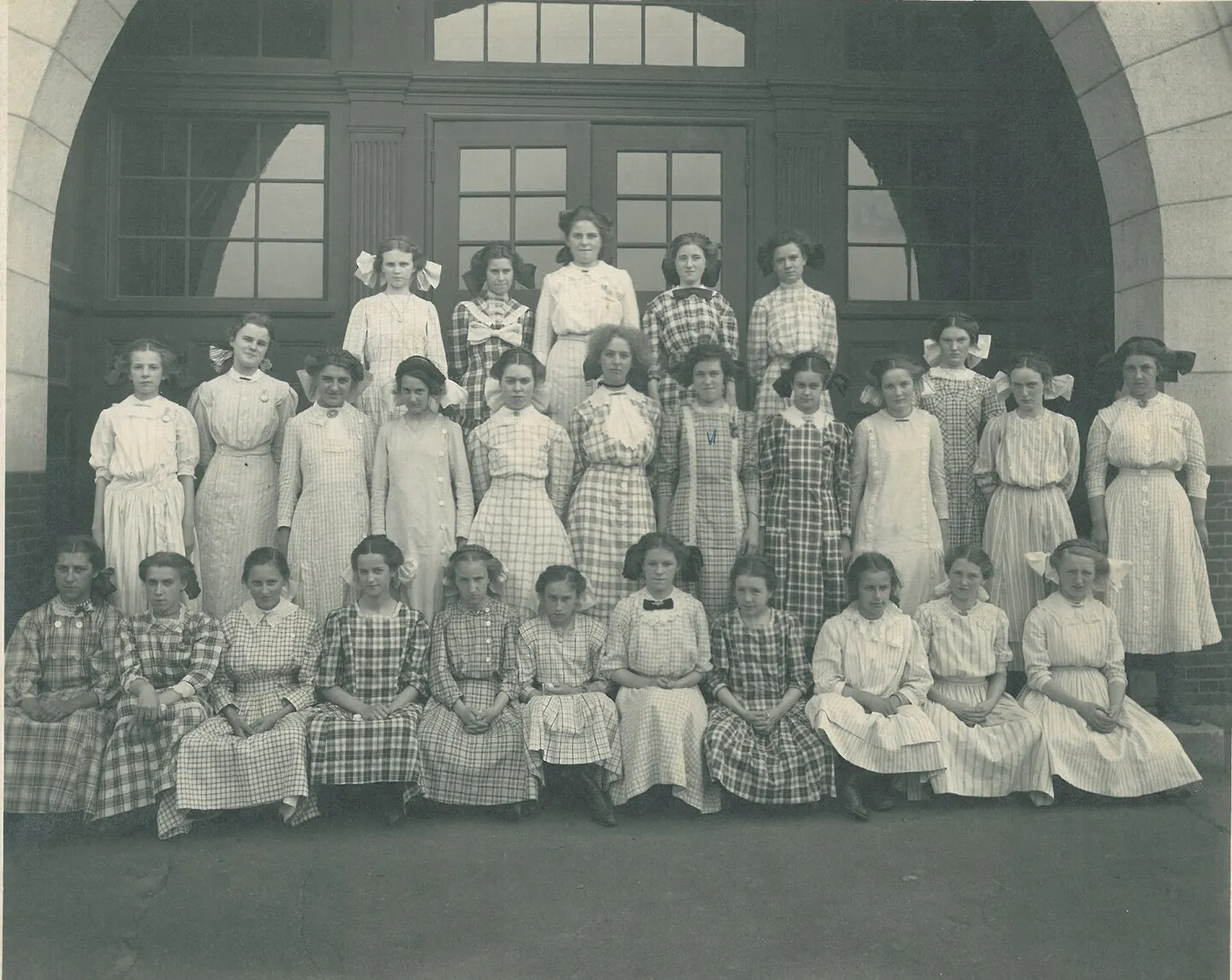
At its height in the 1910s, Amoskeag employed more than 17,000 people. By the end of a six-day work week, these mill workers could produce a total of 5 million yards of cloth, with 470 miles of cloth being finished each day. Amoskeag quickly became the largest producer of cotton cloth in the world, and, in 1873, it became the main supplier of denim used to make Levi jeans. The company was especially famous for its dress goods, particularly its gingham, which was a popular fashion trend at the time.

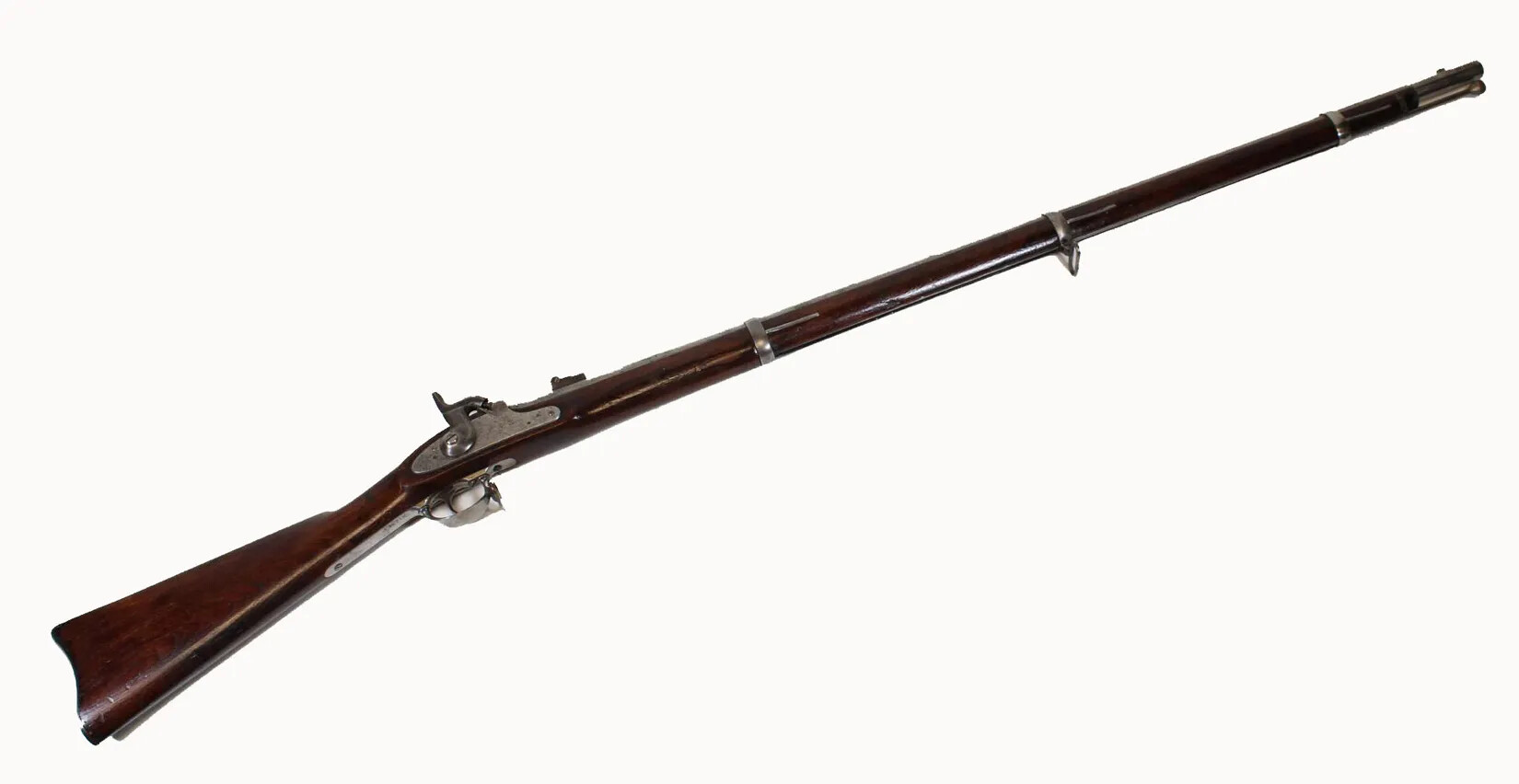
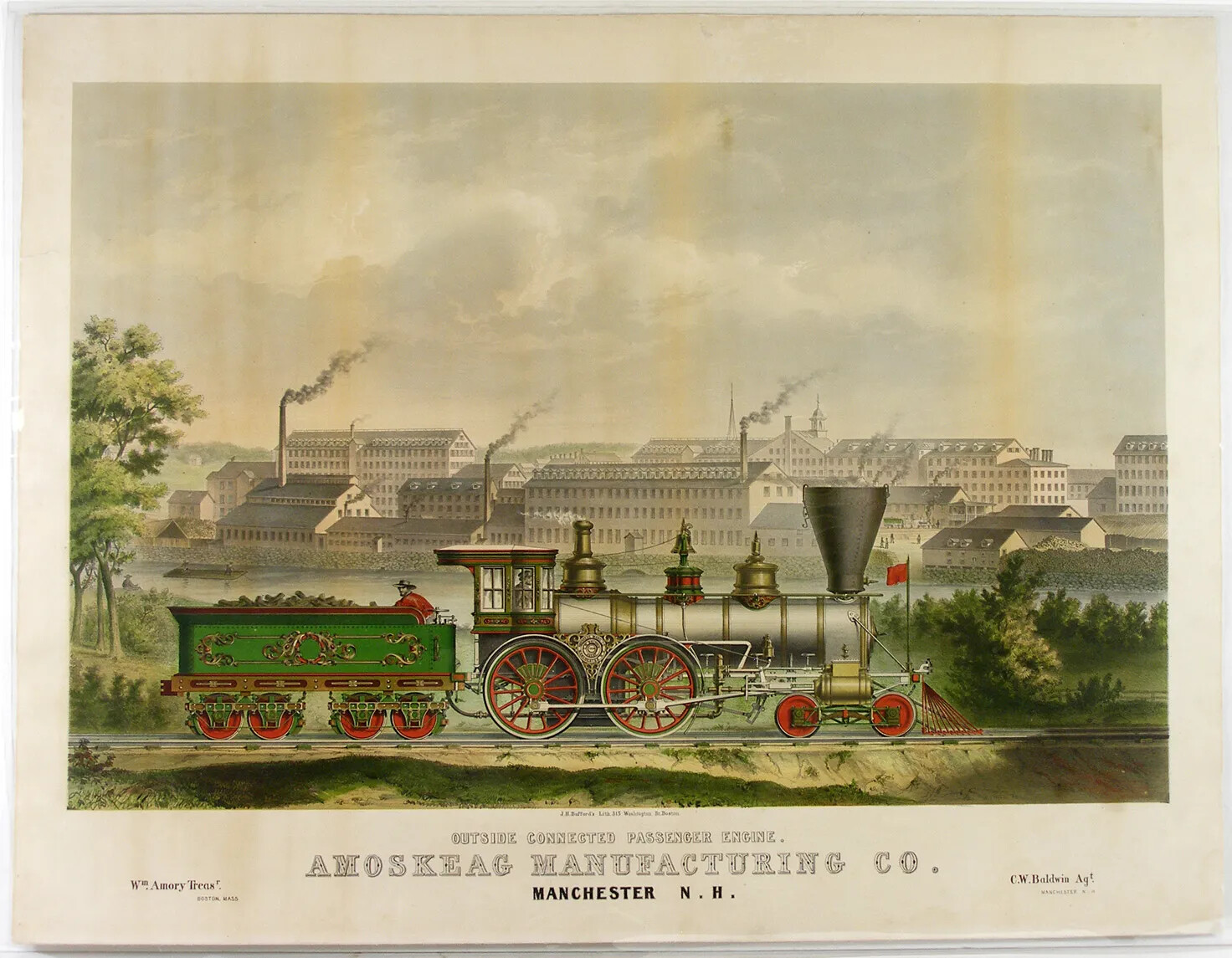
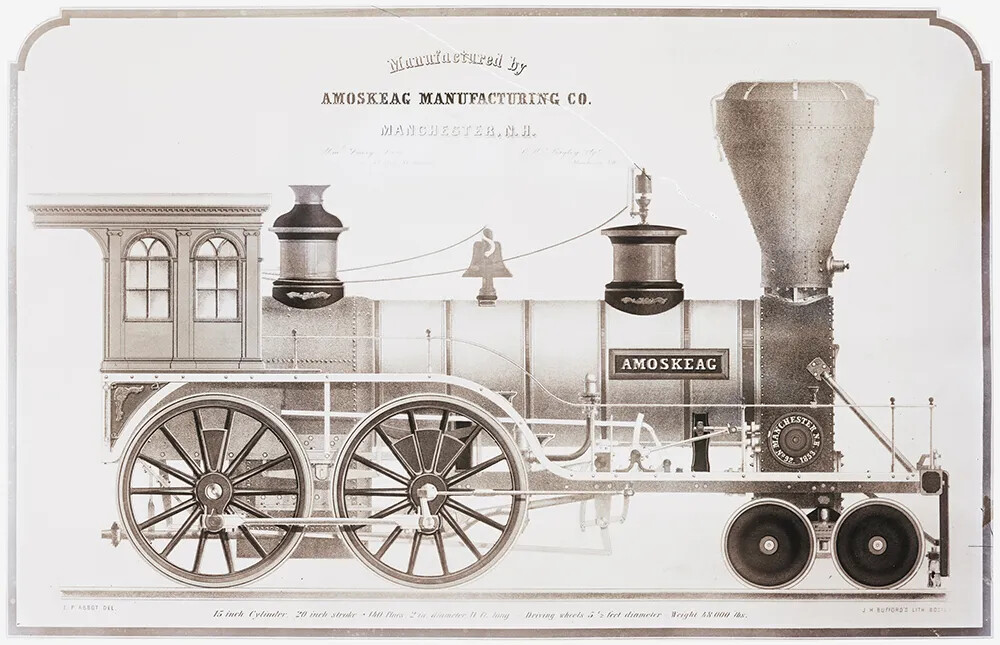
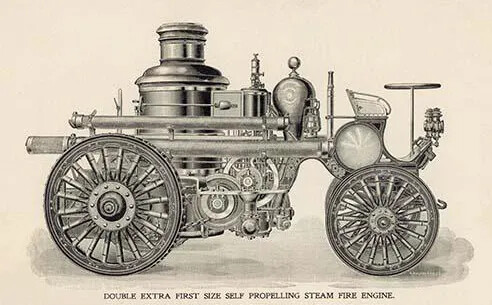
Much of Amoskeag’s success relied on the railroad, which allowed the company to expand its sales beyond the Northeast. Yet the company did not always limit itself to textile production. During the Civil War in the 1860s, when cotton from the South became scarce, the company directed its efforts to the production of carbines, Springfield muskets, sewing machines, locomotives, and fire engines. By the end of the 19th century, Manchester had become a center for New Hampshire’s flourishing shoe industry.

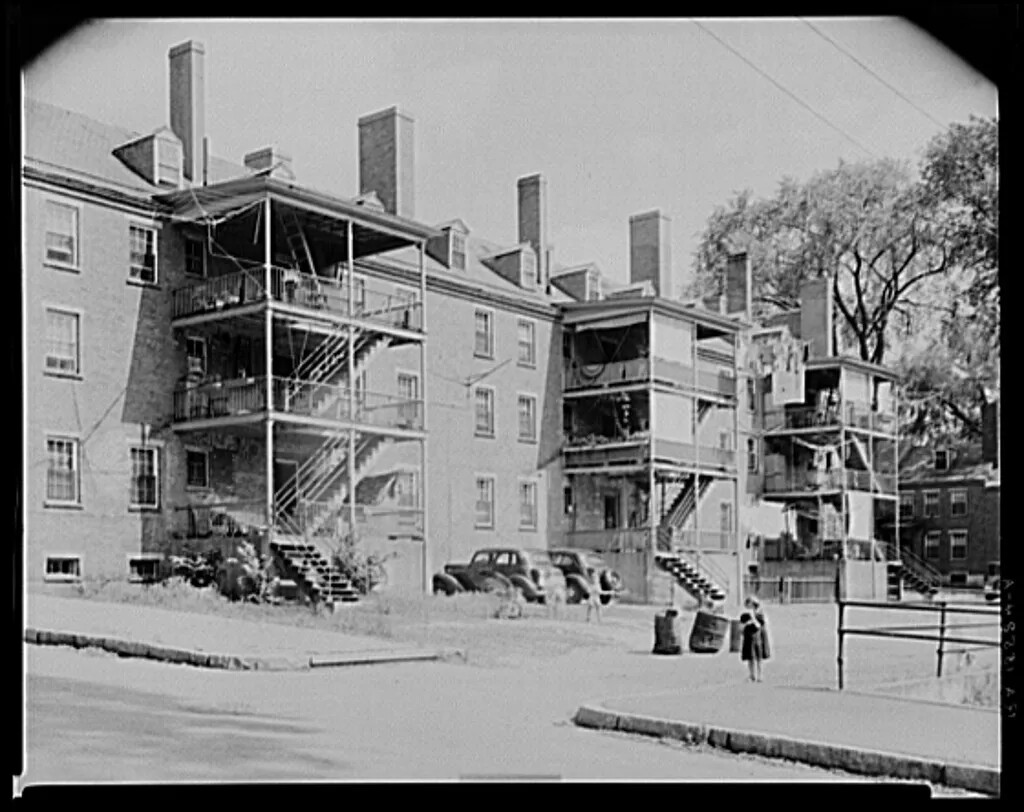
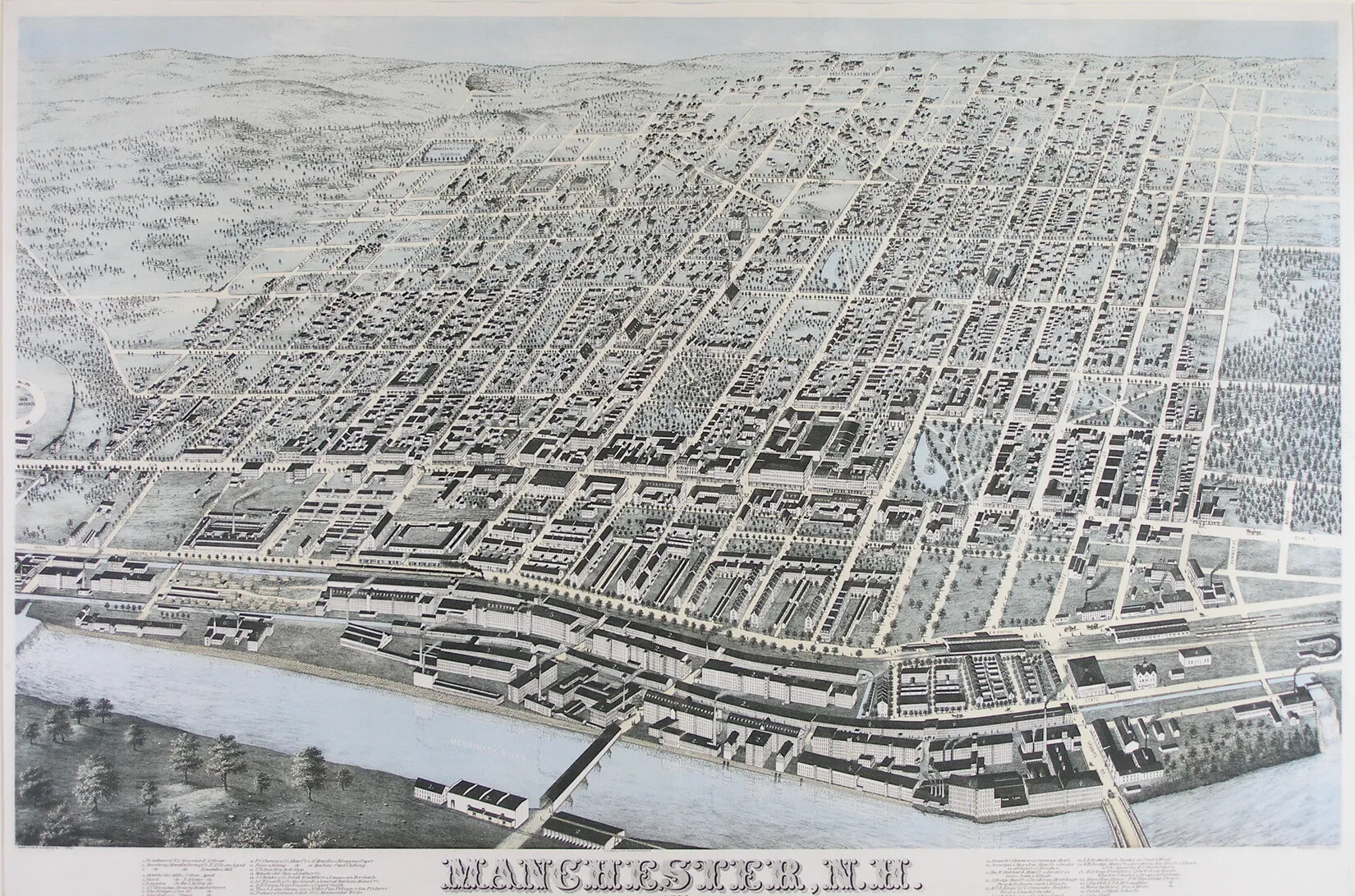
The city of Manchester expanded alongside the Amoskeag Manufacturing Company, with much of the city’s development controlled by the company. Amoskeag planned out the city’s center along Elm Street, set aside land for public parks, and organized housing for its employees.

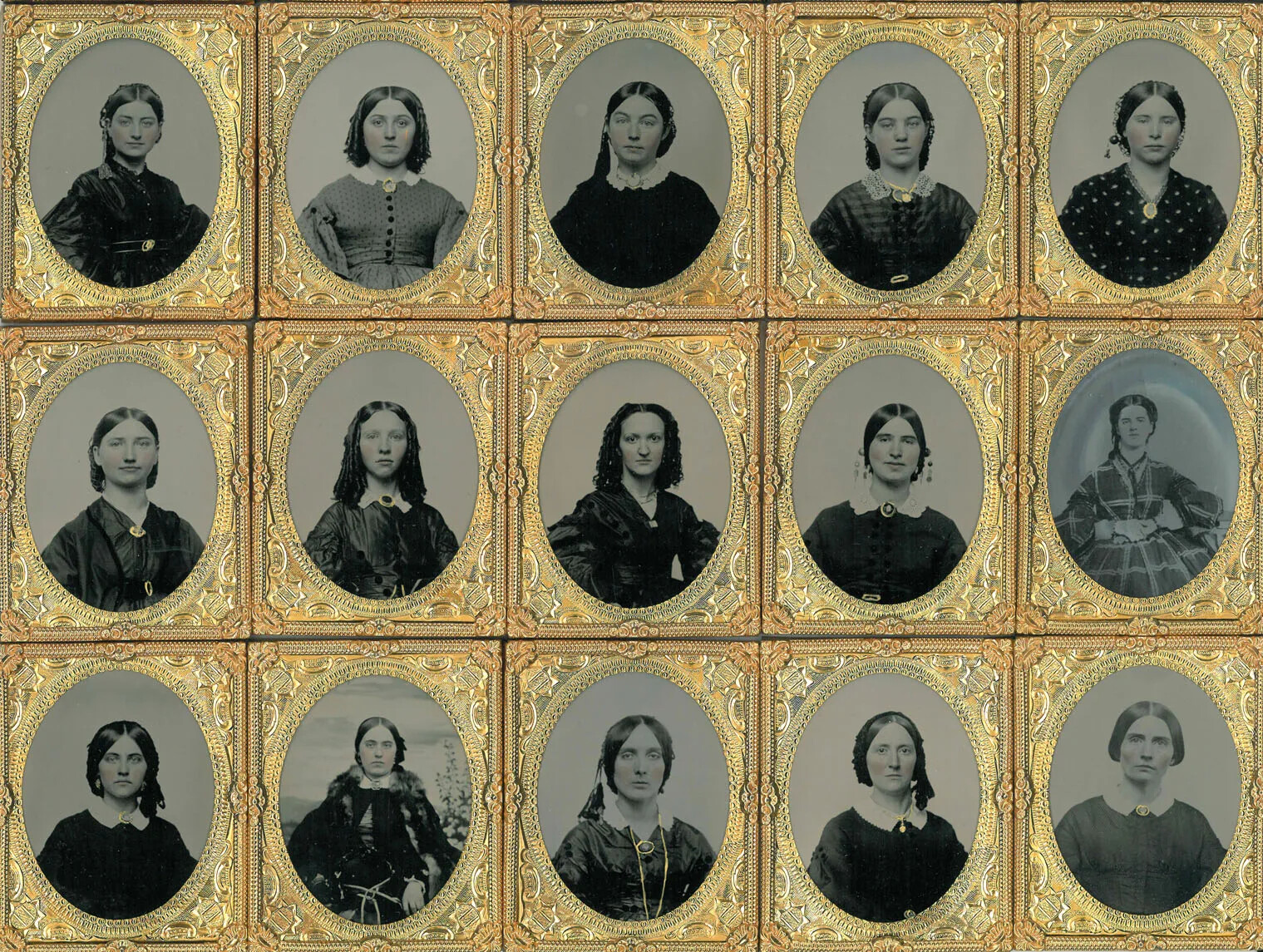
Many of the factories’ first employees were young women, who came to the city from nearby farming communities. But as the need for labor increased, Amoskeag soon relied on newly arriving immigrants from Quebec, as well as those from Ireland, Greece, Germany, Sweden, and Poland. As each immigrant group moved into the city, neighborhoods based on ethnicity soon dominated the character and culture of the City of Manchester. 

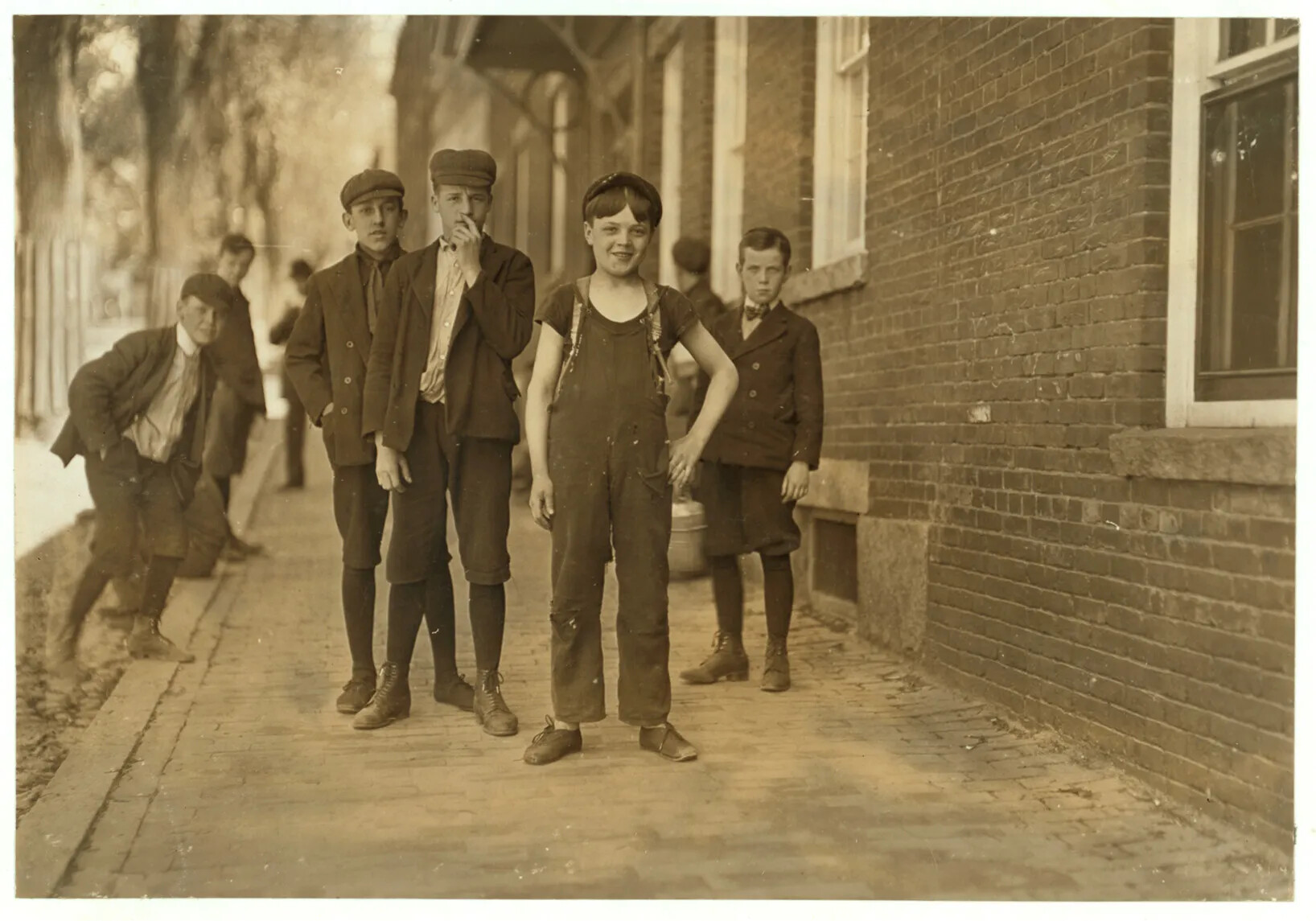
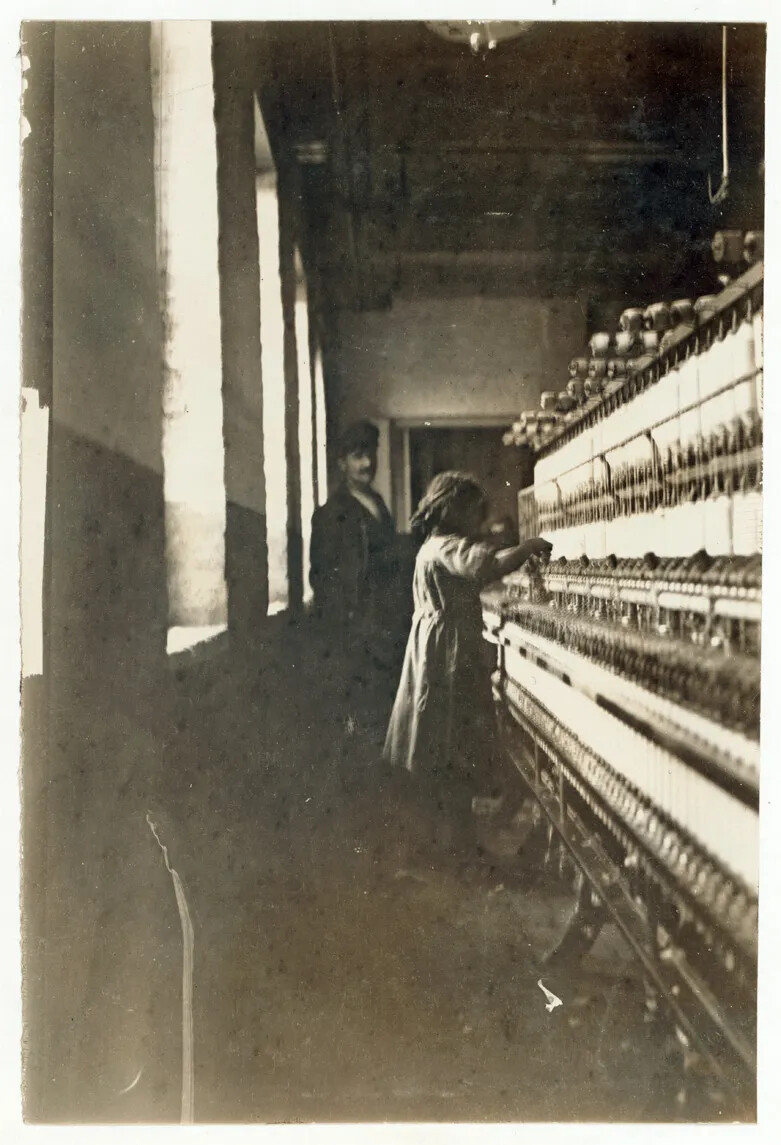
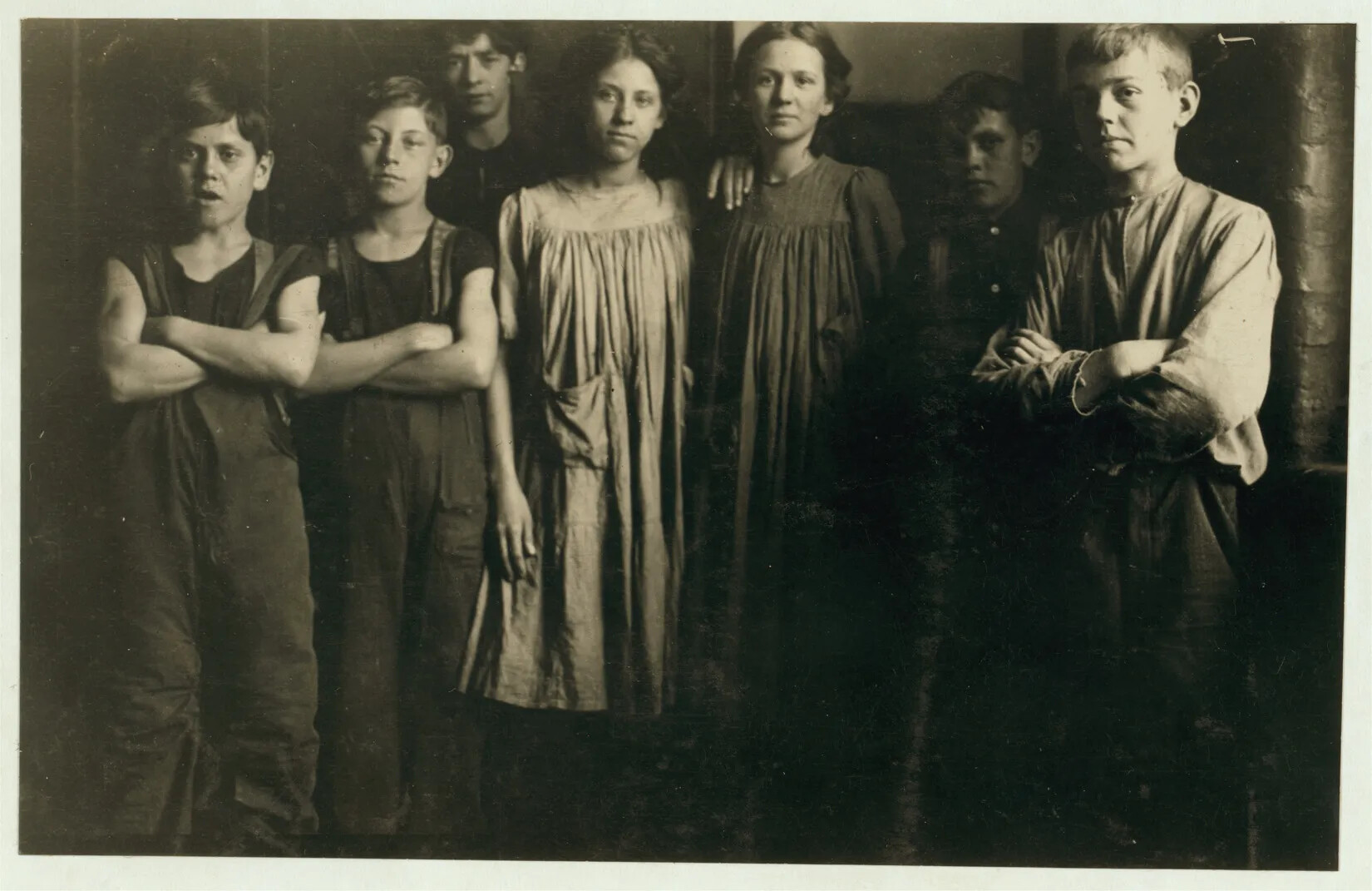
Amoskeag also came to rely on children as a labor source. Because children were smaller than adults, they could climb up into the machines if something broke. Their small fingers also made them well suited to the delicate work of making textiles. But these tasks were not without incident, as injuries, illnesses, and fatalities from accidents were common. The poor working conditions of child laborers inspired the progressive photographer, Lewis Hine, to visit Manchester in 1909. His photographs of children in the mills proved influential in turning public opinion against child labor and resulted in the passage of several child labor laws at the turn of the 20th century. 

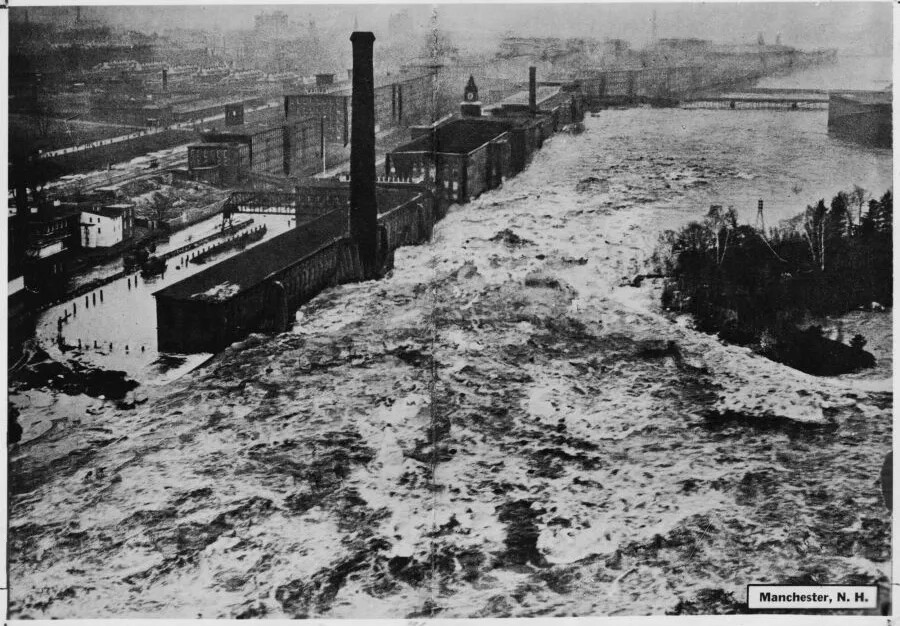
Once the dominating industry in Manchester, the Amoskeag Manufacturing Company began to lose its grip on both its workers and its stance in the textile world in the 1920s. Though Manchester was long considered the “strike-less city,” the loyalty felt by Amoskeag workers towards the company began to recede after Amoskeag announced a 20 percent cut in pay and an increase in the work week from 48 hours to 54 hours in February 1922. The resulting “Strike of 1922,” lasting nine months, cost the company and its employees millions of dollars in production and wages. Aging machinery and the Great Depression of the 1930s provided the final blows. On December 24, 1935, the Amoskeag Manufacturing Company closed its doors and filed for bankruptcy. Damage inflicted upon the mill buildings by a massive flood in the spring of 1936 further solidified the closure of the millyard. 

The National Park Service once approached the City of Manchester about turning the former mill buildings into a park that would commemorate the nation’s industrial heritage. The city turned them down, and the national park instead went to Lowell, Massachusetts. Today, the former millyard has been revitalized, and the renovated mill buildings serve a variety of purposes, including office spaces, restaurants, college classrooms, apartments, and art studios.  

This primary source set guide can be used in several ways to explore the story and significance of the Amoskeag Manufacturing Company. It is not necessary to use all sources in a set to create a meaningful inquiry. Rather, educators are encouraged to select—or have their students select—the sources best suited to your project.


ADDITIONAL RESOURCES

  • Creamer, Daniel, and Charles Coulter, Labor and the Shutdown of the Amoskeag Textile Mills (Philadelphia: Works Progress Administration, National Research Project. 1939).
  • Eaton, Aurora, and Robert B. Perrault, Amoskeag Manufacturing Company: A History of Enterprise on the Merrimack River (Charleston, S.C.: History Press, 2015).  
  • Freedman, Russell, Kids at Work: Lewis Hine and the Crusade Against Child Labor (New York: Clarion Books, 1994).
  • Hareven, Tamara, Amoskeag: Life and Work in an American Factory-City (Hanover, N.H.: University Press of New England, 1978).
  • Macieski, Robert, Picturing Class: Lewis W. Hine Photographs Child Labor in New England (Amherst: University of Massachusetts Press, 2015).
  • Samson, Gary, A World Within a World: Manchester: the Mills, and the Immigrant Experience (Charleston, S.C.: Arcadia Press, 2000).
Focus Questions

In addition to our general suggestions for using primary source sets, consider giving students one of the following prompts for an inquiry using this primary source set about the Amoskeag Manufacturing Company.

  • 1
    What words would you use to describe the Amoskeag Manufacturing Company?
  • 2
    What effects do you think the Amoskeag Manufacturing Company had on the city of Manchester?

Biographies in this Primary Source Set:

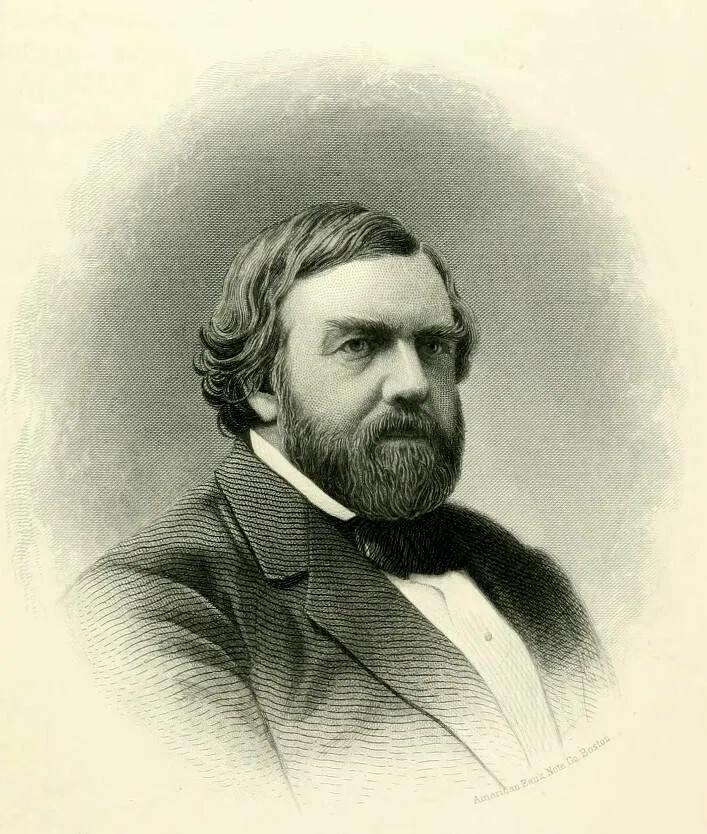
A black and white drawing of a white man with wavy hair and a beard and mustache. He sits with his body to the right, and looks slightly off to the right. He wears a bow tie, a collared shirt, and a suit jacket.
Ezekiel Straw

Documents in this Primary Source Set:

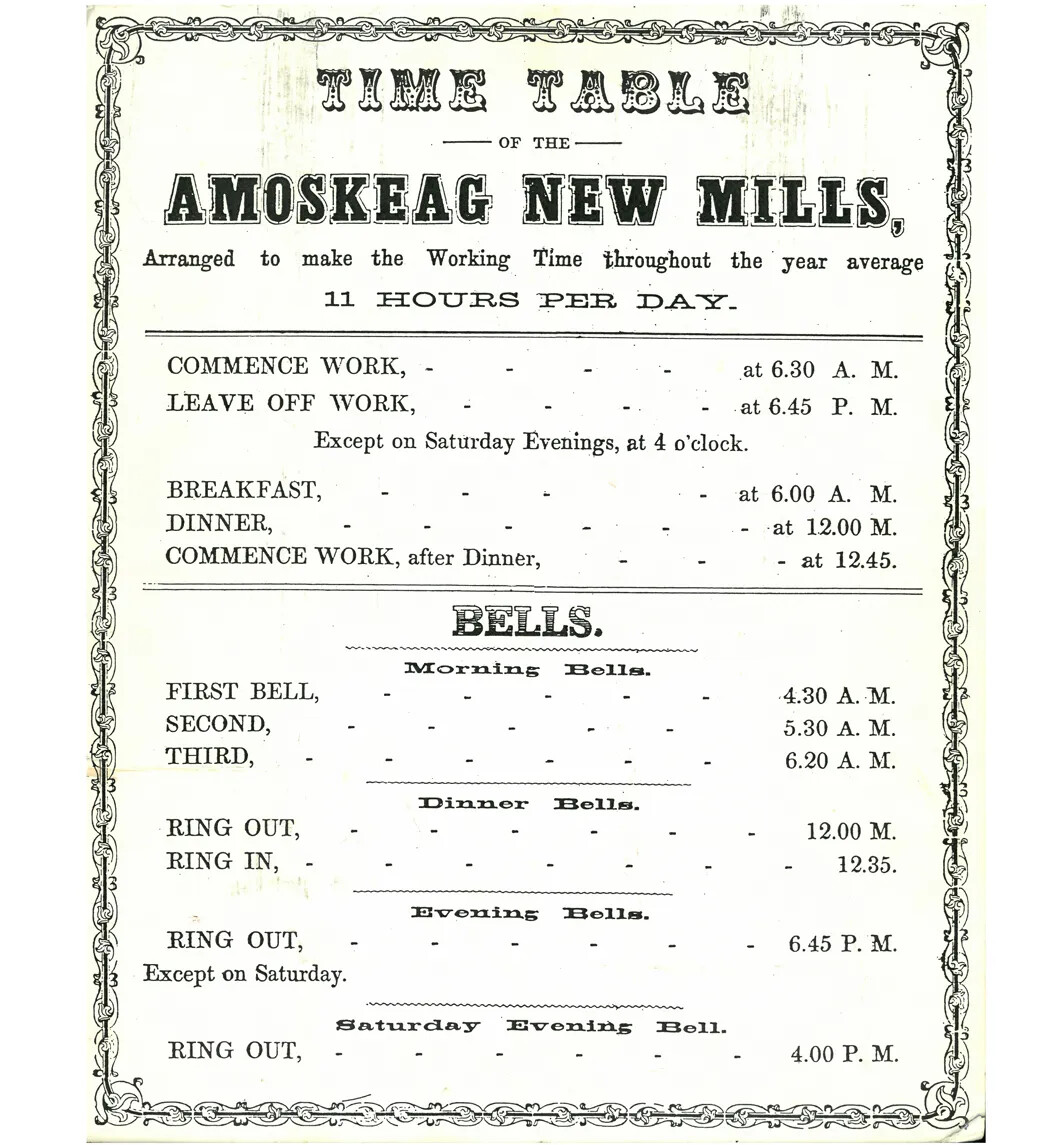
A large document on white paper written in black ink of a daily schedule. The title of the document reads "TIME TABLE/OF THE/AMOSKEAG NEW MILLS/Arranged to make the Working Time throughout the year average/11 HOURS PER DAY." The document is framed by a floral pattern.
Amoskeag Manufacturing Company Timetable
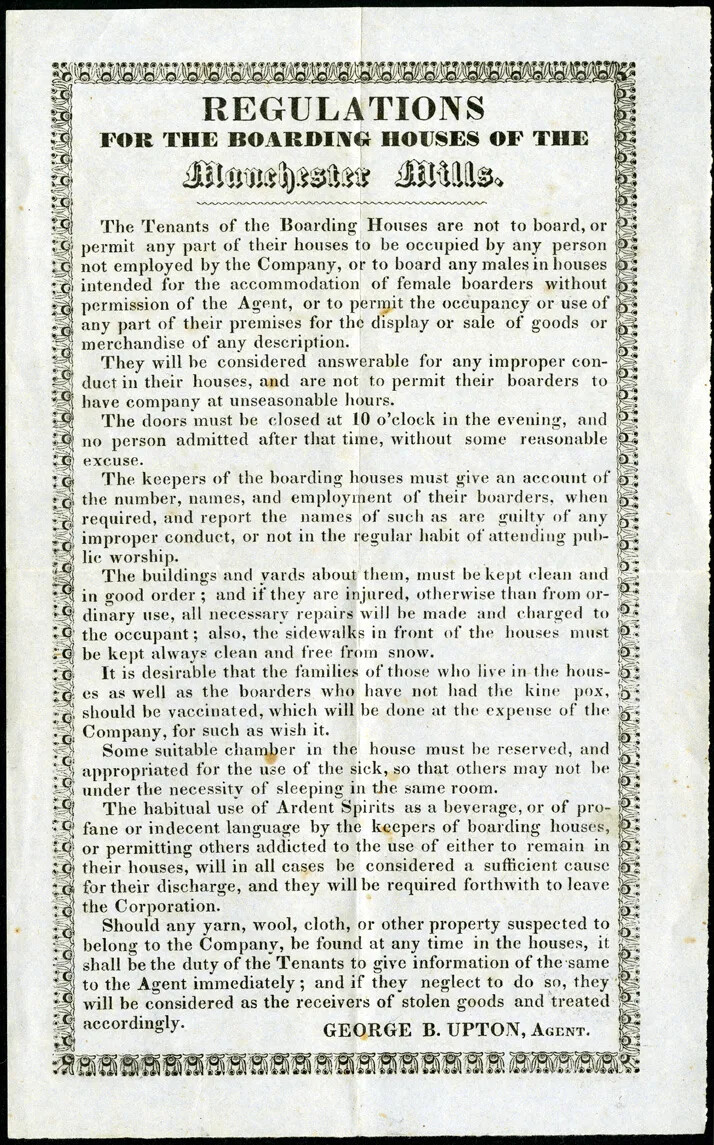
A vertical document with black printed text on white paper. The title of the document, placed along the upper border, reads: "REGULATIONS/FOR THE BOARDING HOUSES OF THE/MANCHESTER MILLS." Beneath the title are several paragraphs of typed text in a smaller font.
Boardinghouse Rules
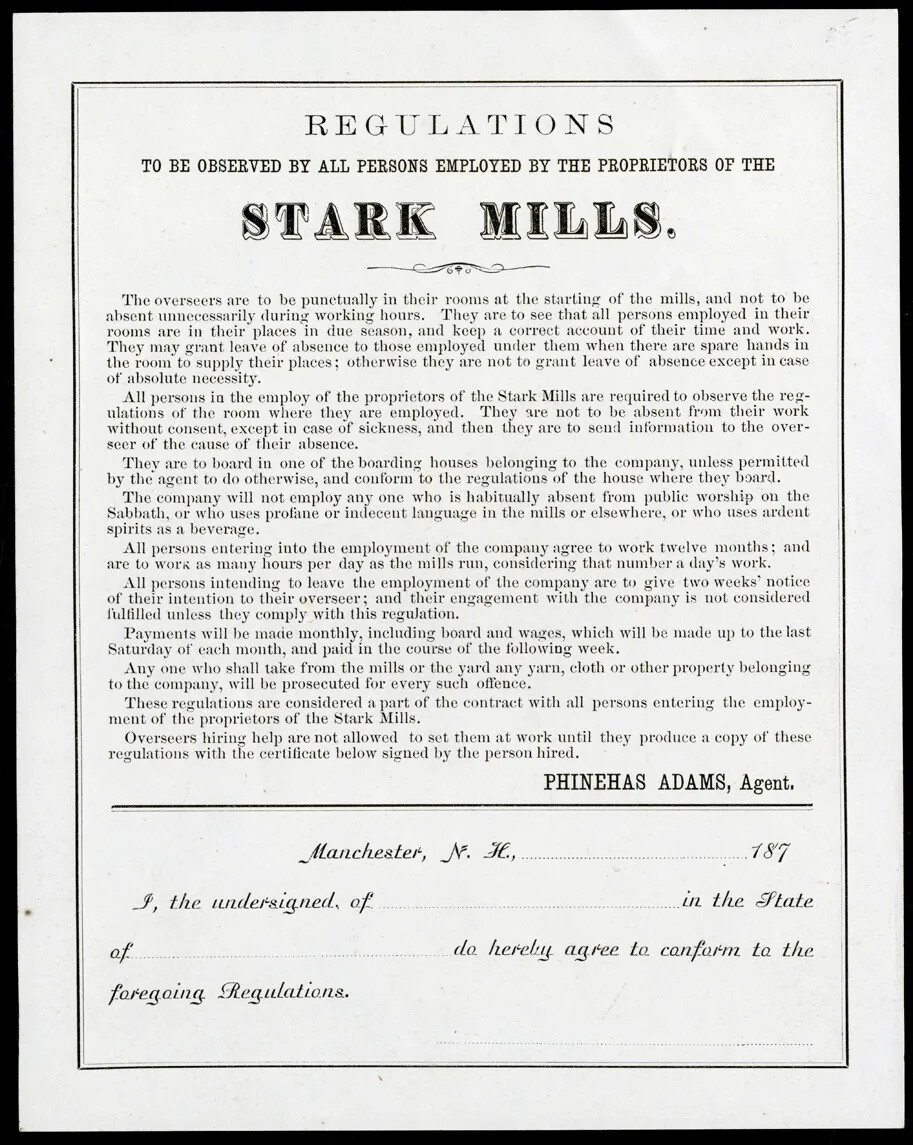
A vertical document with black printed text on white paper. The title of the document, placed along the upper border, reads: " REGULATIONS/ TO BE OBSERVED BY ALL PERSONS EMPLOYED BY THE PROPRIETORS OF THE/STARK MILLS." Beneath the title are several paragraphs of typed text in a smaller font. At the bottom of the document, typed in cursive text, are various words and blank lines on which someone would fill in the blanks: "Manchester, N. H. ___187  /I. the undersigned, of ___ in the State/of ___ do hereby agree to conform to the/foregoing Regulations."
Stark Mills Employee Rules

Explainer Videos and Virtual Field Trips in this Primary Source Set:

Virtual Field Trip: Working Mills and Mill Work

Maps & Charts in this Primary Source Set:

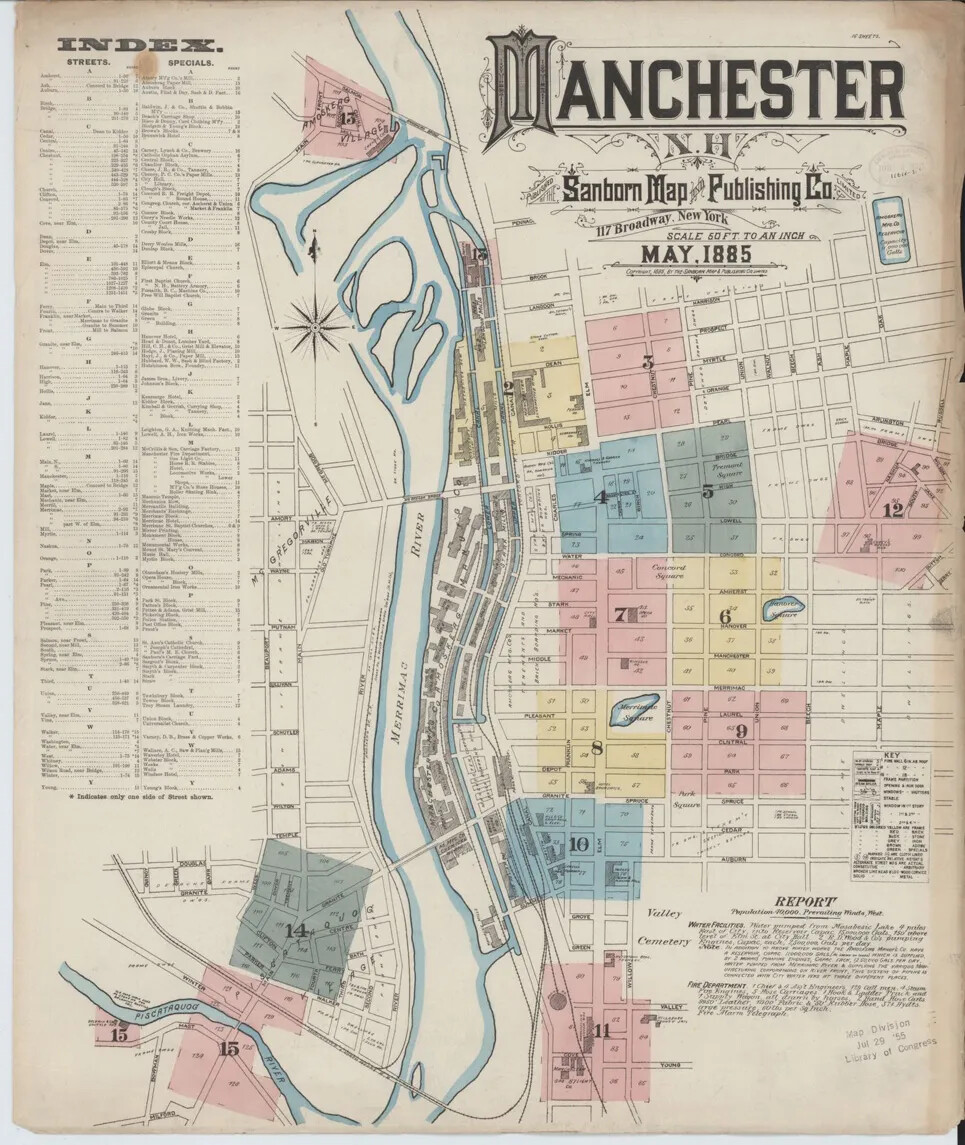
A colored vertical map showing a series of grided streets and buildings to the right of a river. Several of the streets are grouped together in colored sections - red, blue, yellow, and green - and are assigned a number. A long index is placed to the left of the map, beginning in the upper left-hand corner and continuing for more than half way down the page. The title of the map, located in the upper right-hand corner, reads: "MANCHESTER/N.H./PUBLISHED Sanborn Map - Publishing Co. LIMITED/117 Broadway, New York/ MAY, 1885."
Manchester Millyard

Objects in this Primary Source Set:

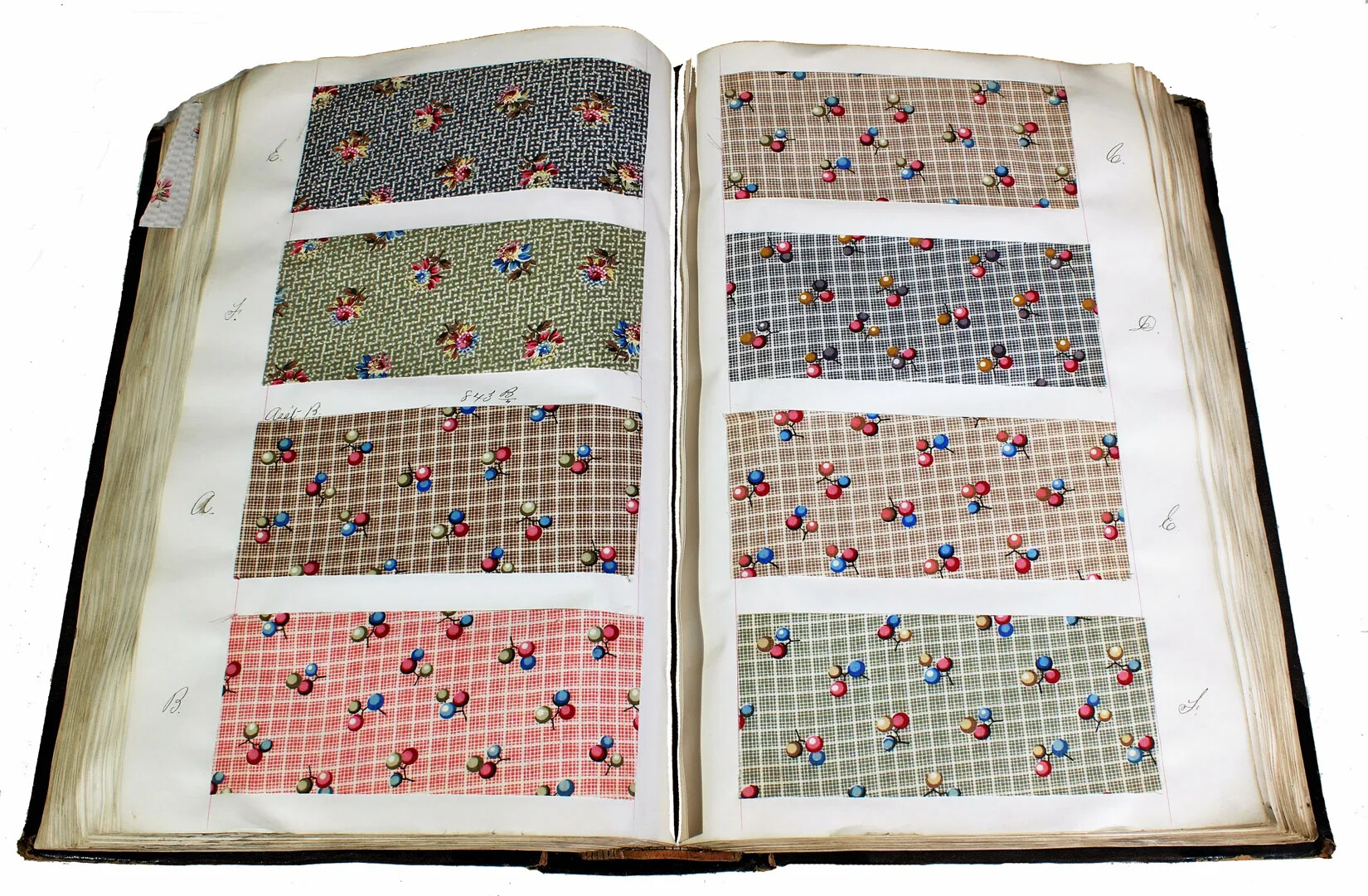
A book of different colored and patterned pieces of cloth in rectangles.The left side of the book has, from top to bottom, three pieces of fabric with red dots on a black background and a floral pattern with vines. The right side of the book has four pieces of fabric that all have different versions of floral designs.
Amoskeag Fabric Sample Book
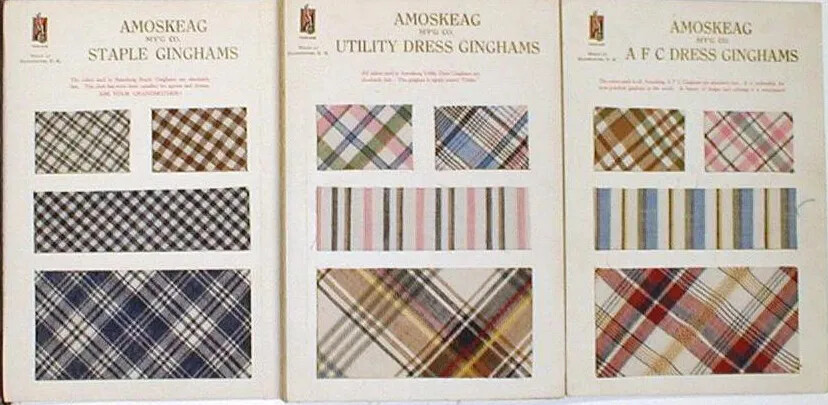
A book of different colored and patterned pieces of cloth in rectangles. The book opens in three parts, and the cloth samples are divided among the following titles, from left to right: "AMOSKEAG/MFG. CO/STAPLE GINGHAMS," "AMOSKEAG/MFG. CO/UTILITY DRESS GINGHAMS," and "AMOSKEAG/MFG. CO/A F C DRESS GINGHAMS."
Amoskeag Gingham Samples
A long wooden and metal gun, with a large base and thin barrel.
Amoskeag Rifle
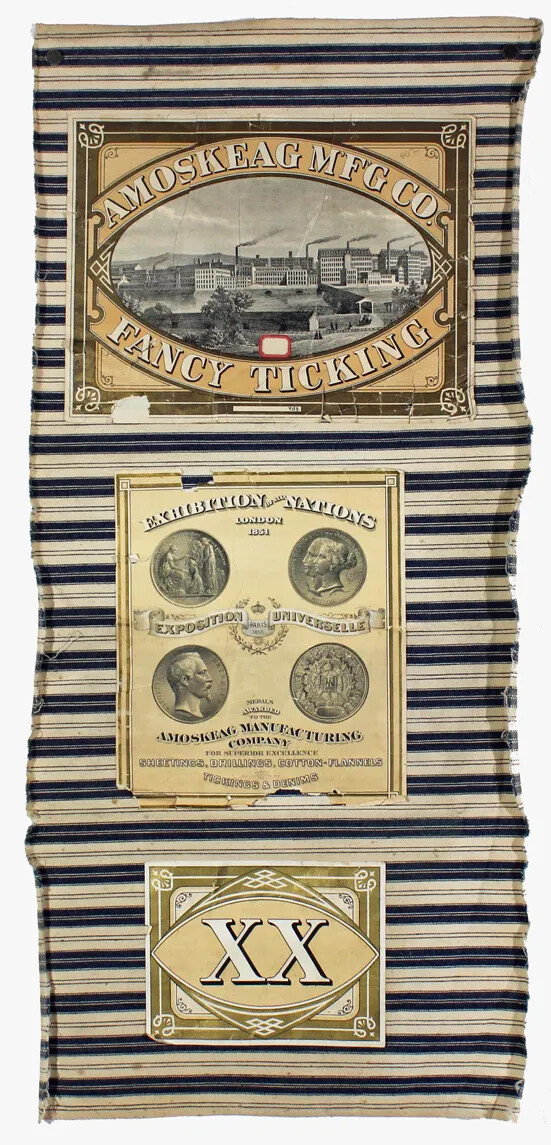
A vertical piece of blue and white striped cloth, with three pieces of paper glued on to it. The first piece of paper shows an oval drawing of a series of orderly rectangular buildings along the banks of a river. Smoke rises above some of the buildings' chimneys. Surrounding the drawing are the words "AMOSKEAG MFG CO./FANCY TICKING" printed in white text on a gold and brown background. The second piece of paper shows a set of four medals and the words "EXHIBITION OF THE NATIONS/LONDON/1864" above two of the medals and the words "EXPOSITION UNIVERSELLE/PARIS/1855" above the two other medals in white text on a gold and brown background. Text along the bottom of the paper, printed in alternating black and white ink, reads: "MEDALS/AWARDED/TO THE/ AMOSKEAG MANUFACTUING/COMPANY/FOR SUPERIOR EXCELLENCE/SHEETING, DRILLINGS, COTTON-FLANNELS/TICKINGS & DENIMS." The third piece of paper has two letter "X" printed in white ink on a gold and brown background.
Award-Winning Amoskeag Cloth
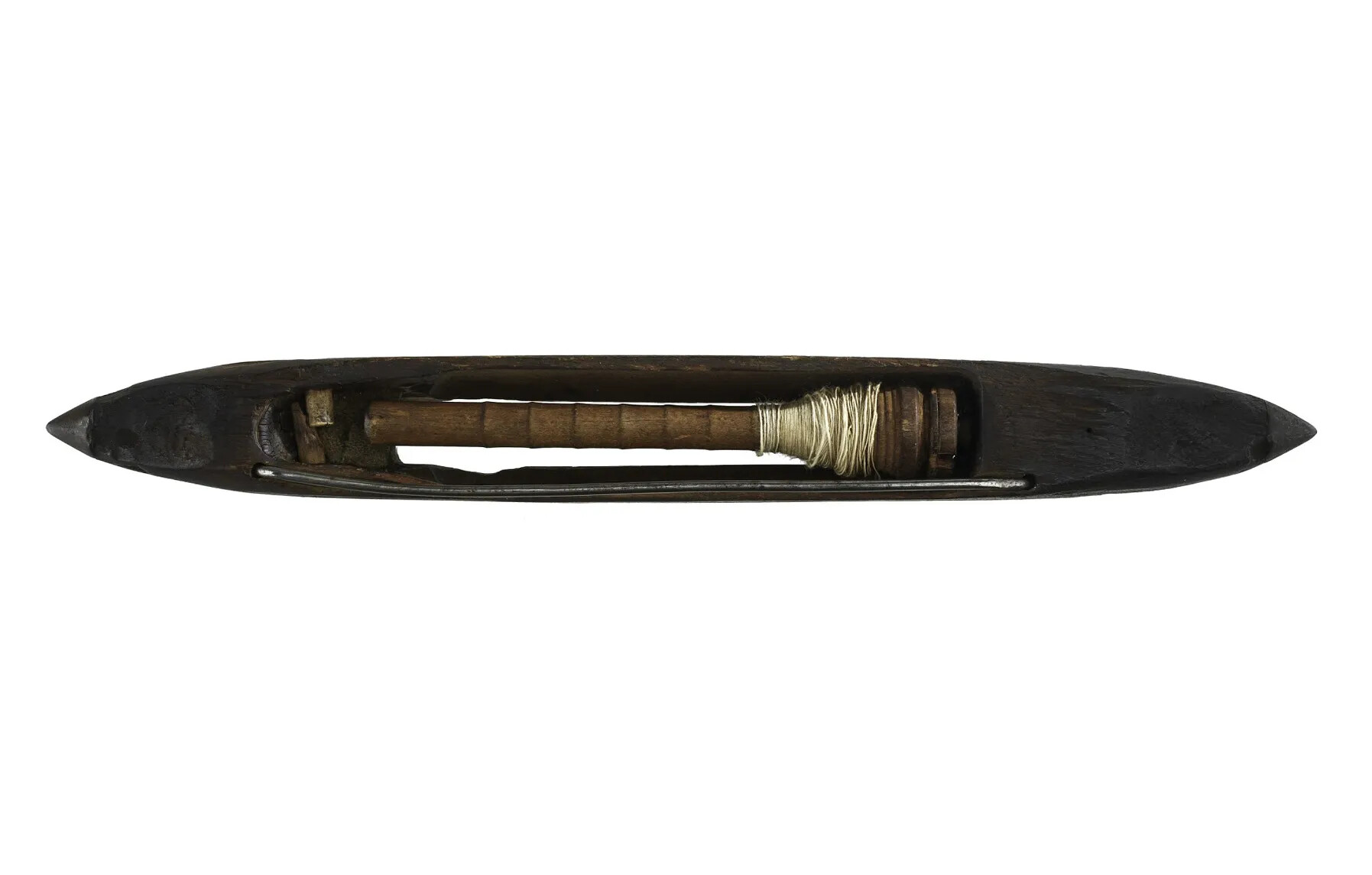
A horizontal piece of wood with pointed ends, slightly rounded sides, and a hollowed-out center. Inside the center is a thin cylinder of wood, with one side larger than the other. On the right end of the cylinder is a wrapped up piece of string.
Shuttle and Bobbin

Photographs & Prints in this Primary Source Set:

A black and white photograph of a series of orderly rectangular buildings, taken from a bird's-eye-view. The buildings are located along the curve of a river, with a narrow canal of water located between the center row of buildings.
Aerial View of Manchester
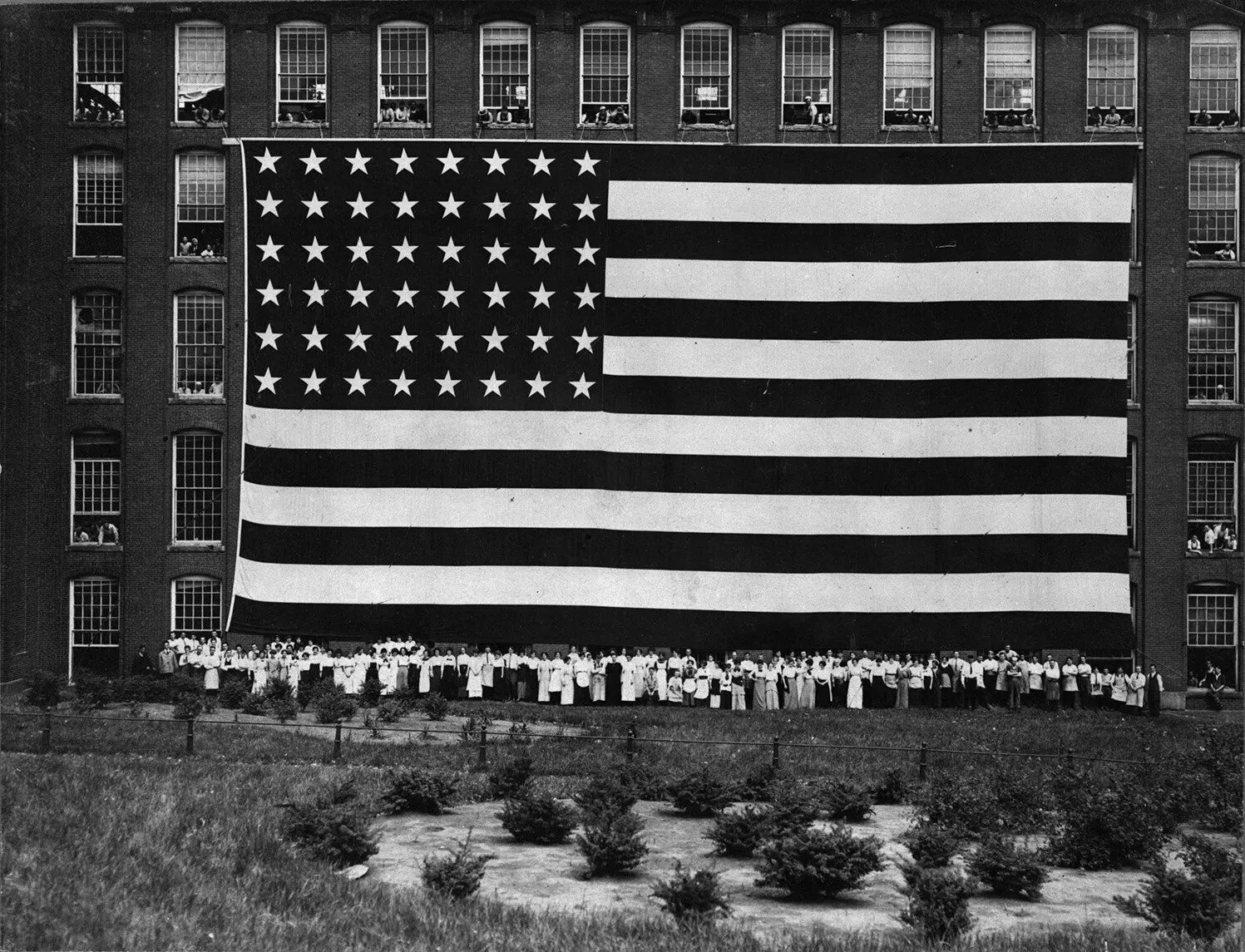
A black and white photograph of an American flag hanging against a multi-storied building. Groups of people can be seen hanging out the windows of the building, as well as at the base of the flag on the grass.
Amoskeag Company Great Flag
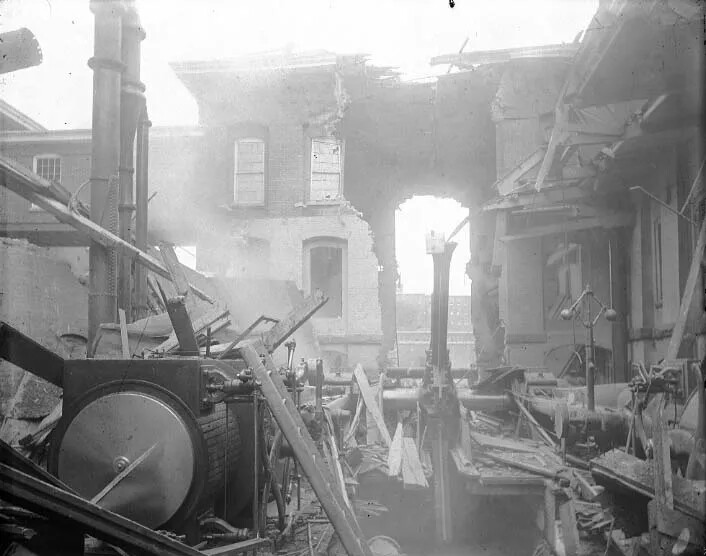
A black and white photograph of the inside of a building that has had its roof and left-side wall torn off. There is a large hole in the back wall, through which buildings on the other side can be seen. Broken pieces of machinery and wood lie on the floor.
Amoskeag Engine Room After an Explosion
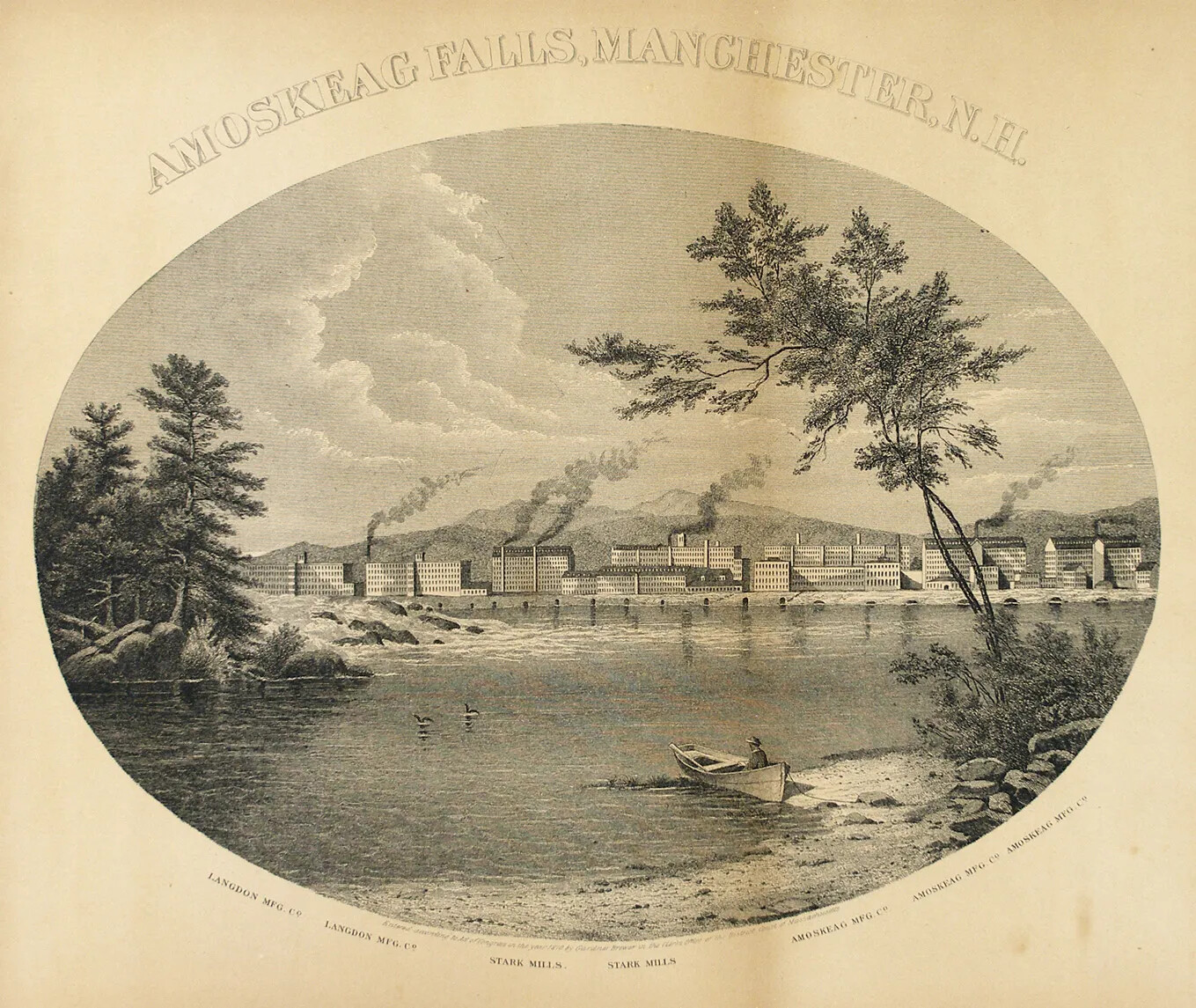
A black and white drawing in an oval frame of a series of orderly rectangular buildings along the banks of a body of water. Smoke rises above some of the buildings' chimneys. A man sits in a canoe at the forefront of the drawing, and looks off into the distance at the buildings. The title of the drawing, located along the upper border, reads "AMOSKEAG FALLS, MANCHESTER, N.H."
Amoskeag Falls
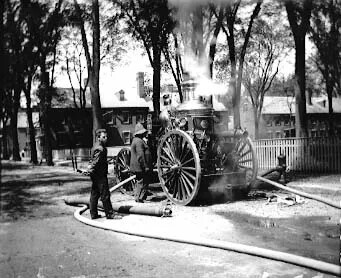
A black and white drawing of a fire engine. The fire engine has a two large wheels in the back and two slightly smaller wheels in the front. A large basin sits among gears in the back of the fire engine. Steam comes out of the top of the basin. Two long hoses lie on the ground on either side of the engine. Two men stand to the left of the engine, and look slightly off to the right.
Amoskeag Fire Engine
A black and white photograph of a long, three-storied building, with six tall chimneys. Attached to the back of the building are three sets of covered porches and staircases.
Amoskeag Housing
A colored horizontal drawing of a gray, gold, and red colored train with a large smoke stack at the front of it, pulling a green and red cargo train car filled with coal. In the background of the drawing, there is a series of orderly rectangular buildings along the banks of a river. Smoke rises above some of the buildings' chimneys. The title of the drawing, located along the bottom border, reads: "OUTSIDE CONNECTED PASSENGER ENGINE./AMOSKEAG MANUFACTUING CO./MANCHESTER N. H."
Amoskeag Locomotive
A black and white horizontal drawing of a train with a large smoke stack at the front of it. The drawing shows two large wheels at the back of the train, and two small wheels at its front. A small sign hangs from the side of the train, reading "AMOSKEAG." The title of the drawing, located along the upper border, reads "Manufactured by/AMOSKEAG MANUFACTURING CO./MANCHESTER, N.H."
Amoskeag Locomotive Number 92
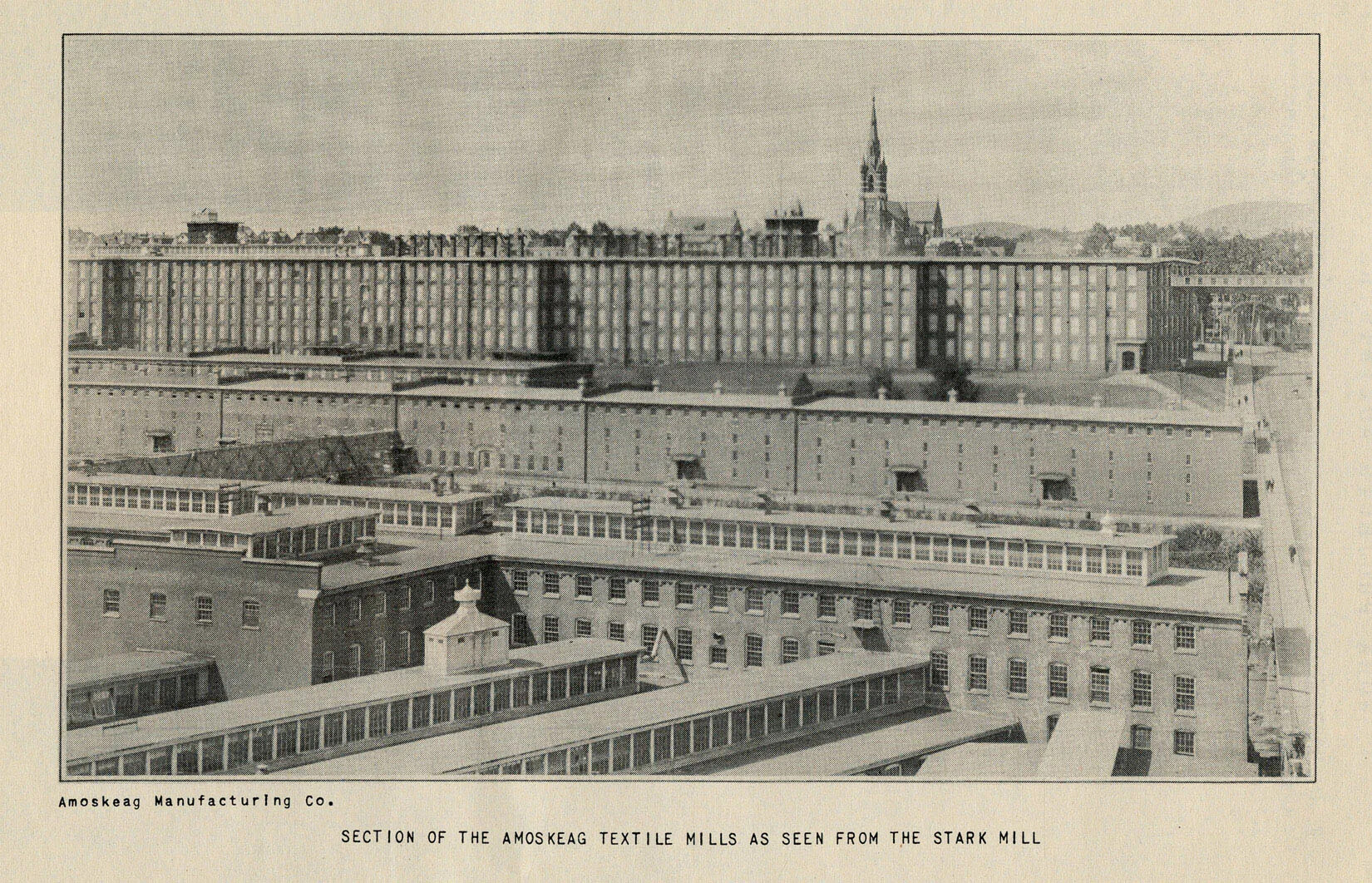
A black and white photograph of several rows of orderly, rectangular buildings. There is a tall church steeple in the background. The title of the photograph, located along the bottom border, reads "SECTION OF THE AMOSKEAG MILLS AS SEEN FROM THE STARK MILLS."
Amoskeag Manufacturing Company
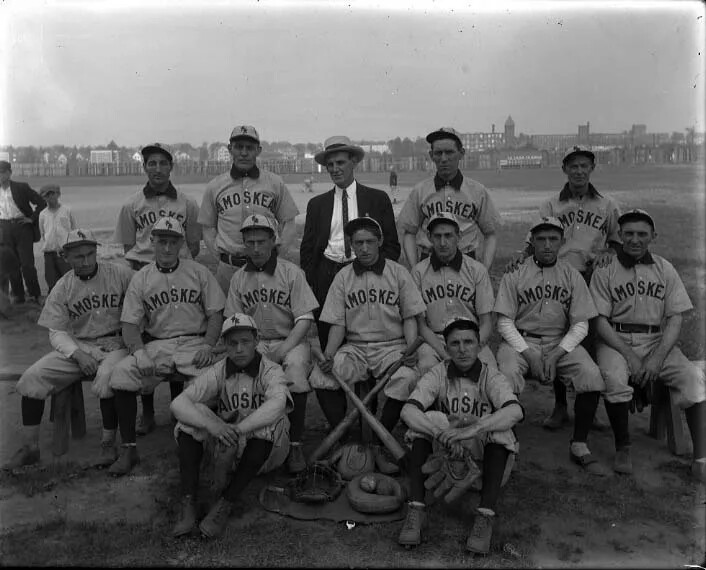
A black and white photograph of a group of young white men wearing baseball uniforms and caps. They are posed in front of the camera, with the back row standing, the middle row seated on a bench, and the front row seated on the ground. The shirts of the men's uniforms have "AMOSKEAG" printed on the front. The center-most man in the back row wears a suit and tie and fedora hat. There are baseball bats, gloves, and balls positioned between the two men in the front row. A baseball field can be seen in the background.
Amoskeag Manufacturing Company Baseball Team
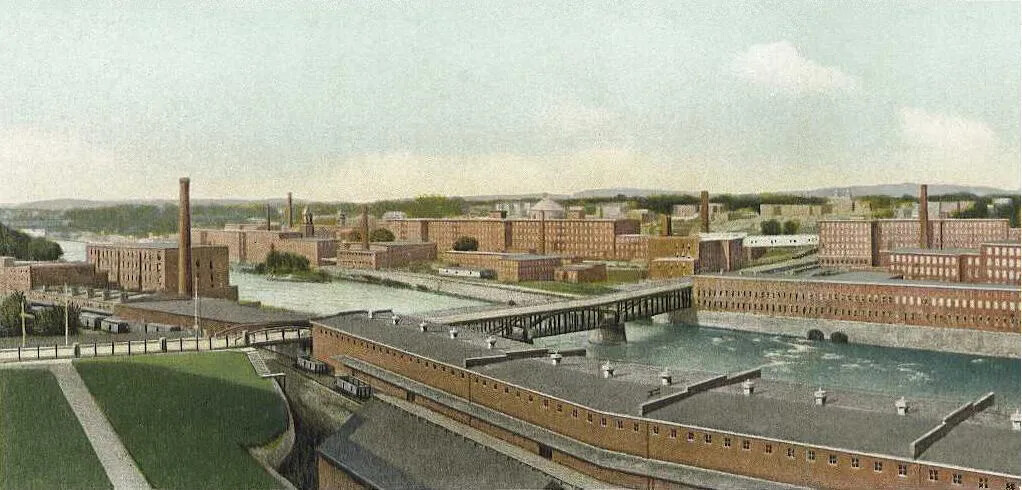
A colored postcard of rows of long, rectangular buildings of varying heights on either side of a river. An iron bridge connects one side of the river to the other.
Amoskeag Manufacturing Company Downriver
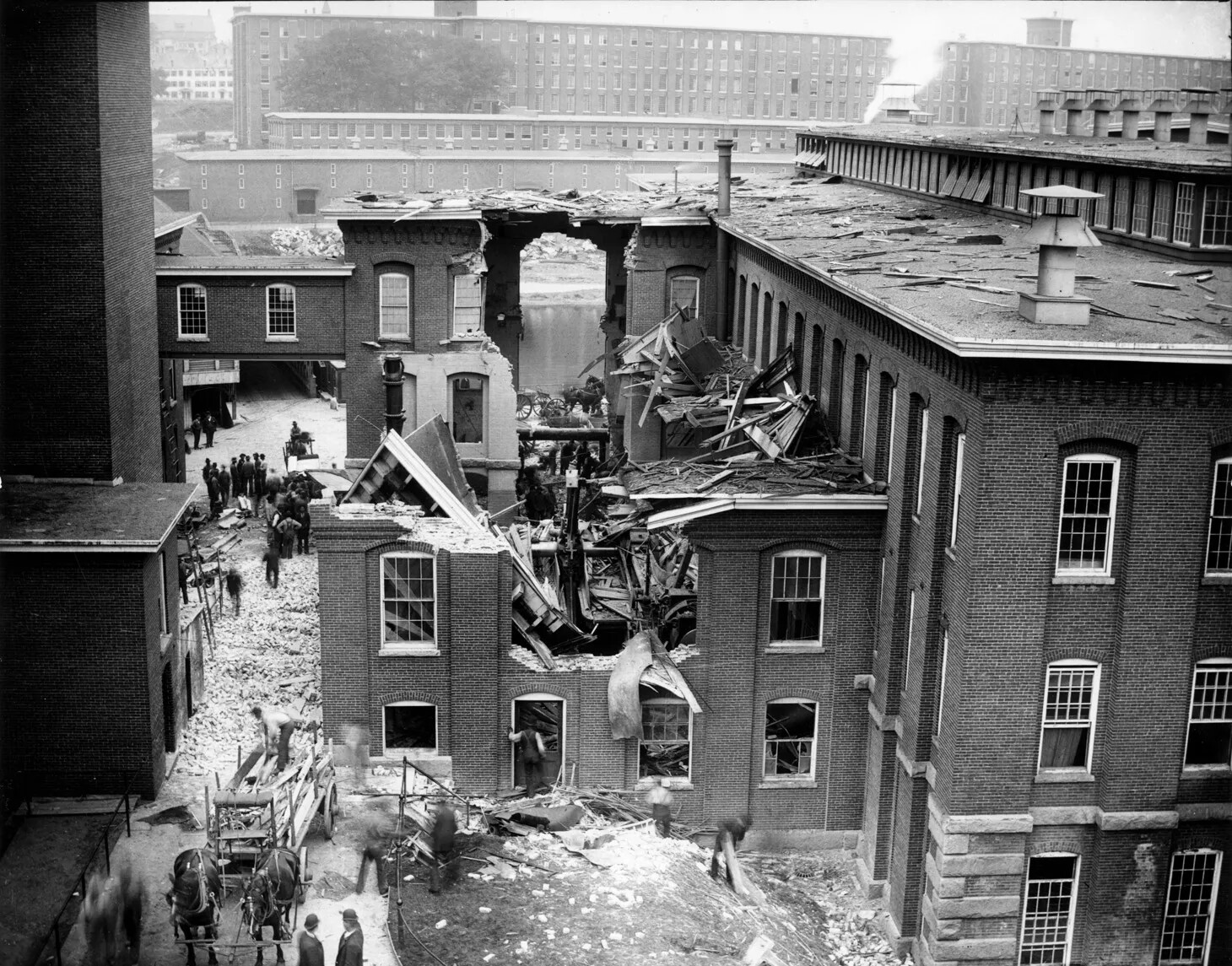
A black and white photograph of a damaged building after an explosion. The roof of the building is caved in, and the viewer can see straight through the hole to another building on the other side. Several groups of people stand and talk to each other to the left of the building. On the left side of the building is a horse-drawn wagon, and several blurred people move around the front of the building.
Amoskeag Manufacturing Company Explosion
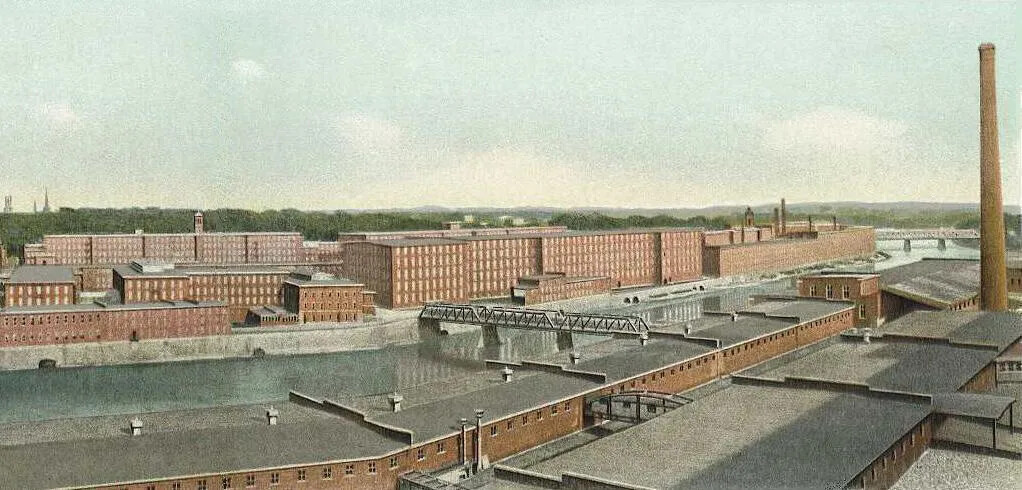
A colored postcard of rows of long, rectangular buildings of varying heights on either side of a river. A covered bridge connects one side of the river to the other.
Amoskeag Manufacturing Company Upriver
A black and white photograph of a large group of men, women, and children standing between two multi-storied buildings. Everyone in the photograph looks up at the camera.
Amoskeag Manufacturing Company Workers
A collection of fifteen individual black and white photographs of women, each enclosed in connecting gold oval frames, five photographs by three photographs. All of the women wear their hair parted down the middle and drawn up in the back, and wear dark-colored dresses of different styles.
Amoskeag Mill Girls
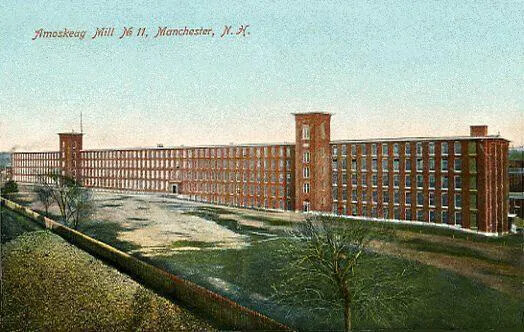
A colored postcard of a long rectangular brick building, with two flat-topped towers. In front of the building is a grassy field with some melting snow on it, as well as some bare trees.
Amoskeag Mill Number 11
A black and white drawing of the side of a fire engine. The fire engine has a large wheel in the back and a slightly smaller wheel in the front. A large basin sits among gears in the back of the fire engine. There is a single seat at the front, placed behind a large horizontal steering wheel.
Amoskeag Self-Propelled Steam Fire Engine
A black and white horizontal print showing a series of grided streets and buildings along the banks of a river, taken from a bird's-eye view. The land on the other side of the river, and to the left of the grided streets, is rolling farm land. The title of the print, located along the bottom border, reads "MANCHESTER, N.H."
Bird's-Eye View of Manchester
A black and white photograph of a group of boys standing on a sidewalk, looking at the camera. The boy closest to the viewer, wearing a a cap and a short-sleeved shirt with overalls, smiles at the camera. The boy directly behind him, wearing a cap, a jacket, a buttoned shirt, knee-length pants, tall socks and ankle-high shoes, covers his mouth slightly with his left hand. The other boys in the photograph are dressed similarly, and just look at the camera with curious or serious expressions.
Boys Working at Amoskeag Company
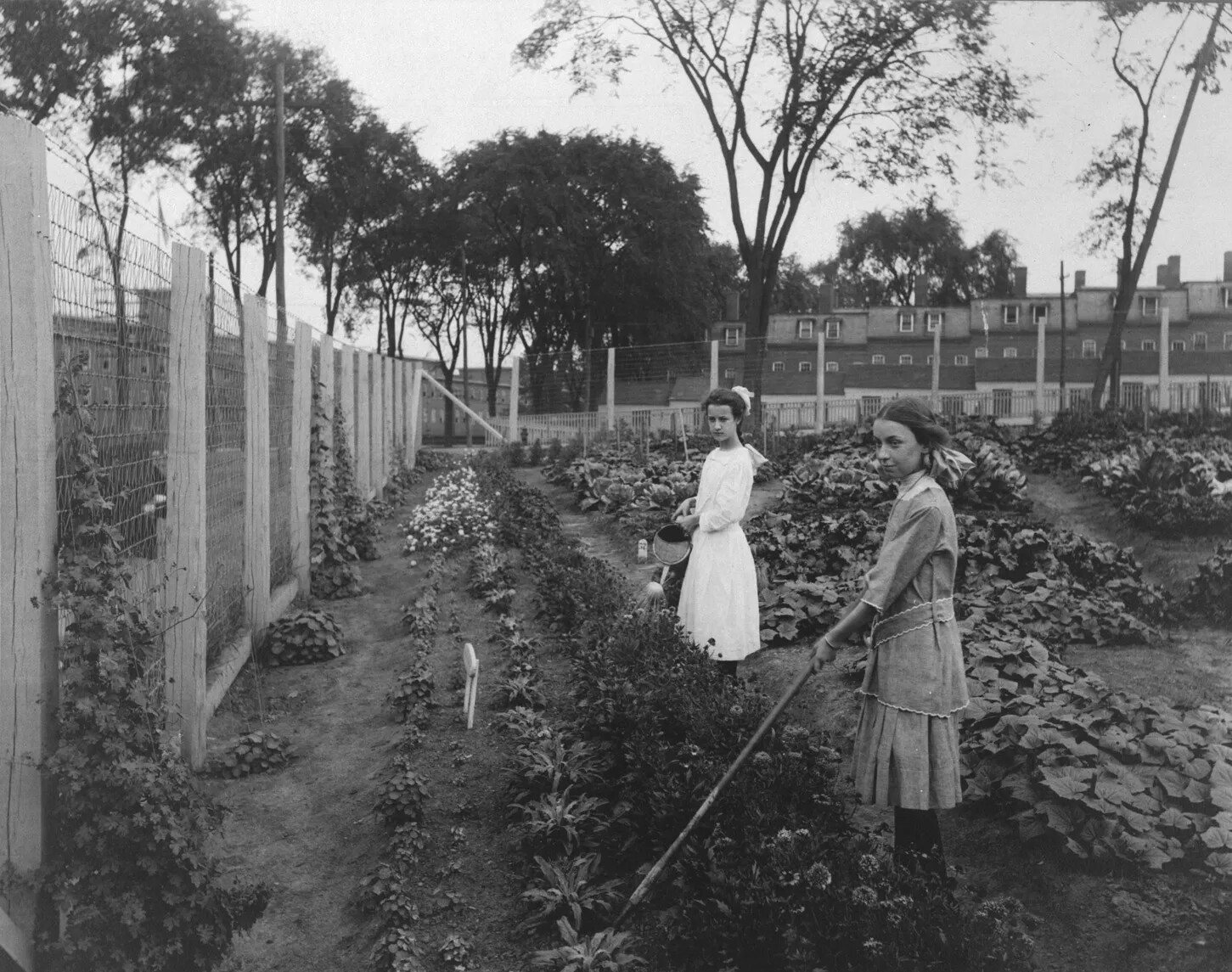
A black and white photograph of two young girls working in a garden. There is a high fencce surrounding the garden, and a row of houses can be seen in the background.
Children's Garden
A black and white photograph of a flooded river, rushing past rows of long, rectangular buildings. A caption in the lower right-hand corner reads "Manchester, N. H."
Flooding in the Manchester Millyard
A black and white photograph of a small girl working in front of a large machine. The machine has spools of yarns wrapped in cylinders placed in rows along the front of the machine. A man with a mustache stands in the background, looking at the camera.
Girl Working at Amoskeag Manufacturing Company
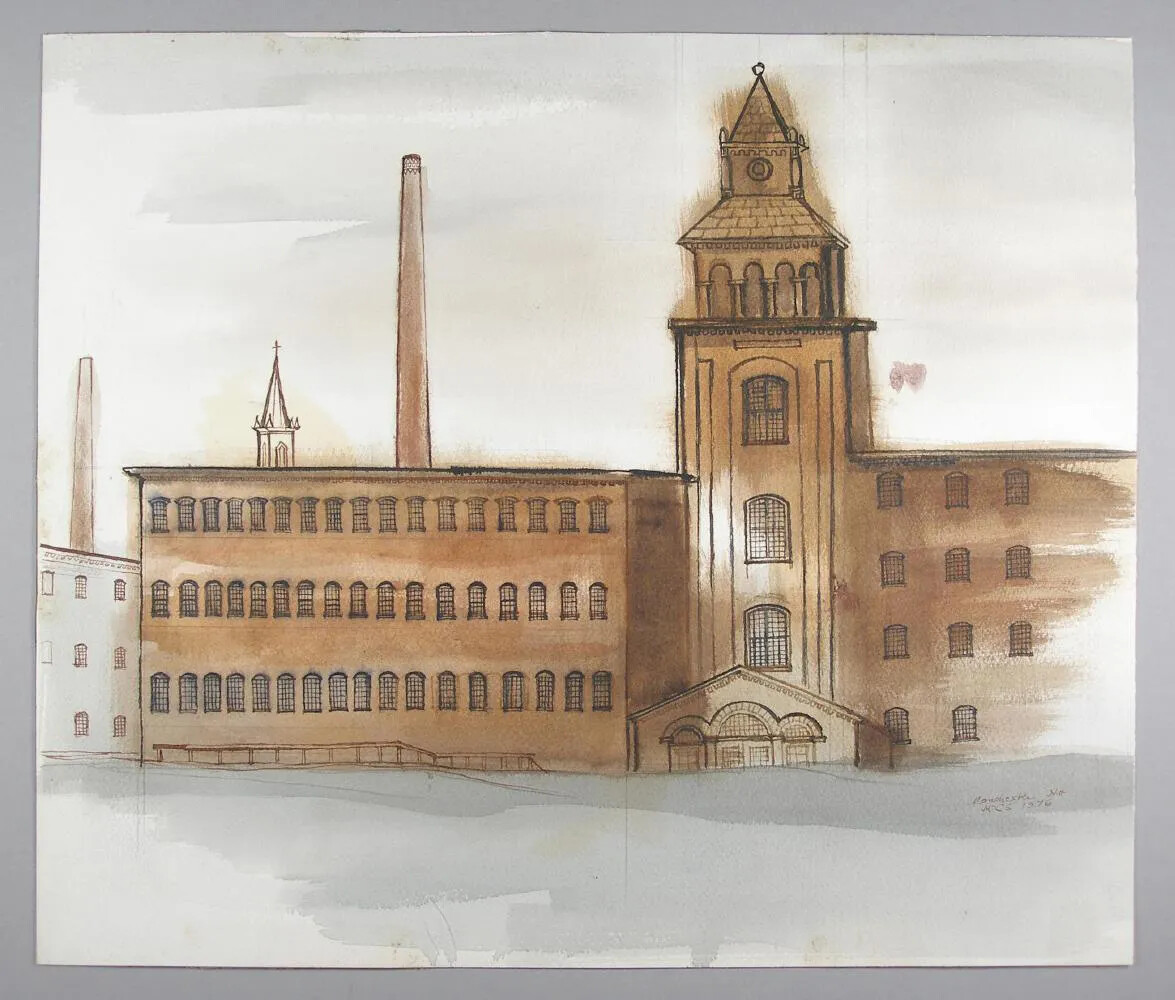
A colored painting of a brown, three-storied rectangular building with a tall pointed tower in the center of it. The smoke stacks of other buildings and a church's steeple can be seen in the background.
Jefferson Mill (1 of 2)
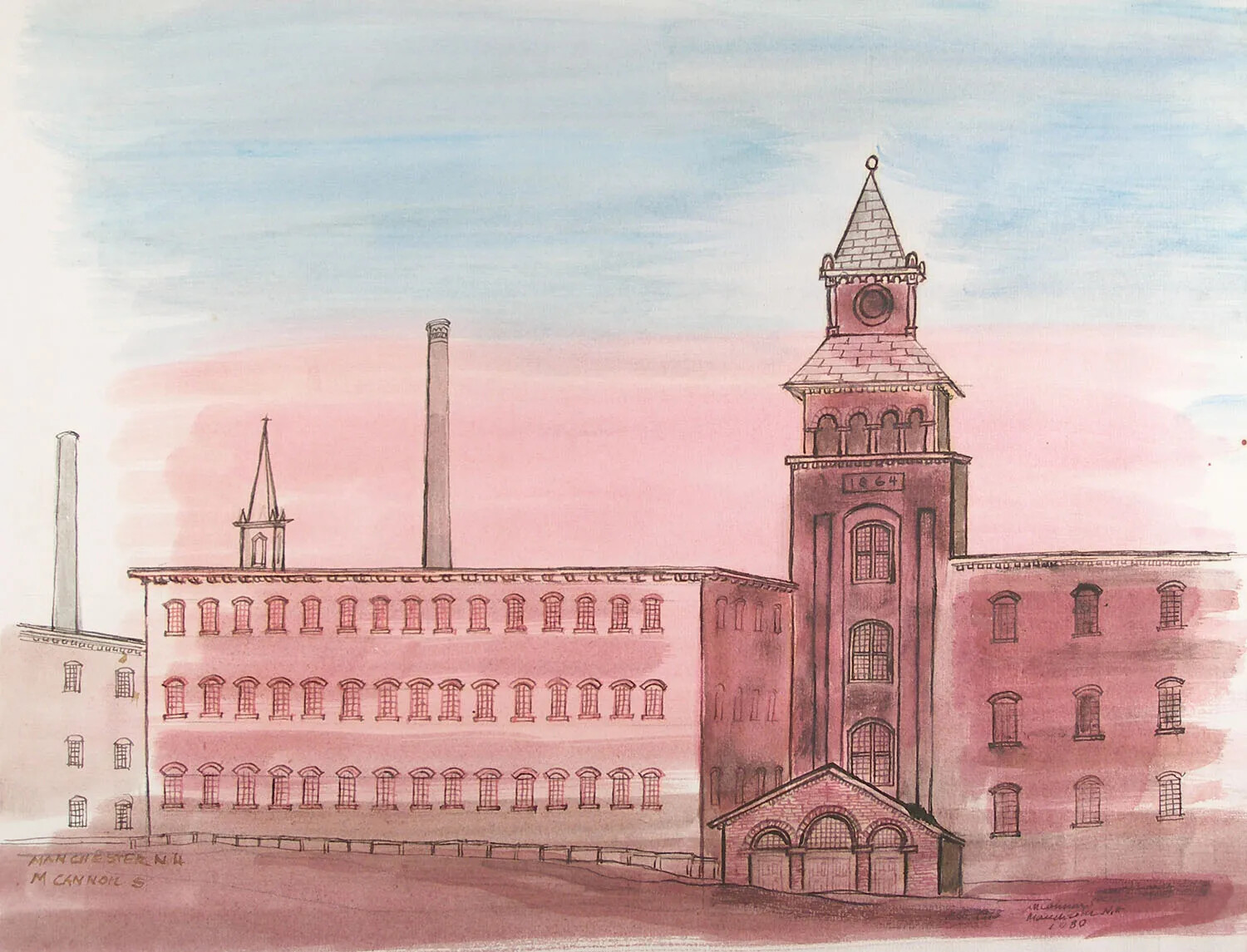
A colored painting of a red, three-storied rectangular building with a tall pointed tower in the center of it. The smoke stacks of other buildings and a church's steeple can be seen in the background.
Jefferson Mill (2 of 2)
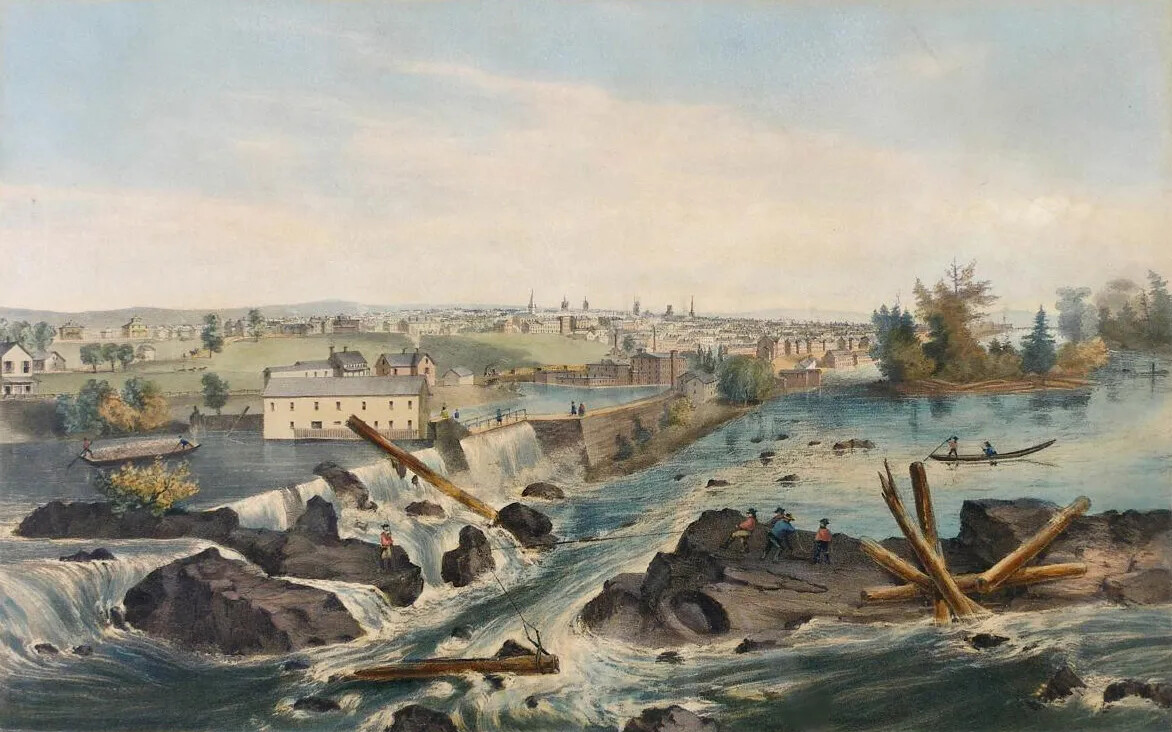
A colored painting of a large body of water, with a town seen in the distance. Parts of the water rush down several small waterfalls and over large gray boulders. Two canoes float in the water, one on the left side of the painting and one on the right side, each with two people standing at the paddles on either side of the canoe. A group of people stand on one of the boulders and tug on a rope that is attached to a large log that is stuck between a set of smaller boulders.
Logging at Amoskeag Falls
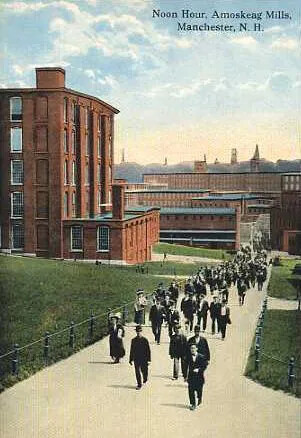
A colored postcard of a group of people walking away from a cluster of rectangular buildings of varying heights. The title of the postcard, located in the upper right-hand corner, reads "Noon Hour, Amoskeag Mills/Manchester, N. H."
Lunchtime at Amoskeag Mills
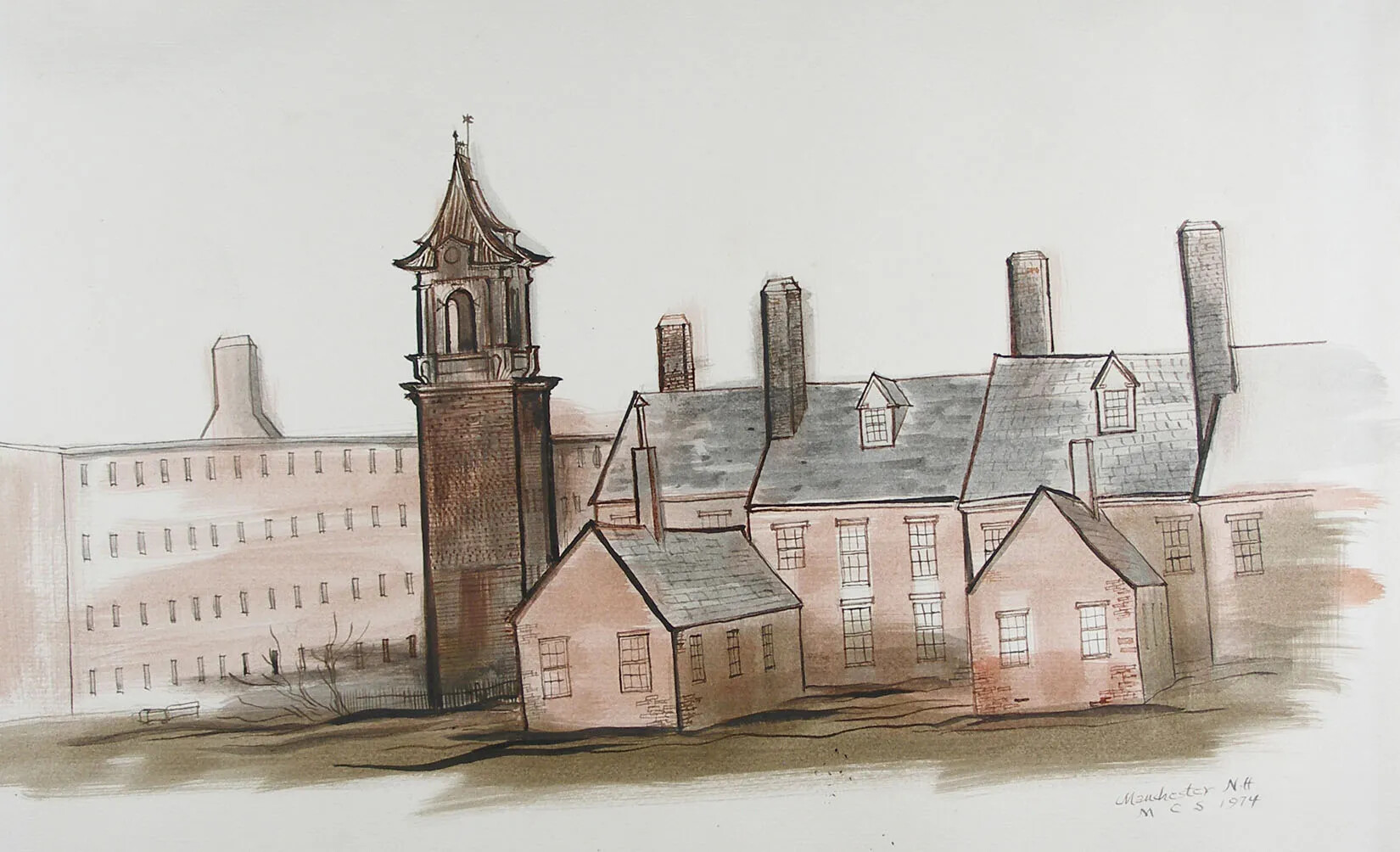
A colored painting of a tall pointed tower, a four-storied rectangular building, and four three-storied houses with chimneys.
Manchester Mills and Mill Housing
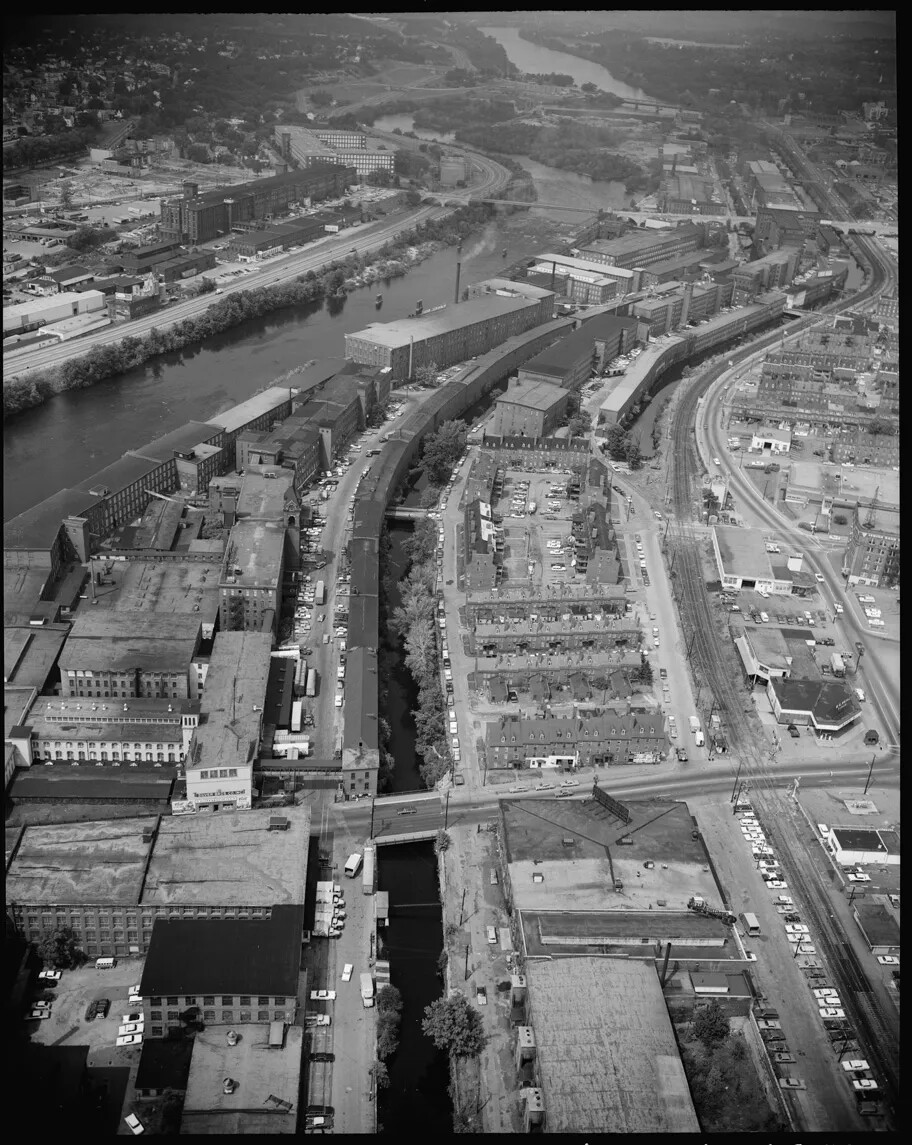
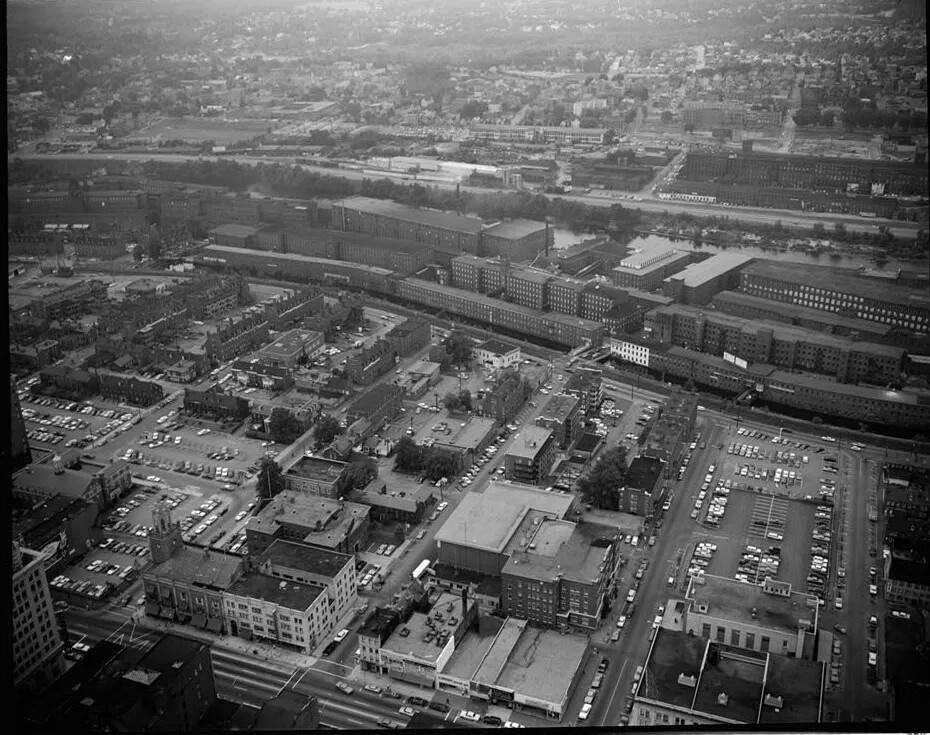
A black and white photograph of a city taken from a bird's-eye-view. There are several large buildings in organized rows in the background of the photograph, and houses and smaller buildings placed in grid-formation in the foreground.
Manchester Millyard in the 1960s
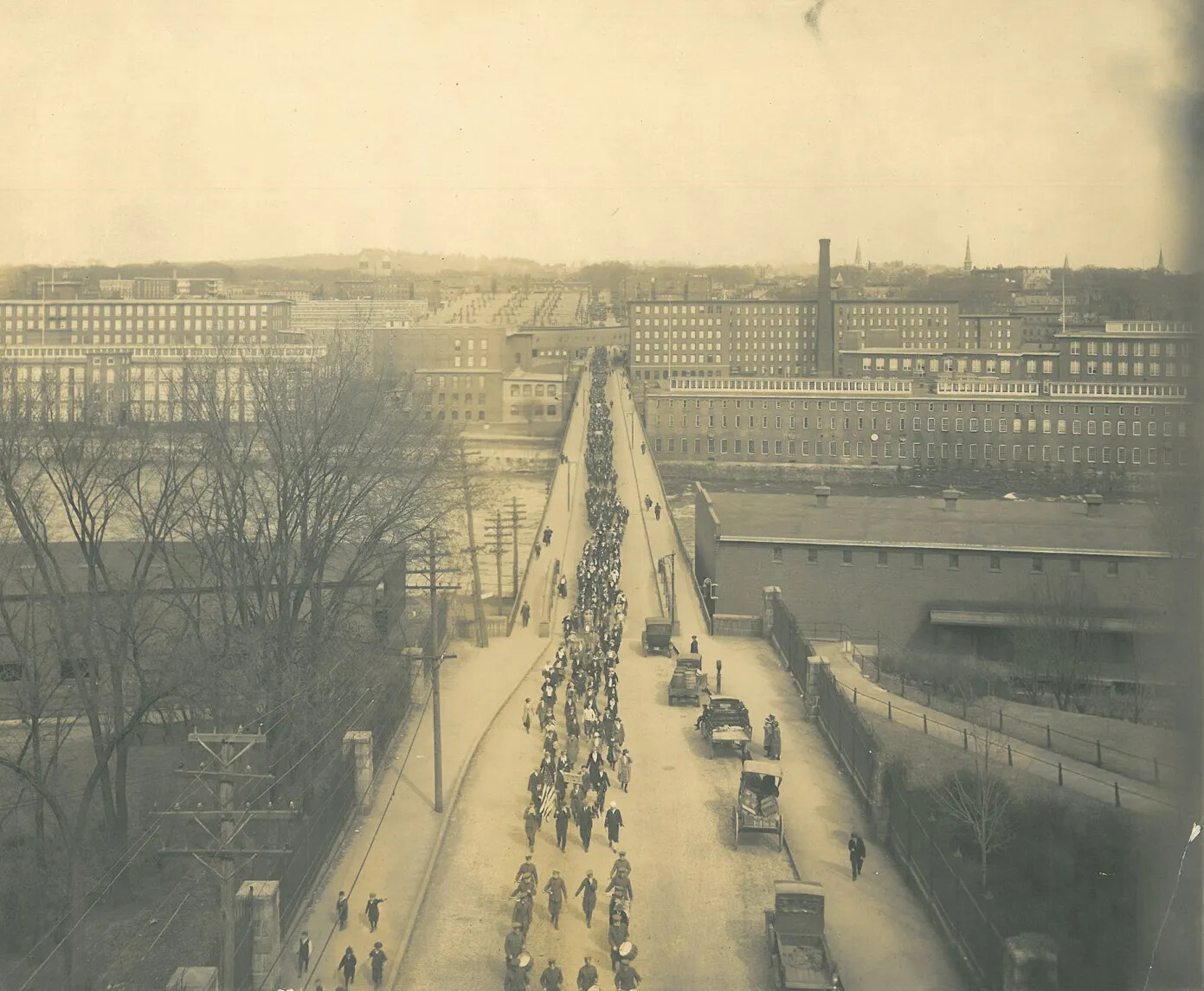
A black and white photograph of a large group of people marching down a street and over a bridge. The photograph was taken from a bird's-eye-view. In the background are orderly rows of rectangular buildings along the banks of a river.
Mill Workers on Strike
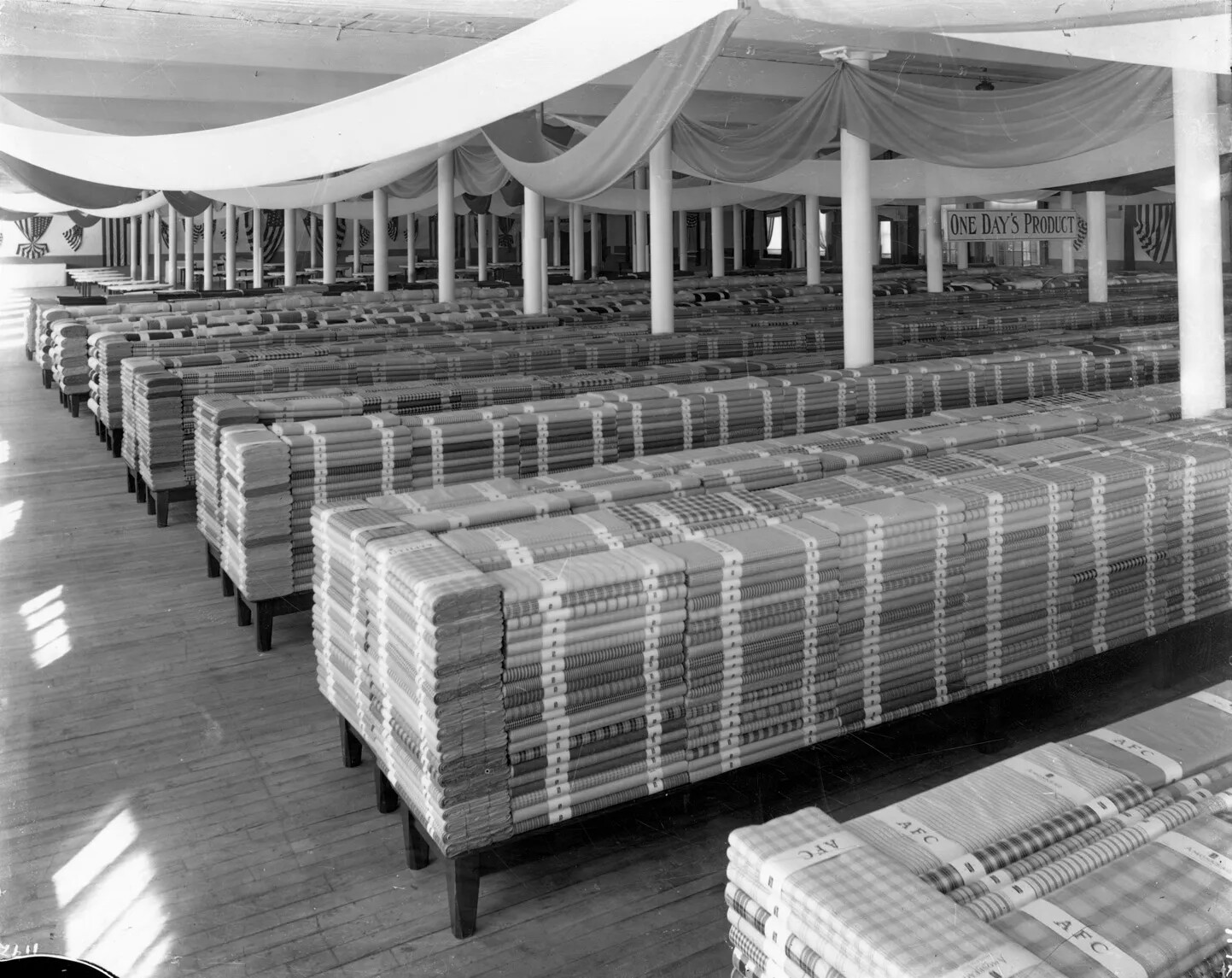
A black and white photograph of the interior of a large room filled with rows of folded fabric on small platforms. The ceiling is held up by vertical poles spaced out across the room. Ribbons of fabric hang from the rafter's. In the background, there a sign that reads "ONE DAY'S PRODUCT," which hangs between two poles.
One Day's Production of Amoskeag Cloth
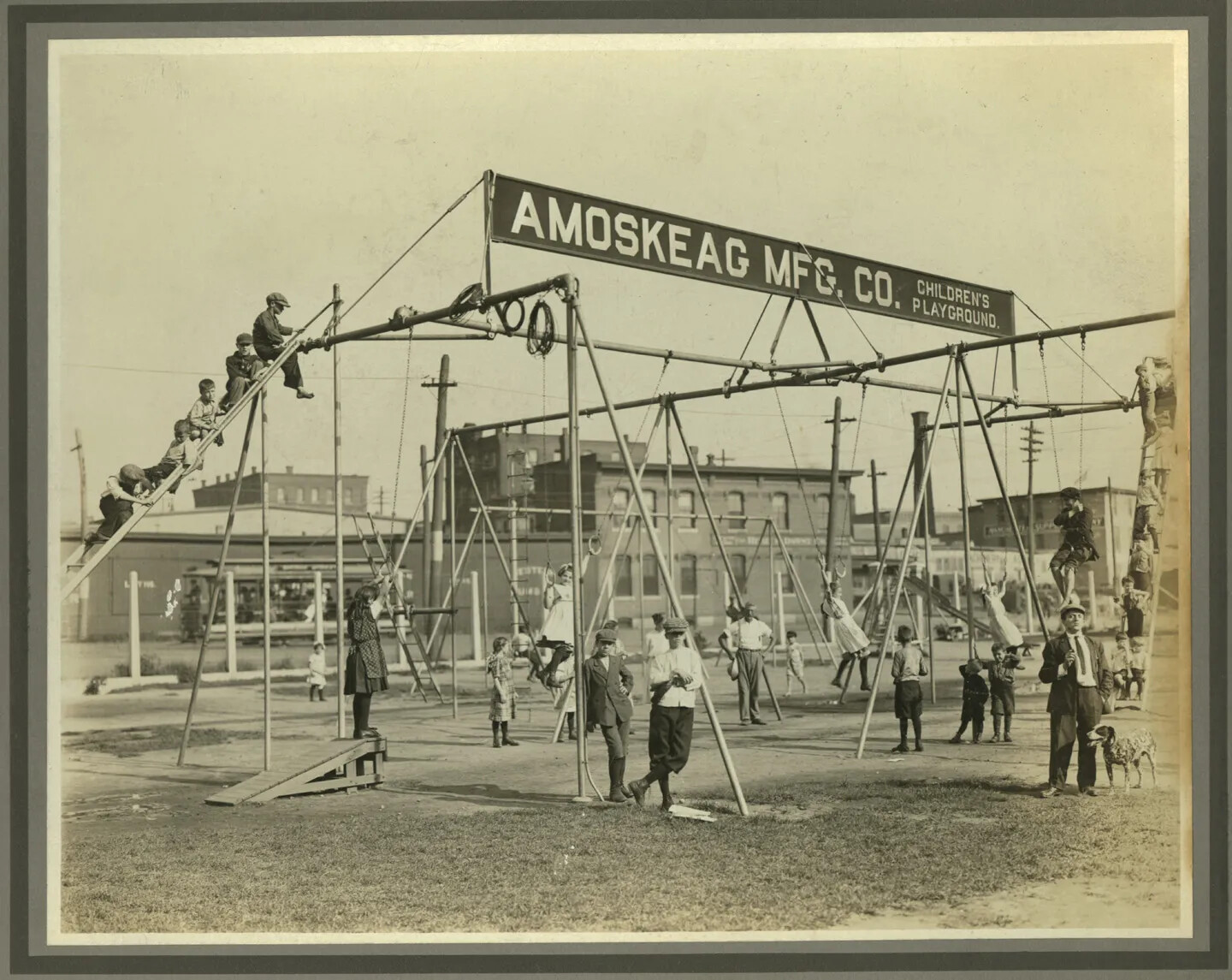
A black and white photograph of children playing on a play structure made out of long pipes, ropes, and hoops. A sign above the play structure reads "AMOSKEAG MFG. CO./CHILDREN'S/PLAYGROUND."
Playground at Amoskeag Manufacturing Company
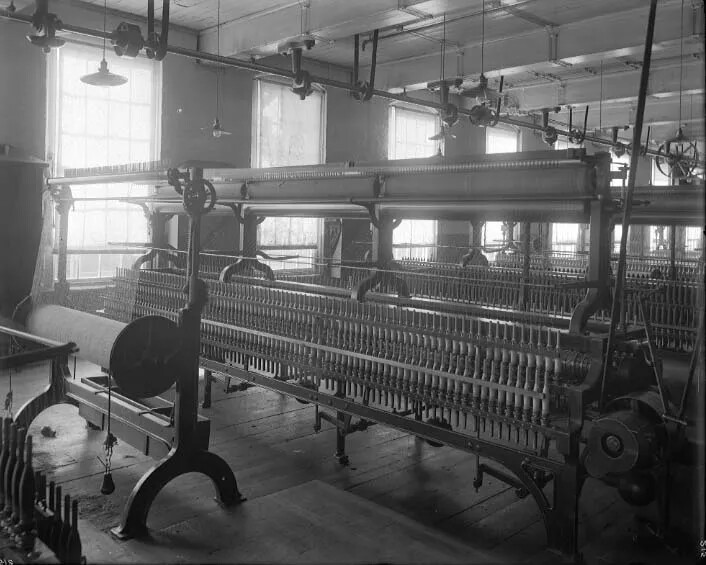
A black and white photograph of a large machine, with two long rows of cylinders with light-colored yarn wrapped around them. There are several similar machines seen in the background.
Quilling Machine at Amoskeag Manufacturing Company
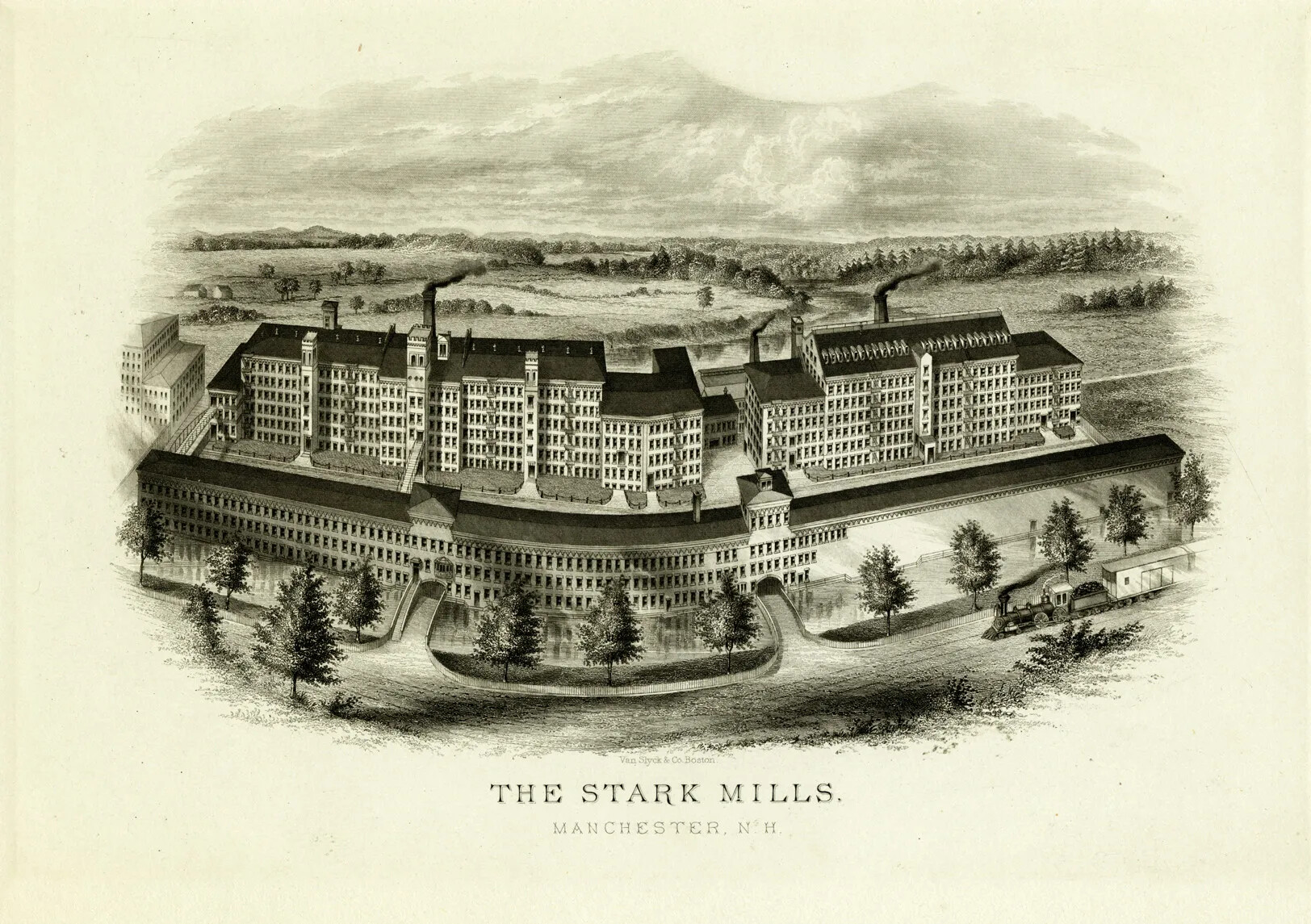
A black and white drawing of a series of orderly rectangular buildings, taken from a bird's-eye-view. Smoke rises above some of the buildings' chimneys. A railroad track runs in front of the buildings, and a train enters the tracks from the right side of the drawing. Behind the buildings are vast grassy fields filled with trees. The title of the drawing, located along the bottom border, reads: "THE STARK MILLS/MANCHESTER, N. H."
Stark Mills
A black and white photograph of a group of girls posed in three rows on a set of stairs in front of a building's arched entrance. All of the girls wear knee-length dresses made from checkered or striped fabric.
Varney School Students Wearing Amoskeag Gingham
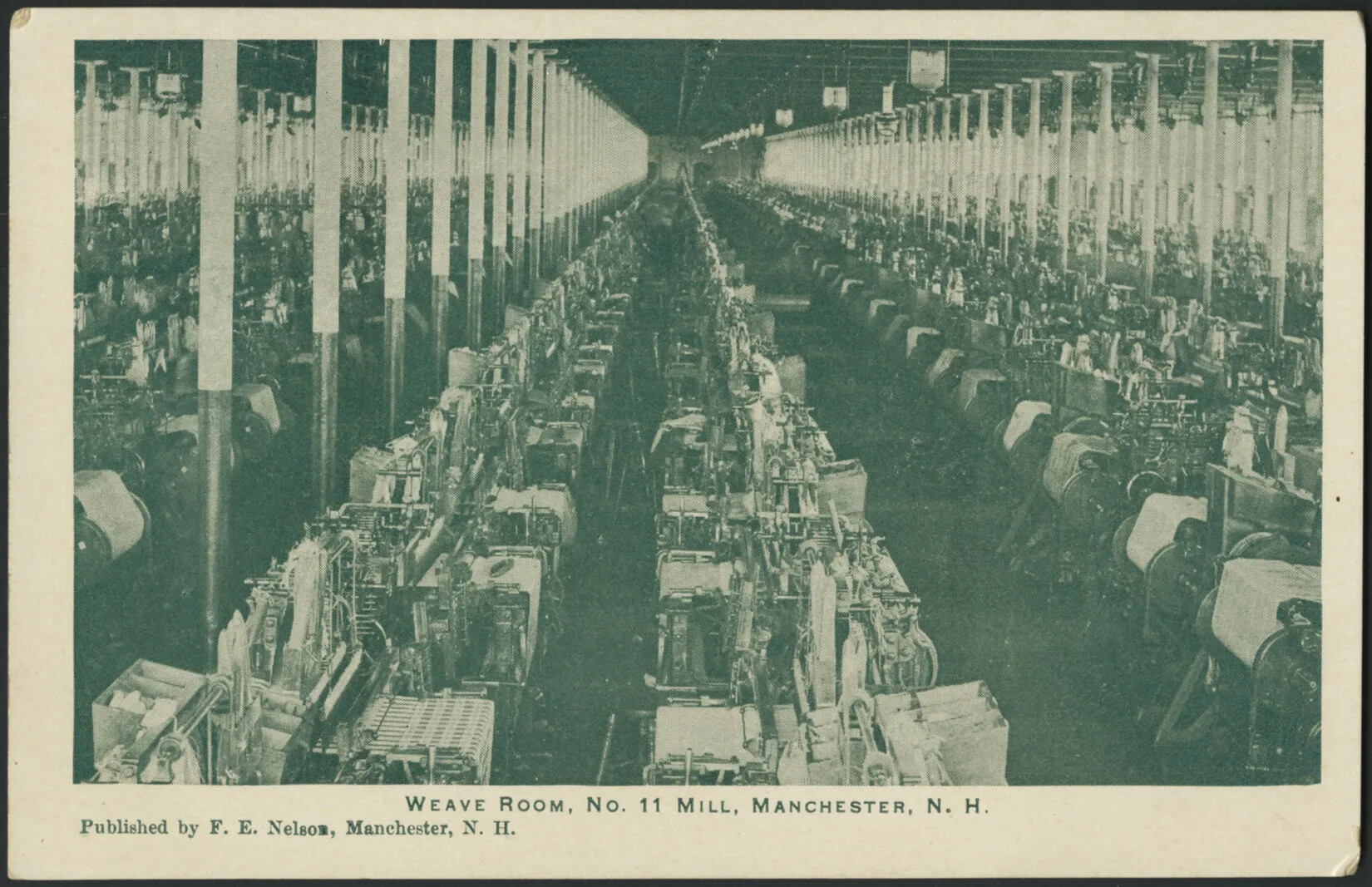
A black and white photograph of a large room. There are several rows of machines. The room has a tall ceiling and lots of poles that are black on the bottom half and white on the top half. The title of the photograph is centered on the bottom border, and reads "WEAVE ROOM, No. 11 MILL, MANCHESTER, N. H./Published by F. E Nelson, Manchester, N. H."
Weaving Machines at the Amoskeag Manufacturing Company
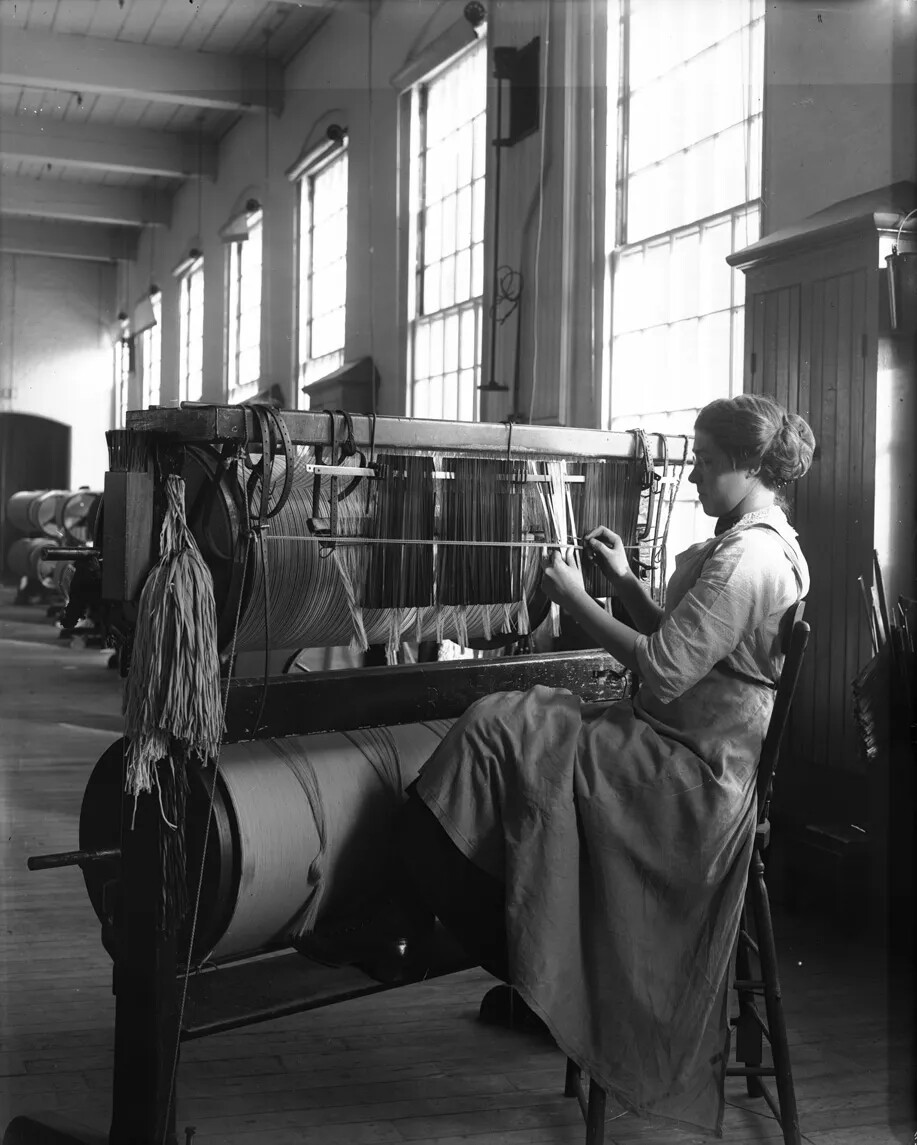
A black and white photograph of a woman seated on a stool, weaving pieces of yarn by hand at a machine. The room she is in has tall windows on the right side wall, and light shines through them into the room. She sits with her feet placed up on the lowest rung of the machine. She wears her hair in a bun, a collared, long-sleeved shirt, and a long skirt.
Woman at Loom
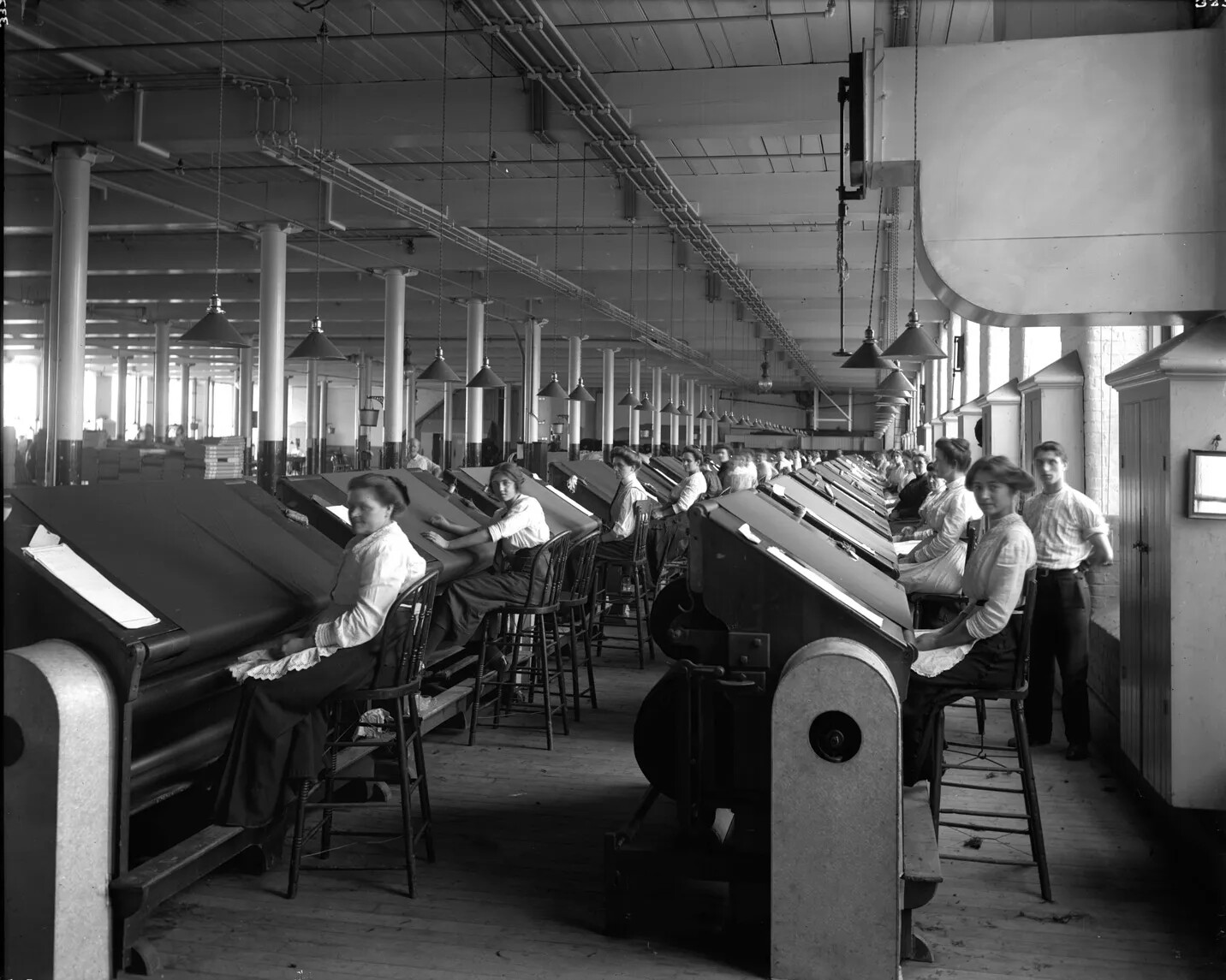
A black and white photograph of a group of women seated at slanted tables, with large pieces of fabric draped over the tables. All of the women wear light-colored long-sleeve shirts and long, dark-colored skirts. A man stands along the right wall, with his hands behind his back. He wears a light-colored button-down shirt with the sleeves rolled up past the elbow, and dark-colored pants.
Women Working at the Amoskeag Manufacturing Company
A black and white photograph of a group of five boys and two girls, standing posed in front of the camera. Three of the boys have their arms crossed, and one of the girls has her hand resting on the shoulder of the other girl.
Young Workers at Amoskeag Manufacturing Company